#100daysofbfotc Day 19: Clovelly Quay

10393817_343879402427231_2897722245522442543_nThe quayside at Clovelly is the lifeblood of the village and it is a location that forms an integral thread in the fabric of Barefoot on the Cobbles. Here, the fisherman put out to sea, risking their lives for an uncertain harvest. When the weather is inclement, they mend their nets or weave lobster pots on the quayside, eager to get back in the tiny wooden boats and seek the shoals that are their livelihood. Holidaymakers alight here to exclaim over the village’s quaintness and to swell the coffers of the inhabitants. Anxious watchers line the quay scanning the waves for the returning lifeboat.

In the time of the novel, it was a bustling, working quay, with a fishing fleet unloading its daily catch and men now too old for the rigors of the sea, watchfully reliving their youth. Thus the quay is the social hub of the village, a focus for gossip and the comfort of old friends. Barefoot on the Cobbles is set at a time when the tourism was just beginning to compete with fishing as the lynch pin of the village economy.

‘For years he had sat on the quayside, listening to the old men yarning about their younger days. He had envied their memories, stories of travel and exploits that became more far-fetched with every telling but which awed the small boys whose lives had yet to unfold.’

Barefoot on the Cobbles will be published on 17 November 2018. More information about the novel can be found here. Copies will be available at various events in the weeks following the launch or can be pre-ordered from Blue Poppy Publishing or the author.

#100daysofbfotc Day 14: Merelda Badcock

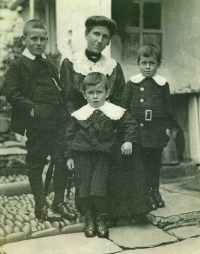
Merelda Badcock nee Dunn widow of Frank (died 1919) with William (left) Arthur and Charlie c 1916Merelda Badcock née Dunn is a mariner’s wife, whose life has been shaped by the rugged North Devon coast. She was born in Clovelly, into a seafaring family, on 3 March 1882 and married Frank Badcock in 1905. Over the years, she watched her menfolk risk their lives on the ocean. Her three sons were all born in a small Clovelly cottage. We meet her at the end of the book, when, desperate for food, her husband, having just returned from the war, puts out to sea on New Year’s Day. Merelda is left waiting anxiously on the shore, as her husband’s fishing boat, the Annie Salome, sets off into a storm.

‘There was silence as Merelda Badcock and Rose Harding arrived at the lifeboat house, hands clasped, faces white and strained. The women had grown up together on the quay and were well used to the tragedies of the sea. Now they were united in fearfulness, husbands in danger and brothers attempting the rescue.’

Barefoot on the Cobbles will be published on 17 November 2018. More information about the novel can be found here. Copies will be available at various events in the weeks following the launch or can be pre-ordered from Blue Poppy Publishing or the author.

#100daysofbfotc Day 12: Daisy

0U9A3415Daisy is arguably the heroine of Barefoot on the Cobbles, she is certainly the catalyst for the main events. It is particularly poignant to post about her today, as this would have been her 124th birthday. Co-incidentally, it is also the birthday of her younger brother, Leonard. Daisy was born in the North Devon fishing village of Clovelly, the eldest of eight children. Much of Daisy’s story, as retold in the novel, is based on fact, including minor incidents, such as her throwing her hat out of the train window. Other aspects, including her early employment history and her nascent romance, are products of my imagination. I have given Daisy a personality that I feel fits with the known events. I hope that her restlessness and desire to break free from her background, sits well with her move to Torquay, a world away from her Clovelly home. Writing about Daisy’s illness was a challenge, although I was helped by detailed newspaper accounts. I hope that my interpretation of her mental state does her justice. So, happy birthday Daisy. It has been a privilege to bring your story to a wider audience.

‘Daisy was a child of the season, delighting in the heat and the chance to discard her boots in favour of skipping over the cobbles in her bare feet. She loved the feel of the hard stones as she curled her toes round each pebble, like a bird poised for flight.’

Barefoot on the Cobbles will be published on 17 November 2018. More information about the novel can be found here. Copies will be available at various events in the weeks following the launch or can be pre-ordered from Blue Poppy Publishing or the author.

#100daysofbfotc Day 10: The Red Lion, Clovelly

Steps-Archway-Red-Lion-Hotel-CLOVELLY-Devon

The Red Lion is one of the two Clovelly inns that feature in Barefoot on the Cobbles. Formerly a row of fishermen’s cottages, by the time of the novel, it was a flourishing hostelry, providing accommodation for tourists and refreshment for visitors and locals alike. Its dominant position on the quay at Clovelly, meant that it became a meeting point for the elderly fishermen of the village, who would sit outside the Red Lion with their baccy and beer, yarning about their days at sea. In inclement weather, they would huddle under the archway, which also provided shelter for the Clovelly donkeys. The Red Lion housed the Mariner’s Union Club Room and although inquests were known to be held there, the inquest that features in Barefoot was held elsewhere. The Red Lion’s publican, Mr Moss and his daughter Mary, are mentioned in the book.

‘The old fishermen, ruminating in the shade of the Red Lion’s archway, nodded sagely and muttered that the dry spell would break before the week was out.’

Barefoot on the Cobbles will be published on 17 November 2018. More information about the novel can be found here. Copies will be available at various events in the weeks following the launch or can be pre-ordered from Blue Poppy Publishing or the author.

#100daysofbfotc Day 7: Captain William Pengilly

William PengellyCaptain William Pengilly has long since met with an unfortunate end by the time he is mentioned in Chapter 7 of Barefoot on the Cobbles. In the book, his granddaughter, Annie, outlines the story of his demise. A Clovelly mariner, with eight children, his wife ran a tea-shop in the village whilst Captain William was away at sea. Captain Pengilly is also believed to have been the superintendent of the Methodist Sunday School in Clovelly, as Sunday School prizes survive that are inscribed with his name. His vessel, Queen of the South, was delivering coal to the cement mills at Dodnor, near Newport, Isle of Wight, when a tragic incident led to William’s death, at the age of 43. To find out about the manner of his passing, you will need to turn to Chapter 7.

‘ ‘They say he was drunk,’ she whispered. Now Leonard was genuinely astonished, surely Captain Pengilly had been a Methodist.’ ’

Barefoot on the Cobbles will be published on 17 November 2018. More information about the novel can be found here. Copies will be available at various events in the weeks following the launch or can be pre-ordered from Blue Poppy Publishing or the author.

#100daysofbfotc Day 1: Clovelly Cobbles

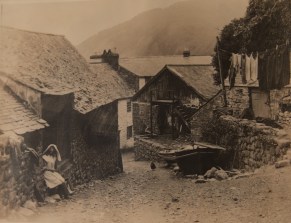
New InnMuch of Barefoot on the Cobbles is set in the unique village of Clovelly. Clovelly is a privately-owned fishing village on the rugged North Devon coast and many of the cottages that are lived in by the novel’s characters are 400 years old. The steep, cobbled street, that is reflected in Barefoot’s title, means that motorised transport is prohibited. Modern-day residents walk up and down the main street just as Polly, Albert, Daisy and other inhabitants of Barefoot would have done. Although, in the early twentieth century, donkeys, as well as sledges, were used to transport goods, nowadays the donkeys are merely there to recreate the atmosphere of the past. In Barefoot’s time, tourism was secondary to the fishing fleet, whose small boats sought herring, lobster, prawns and mackerel on the uncertain waves. Now, the fishing fleet has dwindled to a handful of boats and Clovelly is dedicated to catering for visitors.

‘Daisy was a child of the season, delighting in the heat and the chance to discard her boots in favour of skipping over the cobbles in her bare feet. She loved the feel of the hard stones as she curled her toes round each pebble, like a bird poised for flight.(Chapter 4)

Barefoot on the Cobbles will be published on 17 November 2018. More information about the novel can be found here. Copies will be available at various events in the weeks following the launch or can be pre-ordered from Blue Poppy Publishing or the author.

Introducing 100 Days of Barefoot on the Cobbles

0U9A3415On 9 August it will be 100 days until Barefoot on the Cobbles is launched. Each day, from 9 August onwards, I will be posting a short item about one of the characters you will meet in the novel, or one of the locations that is mentioned. This will give readers an opportunity to learn more about some of the people and places that grace its pages. These will be accompanied by lines from the book. I will continue to bore you with other elements of my rather eccentric existence but these posts will be separate. I hope you will enjoy getting to know the people who have been part of my life for the last couple of years.

The Clovelly Storm of 1838, One Place Hanging Out, C17th London and Other Matters

With hurricanes forecast for the night of 27th/28th October, it is a good time to ask for help with one of my (many) research projects. Exactly 175 years ago there was a bad storm off Clovelly. In a direct response to the loss of life in this tragedy, in 1839, the Shipwrecked Fishermen and Mariners Royal Benevolent Society, better known as the Shipwrecked Mariners’ Society was founded. This was set up by Charles Gee Jones and John Rye, in order to raise funds to assist the fishermen’s widows, orphans and parents. I am attempting to identify those involved, both victims and survivors and trace living descendants of any of these men. There is plenty of information available about the storm of 1821 but much less about that of 1838. Newspaper reports are inconsistent about the number of boats and men who were caught in the storm and the number of victims.

One version of the list of those who were lost includes the following:-

From Clovelly:-  James Britton senior; James Britton junior son of the above; John Britton, son of James senior; John Shersel, a married man; William Shersel, brother of the above, a married man; John Lewis who left a widow and family; Thomas Jenn and Richard Lane.

From Bucks Mills:- John Braund, left a widow and 3 children; James Veale; John Bagelhole, left a widow and child.

From Hartland:- Hugh Bayley; Thomas Trick, left a widow and 2 children; Philip Cowell, left a widow and family.

Also:- James Radford from Ilfracombe, left a widow and family; Mr Carpenter from Ilfracombe, left a widow and family. James Kelly from Appledore, left a widow and 6 children; Richard Lock from Appledore, left a widow and 3 children; Henry Pooley from Bideford, left a widow, his body was recovered; Richard Parker from Bude; An unknown Cornishman.

Unfortunately, for those whose bodies were not recovered, there can be no death or burial records. So tracing these men and their descendants is difficult.

Last night I had my first experience of participating in a Google+ Hangout on air, on the topic of One Place Studies. The result is now available on YouTube. I have no idea why I sound so out of breath and hesitant – it was past my bedtime – that’s my excuse and I am sticking to it! Good fun though and a very productive discussion.

Not too sure about the variations on ‘Scarborough Fair’ as a musical accompaniment but as someone who lives in the seventeenth century, this new game (at least I think it is going to be a game) was of interest. All about the Streets of London – now wouldn’t that have been a better track? – great fan of Ralph McTell me. Do play the video. It could even persuade me to start computer gaming. Mistress Agnes would have put it on her Christmas list but I have pointed out that not only have computers not yet been invented but Cromwell is about to ban Christmas.

Some very interesting documents have been loaned to me lately. I am currently guarding with my life some old school registers and the archive for the local WI. The latter includes a wonderful survey of the village in 1965 and contains a very unusual picture of my house.

Coles Manning 1965 Lloyd Prance - WI

This is particularly strange as my house was thought to be make of cob, as the walls are two feet thick. This clearly suggests that there are bricks involved.

Anyone worried about Halloween needs this seventeenth century preventative:- The thumb of a hanged man in your left shoe wards off witchcraft.