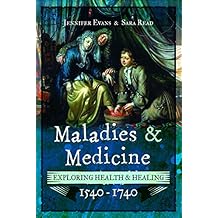
 Now for the second offering from Sara Read, this one co-authored by Jennifer Evans. I would like to introduce you to Maladies and Medicine: exploring health and healing 1540-1740. After an introduction that explains the theories underpinning medical practices at the time, the book is arranged on an ailment by ailment basis. The authors look in turn at head complaints, abdominal maladies, whole body ailments and reproductive maladies. Each condition is discussed in terms of ‘causes’, as understood at the time, preventatives and ‘cures’. The authors have used a wide range of contemporary sources, medical treatises, letters, herbals, diaries and case notes, to help the reader understand attitudes to and treatments of, diseases and conditions in the early modern era. The book is enhanced by black and white illustrations and a bibliography of written and online sources.
This is another book that is comprehensible to the interested amateur, whilst being underpinned by serious academic research. The writing style is accessible and amusing at times, although perhaps not for the fainthearted, as historical medical treatments were not pretty. This book had obviously appeal to me in my Mistress Agnes mode and I particularly enjoyed writing the health and medicine chapters in my own Coffers, Clysters, Comfrey and Coifs and Remember Then. The former even has a medical procedure on the cover! When Maladies and Medicine hit the shelves earlier this year, I had no hesitation in adding it to the reading lists for the students on my online In Sickness and in Death – researching the ill-health and death of your ancestors course. It only doesn’t feature in Til Death us do Part: causes of death 1300-1948 (or for ebook fans) because I wrote it before Maladies and Medicine was published.
And in ordinary life, what ever that is, the great cover debate for Barefoot on the Cobbles continues. It now looks very different from yesterday’s version. Amidst addressing Christmas cards and anguishing over cover designs, I have been writing the Barefoot inquest scene and wishing there were forty eight hours in a day.
![How to be a Tudor: A Dawn-to-Dusk Guide to Everyday Life by [Goodman, Ruth]](https://images-eu.ssl-images-amazon.com/images/I/61blmkkyi%2BL.jpg) Behind today’s advent ‘window’ is a true social history by Ruth Goodman, of Victorian/Edwardian/Wartime etc. Farm fame. In
Behind today’s advent ‘window’ is a true social history by Ruth Goodman, of Victorian/Edwardian/Wartime etc. Farm fame. In  Yesterday I managed to complete a very harrowing chapter of
  Another one for those interested in agricultural history today and it is a whole series of books, rather than just one. Most family historians I speak to have agricultural labourers hidden somewhere in the boughs of their family tree. What we need to realise is that these are not some amorphous group whose experiences were all very similar. Farming practices differ according to soil, terrain and climate. The
 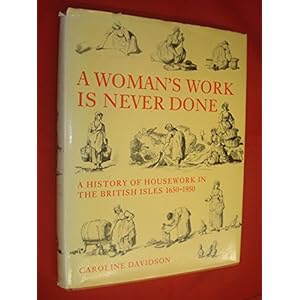 As I sit down, having just finished the washing up and sticking what may well turn out to be onion-flavoured marzipan on my Christmas cakes (short but sad story), what better than to introduce you to a book about housework. Caroline Davidson’s
 This comprehensive account was first published in 1919 and was written by Alice Clark, of the Quaker shoemaking family. Clark (1874-1934) herself is an interesting character, rising to become a director of the family firm in an era when this would have been very unusual. Her
 ![Henry Stephens's Book of the Farm: concise and revised edition by [Langlands, Alex]](https://images-eu.ssl-images-amazon.com/images/I/51ZqC-0IwZL.jpg) This one is for all those family historians with agricultural labouring ancestors and for writers of historical fiction who are using a nineteenth century rural setting. The lavish production and copious illustrations also make it ideal for history lovers in general to browse. Henry Stephens’
This one is for all those family historians with agricultural labouring ancestors and for writers of historical fiction who are using a nineteenth century rural setting. The lavish production and copious illustrations also make it ideal for history lovers in general to browse. Henry Stephens’  A much more recently written offering behind today’s advent window: Rebecca Ridal’s
  With some technical wizardry, this post should appear at a time when I am languishing in a local shopping centre hoping to sell my books to unsuspecting passers-by. I have a small share in a stall, along with other local authors. No idea how successful it will be but I will try anything once.
 The History Interpreter - Janet Few