#100daysofbfotc Day 13: Torquay Town Hall Hospital

Torquay Town Hall HospitalThe military hospital that was set up in the Town Hall in Torquay at the beginning of the First World War was one of the largest in the country. The climate in Torquay was thought to be particularly suitable for convalescing soldiers and there were a number of other hospitals in the town. The hospital is mentioned in Chapter 10 of Barefoot on the Cobbles as Daisy’s friend Winnie has been working there as a VAD nurse. Unlikely though they may sound, Winnie’s experiences, that are described on pages 200-201, are based on the memoirs of a real volunteer at the hospital. Although family information suggests that Daisy nursed whilst she was in Torquay, there is no record of her having been attached to the Red Cross as a VAD, in the Town Hall Hospital or elsewhere. I have therefore given her a slightly different role.

More information about the wartime work of the Red Cross volunteers and the auxiliary hospitals that they manned, can be found on the British Red Cross website.

‘ ‘What’s so bad at the hospital?’ asked Daisy. ‘I mean, I know that the men are fearfully wounded and that …. and that some of them …  well, some of them don’t get better. But surely it is wonderful to be part of it all? I feel so useless. There’s all the men risking their lives, off to war and all I can do is polish the brass and empty chamber pots.’ ’

Barefoot on the Cobbles will be published on 17 November 2018. More information about the novel can be found here. Copies will be available at various events in the weeks following the launch or can be pre-ordered from Blue Poppy Publishing or the author.

#100daysofbfotc Day 12: Daisy

0U9A3415Daisy is arguably the heroine of Barefoot on the Cobbles, she is certainly the catalyst for the main events. It is particularly poignant to post about her today, as this would have been her 124th birthday. Co-incidentally, it is also the birthday of her younger brother, Leonard. Daisy was born in the North Devon fishing village of Clovelly, the eldest of eight children. Much of Daisy’s story, as retold in the novel, is based on fact, including minor incidents, such as her throwing her hat out of the train window. Other aspects, including her early employment history and her nascent romance, are products of my imagination. I have given Daisy a personality that I feel fits with the known events. I hope that her restlessness and desire to break free from her background, sits well with her move to Torquay, a world away from her Clovelly home. Writing about Daisy’s illness was a challenge, although I was helped by detailed newspaper accounts. I hope that my interpretation of her mental state does her justice. So, happy birthday Daisy. It has been a privilege to bring your story to a wider audience.

‘Daisy was a child of the season, delighting in the heat and the chance to discard her boots in favour of skipping over the cobbles in her bare feet. She loved the feel of the hard stones as she curled her toes round each pebble, like a bird poised for flight.’

Barefoot on the Cobbles will be published on 17 November 2018. More information about the novel can be found here. Copies will be available at various events in the weeks following the launch or can be pre-ordered from Blue Poppy Publishing or the author.

#100daysofbfotc Day 11: Laura Kate Cornelius

Upton Road

Upton Hill, Torquay

Kate Cornelius straddles an awkward social divide. In the Barefoot on the Cobbles, I have used her character to explore the issue of social mobility in early twentieth century Britain. She was born Laura Amelia Kate Mayers or Meyers, in January 1881, to a working-class family; her father was a packer on the railway. She spent her childhood in Upton Hill, Torquay and it is here that we meet her, in Chapters 10 and 11, as the First World War is drawing to its close.

Laura’s working life began as ‘Kate’, a nursemaid to the Gilley family; as such she was associating with Torquay’s elite. Mr Gilley, of Aylwood, ran a railway cartage business and it is likely that he employed Laura’s father. Kate moved on to work in a smaller household in Babbacombe, as a servant to Mrs Macphearson. In 1913, already in the thirties, Kate married a local butcher, Percy Cornelius. This gave her a new respectability and she was able to employ a servant in her home, back in Upton Hill. By the time of the novel, the Cornelius’ first child has been born; they later go on to have two further children. Kate also appears in the final court scene, as a discomforted witness. She lived to reach the age of 91, dying in Torquay in 1972.

‘Mrs Cornelius exhibited all the snobbery of the social climber. Kate Cornelius would be horrified if these securely middle-class matrons realised that she, Kate, was formerly one of Aylwood’s servants.’

Barefoot on the Cobbles will be published on 17 November 2018. More information about the novel can be found here. Copies will be available at various events in the weeks following the launch or can be pre-ordered from Blue Poppy Publishing or the author.

#100daysofbfotc Day 10: The Red Lion, Clovelly

Steps-Archway-Red-Lion-Hotel-CLOVELLY-Devon

The Red Lion is one of the two Clovelly inns that feature in Barefoot on the Cobbles. Formerly a row of fishermen’s cottages, by the time of the novel, it was a flourishing hostelry, providing accommodation for tourists and refreshment for visitors and locals alike. Its dominant position on the quay at Clovelly, meant that it became a meeting point for the elderly fishermen of the village, who would sit outside the Red Lion with their baccy and beer, yarning about their days at sea. In inclement weather, they would huddle under the archway, which also provided shelter for the Clovelly donkeys. The Red Lion housed the Mariner’s Union Club Room and although inquests were known to be held there, the inquest that features in Barefoot was held elsewhere. The Red Lion’s publican, Mr Moss and his daughter Mary, are mentioned in the book.

‘The old fishermen, ruminating in the shade of the Red Lion’s archway, nodded sagely and muttered that the dry spell would break before the week was out.’

Barefoot on the Cobbles will be published on 17 November 2018. More information about the novel can be found here. Copies will be available at various events in the weeks following the launch or can be pre-ordered from Blue Poppy Publishing or the author.

#100daysofbfotc Day 9: Mrs Emily Powell

Western Gazette 3 July 1891 page 4 col advert for servant in Chuudleigh villas col b

Western Gazette 3 July 1891

Emily Powell is a woman whose life is beset with adversity. Her respectable, middle-class home at Chudleigh Villas in Bideford hides her struggle to maintain the illusion of gentility. Coping with her husband’s mounting debts and alcoholism is secondary to her inability to come to terms with the death of her daughter. The loss of Florence, which occurred just before we meet Emily in Chapter 2 of Barefoot on the Cobbles, pervades every aspect of her life. In an attempt to cope with her grief, Mrs Powell all but ignores her other children, who are constant reminders of her loss. Her resulting attitude to motherhood is to have a lasting effect on her young servant, Polly.

Mrs Powell was tall and thin with swept back, wispy, fair hair, and a harassed expression. She was dressed in the deep lilac of half-mourning. Polly knew, from having spent a week listening to Lydia’s raptures about the latest fashions, that Mrs Powell’s gown, although elegant, was not new.’

Barefoot on the Cobbles will be published on 17 November 2018. More information about the novel can be found here. Copies will be available at various events in the weeks following the launch or can be pre-ordered from Blue Poppy Publishing or the author.

#100daysofbfotc Day 8: Rose Cottage, Bucks Mills

Rose CottageIn the novel, Rose Cottage is the home of William and Mary and their two adult sons. We encounter the Cottage and its inhabitants in the first chapter of Barefoot on the Cobbles. The name is used anachronistically; this small fisherman’s cottage at the top of the village of Bucks Mills was given the name Rosie’s Cottage in the mid-twentieth century. It is now known as Rose Cottage and in the absence of a contemporary name, it seemed appropriate to refer to William’s home by its current appellation. In the summer of 1890, when Eadie comes to join the family, Rose Cottage was a four roomed, thatched, cob cottage, typical of others in the village of Bucks Mills. It is set back from the road, next to the former ale house, The Coffin Arms and a small terrace of cottages known as Forest Gardens. Rose Cottage was to remain in the family for another seventy years.

More information about Bucks Mills can be found here.

‘The pervading scent of fried fish reached them as they approached the bend in the road and turned towards the path that led to Rose Cottage, near the top of the street.’

Barefoot on the Cobbles will be published on 17 November 2018. More information about the novel can be found here. Copies will be available at various events in the weeks following the launch or can be pre-ordered from Blue Poppy Publishing or the author.

#100daysofbfotc Day 4: East-the-Water, Bideford

DSCF0566

Looking across the River to East-the-Water

As the name suggests, East-the-Water refers to the part of Bideford that lies on the eastern bank of the River Torridge. One of the principal characters of Barefoot on the Cobbles arrives in East-the-Water in Chapter 2 and the following Chapter is centred on this part of the town. Although East-the-Water has never been the principal part of the town, at the time of the novel, the riverside’s wharves swarmed with activity. Higher up the hill were the prestigious villas of the Chudleigh Estate, built in the lee of the seventeenth century Chudleigh Fort. The Way of the Wharves, community history project explores the history of this area in more detail. There is also an account of East-the-Water’s history on the community website.

#100daysofbfotc Day 1: Clovelly Cobbles

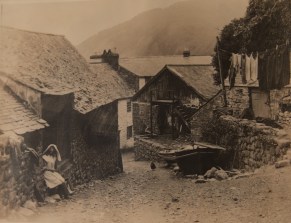
New InnMuch of Barefoot on the Cobbles is set in the unique village of Clovelly. Clovelly is a privately-owned fishing village on the rugged North Devon coast and many of the cottages that are lived in by the novel’s characters are 400 years old. The steep, cobbled street, that is reflected in Barefoot’s title, means that motorised transport is prohibited. Modern-day residents walk up and down the main street just as Polly, Albert, Daisy and other inhabitants of Barefoot would have done. Although, in the early twentieth century, donkeys, as well as sledges, were used to transport goods, nowadays the donkeys are merely there to recreate the atmosphere of the past. In Barefoot’s time, tourism was secondary to the fishing fleet, whose small boats sought herring, lobster, prawns and mackerel on the uncertain waves. Now, the fishing fleet has dwindled to a handful of boats and Clovelly is dedicated to catering for visitors.

‘Daisy was a child of the season, delighting in the heat and the chance to discard her boots in favour of skipping over the cobbles in her bare feet. She loved the feel of the hard stones as she curled her toes round each pebble, like a bird poised for flight.(Chapter 4)

Barefoot on the Cobbles will be published on 17 November 2018. More information about the novel can be found here. Copies will be available at various events in the weeks following the launch or can be pre-ordered from Blue Poppy Publishing or the author.

Introducing 100 Days of Barefoot on the Cobbles

0U9A3415On 9 August it will be 100 days until Barefoot on the Cobbles is launched. Each day, from 9 August onwards, I will be posting a short item about one of the characters you will meet in the novel, or one of the locations that is mentioned. This will give readers an opportunity to learn more about some of the people and places that grace its pages. These will be accompanied by lines from the book. I will continue to bore you with other elements of my rather eccentric existence but these posts will be separate. I hope you will enjoy getting to know the people who have been part of my life for the last couple of years.

Historical Fiction and other Excitements

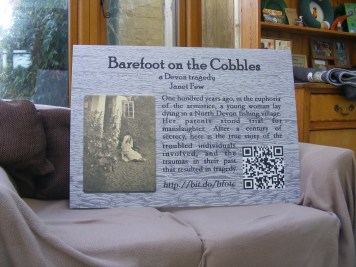
Picture of posterAs I am in full-on Barefoot on the Cobbles marketing mode, I am excited to share my latest acquisition. Well, that’s the zero marketing budget well and truly blown. I am still working out where I can keep it! I am also now able to announce that I will be speaking at The Genealogy Show at the NEC in Birmingham next June. There are some great speakers from across the globe on the bill, many of who I am proud to call my friends.

Today I was giving a talk in South Devon and was able to combine it with searching out the probable burial place of my 7 x great grandfather, John Braund. It took me 37 years to find him, now I am frustrated because I can’t confirm his parentage after only four years of searching. I am almost certain I know who they were but assembling sufficient evidence to support my supposition is another matter.

And finally because, as a Brit, I have to talk about the weather, an incident from earlier this week. Don’t get me wrong I love the heat, unless I am incarcerated in a small space with a large number of hormonal teenagers that us. The downside is that numerous pesky insects have decided that I make a half-decent meal. My incredibly expensive super-strength insect repellent was confiscated by Qantas security but I do have the equally expensive and as yet unused insect repellent scarf, purchased in order to go to Peru. This takes the form of a circle of stretchy material, which can, the instructions allege, be worn in a variety of ways. Most of these involve me looking as if I am about to hold up a bank (I wish – we are now bereft of an even half local bank and there’s a y in the day, so no chance of the mobile post van turning up). I opt for the least sinister style, which means I have just hung the loop round my neck. It is 80 degrees. Casual callers, such as the postman, clearly think this scarf wearing lunatic should be certified.