Social History Book Advent Calendar Day 4

Apologies for the late arrival of today’s contribution to the advent calendar. I have spent the last eighteen hours adding to the list of things I do not have wrong with me. Said list is now assuming the proportions of a three volume novel. Still the good news is that, although what I do have remains a mystery, I don’t appear to have anything sinister. I spent the whole of last night on a trolley in A & E and this afternoon raising the alarm when the woman in the opposite bed tried to pull her cannula out, something that occurred about every five minutes. This means I haven’t slept for 36 hours, so I hope I can be excused if I cheat a little with today’s social history book and use one of my own. I say one of my own; it has my name on the cover but it is really the work of eighty wonderful ladies.
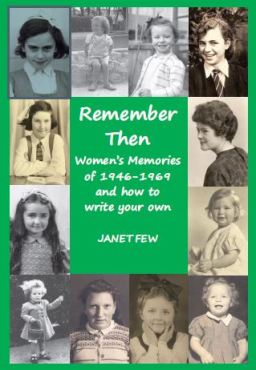
CoverRemember Then: women’s memories of 1946-1969 and how to write your own  is what happens when you let eighty women spend a year and a half recording their memories of life in Britain throughout the pivotal period 1946-1969. This twenty four years was one of tremendous change in almost every area that they investigated. During this time, we moved from liberty bodices to mini skirts and from ration books to ready meals. We witnessed the emergence of youth culture, the comprehensive education system, conspicuous consumerism and a new wave of feminism; the Britain of 1969, was very different to that of 1946.

Very little additional research has been done, the women’s voices have been allowed to speak for themselves. Memories are just that and sometimes memory is fallible. Efforts have been made to check dates and facts but for the most part, the ladies’ accounts have been taken at face value. The aim was not to write a comprehensive social history but to give a flavour of the period from the view-point of those who lived through it. Even reading the first names of the participants takes you back to the classrooms of the 1950s.

The ladies described their homes and neighbourhoods, clothes, housework and food, education and work, health and childrearing, leisure and celebrations, as well as tackling more emotive subjects, such as relationships and attitudes. Over a hundred illustrations and a comprehensive timeline of events evoke the essence of the era. This book is much more than just a collection of women’s memories. At the end of each chapter is the brief that the volunteers were given when working on that topic. This can be applied to other time frames and will help the reader, male or female, to write reminiscences of their own.

The women who took part came from a variety of social, economic and geographic backgrounds. Some ladies went to boarding schools, some to grammar schools and others to secondary moderns. Some left school at fourteen, others have PhDs. Some are only children, others had large extended families and some grew up in care. The ladies were aged from 59 to 95, so some experienced this era as children, some as teenagers and others as married women with families. I wove together the words of this disparate group of volunteers, using direct quotations from their reminiscences wherever possible, to reveal this period, as seen through their eyes. The result is a many faceted perspective of life at the time.

The book allows those born after 1969 to gain an understanding of what life was like for earlier generations. This makes it valuable reading for those working with older people, as it can spark conversations and help to awaken memories. If you lived through this era yourself, you will find yourself exclaiming, ‘I remember that!’ on every page.

One Place Studies, Electrics and More Trolley Adventures

Another lovely day at Who Do You Think You Are? Live, our journey being made easier with the absence of the trolley. I do another stint as an expert waiting to be asked. I am somewhat hampered by the computer, that to all intents and purposes is attached to mains electricity, dying for lack of battery. The brick walls come in thick and fast. I field questions about ancestors with three ‘wives’, potential Dutch immigrants, connections to Irish film stars and disappearing Scottish grandmothers.

Tickets for my talk have sold out by 10am, unfortunately my voice has given out too. Studio 3 involves competing with a great deal of background noise and a PA system that means you can’t actually hear how loud you are speaking. Nonetheless I manage to croak my way through my ‘Putting Your Ancestors in their Place’ talk and appear to have won some converts to the excitements of one place studies. I just hope that people don’t think my voice always sounds like a strangled frog. In the general enthusiasm I mange to pour a cup of water over something that looks suspiciously like some vital electrical connection. That would be because it was a vital electrical connection – not a good move but I seem to avoid electrocution.

Books sold we head back to the van. We have scrounged a trolley, a more substantial affair than our wheel-less version. Security turn out in force and try to prevent us leaving not, as last year, because they think we are breaking down a stand early but because trolleys are not allowed in the exhibition area whilst the public are still on the premises. I fail to see how a trolley is any more lethal than a buggy or wheelchair. We are escorted the twenty yards to the door and escape. The only way to get the boxes and trolley over the footbridge is to take the boxes one at a time. We ignore the tannoy’s exhortations not to leave parcels unattended and hope for the best as we play put and take with the boxes. Two kind gentlemen assist us. We are happy to surrender boxes containing hundreds of pounds worth of books to complete strangers, safe in the knowledge that no one will run off with them. In fact it is difficult to do much more than stagger drunkenly carrying a box of that weight. They can barely lift them from the ground let alone make a quick exit with one under their arm.

DSCF1325The next day a surprise visit (well I was surprised) to see my number one granddaughter and her lovely parents. This required us to drive through the Blackwall Tunnel. I am really not a fan of tunnels, although I cope fine with the underground. I manage to avoid a panic attack and we arrive at a new road layout near Kidbrooke. With no apparent prior warning we are met with a choice between driving down a bus lane or driving through a portion of road with a seven foot width limit. Remember we are towing a caravan. To make matters worse the seven foot wide section is not even straight. Always law abiding, we do not take the bus lane. Chris subscribes to the view that if his extending wing mirrors fit through a gap so will the caravan (isn’t there a similar theory involving cat’s whiskers?) Bit of a shame then that the caravan turns out to be seven foot one inch wide. Actually, thanks to a combination of Chris’ superior driving skills and inaccurate measuring on the part of the sign writers, we pass through the gap unscathed but it was a very close thing.


Communities, Celebrities, Conservatories and oh yes a bit more Crafting

A great week on the community history front. I spent yesterday presenting my day course ‘Researching Your Ancestors and their Communities in the Early Twentieth Century’ to an enthusiastic group of students. There are some major events coming up on the presentations calendar. I was excited to be asked to lead a remote workshop on North Devon emigrants at the forthcoming British Isles Family History Society of Greater Ottawa conference. I just hope that the technology is kind to me. I am grateful to Buckinghamshire Family History Society who were very understanding about rescheduling my appointment with them so that I could do both.

First though Who Do You Think You Are? Live next weekend. I have only just registered that my ‘A to Z of Family History’ talk, designed to tie in with Family Historian’s Enquire Within, has been scheduled for the celebrity studio and will be accompanied by signing (as in sign language – although I will sign books too if asked – in fact I’ll sign pretty much anything). Not that I think I am in any way a celebrity – there was probably nowhere else to put me but wow! Next thing we know I will be asked to take part with other non-celebrities in reality TV. I was also excited to see that the Institute of Heraldic and Genealogical Studies had made Family Historian’s Enquire Within book of the month.

I hope I will be able to catch up with some of my family history friends over the weekend, I am there Friday and Saturday. 11.00-13.00 each day I will be found in the ‘ask the experts’ area – not only a non-celebrity but also an ‘expert’ – what a lot to live up to. Friday at 14.45 I am – whisper it quietly – in the celebrity studio and Saturday at 15.15 I am in the more lowly studio 3 talking about One Place Studies and promoting my other new book Putting Your Ancestors in their Place: a guide to one place studies after which I hope to get together with other one placers. I need to sell some books otherwise we have to work out how to get 10 boxes on two London trains and up a half mile hill to the caravan. The rest of the time I will be chatting to people and trying to resist the temptations of the book stall. I still have some of last year’s haul to work through.

I am thrilled by the continuing response to my 1946-1969 project. Janets have been flocking in and now outweigh the Lynnes, adding weight to the theory that everyone of a certain age is indeed called Janet.

In between the history I have been planning our summer holiday in Scotland. Look out frozen north here we come. Plenty of countryside, islands and heritage and as few cities as possible, apart from two days at the Commonwealth Games.
DSCF1303

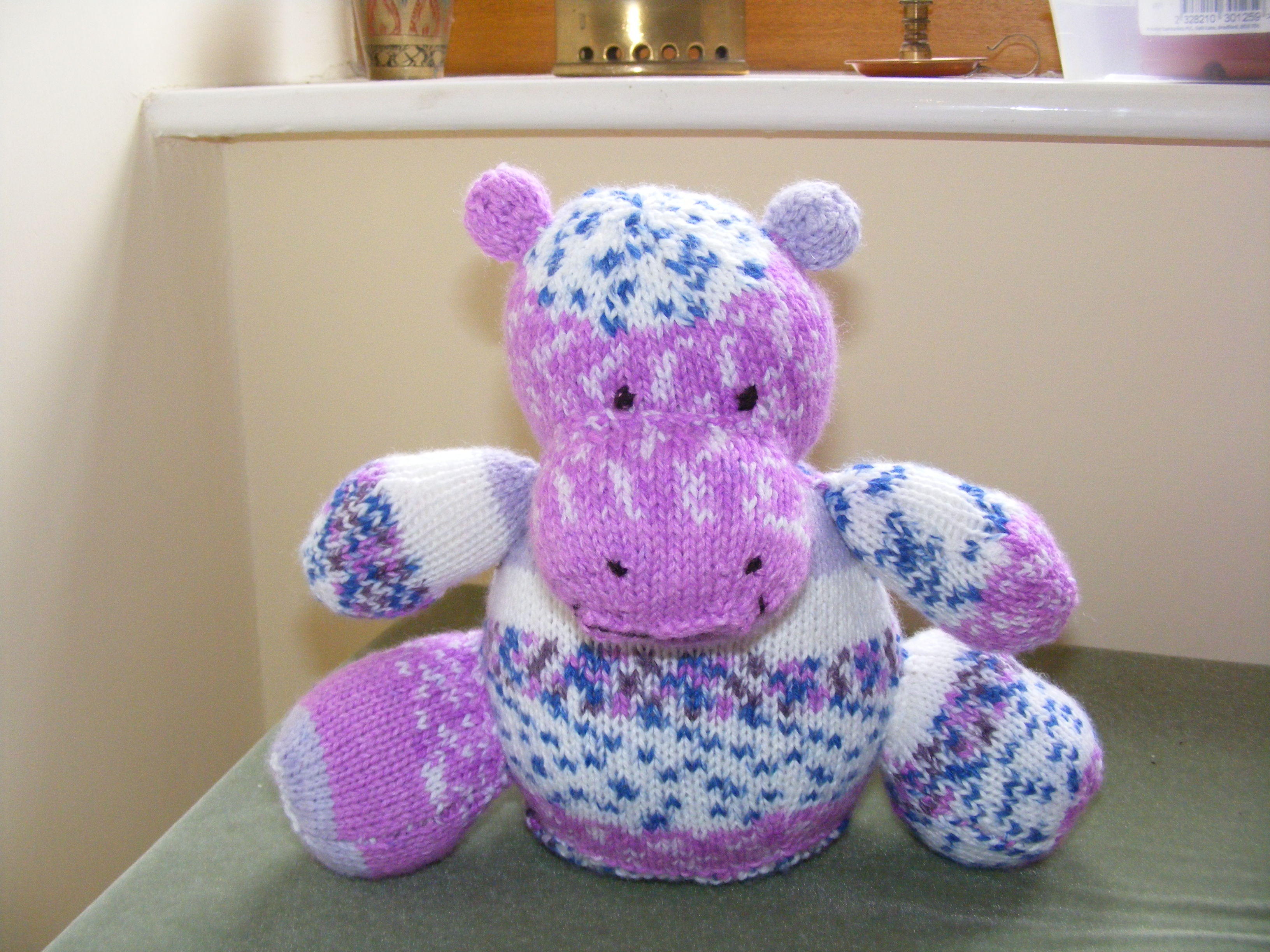
The latest grandmotherly crafting project is a knitted Hippo in rather a natty rainbow wool. She is now awaiting the arrival of her owner next month, or if his mother is to be believed, rather sooner than that.

DSCF1304


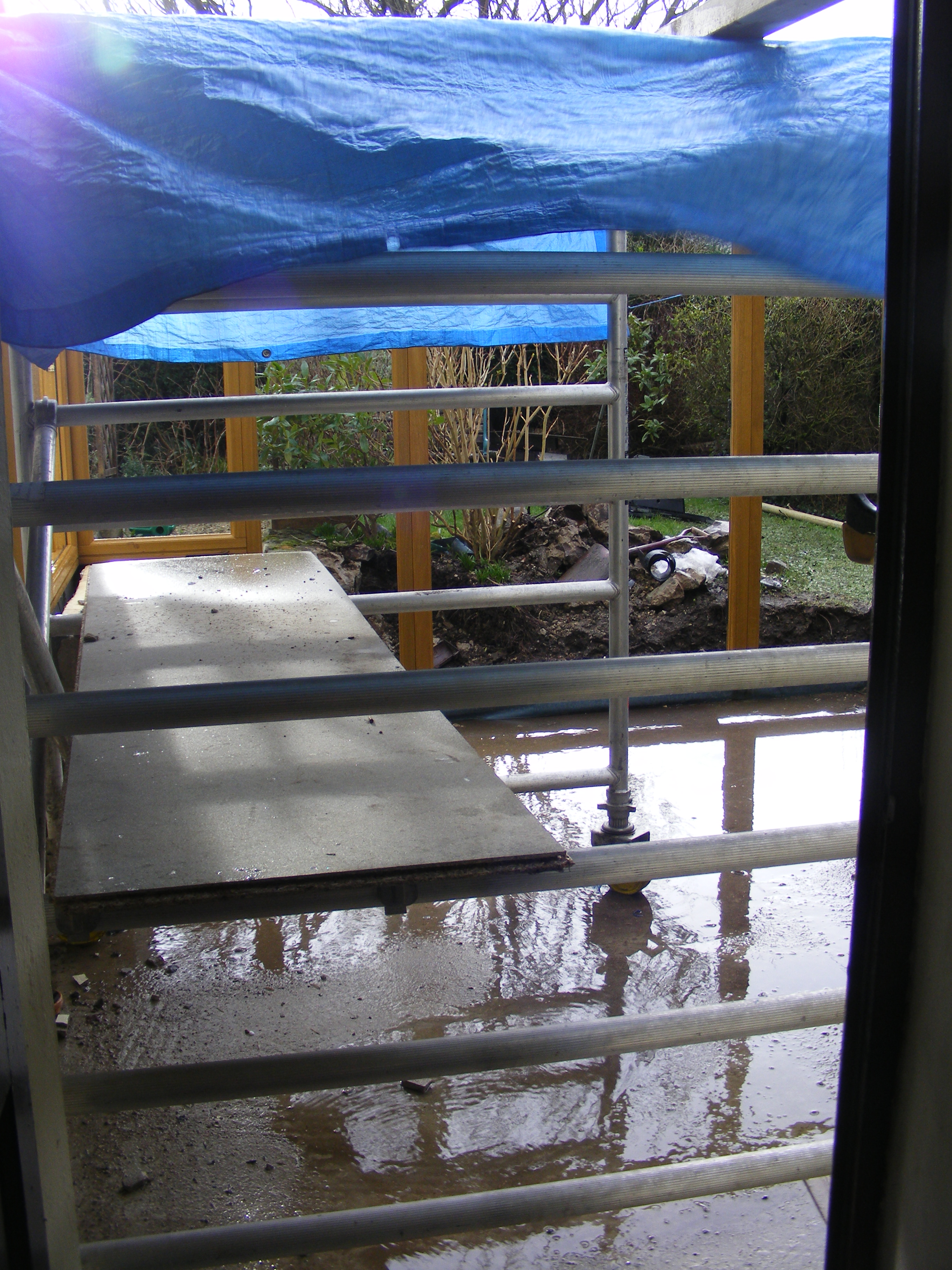
8 February 2014 View through the back doorOh and thank you for asking, the porch and conservatory building has recommenced after a week’s break. Both now have window frames but I am unable to use my back door. I am fortunate not to have suffered as badly as many of my west country neighbours but it is rather disconcerting sitting in a force 10 gale with tarpaulins flapping, loose drain pipes rattling and scaffolding creaking.