Day 23 #bfotc sources

Day twenty-three of the ‘advent calendar’ focusing on some of the historical/genealogical sources that I used in the writing of Barefoot on the Cobbles.
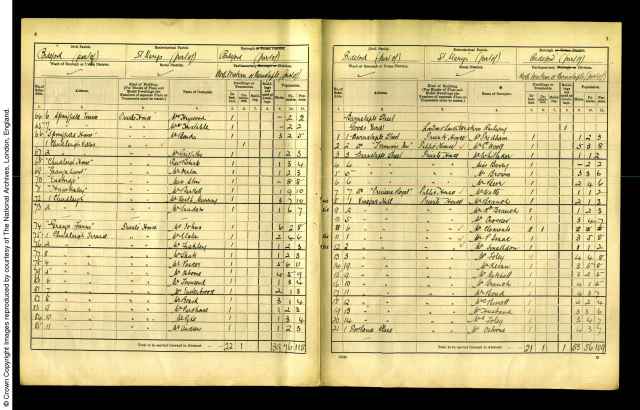
GBC_1911_RG78_00781_0155

An Enumerator’s Book List

When trying to work out precisely where my characters lived, I made use of the census returns, particularly the 1911 census. This is a key resource for family historians but many do not venture beyond the household schedules. The key data providers, that most people use in order to access these records, allow us another opportunity. Having found a return for a single household, in the usual manner, it is possible to opt to view ‘related images’. Of these, I find the one described ‘enumerator’s book list’ very useful. This is pretty much what its name suggests. It is a list of the properties on that enumerator’s route. Not only are these lists normally in a logical order, with properties in close proximity next to each other on the list but occasionally the lists give the name of a property that is merely described as ‘village’ on the household schedule. The ways of accessing these lists differ between data providers. I use FindmyPast but I understand these lists can also be viewed on other sites.

I spent hours agonising over a series of census returns, the 1939 register and street directories, in an attempt to identify exactly which house the Powells inhabited in Bideford. This was made more difficult because, historically, several properties bore the same name. In fact, chapter 2 stalled for many months during a period of frustration because I could not associate the family with a particular property. In the end, I am fairly confident that I have selected the correct one. It was probably a good job that I did not write the novel in the right order and I was able to work on later chapters whilst I was waiting to feel comfortable with chapter 2.

More information about Barefoot on the Cobbles can be found here. Copies are available at various events and at all my presentations. You can order from Blue Poppy Publishing or directly from me. Kindle editions are available for those in the UK, USA, Australasia and Canada.
Day 21 #bfotc sources

Day twenty-one of the ‘advent calendar’ focusing on some of the historical/genealogical sources that I used in the writing of Barefoot on the Cobbles.

CaptureI would like to mention another local archive today: The Bideford and District Community Archive. The Bideford Archive was established in 1983 and has premises in Northam, where its holdings can be consulted. There is also an excellent website, which can be searched by place, personal name or topic. I used the archive principally in order to consult original copies of the local newspaper, the Gazette, which I could not access online. The archive is a treasure trove of local information, some of which is not available elsewhere. If you want to delve into the history of Bideford and the surrounding rural hinterland do pay them a virtual or actual visit.

More information about Barefoot on the Cobbles can be found here. Copies are available at various events and at all my presentations. You can order from Blue Poppy Publishing or directly from me. Kindle editions are available for those in the UK, USA, Australasia and Canada.

Day 19 #bfotc sources

Day nineteen of the ‘advent calendar’ focusing on some of the historical/genealogical sources that I used in the writing of Barefoot on the Cobbles.

CapturePrevious advent posts have mentioned the importance of local archives, local history books and relevant websites, when an author is trying to recreate the geographical context for a novel that is set in the past. When my character, Polly, moved to East-the-Water, Bideford, to take up her position with the Powell family, I needed information about the area. An excellent summary of life on the eastern bank of the Torridge appears on the Human History pages of the East-the-Water website. Page 8 was the most relevant to my story but the other pages also provided interesting background.
More information about Barefoot on the Cobbles can be found here. Copies are available at various events and at all my presentations. You can order from Blue Poppy Publishing or directly from me. Kindle editions are available for those in the UK, USA, Australasia and Canada.

#100daysofbfotc Day 91: Florence Powell

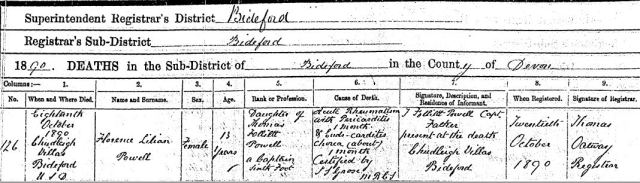
FlorenceWe never actually meet Florence Powell in Barefoot on the Cobbles, yet her short life, or more precisely her death, has ramifications that echo throughout the novel. Florence Lilian Powell was the second daughter of Thomas Folliott Powell and his wife Mary. She was born in Saltash, Cornwall in 1877 but shortly after her birth, the family relocated to Tavistock. By the time Florence was about eleven, the family had moved again, this time to Chudleigh Villas, East-the-Water, Bideford. On the 18 October 1890, Florence died at home from rheumatic fever. Receiving the copy of her death certificate was very exciting for me as there was already another character in the novel who died from the same cause. This gave me scope for drawing a number of parallels. Florence was the first person to be buried in the new East-the-Water cemetery. I searched through the undergrowth for a gravestone in vain. Perhaps there never was one; the family had financial worries. I hope that her place in the novel can be a memorial.

Her mother placed a bunch of rusty chrysanthemums on the long, wet grass in front of a forlorn gravestone. The name, Florence Louisa Powell, was deeply incised in the slate; a short life marked by the stark dates 1877-1890. The family was paying homage at this tangible reminder of a daughter, of a sister, who was forever frozen in time.’

Barefoot on the Cobbles will be published on 17 November 2018. More information about the novel can be found here. Copies will be available at various events in the weeks following the launch or can be pre-ordered from Blue Poppy Publishing or the author. Kindle editions can be pre-ordered for the UK and also on Amazon.com.

#100daysofbfotc Day 84: Temperance Lloyd

Hanging WitchesIt is fitting that today we should mention Temperance Lloyd, noted as being one of the last people to be hanged for witchcraft in England, in 1682. Her name has echoed down the centuries and together with Susanna Edwards and Mary Trembles, she lives on in North Devon folklore. What is she doing in a novel set in the early twentieth century? She appears in Barefoot on the Cobbles as a reminder that elderly women, women whose names may well have been known to my characters, were convicted of capital crimes. Precisely what Temperance was, or was not, guilty of is debatable. Like Polly, hers too was a crime that hinged on the accusations of others. I do have another reason for mentioning Temperance, one that may become clear in the coming months but for now, that is a secret.

Here is Polly, on her way to court in Bideford: ‘Then there was the old cemetery, the school, and the site of the house where it was said the witches used to live. Polly was not the only parent who had threatened her recalcitrant small children with tales of how Goody Lloyd would cast a spell on them if they did not behave. Temperance Lloyd and her co-accused had been hanged outside Exeter jail. Reminders of capital punishment were hardly reassuring.’

Barefoot on the Cobbles will be published on 17 November 2018. More information about the novel can be found here. Copies will be available at various events in the weeks following the launch or can be pre-ordered from Blue Poppy Publishing or the author.

#100daysofbfotc Day 81: Dr Toye

Capture

Western Times 28 January 1938

Dr Toye is one of several medical men who grace the pages of Barefoot on the Cobbles.

Edwin Josiah Toye was born at 8 Bonner’s Park, Bethnal Green, London on 3 November 1871. His father, another Edwin Josiah Toye, was a chemist. His mother was Jane née Buggel. Edwin trained at St Bartholomew’s Hospital and specialised in opthalmics but was also awarded a gold medal for his achievements in the field of obstetrics. He worked as a house physician at the Metropolitan Hospital before coming to Bideford as a locum to Drs Rouse and Gooding.

After the death of Dr Rouse, Edwin became Gooding’s assistant and later a partner in the practice. He is credited with owning the first car in Bideford, in 1902. Dr Toye was a leading Rotarian and served as mayor of Bideford in 1925. It was during his tenure that the building of the new Bideford Hospital was begun and Bideford Bridge was repaired. On 8 September 1903, married an older lady, Mary Ellen Keene née Greatorex, in Northam and they lived at Stanhope in Northam Road. She already had children but they had none of their own. Dr Toye died suddenly at Stanhope on 2 January 1938.

‘Dr Toye was a tall, brusque man in his forties. When Dr Kay called, you felt that he was visiting for a cosy chat, Dr Toye was very different; he was business-like, hurried, eager to give his verdict and to move on to the next patient.’

Barefoot on the Cobbles will be published on 17 November 2018. More information about the novel can be found here. Copies will be available at various events in the weeks following the launch or can be pre-ordered from Blue Poppy Publishing or the author.

#100daysofbfotc Day 65: Bideford Pannier Market

Pannier MarketIn 1891, when Polly visits Bideford Pannier Market in the second chapter of Barefoot on the Cobbles, the new market building had only been open for seven years. It replaced an earlier market on the same spot and was designed, in particular for the butchers, in a designated Butchers’ Row and fishmongers. It was also the local corn exchange. The previous market had been owned by the Lords of the Manor but as they were disinclined to improve the building, the Corporation took responsibility. Market days were Tuesdays and Saturdays and attracted many traders and shoppers from the surrounding rural villages.

The building cost the ratepayers £4200 and it opened on 15 April 1884 amidst great celebrations. The area was bedecked with garlands and there was a peal of church bells, a gun salute and a mayoral procession. Other activities including a concert, a dinner for 200 town worthies, with food provided by the nearby (and now closed) New Inn. This must have been a protracted affairs there were many loyal toasts. The North Devon Gazette gives a detailed account of the proceeding and the attendees at the dinner. Later in the week there was a tea party for 2000 children.

Bideford’s market charter dates from 1272 and the Medieval market was in a different location, at the bottom of the High Street, near the river. The panniers, that give the market its name, are the woven baskets that would be slung either side of the backs of the donkeys and pack horses who brought the produce to market.

‘Tuesday brought market day, with its feverish hubbub and bustle. From early morning, eager sellers arrived with their produce, by rail, by cart, or with panniers slung across the back of a horse or a donkey. Farmers’ wives walked to the town from the surrounding villages to sell eggs, cheese or succulent pies. The smell of the butchers’ stalls with their carcasses of meat and hanging game, caught the throats of the more fastidious. Squawking chickens in stacked crates and the shouts of the stallholders, vied with the chatter of gossiping women and the squeals of children clamouring for sweetmeats.’

Barefoot on the Cobbles will be published on 17 November 2018. More information about the novel can be found here. Copies will be available at various events in the weeks following the launch or can be pre-ordered from Blue Poppy Publishing or the author.

#100daysofbfotc Day 33: Bideford Bridge

Bideford BridgeIn Chapter 2 of Barefoot on the Cobbles we cross Bideford Bridge with Polly, as she goes to begin a new life on the eastern side of the River Torridge. In 1280, the ford that is thought to give Bideford (By the ford) its name was replaced with a wooden bridge, to enable pack-horses to cross the river. At 677 feet, it is thought to be one of the longest medieval bridges. The twenty four arches are of uneven width and there are several theories as to why this came about. It may be that each arch was funded by a different gild and the disparity in their donations meant the arches were not a uniform size. Alternatively, it could be because the available oak beams were of different sizes, or that the piers were placed on firmer ground and the stony outcrops were not evenly spaced. There is also a legend that the piers were set on bales of wool, a symbol of the town’s wealth.

The original wooden bridge was subsequently encased in stone. The bridge was widened in the 1790s and again in 1865, twenty six years before Polly makes her crossing. It was to be further widened in 1925. There were attempts to run a permanent railway track across the bridge but the only time a train crossed the bridge was during the First World War, when temporary tracks were laid. In 1968, a section of the bridge collapsed and one of Barefoot’s characters, Leonard, was to man the safety boat whilst reconstruction took place.

‘Unusually, there was not a gasp of a breeze coming from the river as Polly turned to walk across Bideford bridge, narrowly avoiding the brewer’s dray that was heavily laden with barrels for the inns on the quay.’  

Barefoot on the Cobbles will be published on 17 November 2018. More information about the novel can be found here. Copies will be available at various events in the weeks following the launch or can be pre-ordered from Blue Poppy Publishing or the author.


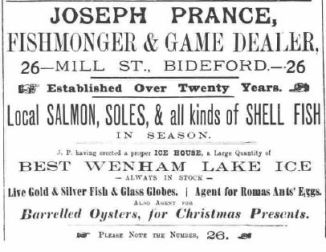
#100daysofbfotc Day 28: Joe Prance

Capture

North Devon Gazette 22 December 1896

Joe Prance appears in Chapter 2 of Barefoot on the Cobbles, when the action moves from the rural tranquillity of the North Devon coastline to the bustling town of Bideford. He was primarily a fishmonger and game dealer, with a shop at 26 Mill Street but he also sold dried goods. He had been born in 1834 in the fishing hamlet of Peppercombe, where his father was a fisherman. He was involved in a childhood accident, which left him with one leg longer than the other. Perhaps surprisingly, in an era before compulsory schooling, he received a good education. The 1861 census finds him lodging in Bideford in order to attend school. He returned to fish from Peppercombe and married a local girl, Susan Found; they had eight children, two sons and six daughters.

In the 1870s, the family moved to Bideford and initially the fishmongers was at 25 Mill Street. It appears that at some point during the next decade, the business absorbed the greengrocer’s at 26. In old age, Joseph and his wife lived at Lower Meddon Street with their married daughter. Joseph died in 1912.

‘Uncle Prance was at the counter arranging the dried goods to his satisfaction and awaiting the delivery of crabs, lobsters, and shimmering bass to lay temptingly in the window.’

Barefoot on the Cobbles will be published on 17 November 2018. More information about the novel can be found here. Copies will be available at various events in the weeks following the launch or can be pre-ordered from Blue Poppy Publishing or the author.