Finally, we seem to have adjusted to the time difference. I attempt to download my photographs from my camera and after a fruitless search, remember that there is no slot for an SD card in this tiny lap top. Do I have the required cable? Of course I do, I just don’t have it here. Fortunately I am able to borrow a slot enabled laptop and back up copies. We sit chatting while we wait for our White Pass Railway and Scenic Skagway tour. There are rumours of Hurricane Florence approaching, forecast to hit the east coast on Friday. That would be the Friday when we are flying home from the east coast. Deep joy, now we are likely to be stranded in Washington airport.
We leave the ship in plenty of time to get our bus and have a quick look at the pier end of Skagway first. The cliff sides are painted with ships’ flags and captains’ names. We later learn that this is a rolling registry of ships that was begun in 1898 and allegedly, the higher the sign, the greater the regard in which the captain was held.
Our driver on bus 109 is Caleb. He warns us that it is a no smoking bus and if anyone smokes, it will be assumed that they are on fire and they will be duly extinguished. After a couple of minutes on the bus we all disembark in order to watch a short video about the area. The Klondike gold rush of 1898 led to the development of Skagway. The trail to the gold fields took an enormous toll on both horses and men. It takes a ridiculously long time for everyone to get back on the bus and two minutes later we are reversing the process yet again as we are at the station.
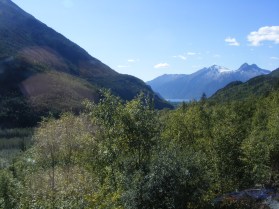 Our railway carriage, one of 83 in the fleet, is named Lake Klukshu. Skagway means ‘land of the north wind’ but we are fortunate that the weather is glorious, so we have great views of the White Pass and Yukon route. Following the discovery of what was actually very little gold, Captain William Moore, founder of Skagway, together with Skookum Jim, one of the two first nations people who found the initial gold, sought to establish a route to the Klondike that was easier than the existing Chilkoot Pass. Their route, past Lake Bennett, was named White Pass. A sensationalist newspaper headline about the discovery of gold, led tens of thousands of prospectors to take steamers up the inside passage and begin a hazardous 600 mile trek across country to the Klondike. No prospector was allowed to begin the journey without a ton of supplies. The slightly easier White Pass was favoured over the shorter Chilkoot Pass as it was, in theory, possible to take pack animals. Over 3000 horses or donkeys perished on the Pass before the railway on which we are travelling was constructed. They began building this narrow gauge railway in 1898 and reached the summit, 110 miles away in 1899. The route involves steep gradients and tight turns and construction was hampered by temperatures as low as minus 60. By the time the track heading north joined the track coming up from the south, in 1900, over 35,000 men had been employed in building the railroad at some point. The tracks ceased to carry ore after the price slumped in 1982 and the railroad became a tourist destination.
The steam engine that works this route is undergoing maintenance, so we are being pulled by a diesel engine. We travel forty miles through impressive scenery and across scarily rickety looking bridges beyond the White Pass summit, which is 2885 feet above sea level, as far as Fraser, where we disembark. We have now crossed into British Columbia, Canada but not for long. The lakes here freeze in winter and there is sometimes still ice in June, so they are lifeless. After our train ride, Caleb collects us in the coach for our drive back down the Tormented Valley to Skagway. The valley gets forty feet of snow a year. Caleb tells us that no-one has been born in Skagway in twenty seven years. There is no doctor here just two nurse practitioners. As soon as someone is thirty weeks pregnant, they are sent to Juneau. As an aside, the women in front of us are each wearing two baseball caps. This is just plain weird.
We are dropped off in the interesting town of Skagway, in which almost every shop is a tourist trap. There probably aren’t many other employment opportunities for the resident population of 850. Many of the shop owners are standing outside, trying to entice us in and deprive them of their end of season stock.
It is very hot and we spend an enjoyable hour on the deck in the sun once back on board. After a meal of chilli jacket potatoes, the waiter entertains us by balancing three forks on top of cocktail sticks that are in turn balanced in the pepper pot holes – you kind of have to see it. In the evening Dick Eastman talks to us about getting the best out of Google.
 Fred, Albert’s younger brother, is referred to briefly in Barefoot on the Cobbles. In reality, he was Alfred, known as Alf but I felt that this was too similar to Albert, so I opted for the alternative abbreviation. Like Albert, Alfred moved from his Bucks Mills birthplace to Clovelly. He married there and had two children. He was an active lifeboatman and was coxswain for a number of years.
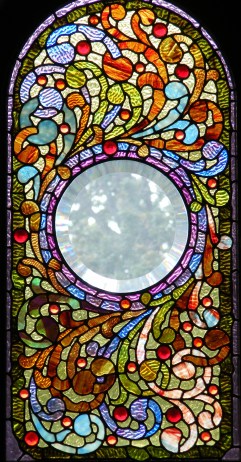 Robert Dunsmuir made a fortune from the coal industry. Initially he came out from Scotland to work for the Hudson’s Bay Company, travelling via South America and up the west coast. He soon set up on his own, having found a rich coal seam. He set out to build Craigdarroch Castle but died before it was finished in 1890. His widow did not like it so moved out in 1908, since which time the ‘Castle’ has had many uses. These include a military hospital for ‘incurables’; it is patently unsuitable for this as it is built over four floors. It has also been a College, a Music School and offices. It is now run as a tourist attraction, with 100,000 visitors each year. One of the most impressive aspects of Craigdarroch is its stained glass. Typically of cruise excursions, we don’t have anything like long enough there, so rush round before re-boarding our coach. Once back on board, we had planned to sit on deck but the unseasonal weather makes this less than pleasant, so we force ourselves to make the most of the Windjammer’s offerings. We are invited to clap the staff as they parade round the dining area.
 Icebergs prevent us from getting right up Tracy Arm but we still have beautiful views to admire. It is too chilly to sit outside for long so we spend the morning in the Windjammer again, as breakfast blends in to coffee and then into lunch. Great to relax and chat as the scenery and icebergs flash by. I later realise that I spectacularly failed to get any close up iceberg photos. I seem to keep missing out on this trip.
 Finally, we are able to dock and the sun is shining on the righteous and on us too. Juneau was a gold rush town, founded in 1880 and is now the state capital. We are invited to join a mad genealogists’ excursion to the Mendenhall Glacier in a hired mini-bus. The first challenge is to cram all twelve of us inside. This involves trying to avoid being garrotted by the seat belt that is strung across the doorway. It is a short drive to the glacier near Nugget Falls. Despite the name, virtually no gold was taken from here and in the early part of the twentieth century, money was made from hydro-electric power, before the area turned to tourism. We learn a little of the local Tlingit people. It is very peaceful here, despite it being a tourist honey pot. Sadly, climate change is taking its toll and the glacier is retreating at an alarming rate. We see some bald-headed eagles on our journey but not in a spot suitable for photographing.
 The History Interpreter - Janet Few