On the third day of RootsTech I had been really looking forward to Wanda Wyporska’s session (from late UK time on day 2) about researching women and was sad to see that it was not able to be recorded. As the custodian of ancestral christening gowns, wedding dresses and quilts Preserving your Ancestors’ Textiles and Handmade Treasures by Melissa Barker was another that was high on my ‘must watch’ list. Again, if you watch, you can skip the first 3 minutes 19 seconds of setting up chat. Sadly my house is too small to follow all of her advice. Interesting to learn that folded textiles should be refolded in a different way every few months to avoid deterioration along the creases.
Next, another talk from Diahan Southard, My Messy, Complicated Birth Roots Story. This was a fascinating and well-presented session, highlighting the problems of trying to identify DNA matches, particularly if you are related to someone through two different family lines. Highly recommended.
30 Fun and Meaningful Activities for Kids and Grandkids to Celebrate their Ancestors Sharlene Habermeyer was also on my watch list. Two minutes in before this one starts. I do appreciate and welcome the fact that these videos have been made available so quickly but wonder if a little editing out of the set up might have been useful. The presentation does what it says in the tin and Sharlene’s website has free downloadable resources http://www.growinglittleleaves.com/printables.html. A few are US orientated but there are others that are applicable to all. I did cringe however at her suggestion of cleaning graves and making rubbings of them. This is common practice elsewhere but is definitely not advised, or indeed legal, in Britain, where the lichens that grow on gravestones are protected. I did love the idea of sharing memorabilia; I just wish my grandchildren visited often enough to do this. Trying on ancestral wedding dresses or uniforms was another great idea, although I don’t see why this should be a gendered activity. Plenty of really good suggestions for using ancestral photos. I shall be reading the full details of the activities mentioned by Sharlene on her website and trying some of the ideas; first I think will be the talents and hobbies activity and the timeline. On a similar topic, I listed to Sarah Day’s short GenZ Genealogy presentation from 2022, outlining how we can support 10-24 year olds on the genealogical journeys. She also suggests what GenZ themselves can do. Pleased to hear that this included joining societies. Another catch up from last year was Write your Family Stories (in 30 minutes or less) by Brenda Hudson. Useful suggestions here for those who struggle with starting to write stories.
So that’s a wrap. I do still have a couple left on this year’s play list and few few lingering from previous years. I will no doubt add more when others share their recommendations. I will try not to leave it until next year to watch these. The dates for next year are announced – so make a note in your diaries.
No, this is not me trying to learn another language. The Cornish continues (note I didn’t say progresses) and I will report on that another time.
I had a wonderful once-in-a-lifetime holiday touring the whole of the island of Ireland planned and booked. What could possibly go wrong? What went wrong was that the holiday was planned for May 2020. It is always difficult to arrange to spend long periods away from home but finally, later this year was to be the time for the rearranged Irish holiday. I do like everything planned in advance. Some call me organised and in a sense I am but this is not a virtue, it is a coping mechanism. I revisited the 2020 itinerary, tweaked a few things, made sure the tourist attractions we planned to visit hadn’t permanently closed and prepared to re-book everything.
When you are touring, three days here, four days there, everything hinges on the start date. This means I needed to begin by confirming the ferry. I didn’t do a year long course with an Irish University without learning how beautifully laid back the atmosphere is in Ireland (and no, still no certificate, one month after it was posted), so, in early January, it was not a surprise to learn that bookings had not yet opened for the ferry crossings later in the year. ‘Try next week’. After several ‘next weeks’, finally, a confirmed ferry booking.
Next step, caravan sites. Some of those we’d hoped to stay in were no longer running, others didn’t open until May and weren’t taking bookings yet. I know, I know, ‘’Twill be grand’ and all that but I really do like to know that we will have somewhere to pitch the van. Sites don’t seem to be anything like as plentiful as on mainland Britain, so arriving somewhere and hoping for the best is definitely not a great idea, at least not if you are me. Wild camping is illegal on the island of Ireland, or perhaps it isn’t, Mr Google is unclear on the matter. Having read ‘it isn’t strictly legal but you’ll probably get away with it’, I know this isn’t an option. The one person who won’t get away with it will be me. So back to trying to book sites. It was a real mixture, some online booking forms wanted to know the equivalent of the inside leg measurements of all guests, other sites took days to answer emails. We still can’t book a site for the end of the holiday. It was difficult enough finding one anywhere near the right place. Some only took motor homes not caravans, some closed for the season before we wanted to stay. In the end, we’ve had to settle for ‘just turn up no need to book’, which really doesn’t sit well with me. There are fifty odd pitches on this site, what happens if fifty one someones ‘just turn up’ and we are number fifty one? We had a site issue in Canada, two sites that we had booked had decided to close early for the season, leaving us in the lurch. Really hope this doesn’t happen again.
Tours then, booking tours is particularly important as we are only in a place for two or three days, so if we can’t get a ticket on a particular day, we can’t just go the following week. Surely we can book tours to things that say ‘early booking essential’? It seems not. ‘Early’ seems to equate to a couple of days in advance, which means we will already be away and I will have to struggle to do this when we have wifi or by phone, deep joy.
After a hectic week of googling ‘touring caravan site near x’ we are as prepared as Ireland will let us be. Apart from regular checking to see if ‘early’ is now, all that is left is to anticipate the trip and keep everything crossed that fire, famine, plague or earthquake don’t mean we have to rearrange again.
I am still recovering from our Few Forgotten Women Friday back in January. In the end, fifty three of us each took one or more of the girls from the Leeds Industrial School and attempted to find out more about them. Given that we had a zero budget (though a few of us did succumb to buying a certificate or two) and were restricted to what we could find online, we were remarkably successful. Of course there were those for whom very little could be found and others where we found someone of the right name but couldn’t be sure we had the right person. The nature of the lives that these girls and their families led meant that they were likely to avoid appearing in the official records, or did so under an alias. Nonetheless, some fascinating stories are emerging. Sadly, many of them did not end happily but some of the girls did seem to turn their lives around. The stories are gradually appearing on the website, so do take a look. There’s a now a new Forgotten Women Friday on the horizon in March. So do get in touch if you fancy honing your research skills on an inebriate woman.
Every now and then I revisit one of my family lines to see what more can be found. It is currently the turn of the Smiths of London (I know – someone has to take one for the team). I have (possibly rashly) agreed to make them the subject of a talk, focussing on the possibilities when researching the country’s most common surname in the most highly populated city. It is surprising what a range of sources can be used, both for the genealogy and the contextual history. I am getting lost down more rabbit holes than you can imagine.
Whilst on the subject of elusive ancestors, I have been working on a new course for Pharos Teaching and Tutoring about Migration and those ancestors that just disappear. A positive warren of rabbit holes here. If any of you have managed, thus far, to escape being drawn in to the obsession that is family history, despite reading my blog, now is the time to start. Pharos have just launched a two-part Foundations of Family History course that can be taken at any time; ideal for those who are just stepping their toes in the water but be warned – there is no going back. While I am on the topic of courses. There’s another chance to take my online ‘Are you Sitting Comfortably? Writing and Telling your Family History’. This usually runs twice a year but this will be the only chance in 2023 and there is an option to submit a piece for me to feed back on if you wish. The course starts with Pharos Teaching and Tutoring on 13 March.
Writing has mostly been about finishing the draft of the non-fiction book I’ve been working on for the past year. I’m afraid the title is embargoed and it may be a year before copies hit the bookshelves but it has been great fun to write. I am now dealing with the dreaded task of sourcing copyright free illustrations. There are plenty of documents I’d love to include but the responses are usually along the lines of ‘that will be £200 please’, which means it will cost me a fortune to produce the book. I accept that, if it sells well, I will be making a few pence an hour for writing it but that really is, literally, a few pence, so shelling out to use illustrations is not an option. Despite what trawling the internet might suggest, you really can’t just use images as and where you please.
I’ve been keeping in touch with my lovely colleagues from the Experimental Archaeology Course and there was great excitement three weeks ago as certificates marking our success began to be delivered. I eagerly searched my doormat – nothing. Days passed – still nothing. I know I live in the back of beyond, where postmen rarely dare to tread but certificates have reached Australia and I still don’t have mine. I have asked the powers that be and am now anxiously awaiting a reply as well as a certificate.
I’ve been giving talks here and there, in person and on line and had a chat about family history to Radio Devon last week, as you do. Everything you know about family history in ten minutes was a tad of a challenge but always a pleasure to speak to the lovely Pippa Quelch.
Signs of spring are wonderful. I just wish the sun could shine without showing quite so much dust.
The holiday season is over, although I have to confess that I still have Christmas cards and a Christmas tree to take down. Bearing in mind that half the cards didn’t arrive until January, it seemed a shame not to display them for a while. I am probably risking the wrath of the bad luck fairy that dictates that decorations have to be away by the 6th (or is it on the 6th – who knows?) but I’ll survive.
I was away from home at New Year, so didn’t do the typical old year reflection/new year plans post. Better late than never – highlights of last year (in no particular order): spending time with friends and family; visiting some beautiful English coast and countryside; working on the revamped Braund Society website; being part of the Few Good Women group and launching the Few Forgotten Women project (another website created); passing (just) my grade 1 piano exam; passing (with rather more success) my postgraduate certificate in Experimental Archaeology and Material Culture; starting to learn Cornish; creating a living willow chair (even though ‘living’ is up for debate), some fused glass and learning to plait straw; making two separate, exciting family history discoveries in asylum records.
Plans for 2023: more of the same and finishing some projects started in 2022 including a book to complete, a dedicated family history website to launch, a course to write, Ivy’s biography to finish and a new one to create; Ireland to visit (postponed from 2020); more Cornish to learn, speaking in sentences would be good!
Even though I have only had a few days back in the old routine, there has been so much going on. My article The Family History Revolution, looking back over five decades of the world of family history, with thoughts on what may come, has appeared in Family Tree Magazine. The book I am writing is finally nearing completion, with half a chapter an introduction and a conclusion to go. It is a non-fiction family history book. I can’t announce the subject yet but you won’t be surprised to learn that it isn’t all sweetness and light. There is some overlap with my work on the Few Forgotten Women Project. What fun that is proving to be and it is such a lovely group of ladies to be working with.
Just before Christmas, some of our Forgotten Women team chatted to Helen Tovey of Family Tree Magazine and the podcast has just been released. Our next venture is a joint research project on Friday 20 January, dedicated as what we hope will be the first of a series of Forgotten Women Fridays. We are going to look at a particular set of records that feature forgotten women and collectively research those ladies on that day. We are inviting family historians to help us, so if any of my genealogy readers want to give us a hand, we’d love to allocate you one of the women from our chosen list. You have a day to find out as much as you can, using what is available online. Keep an eye on the Few Forgotten Women website on Friday for full details.
Another collaborative project: our local history group is preparing for a cemetery workshop at the end of the month. We are trying to compile mini biographies of those who are commemorated in our churchyard.
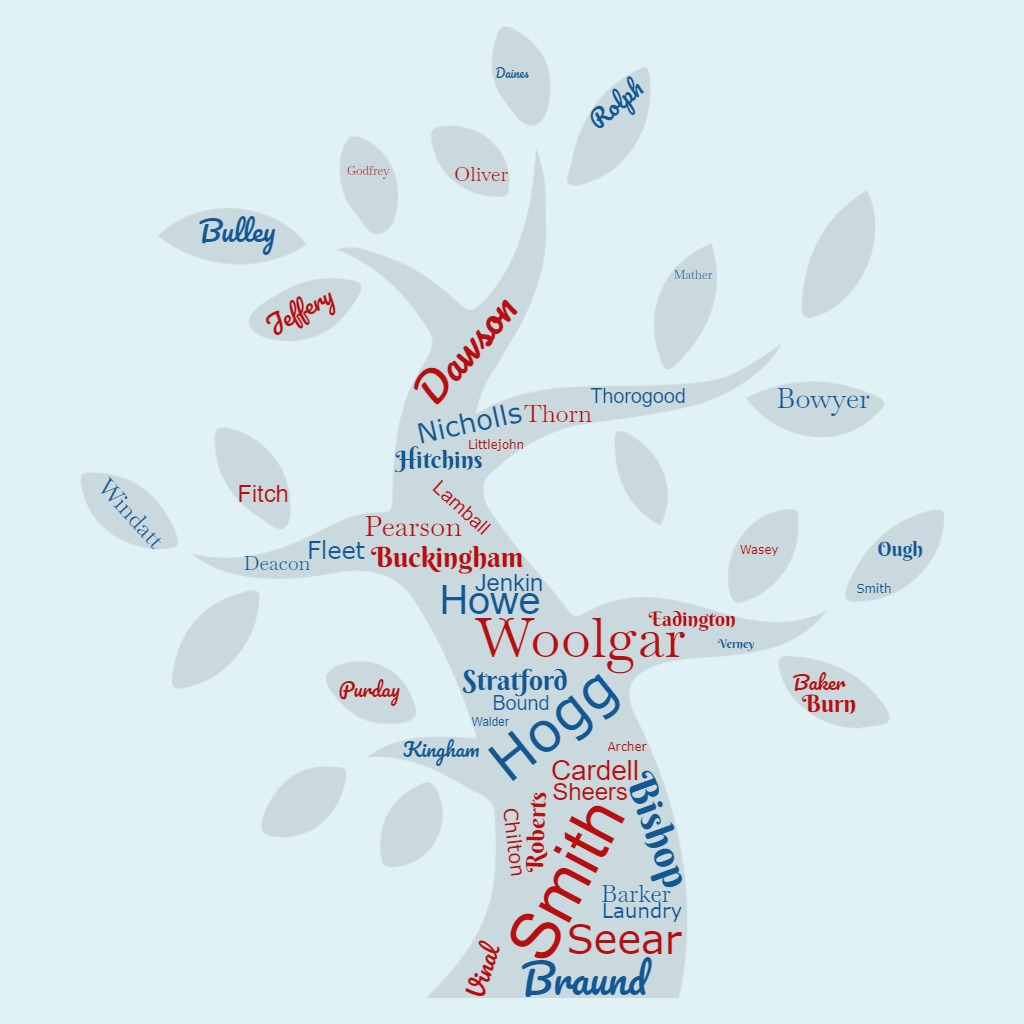
As part of my preparation for my, as yet to be revealed, website showcasing my own family history, I was looking at the surnames of my direct ancestors and created this using Wordclouds. There is a choice of outlines and colours. It includes the forty nine surnames I’ve discovered in my direct ancestry, back to my 4x great grandparents. I could have included the other sixty eight names from earlier generations but I rather lost the will. In theory, the names that feature in my more recent ancestry should be larger but that is not exact.
This draw is now closed thank you for participating.
To wish you all a Happy New Year, I am announcing my free give-away of a ticket to RootsTech 2023. As a RootsTech Influencer, I have an in-person three-day pass to give to one of my readers. This pass, worth $98, includes access to all on-site classes, entrance to all keynote and general sessions, as well as the Expo Hall.
RootsTech is the biggest event in the international genealogical calendar and this year, takes place in Salt Lake City from 2-4 March. There is an exciting line-up of speakers from across the global, many of whom I am proud to call friends. Already purchased a ticket? Not to worry, the winner’s ticket price will be refunded if that is the case. Can’t get to Salt Lake? Then there is a virtual option, which will cost nothing at all.
I thought I’d make you do a little work in order to take part. This will involve you visiting some other websites that are part of my family history life.
To enter, just send me a message using the contact box on the home page with the answers to the following questions.
Using this website, tell me the title of one of my historical novels.
Visit the Forgotten Women website and name one of the ladies whose stories feature.
On the Swords and Spindles website, visit the links and resources page, scroll down and follow the link to name one book in the ‘Books for Children and Young People’ section.
Go to the website of The Braund Society and tell me when the Society was founded.
Finally, look and the website of Buckland Brewer History Group and tell me the name of the speaker we will be listening to in May 2023.
The winner will be chosen at random from all the correct responses received by midnight (London time) on Sunday 29 January.
I have had a particular affinity with my great, great grandmother, Ann Stratford, ever since I discovered that her childhood home was in the road I myself lived in for three years. Ann was the third of the five children of Richard and Grace Stratford née Kingham.[i] She was baptised on the 13th of May 1834 at St. Michael and All Angels, Aston Clinton, Buckinghamshire[ii] and it seems that she spent the first twenty-one years of her life living there.[iii] Aston Clinton is a village situated on the main road between the towns of Tring, in Hertfordshire and Aylesbury in Buckinghamshire. Once married, Ann moved six miles away to Little Kimble,[iv] another Buckinghamshire village whose economy was dependent on agriculture. In company with many rural areas, Buckinghamshire was a flourishing centre for home industry, in particular lace-making and straw-plaiting. Many members of the Stratford family were involved in the plaiting and distribution of straw for the hat trade, which centred on Luton. Born on the eve of the Victorian era, in 1834 and dying a month before Edward VII, in 1911, Ann Stratford’s life-story spans not just the Victorian age but also the rise and demise of the domestic straw-plait trade.
St. Michael and All Angels, Aston Clinton
At the time of Ann’s birth, Buckinghamshire was still suffering from the aftermath of the Swing Riots. In 1830, following an agricultural depression and a series of bad harvests, the plight of agricultural labourers led to protests, during which threshing machines across the south of the country were destroyed under the auspices of the mythical Captain Swing. Conditions and wages were poor, with workers increasingly being hired on short term contracts and having to find their own accommodation, leaving them destitute when work was scarce. Prior to the Poor Law Amendment Act of 1834, poor relief was inadequate and the obligation of church tithes was punitive. The riots spread across the south of England and were prevalent in Buckinghamshire and the surrounding counties.
The Swing rioters targeted those they perceived as wealthy and overseers of the poor were sent threatening letters, ostensibly from Captain Swing. The rioters demanded increased wages, better conditions, reductions in rents and tithe payments, as well as the destruction of threshing machines. Groups of rioters roamed the countryside damaging threshing machines, burning ricks and attacking property. As labourers in an agricultural community, even if they were not actively involved, the Stratfords must have been affected by causes and consequences of these troubles.
Before Ann’s birth, in 1829, her father Richard, had twice been in court for petty theft.[v] This may have been as a result of the actions of a headstrong young man but the stealing of firewood and turnips suggests perhaps that the family were in dire straits. As poverty tightened its grip, families, such as the Stratfords, were increasingly dependent on income from home industries, in their case straw-plaiting. In 1839, Ann’s short-lived younger brother was born.[vi] In the January of 1840, her two and a half year old sister, Mary, died of convulsions.[vii] Just a month later, Ann’s mother, Grace, mother died of tuberculosis.[viii] This left Ann’s father, a straw dealer, with three young children, Ann and her two older brothers, to care for. Just over three months after the death of his first wife, Richard Stratford married again, to nineteen year old Hannah Young;[ix] Ann was just six years old.
The plait trade flourished in the years known as the ‘hungry forties’. The Stratford’s local market would have been five miles to the east, in Tring. By 1846, a new market opened up to the west in Aylesbury, four miles away from Aston Clinton. The first Aylesbury market was held on the 3rd of October and twenty children under the age of twelve, from surrounding villages, were give monetary prizes for their plait; one of the winners was eleven-year-old Ann Stratford.[x] Ann was recorded as a plaiter in the 1851 census. She was living with her family in Green End Street, Aston Clinton, where I was to live in the 1980s.[xi] It was in 1851 that Anthony Nathan de Rothschild purchased the Aston Clinton estate from The Duke of Buckingham.[xii] The Rothschilds were to set up a model farm in the parish.
Green End Street, Aston Clinton
According to Gróf, 4% of the female population of Buckinghamshire in 1851 were involved in the plait trade, yet in some parishes, such as Edlesborough, the figure was as high as 58%.[xiii] Conditions were notoriously hard for straw-plaiters, who would be brought weekly supplies of straw by the plaitman and paid by the score (twenty yards) for what they produced; the more complex patterns commanding the highest rates. From a very young age, children would be expected to contribute to the family income in this way, some in plait schools that gained a reputation for ‘places of child exploitation amid exceptional squalor, and even cruelty’.[xiv]
In 1851, Ann was one of one hundred and eighteen females aged between five and twenty five in Aston Clinton, 59% of whom were involved in the plait trade. In all, 60% of Aston Clinton females, including children, were recorded with some form of occupation; two thirds of them were plaiters.[xv] Ann Stratford’s father Richard was a straw dealer,[xvi] as was her older brother Peter;[xvii] another brother, Henry, was a straw drawer, preparing the straw for plaiting.[xviii] The graph below shows the age and gender distribution of the two hundred and thirty nine plait workers in Aston Clinton in 1851; they made up 41% of the workforce in the parish.
Inhabitants of Aston Clinton in 1851 who were involved in the Plait Trade[xix]
Children as young as three would begin to learn to plait. Plaiting expert, Veronica Main, has found a record of a child of eighteen months involved.[xx] The children would be crowded into plait schools, held in small cottage rooms= that had poor lighting and were full of fumes from the ‘chaddy pot’ charcoal heaters that they put under their skirts for warmth. Those running the schools were accused of exploiting their labour-force. School is a misleading appellation, the education provided related solely to plaiting. Ann was illiterate, signing her marriage certificate and registering her daughters’ birth with a cross.[xxi] A child’s early attempts at plait would not be saleable and were termed ‘widdle waddle’ but by the age of ten, a child could earn two-thirds of an adult’s income.
The plaiters would work twelve or fourteen hour days but the rewards were significant; the most proficient, who produced the more complicated patterns, might earn more than their agricultural labouring husbands. Plain plait was worth seven pence a score. In 1813, Priest wrote, ‘women and children here make great earnings by making lace and platting [sic] straw, unfortunately to the disadvantage of agriculture; for whilst they can earn by such work from 7s. to 30s. per week ……, it can scarce be expected they would undertake work in the field’.[xxii] Lucy Luck referred to the straw season, as being from January to June, saying that there was less work during the remainder of the year[xxiii] but there was a good living to be made from plaiting.
There were several roles involved in the plait trade, including drawers, strippers, cutters, splitters, sorters, bleachers, dyers and the plaiters themselves. One splitter could provide enough straw for fifty plaiters. Although it was possible to fulfil more than one of these roles, increasingly, individuals specialised in one or the other. At the top of the hierarchy were the straw dealers, some having large-scale, highly profitable businesses. At the first Aylesbury plait market, held in 1846, Mr Thorn of Aston Clinton brought 500 score of plait to sell; the most productive dealer bringing 1300 score and nearly £1000 of plait changed hands.[xxiv]
There were health hazards associated with plaiting. Plaiters developed cracks at the corners of their mouths, from dampening the straw. If dyed straws were used, the dye transferred to the plaiter’s mouth. The posture required also led to hunched left shoulders.
Throughout the nineteenth century, middle-class men passed judgements on the lifestyle of the straw-plaiters. Straw-plaiting was regarded as leading to immorality and ignorance, with plaiters deemed to be more likely to have illegitimate children and lack proficiency in essential domestic tasks. The plaiters’ husbands were accused of being lazy and living on their wives’ incomes. In 1882, it was reported that plaiters
“are a sadly untidy and unthrifty set of people, scarcely knowing how to do a stitch of needlework, or cook a potato; addicted to making a cup of tea and eating dry bread and butter if they can afford it.”[xxv]
Goose writes that,
“The Clergy Visitation Returns for Buckinghamshire in 1854 and 1866 blamed high levels of illegitimacy squarely on the industry. At Stewkley and Linsdale the ‘evils’ of the trade were castigated, while at Aston Clinton the local clergyman complained that plaiters became independent of their parents too soon, leading to early marriages and unspecified ‘immorality’ which, it was claimed, frequently took place on Buckland Common.”[xxvi]
Goose goes on to point out that, in 1864, the Royal Commission on Children’s Employment reported that children could earn 6d a week from straw-plaiting, therefore there was a significant incentive for parents to put them to work, thus, “it is not surprising… that ignorance and vice abound among a population so reared.”[xxvii] As early as 1804, Arthur Young wrote in General View of Agriculture of the County of Hertfordshire that, “the farmers complain of it, as doing mischief, for it makes the poor saucy, and no servants can be procured, where this manufacture establishes itself.”[xxviii] George Culley’s report to the Royal Commission on the Employment of Children, Young Persons and Women in Agriculture of 1867/8, commented on the “great want of chastity amongst the plait girls,” blaming the early independence from their parents, that earnings from plait allowed and the fact that, “male and female plaiters go about the lanes together in summer engaged in work which has not even the wholesome corrective of more or less physical exhaustion”.[xxix]
Despite these contemporary claims, Gróf’s study of Edesleborough in Buckinghamshire[xxx] concluded that the assertions of higher illegitimacy rates amongst plait workers were unfounded. Goose’s wider study of Hertfordshire suggests that despite indications of enhanced rates of illegitimacy in some plaiting areas, this was not necessarily attributable to plaiting, other factors being at work.[xxxi]
Plait-School
Image George Washington Brownlow in the public domain
Studying the Stratford family shows that Aston Clinton was similar to Edlesborough, in that their women played a vital role in the family economy. These villages had far more women with recorded occupations than the county average of 4%. Two of the factors that Pennington and Westover cite as being likely to result in the emergence of home industry, such as plaiting, were low wages for men and the prevalence of casual labour; both factors which also stimulated the Swing Riots.[xxxii] It can be seen that Ann was part of a much wider pattern of female employment.
On the 13th of March 1855, Ann gave birth to an illegitimate daughter, Mary Ann Howe Stratford in Aston Clinton.[xxxiii] There is no DNA evidence to confirm or refute the identity of Mary Ann’s father but it seems almost certain that he was William Howe. Ann was to marry William three months later in his home village of Great Kimble, where the couple set up home. What then of the allegation of immorality amongst plait workers? Ann’s eldest brother had been born three months before her parents’ marriage. Ann’s own first child was also born out of wedlock. Would Ann, or her mother Grace, have been subjected to the ‘rough music’ that traditionally accompanied illegitimate births? This involved banging saucepan-lids or tins cans together to cause a commotion outside the mother’s home. At her baptism, which took place in Great Kimble after the marriage of William and Ann, Mary Ann’s parents were listed as Robert and Charlotte Howe, who were in fact William’s parents.[xxxiv] As Charlotte would have been fifty at the time this seems unlikely, also Mary appears in the 1861 census as William’s daughter.[xxxv] Mary Ann’s birth was registered as Mary Ann Howe Stratford,[xxxvi] underlining the probability that she was the child of William and Ann and illustrating that the baptism record is misleading.
St. Nicholas’, Great Kimble
From this single instance it is difficult to draw any conclusions about pre-marital pregnancy however, in this respect Ann was adding weight to those who reviled the straw-plaiting women as being promiscuous. Gróf mentions an unreferenced Parliamentary Report of 1842 which stated that, “the moral condition of the lace-makers seems nearly as low as that of the plaiters… chastity is at a sad discount … prostitution is at a high premium.”[xxxvii]
Ann’s husband, William, was an agricultural labourer. Despite the Swing Riots and increased demand for labourers following waves of emigration, agricultural wages were still low in Buckinghamshire in the 1850s. Perhaps attracted by the promise of up to £6 bounty, in 1852, whilst still a single man, William Howehad responded to a recruiting poster and enlisted in the Royal Bucks King’s Own regiment of militia.[xxxviii] The militia were groups of amateur soldiers, mustered in times of strife or perceived threat. The Militia Act of 1852 was a response to the fear of French invasion and 80,000 men were sought. It was hoped to recruit sufficient volunteers but the Act did provide for a ballot to force men to enrol should they not come forward. Private 492 William How [sic] was recruited on the 28th of October 1852 at the age of twenty years and eight months[xxxix]. His height was 5’ 6¼”, his occupation was listed as labourer and he received an initial bounty of sixteen shillings. Over the next two years William undertook several periods of service throughout the county, receiving regular bounty payments of up to £3 13/- a quarter.[xl] This illustrates how wider reaching foreign affairs affected the life of a simple agricultural family in the provinces.[xli]
When Ann married William Howe at St. Nicholas’, Great Kimble on the 26th of June 1855; she was described as a servant of Great Kimble and William was recorded as being a militiaman.[xliii] It appears that William and Ann spent thirty years in the same cottage.[xliv] It is likely that they moved there on marriage in 1855 and were still there in 1886 when their daughter, Caroline, returned from Battersea in south London, in order to give birth to her daughter, my grandmother, Elizabeth Ann Hogg.[xlv] The census returns of 1861 and 1871[xlvi] suggest that this cottage was close to a chapel and the Crown Inn, with just one cottage between the Howe’s and the Inn. In Little Kimble, when I visited in the 1990s, Old Chapel Close indicated the site of the Chapel and an Indian Restaurant inhabited what appears to be the former Crown Inn. Next door was one cottage, then named ‘*** ******’, clearly old enough to have been built by the 1850s. Further on again, was Brookside House, where William and Ann’s daughter Jane was working in 1881.[xlvii] So where could William and Ann have lived? Had it been demolished? Looking more carefully at ‘*** ******’ it became obvious that this was once two cottages; the brickwork round a second front door was clearly visible to the left of the existing door. So, the right-hand half of ‘*** ******’ was home to William, Ann and their nine children. In 1861, the family, by then with four children, even found room for a lodger, George Fleet; almost certainly an economic necessity. According to the 1861 census, Ann was still plaiting.[xlviii]
The Probable Former Home of William and Ann Howe
William and Ann went on to have five more daughters and three sons. They all survived to adulthood and married, which seems unusual in times of poverty and poor public health. It is possible that there were miscarriages but the children are very evenly spaced.[xlix]
Although no occupation is listed for Ann in the censuses from 1871 to 1891,[l] it is almost certain that she would have continued to plait; women’s occupations are notoriously under-represented in the census returns. Toward the end of their lives William and Ann went to live in Weston Road, in Ann’s home parish of Aston Clinton, next to their son Joseph, for a time. They were there in 1891, when, at the age of sixty, William was working as a roadman and by this time, Ann had lost her hearing.[li] Ten years later, they had returned to Great Kimble and were living in Smokey Row. William was working as a horseman on a farm. Ann was then recorded as plaiting straw.[lii] William, described as a farm labourer, died in Great Kimble of exhaustion and acute bronchitis on the 14th of December 1904. His death was registered by his daughter-in-law Louisa, who had come down from Fulham and had been in attendance at the time of William’s death.[liii]
Ann’s generation was the last to depend on straw. The market had collapsed in the face of cheap imports and former plaiters were forced to turn to sewing the foreign plait into bonnets, or to seek other means of contributing to the domestic economy. Of Ann’s daughters, only the eldest, Mary Ann, took up plaiting, something she did into adulthood, although by the time she was widowed, in 1911, she was engaged in laundry work, there being no longer any demand for plaiting.[liv] The remaining daughters went into domestic service, or worked as dressmakers.[lv]
On the 1st of April 1911, Ann died in Saunderton Workhouse infirmary of old age and exhaustion. Her death was registered as Hannah How.[lvi] Ann was buried with her husband at Great Kimble.[lvii]
Clarke, E. ‘Plait and Plaiters’ in Cassell’s Family Magazine (1882) Vol. 8 pp. 76-79.
Davis, Jean Straw Plait Shire Publications Ltd. (1981).
Few, Martha unpublished, untitled essay for The Open University course A173 (2008).
Goose, Nigel ‘How saucy did it make the poor?: Illegitimacy fertility and the family in nineteenth century Hertfordshire’ in History Vol. 91.4 304 (2006) pp. 530-556.
Gróf, Lázló L., Children of Straw, Baron, Buckingham (2002).
Luck, Lucy ‘Lucy Luck Straw-plait Worker’ in Burnett, John Useful Toil: autobiographies of working people from the 1820s to the 1920s Routledge (1974) pp. 53-62.
Pennington, S and Westover, B., A Hidden Workforce, homeworkers in England 1850-1985, Macmillan Education, Basingstoke (1989).
Page, William [ed.] ‘The parishes of Aylesbury hundred: Aston Clinton’, in A History of the County of Buckingham: Volume 2,Victoria County Histories (1908), pp. 312-319. Accessed via British History Onlinehttp://www.british-history.ac.uk/vch/bucks/vol2/pp312-319 accessed 23 September 2022.
Priest, St. John General View of Agriculture of the County of Buckinghamshire (1813).
Tremenheere, Hugh S. Commission on Employment of Children, Young Persons and Women in Agriculture H. M. Stationery Office (1867)
Young, Arthur General View of Agriculture of the County of Hertfordshire (1804).
Acknowledgements
Thanks to Martha Barnard, Lorna Brooks, Stephen Daglish, Vicki Morphew.
[i] Aston Clinton entries from Buckinghamshire Baptisms Index via www.findmypast.so.uk original document reference PR8/1/4. 1851 census for Green End Street, Aston Clinton, Buckinghamshire HO107 1721 folio 485.
[ii] Aston Clinton entries from Buckinghamshire Baptisms Index via www.findmypast.so.uk original document reference PR8/1/4.
[iii] Aston Clinton entries from Buckinghamshire Baptisms Index via www.findmypast.co.uk original document reference PR8/1/4. 1851 census for Green End Street, Aston Clinton, Buckinghamshire HO107 1721 folio 485.
[iv] 1861 census for Great Kimble, Buckinghamshire, RG9 861 folio 91.
[v]Bucks Gazette 16 May 1829 p. 4 col. d. Bucks Gazette 28 November 1829 p. 4 col. c.
[vi] Birth certificate of male Stratford 1839 digital image from the General Register Office.
[vii] Death certificate of Mary Stratford 1840 digital image from the General Register Office.
[viii] Death certificate of Grace Stratford née Kingham 1840 pdf from the General Register Office.
[x]Bucks Advertiser & Aylesbury News 10 October 1846 p. 4 col. d.
[xi] 1851 census for Green End Street, Aston Clinton, Buckinghamshire HO107 1721 folio 485.
[xii] Page, William [ed.] ‘The parishes of Aylesbury hundred: Aston Clinton’, in A History of the County of Buckingham: Volume 2,Victoria County Histories (1908), pp. 312-319. Accessed via British History Onlinehttp://www.british-history.ac.uk/vch/bucks/vol2/pp312-319 accessed 23 September 2022.
[xiii] Gróf, Lázló L., Children of Straw, Baron, Buckingham (2002).
[xiv] Gróf, Lázló L., Children of Straw, Baron, Buckingham (2002) p. 65.
[xv] 1851 Census Index CD, Buckinghamshire Family History Society.
[xvi] 1851 census for Green End Street, Aston Clinton, Buckinghamshire HO107 1721 folio 485.
[xvii] 1861 census for Plumbers Arms, Weston Road, Aston Clinton, Buckinghamshire RG9 867 folio 8.
[xviii] 1841 census for College Farm Road, Aston Clinton, Buckinghamshire HO107 40/1 folio 10.
[xix] Few, Martha unpublished, untitled essay for The Open University course A173 (2008).
[xx] BBC2 Made in Britain: hats first screened 2018.
[xxi] Marriage certificate of William Howe and Ann Stratford 1855 from the Local Registrar. Birth certificate of Mary Ann Howe Stratford digital image from the General Register Office.
[xxii] Priest, St. John General View of Agriculture of the County of Buckinghamshire (1813) p .346.
[xxiii] Luck, Lucy ‘Lucy Luck Straw-plait Worker’ in Burnett, John Useful Toil: autobiographies of working people from the 1820s to the 1920s Routledge (1974) p. 63.
[xxiv]Bucks Advertiser & Aylesbury News 10 October 1846 p. 4 col. d.
[xxv] Clarke, E. ‘Plait and Plaiters’ in Cassell’s Family Magazine (1882) Vol. 8 p. 76.
[xxvi] Goose, Nigel ‘How saucy did it make the poor?: Illegitimacy fertility and the family in nineteenth century Hertfordshire’ in History Vol. 91.4 304 (2006) p. 534.
[xxvii] Goose, Nigel ‘How saucy did it make the poor?: Illegitimacy fertility and the family in nineteenth century Hertfordshire’ in History Vol. 91.4 304 (2006) p. 535.
[xxviii] Young, Arthur General View of Agriculture of the County of Hertfordshire (1804) p. 222.
[xxix] Tremenheere, Hugh S. Commission on Employment of Children, Young Persons and Women in Agriculture H. M. Stationery Office (1867) p. 135 mentioned in Goose, Nigel ‘How saucy did it make the poor?: Illegitimacy fertility and the family in nineteenth century Hertfordshire’ in History Vol.91.4 304 (2006) p. 535.
[xxx] Gróf, László Children of Straw: the story of straw plait, a vanished craft and industry Baron (2002).
[xxxi] Goose, Nigel ‘How saucy did it make the poor?: Illegitimacy fertility and the family in nineteenth century Hertfordshire’ in History Vol. 91.4 304 (2006) pp. 530-556.
[xxxii] Pennington, S and Westover, B., A Hidden Workforce, homeworkers in England 1850-1985, Macmillan Education, Basingstoke (1989).
[xxxiii] Birth certificate of Mary Ann Howe Stratford digital image from the General Register Office.
[xxxiv] Aston Clinton entries from Buckinghamshire Baptisms Index via www.findmypast.co.uk original document reference PR8/1/4.
[xxxv] 1861 census for Great Kimble, Buckinghamshire RG9 861 folio 91.
[xxxvi] Birth certificate of Mary Ann Howe Stratford digital image from the General Register Office.
[xxxvii] Gróf, Lázló L., Children of Straw, Baron, Buckingham (2002) p.80. He is presumably refering to the second report of the Children’s Employment Commission.
[xxxviii] WO13 199 Muster Books and Pay Lists Royal Bucks King’s Own Regiment of Militia Enrolment Account 1852.
[xxxix] He was in fact twenty one years and eight months old.
[xl] WO13 199 Muster Books and Pay Lists Royal Bucks King’s Own Regiment of Militia Enrolment Account 1852.
[xli] Some of the information in this paragraph is based on Few, Martha unpublished, untitled essay for The Open University course A173 (2008); used with permission.
[xlii] Recruiting Poster reproduced in Beckett, Ian Call to Arms: Buckinghamshire’s Citizen Soldiers Barracuda Books (1985) p. 49.
[xliii] Marriage certificate of William Howe and Ann Stratford 1855 from the local registrar.
[xliv] 1861 census for Great Kimble, Buckinghamshire RG9 861 folio 91; 1871 census for Aylesbury Road, Little Kimble, Buckinghamshire RG10 1408 folio 109; 1881 census for Aylesbury Road, Little Kimble, Buckinghamshire RG11 1469 folio 95.
[xlv] Birth certificate of Elizabeth Ann Hogg 1886, short certificate in family possession, full certificate from the General Register Office.
[xlvi] 1861 census for Great Kimble, Buckinghamshire RG9 861 folio 91; 1871 census for Aylesbury Road, Little Kimble, Buckinghamshire RG10 1408 folio 109.
[xlvii] 1881 census index for Brookside, Little Kimble, Buckinghamshire RG11 1469 folio 97.
[xlviii] 1861 census for Great Kimble, Buckinghamshire RG9 861 folio 91.
[xlix] 1861 census for Great Kimble, Buckinghamshire RG9 861 folio 91; 1871 census for Aylesbury Road, Little Kimble, Buckinghamshire RG10 1408 folio 109; 1881 census for Aylesbury Road, Little Kimble, Buckinghamshire RG11 1469 folio 95. Birth indexes of the General Registrar.
[l] 1871 census for Aylesbury Road, Little Kimble, Buckinghamshire RG10 1408 folio 109; 1881 census for Aylesbury Road, Little Kimble, Buckinghamshire RG11 1469 folio 95. 1891 census for Weston Road, Aston Clinton, Buckinghamshire RG12 1146 folio 37.
[li] 1891 census for Weston Road, Aston Clinton, Buckinghamshire RG12 1146 folio 37.
[lii] 1901 census for Smokey Row, Great Kimble, Buckinghamshire RG13 1352 folio 83.
[liii] Death certificate of William Howe 1904 from the Local Registrar.
[liv] 1911 census for Great Kimble, Buckinghamshire RG14 7901 sn 7.
[lv] 1881 census for 10 Church Street, Aylesbury, Buckinghamshire RG11 1472 folio 32. 1891 census for Church Cottages, Great Kimble, Buckinghamshire RG12 1142 folio 79. 1891 census for 37 Park Lane, St, George’s Hanover Square, London RG12 67 folio 87. 1881 census for Brookside, Little Kimble, Buckinghamshire RG11 1469 folio 97. 1891 census for 100 Fetter Lane, London RG12 238 folio 34. 1881 census for 14 Rickford’s Hill, Aylesbury, Buckinghamshire RG11 1472 folio 24.
[lvi] Death certificate (pdf) Hannah How 1911 from the General Register Office.
[lvii] Gravestone at St. Nicholas’ Great Kimble, Buckinghamshire.
Having enjoyed the 2012 Olympics and 2014 Commonwealth Games in Glasgow, the 2022 Commonwealth Games have been in my diary since the venue was announced. The Birmingham caravan site was booked as soon as I was able for the duration of the games, whilst I waited to see what tickets I could get and how long we would actually need to stay. I duly applied to spend a small fortune on tickets and secured two athletics sessions fairly swiftly. Something that looked like tickets arrived by email. A few weeks ago, I managed to buy tickets for an additional session. This time the ’ticket’ looked different and I realised that the first two did not include seat numbers, whereas the later ones did. Panic one – had I missed an email with actual tickets in? I used the contact us facility on the website and waited and waited and waited some more and heard precisely nothing. Would we not be able to go after all? Finally after a great deal of poking around on the website, I found that I could access actual tickets and download them that way. This was not without incident but was accomplished.
Panic two – how were we going to get from the caravan site to the venue, which was on the other side of Birmingham? To be honest I’d assumed we’d use public transport. Further investigation revealed train stations near the site and the venue but the need for two trains and a walk to get from one to the other and a warning that the last train left the venue before the end of the evening session! Well, that’s helpful (or similar) thought I. We were warned that there was no parking at the venue. Could we perhaps drive to a station and then pick up public transport? That of course didn’t solve the trains not running late enough issue. Could we park in the road anywhere up to a couple of miles away and walk in? Possibly but panic three would these roads be residents only parking? It seemed that it was possible to book a spot at a park and ride at significant cost. The most convenient one was already fully booked but I managed to get three spots at a further distant park and ride. More ticket downloading to negotiate. Said tickets and the website warned that we must arrive in out allotted time slot or risk not being allowed to park.
I checked the what you are allowed to take into the venue regulations carefully. Then I noticed something to engender panic four. If you downloaded your tickets more than once only the most recent one would be valid as a new barcode would be generated each time. I wasn’t convinced that this would actually be the case but supposing it was? Supposing I hadn’t printed the latest version. Maybe I should download them again. Oh dear, there were warnings that if you repeatedly tried to download it wouldn’t work. Nonetheless, I decided to risk downloading again. By this time, my computer had died a sad and stress inducing death and I was working on a combination of two replacement machines. These are a borrowed laptop that I could use to access websites, as I could persuade it to remember my passwords but it had all the wrong software and didn’t connect to my printer and a tiny broken netbook with no memory (so won’t update) but does at least have the right software even though it doesn’t use the same browser. Undaunted by swapping from machine to machine I reprinted the tickets, making sure I saved the originals ‘just in case’.
The journey to Birmingham was uneventful but the caravan site is entered and exited via a charged barrier card. We have to be at the park and ride between 6.45am and 7.00am. It is forty minutes away. In my language this means we leave at 5.30am. Panic five, what happens if the card hasn’t been charged properly and we can’t get out? I am persuaded, against my better judgement that this won’t happen. It doesn’t, so next day and we set off for the park and ride. I try to put the postcode into the sat-nav. The postcode does not exist. I put the street address in instead. That leads us to a residential road with no multi-storey car-park in sight. See, I knew we needed to allow extra time. What to do now? Fortuitously, I had for some random reason downloaded what-three-words on my phone. I have the car-park’s three words. After a couple of false starts I make this work. Inevitably, we are still too early but we are allowed to wait and park at 6.45am. We walk round to the shuttle bus. Panic six – we will be in this car park all day. Technically our first ticket is for 6.45-3.00 and the next for 3.30-11.45. It did say we could stay all day and I have had both tickets scanned so let’s hope we don’t come back to find ourselves clamped. The bus to the stadium is uneventful. We have seats that are rather higher up than is comfortable for someone who doesn’t even like standing on chairs but we have a good view of the finish line. We see some heptathlon events, with three English competitors including Katerina Johnson-Thompson and women’s 800m heats with Laura Muir, men’s long jump qualifying, then rather a lot of men’s 100m heats and women’s T37/38 heats with Sophie Hahn.
Weirdly, the food outlets close before the end of the morning session and we have to leave the stadium. We elect to sit on a random piece of grass for four hours and eat the food we have brought with us. In the evening, we are high up again at the opposite end of the stadium. This gives us a good view of the women’s pole vault. There is more heptathlon, men’s 400m hurdles rounds, the men’s T45/47 100m final, women’s T37/38 100m final, the men’s 110m hurdles rounds, the women’s discus final, the women’s T33/34 100m with Hannah Cockcroft and the men’s 10,000m final. It seems that the British Virgin Island team is pretty much all the same family, with five siblings, including two sets of twins, competing. We are at the furthest point from the shuttle buses but panic seven (that we might miss the last shuttle bus) is unfounded. Even more peculiar that the closing of the food outlets is the closing of all the toilets before the spectators leave the stadium. It seems that buses have been bussed in from across the country and we board a Trumpington park and ride bus. All is well and we retrieve the car, which hasn’t been clamped.
We decide we can safely leave half an hour later for our second morning session. We are still just a little early so hide in a side road and turn up at exactly 6.45am to be told that they are not letting anyone in until 7.15am. I point out that our ticket says be there between 6.45am and 7.00am on pain of death to no avail. We park at 7.15am and are in the stadium in plenty of time. I enjoy watching the pre-event preparations. Radzi and Ewan Thomas are doing a good job of hosting. There are pyrotechnics and the games mascot, Perry the bull, flies in. This time we are much lower down, so we are nearer the action but we don’t get the bird’s eye view of the finish. Fortunately it is mostly 400m and 800m, rounds, as well as more heptathlon. It did get quite hot but I was prepared with my 2012 baseball cap (not worn since 2012). The person sitting next to me is also wearing 2012 merchandise.
Was it worth it? Yes, although I must learn to panic less before I try this again.
You can probably tell from the paucity of posts that life has been busy lately. Last night I was triple booked. Reluctantly, I had to miss hosting an excellent Devon Family History Society Zoom talk. This at least was one that I could leave in the hands of my competent colleagues. Next, to work out how to host the Zoom element of our hybrid local history group meeting and be giving a talk elsewhere myself. This is something I have accomplished before. I open the meeting pass the hosting to an able assistant and go off and give my talk. Simple. Until yesterday morning my laptop flashes up a message reading ‘Locked’ and turns itself off. Said laptop turns back on but I spot that the battery is perilously low and although it reads ‘plugged in’, ominously it does not say ‘plugged in charging’. That would be because it wasn’t charging. Result one dead battery and a laptop that won’t turn on.
The computer shop can get me a new battery – hurrah – but it will take a few days. The current non-battery is only three months old so hopefully under warranty, which means I don’t have the option of trying to source one elsewhere. In any case ‘elsewhere’ is at least 16 miles away.
As 9% battery life became 8% I rapidly pulled off the things on the desk top that I might need and hadn’t quite got round to backing up and watched the gradual demise of the remaining battery. Good news, I have a plan B option in the form of the laptop of the fisherman of my acquaintance. Better news, this machine is in my house ready for being in two places at once later in the day. Not all good news though, it has different versions of the key programmes that I use.
I spend a while tweaking the presentation I am due to give in the evening his free version of powerpoint has different fonts, which has messed up my text. I then realise that I can’t access all my emails on this machine without possibly making life difficult for its owner and the link to join tonight’s meeting is inaccessible. This year however is the year I learnt to use my phone. I use the phone to email the link to the borrowed laptop’s owner – sorted. Next to access the software for the job we must not mention. My own element of this is over for now but I still have to supervise others. This is not an easy process and involves several levels of security, passwords etc.. passwords that are stored …… on the other computer. I manage to use the guest facility to convince the borrow laptop to remember some saved passwords. I even manage to convince the dying battery on my own machine to yield a document I had forgotten to copy that helps me with other passwords. I do have this backed up elsewhere but didn’t want to have to faff about with external hard drives on a day that was already rapidly slipping away.
After about two and a half hours of trying to set the borrowed machine up so I could actually do something, I tell the tale of woe to my daughter. She informs me that if I remove the dead battery from my own machine and plug it in it will stop trying to charge the unchargeable and – work. It seems this is so – yipee. By this time I have totally lost the will to do anything I should be doing – life seems to have been a bit like that lately.
Come the evening. My companion is ready and waiting to host the hybrid local history meeting. I click to join the meeting where I am the speaker. It turns out that I am not the only person whose day has not gone to plan. The host’s modem had died. The substitute host was in the midst of a powercut and running the meeting using her phone as a hotspot. Good job I am not required to do this, my newfound phone proficiency would not extend that far, not to mention my meagre data allowance. Though I do confess to having recently upped the allowance in order to rush round the country catching Pokémon. I am still claiming that this is solely to interact with the grandchildren. My story, I’m sticking to it.
The saga is not yet over. While waiting to start my talk there is a knock on the door. It is the host of the physical element of the hybrid meeting, which takes place next door, to whom I have errrr somehow neglected to send the link. Fortunately there is still time to email this before I have to start speaking.
Well despite the technology gods being against us, somehow three meetings seems to take place without further incident. I would say today can only get better but I am not willing to tempt fate.
Every Easter Sunday in non-COVID times, there is a church service on the clifftop not too far from me. Whatever your religious belief, or lack of the same, this is always an awe-inspiring experience. We’ve been on several occasions in previous years and decided we’d go again this year. Getting up in time to travel fifteen miles and then walk up to the top of the downs before sunrise is not so much of a challenge when Easter is earlier in the year and therefore sunrise later in the day. This year we needed to be there for 5.45am, which meant leaving home almost an hour before that. It seems I am still able to get up, washed, dressed and breakfasted in quarter of an hour, so the alarm was set for 4.30am. I never use an alarm and had we been leaving at 5.15am I wouldn’t have done so this time but being awake for 4.30am naturally was a step too far, even for me. The fisherman of my acquaintance was already at my house in preparation, so agreed to set an alarm on his phone – not something we normally do. This worked well and I was awake at the first bleep. What we hadn’t factored in was that working out how to set the alarm was only part of the process. We also needed to know how to turn it off. This finally accomplished, we could get ready and be on our way.
As it was still pre-sunrise and we were walking across a headland, miles from the nearest light source bar the moon, we needed a torch. I found one that combines a torch with a panic alarm; I think I acquired it because it was free with something. Let’s just say that it turns out that there is a very fine movement of a dial between turning the torch off and setting the panic alarm going. I am not prepared to say how I know this. Those organising the event had permission to light a small fire but even so, it wasn’t exactly warm. We surprised some wild campers who had chosen to pitch their tent right next to where the service was to be held. Not sure they were expecting to be woken up at 5,30am. For the benefit of those of you overseas, I should point out that wild camping is not allowed in England, so they were somewhat disconcerted to see a couple of dozen people congregating nearby, to say nothing of the sparks from the fire floating towards the tent.
The sunrise was spectacular as always.
In other news, I have a new phone. I don’t know why I am so late to the mobile phone use party, when I spend my life on a computer but I’ve never been a fan. With this new-to-me phone, I may almost be being converted into a phone user. My grandchildren were scathing about the old phone’s Pokémon Go-ing ability and this was an unused upgrade phone that the fisherman of my acquaintance couldn’t get on with, so was happy to pass to me. It is an iphone (not that that means much to me) that outdoes the AR Pokémon features that the grandchildren have (I keep quiet about that). I’ve even managed to use it for things like replying to emails. I’ve still not actually made or received a phone call and please don’t ask me what my number is, I’d have to look it up but that’s for another day.
As promised, here is the booking link for the family history Youth Conference. There are ten speakers, all under the age of thirty, from five countries and everyone, of all ages, is encouraged to come along. This is not just a box-ticking, showing your support, exercise. There are some interesting new perspectives on family history being shared by some extremely knowledgeable speakers. It is going to be a great day.
Over the past few months, there has been much discussion about making the genealogical community a more all-embracing space. This covers many groups who are currently not feeling fully included, for a variety of reasons. I have been championing the cause of younger genealogists since I was one myself, a very long time ago. After all the talking and the nodding in the right places, something is finally happening. The Family History Federation have got together with the Society of Genealogists to provide the infrastructure for an online event that will be led by young genealogists across the world and showcase their undeniable talents and expertise.
The idea is to provide a platform for genealogists under the age of thirty to come together, exchange ideas and support each other. This is intended to be an international event enabling young people to contribute to shaping the future of the community. There will be a variety of sessions led by young people. These will include traditional presentations, panels, interviews, discussions and anything else that the contributors like to suggest. Sessions can be live or pre-recorded. Many young genealogists are skilled presenters but it is hoped that this will also be an opportunity for those with less experience to be involved and mentoring is being offered for anyone who is hesitant about stepping forward.
Some of the stakeholders in the genealogy community are coming along to listen to how they can play a part in creating a more inclusive environment. There are hints of possible special offers in the pipeline. We already have some interesting submissions and suggestions. The call for papers is open until 15 March, so if you have something to offer click here. Please spread the word amongst younger family historians in your circles and if you are a younger genealogist yourself, please do put forward ideas for contributions; we are excited to see what you have to offer and are happy to help if needed.
If your days as a younger genealogist, or indeed a younger anything, have passed, please do mark 7 May in the calendar and try to come along to all or part of the event, to encourage this generation of genealogists. We need to create an atmosphere of being amongst supportive friends. Booking details will be available later, don’t worry I will be sure to tell you how you can join in.
I can’t ignore another aspect of this. Incredibly, it seems that, partly due to the announcement of this event, there has been some totally inappropriate activity on social media and some young genealogists have found themselves the victims of online bullying. This is absolutely unacceptable in every way. To begin with, I cannot comprehend why anyone with any human decency and empathy would not welcome the concept of inclusivity and support. That aside, if you can’t see that this is a positive step, why not keep your thoughts to yourself instead of targeting others? Unfortunately, I was a little out of the loop when this was happening but be assured that I will not be standing on the side-lines if I see any evidence of bullying. On the one hand, I hope those responsible are reading this, so I can tell them how much I despise their deplorable behaviour (I edited out stronger comments as I don’t want to sink to their level) on the other hand I don’t want them invading my space, so if you can’t be a decent human being, please unfollow my blog. I am making no excuses for this paragraph, it is not a rant, it is far more important that that. Now back to interacting with the lovely friendly, supportive members of the genealogical community, who fortunately make up the vast majority.











 The History Interpreter - Janet Few