Today was a day for staying in St. Peter Port. We still needed to identify a 23 hour parking slot for tomorrow. We drove up the town, we drove down the town, we drove round the town. I can report that this quest was a total failure, so, instead, we sought out anywhere where we could park for more than two hours today but this too was fruitless. Finally, we secured what must have been the last parking place in St Peter Port, up a less than savoury back street and on a perilously steep hill. The road looked too narrow for passing traffic but we took comfort from the fact that surrounding cars were wider than ours and that Guernsey drivers do take to the pavements in these situations.
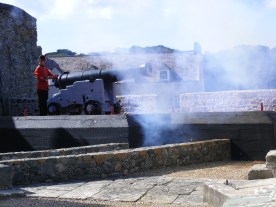 We walked out to Castle Cornet, which guards the harbour. The first Castle was built in the thirteenth century. Initially, it was only accessible on foot at certain very low tides or by boat. Fortunately, there is now a causeway so we don’t have to paddle. Although, in theory, we allowed plenty of time, all the not finding parking places made us wonder if we would arrive before the ‘twelve o’clock gun’, a ceremony when a cannon is fired but we are just in time. A costumed gentleman marches about and does the deed. We are told that today’s twelve o’clock gun was ‘louder than usual’, they are probably not wrong; it was very loud and we are used to musket fire. The historical interpreter invites members of the audience to pose with him for photographs. We aren’t particularly bothered about this ourselves but we do have with us Captain James, who is the travelling toy for members of the Braund family. On the grounds that I am the photographer, I delegate a fisherman of my acquaintance to request that the Napoleonic era soldier poses with a knitted doll. On balance, this may be preferable to some of the over excitable tourists and he agrees.
The gun firing is followed by a living history performance and we have chosen today to come because this is the day for a seventeenth century story. In 1672, ammunition stored in the donjon exploded during a thunderstorm. Seven were killed including the governor, Sir Christopher Hatton’s wife and mother. The island’s governor never lived at the Castle again. The story-teller, from Guernsey History in Action, does a very good job. http://www.ghiac.org/
The Castle is home to several excellent museums and I especially liked the fact that named individuals were mentioned in several contexts. Castle Cornet was the last stronghold to surrender to Parliament during the Civil War and we admire various seventeenth century exhibits. I was interested to learn of Parliamentarian General John Lambert’s imprisonment in the Castle as I had just been reading about him in connection with John Tradescant in Phillippa Gregory’s excellent Virgin Earth. The reconstructed herb garden and plaisance were very well done. The garrison was largely manned by English, rather than local, soldiers. For many years Invalid Regiments (ie those needing light duties) were stationed here. Under German Occupation Castle Cornet was known as Hafenschloss (Harbour Castle).
One museum was dedicated to 201 Squadron but we found the Maritime Museum the most interesting. Here we learn that Guernsey has only been an island for about 9000 years, since after the last Ice Age. It was settled in Neolithic Times and we see a video about the recovery of a Roman ship from the harbour. This was done by the same team who raised the Mary Rose. The boat, nicknamed Asterix, had had a fire on board, which melted the cargo of pitch and helped to preserve the wreck.
Having exhausted the possibilities of Castle Cornet we visit the historic shop that is reconstructed as it would have been c. 1900. It appears that we missed a harbour yesterday so it was home via a quick trip to St Sampson, which is very industrialised.
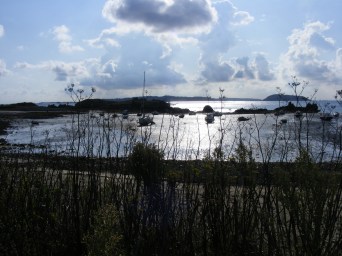 We continue our drive along the north coast, stopping to look at various fishing boats at Grand Harve. Beyond Cobo Bay the coast is comparatively less attractive. On reaching the far north western corner, we start to head south. After a refreshment break at Pleinmont we rethink our plans to circumnavigate the island, as the south coast road is closed. I decide that this is a good opportunity to locate an ancestral church in an inland parish. Not helped by the fact that several roads are closed and the map has road names in English, when on the ground they are in French and vice versa, we eventually arrive at the very well kept twelfth century church at Castel. There are wonderful, commanding views across the island and you can understand why early settlers might have chosen this as a site for a place of worship.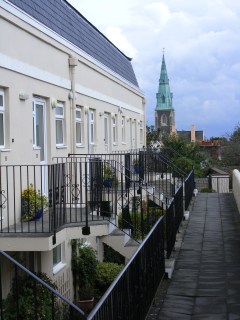
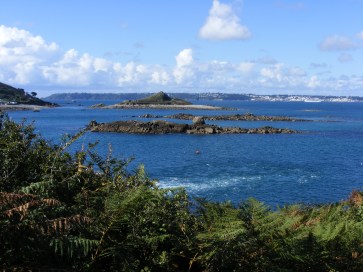 Herm is beautiful and very peaceful. Cars and cycles are forbidden; motorised transport is limited to tractors and quad bikes. We see the remains of some Neolithic burials. There are plenty of butterflies and the sun continues to shine as we reach the white shell beach, which allegedly has fifty different kinds of shells. It is as well I am not visiting with my grandchildren. If they knew that, we would be unable to leave until we had found all fifty. We pause for an ice-cream and the obligatory paddle, in what is pretty jolly chilly water.
 The next installment in my quest to discover why I am not in full health took place yesterday. Just a shame nobody warned me. I am gradually working my way through a long list of hospital departments and the latest referral letter was due no later than today. With a holiday looming, I was concerned that the letter might arrive after I left, with an appointment for before I returned, so, in the absence of a letter, I planned to ring today to see what was going on. It was 1.20pm yesterday, in a break between exciting #Daisy episodes, when, for no particular reason, I decided I would make that call a day early. ‘Yes Madam, your appointment is today. Did you not get the letter?’ Well that would be a no – if I’d got the letter would I be ringing? No wonder they get so many no shows. ‘What time is it? Have I missed it?’ I ask. ‘I’ll have to find out and ring you back.’ At 1.30pm I am told that the appointment is for 2.30pm. ‘Can you get here?’ I do a quick calculation. I am 16 miles from the hospital and I’d rather not drive myself. ‘Are you coming by public transport?’ Probably not – the next bus is tomorrow. She agrees that they will understand if I am late. I ring the fisherman of my acquaintance, now doubling as the chauffeur of my acquaintance, hoping that this isn’t one of those occasions when he has his mobile on divert because he is out of signal and I end up talking to myself. Things continue to go my way as he is home. 1.45pm and he is at my house and we are on our way. We arrive at the hospital with ten minutes to spare. I muse at the irony of those sat smoking under the very large signs explaining that the whole hospital site is a no smoking zone.
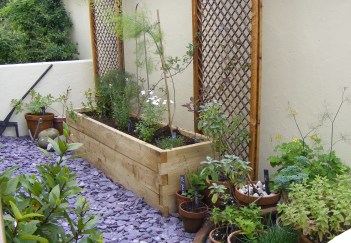
 Then it was the village garden and produce show. I always try to get involved in community events. The cooking classes were clearly a non-starter. I hadn’t had time to create something crafty. As my garden is a wasteland, being as it is mid re-vamp, plant and vegetable classes were challenging. Fortunately I could fall back on my herb garden, which was made-over last year. So second prize for a posy of herbs, or Tuzzy-Muzzy as we say, I’ll take that. I am sure I should be Daisy writing rather than blog writing so that’s it for today. I wonder if I can get another chapter finished amongst two talks to present in two days and the return of the job we must not mention.
 Yes, geese are signing up for Weight-watchers in flocks as I type. I kid you not, the ‘Back to School’ shelves have not yet been cleared and the Christmas cards are on sale. For those of us in the northern hemisphere, with the dark evenings on the horizon, this means our thoughts turn to digging out our virtual or literal family history files and promising ourselves that this year we really will create some order out of the chaos that is the fruits of years/decades of research. Maybe we would like to tempt our dearest and not so nearest to take an interest in our obsession with a yuletide gift of a family history, or we would like to share family stories over turkey and tinsel. Now let’s be honest here, ‘would you like to see my spreadsheet of baptisms?’ just isn’t going to cut it. I can feel the glazed over looks from 100 paces. That fascinating story of great uncle Fred’s bigamy, or auntie Alice’s spell in jail, though, that could just raise a flicker of excitement. Even if your family is devoid of all black sheep, set their lives in the local and social historical context of their time and you could be on to a winner. ‘Did you know great-granddad was the local rat-catcher?’ ‘Granny served tripe twice a week’ or ‘Great great grandma died of cholera, did you know she would have passed 20 litres of diahorrea a day?’ (good one for the gore hungry children that) – so much more engaging than a list of names and dates. If you want some motivation then can I humbly recommend that you take a look at my five week online ‘Are you Sitting Comfortably: writing and telling your family story’ course that starts on 17 October. Details are on the
  #Daisy has been making progress and is currently requiring me to research the poetry of World War I and the Bideford shops of the 1890s. I have just realised that #Daisy is about anorexia, shell shock, death, menopausal women, depression and war – just wondering if that might be a tad dark! Still it is enlivened by depictions of the beautiful Devon landscape.
 The History Interpreter - Janet Few