Social History Book Advent Calendar Day 4

Apologies for the late arrival of today’s contribution to the advent calendar. I have spent the last eighteen hours adding to the list of things I do not have wrong with me. Said list is now assuming the proportions of a three volume novel. Still the good news is that, although what I do have remains a mystery, I don’t appear to have anything sinister. I spent the whole of last night on a trolley in A & E and this afternoon raising the alarm when the woman in the opposite bed tried to pull her cannula out, something that occurred about every five minutes. This means I haven’t slept for 36 hours, so I hope I can be excused if I cheat a little with today’s social history book and use one of my own. I say one of my own; it has my name on the cover but it is really the work of eighty wonderful ladies.

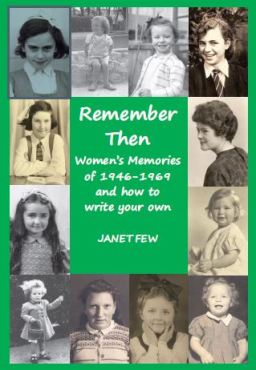
CoverRemember Then: women’s memories of 1946-1969 and how to write your own  is what happens when you let eighty women spend a year and a half recording their memories of life in Britain throughout the pivotal period 1946-1969. This twenty four years was one of tremendous change in almost every area that they investigated. During this time, we moved from liberty bodices to mini skirts and from ration books to ready meals. We witnessed the emergence of youth culture, the comprehensive education system, conspicuous consumerism and a new wave of feminism; the Britain of 1969, was very different to that of 1946.

Very little additional research has been done, the women’s voices have been allowed to speak for themselves. Memories are just that and sometimes memory is fallible. Efforts have been made to check dates and facts but for the most part, the ladies’ accounts have been taken at face value. The aim was not to write a comprehensive social history but to give a flavour of the period from the view-point of those who lived through it. Even reading the first names of the participants takes you back to the classrooms of the 1950s.

The ladies described their homes and neighbourhoods, clothes, housework and food, education and work, health and childrearing, leisure and celebrations, as well as tackling more emotive subjects, such as relationships and attitudes. Over a hundred illustrations and a comprehensive timeline of events evoke the essence of the era. This book is much more than just a collection of women’s memories. At the end of each chapter is the brief that the volunteers were given when working on that topic. This can be applied to other time frames and will help the reader, male or female, to write reminiscences of their own.

The women who took part came from a variety of social, economic and geographic backgrounds. Some ladies went to boarding schools, some to grammar schools and others to secondary moderns. Some left school at fourteen, others have PhDs. Some are only children, others had large extended families and some grew up in care. The ladies were aged from 59 to 95, so some experienced this era as children, some as teenagers and others as married women with families. I wove together the words of this disparate group of volunteers, using direct quotations from their reminiscences wherever possible, to reveal this period, as seen through their eyes. The result is a many faceted perspective of life at the time.

The book allows those born after 1969 to gain an understanding of what life was like for earlier generations. This makes it valuable reading for those working with older people, as it can spark conversations and help to awaken memories. If you lived through this era yourself, you will find yourself exclaiming, ‘I remember that!’ on every page.

Social History Book Advent Calendar Day 3 and Coming up Trumps

As regular readers will know, I am very keen on encouraging the younger generation to take an interest in history and heritage. One of the ideas in my booklet Harnessing the Facebook Generation: ideas for involving young people in family history and heritage* is to use family photographs to make Top Trumps cards. I thought, now that I have grandchildren who are old enough to play this, I would put the idea in to practice. There are available templates online but in the end I made up my own and I found 38 photographs of members of the family tree that could be used. I know I am fortunate to have so many pictures but they are rather one-sided, the vast majority coming from my maternal grandmother’s family. If you don’t have enough pictures you could always use pictures of where they lived or drawings (I did wonder about gravestones but maybe not for 3 & 4 year olds!). I decided not to limit it to direct ancestors, partly because then I wouldn’t have enough but also because I wanted to commemorate 4x great aunts who died childless and would otherwise have no one to remember them.

DSCF4299I did have some problems. The cards, are printed on paper and laminated as my printer won’t take card. This is not ideal and you can see through the backs of the cards but this doesn’t matter because of the way that the game is played. The cards are also a bit of a strange shape and it was incredibly difficult to get them all exactly the same size. It probably took me best part of a day to produce two sets. Yes, I could have gone to a pound shop and bought sets of Top Trumps but that would not be the same on so many levels.

We have yet to try these out with the target audience, as they will see the light of day at Christmas. I know in one case I shall have to somehow make the ancestors relate to robots – I am still working on that bit!

On the topic of Trumps – Twitter came up trumps yesterday. I was busy with the arrest scene in #Daisy aka Barefoot on the Cobbles and wanted to know what wording was used in a caution in 1919. I made a Twitter request and sure enough I woke up to eighteen responses including the answer! Incidentally, Daisy will soon have her own page on this website. As it is a ‘based on fact’ novel, I have a large number of old photographs of the characters and the landscape in which the story is embedded. I will be putting some of these online over the next few months – watch this space – well not exactly this space but the space on the website that doesn’t quite exist yet.

Maids, Wives, Widows: Exploring Early Modern Woman's Lives 1540-1714 by [Read, Dr. Sara]From my bookshelf today I offer you Sara Read’s Maids, Wives, Widows: exploring early modern women’s lives. This is a complete guide to how women lived in the period 1540-1740. It covers their day to day activities both domestic and cultural, employment, both paid and unpaid, childbirth and childrearing and much more. The author has used a wide range of contemporary sources in her research and there is a very useful bibliography. The book is illustrated with black and white plates. Inevitably, any social history of this period is relying on sources that tend towards the better off but nonetheless this is a wonderful book for family historians who want to bring their female ancestors to life, for historical novelists looking for background for powerful female characters or for those who just like to immerse themselves in the past. The Amazon link gives you the option of a quick ‘Look Inside’ preview – go for it. I predict that Alex in New Zealand – who is seeing how far through December she can get without buying one of my suggestions – may succumb at this point. There may well be another offering from Sara Read behind a later advent ‘window.’
(Available from me, from the publishers or as an ebook. It is also available via UK and Canadian outlets.)

Social History Book Advent Calendar Day 2 and a bit about Christmas trees

It seems I should have issued a Government Health Warning, so I will remedy that today. If as a result of ‘opening’ my advent calendar, your book budget plummets and your book shelves bulge – I TAKE NO RESPONSIBILITY. Clear?

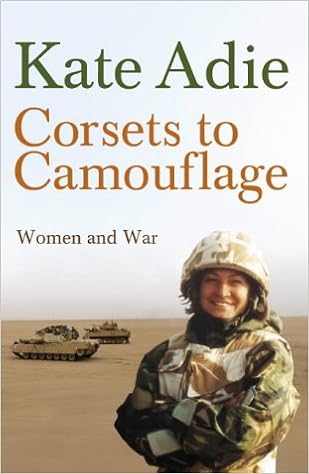
Today’s offering is Kate Adie’s Corsets to Camouflage: women at war. Former war correspondent, Kate Adie, looks at the contribution of British women to the war effort, principally but not exclusively, in the two world wars. She covers not only the armed forces but nurses, land girls and munitionettes. Her own experiences reporting on the gulf war conclude the book. I particularly like the personal touches, when the author reveals snippets of her own family history to illustrate situations or outlooks. The book is illustrated with some not very clear black and white photographs of women involved in conflict at the beginning of each chapter and some much better plates in colour and black and white. This is not just a book about warfare, it is an important contribution to women’s history and an account of changing attitudes to women in traditionally male roles.

So this week I have been decorating the Christmas tree. I know this seems early but my decorations will be abandoned straight after Christmas and I wanted to get my money’s worth. Regular readers will know that my Christmas decorations hold a special significance for me and may also remember the awful incident two years ago when I thought I had lost them. Fortunately no such trauma this time. The tree may be a little smaller than the ideal – it fitted in the room without difficultly but I am please to have it there. I also assembled the History Group’s entry for the village Christmas tree competition. Last year our entry won a prize but this year groups have seriously upped their game and some entries resemble a Harrod’s window display. My excuse for our somewhat low-key effort is that we’ve been spending time on history group activities instead; nonetheless we wanted to be support the event. It is the taking part and all that.


Social History Book Advent Calendar Day 1 and a bit about Medical Procedures

It is December, my descendants have snow, so it must be time for something seasonal. Last year I shared some of my favourite historical novels in my blog ‘advent calendar’; this year it is the turn of non-fiction. Family historians, historical novelists and history fans in general need to immerse themselves in the past; these are books that help you to do just that. For the next twenty four days I will share with you a book that has helped me to evoke a past era. I have just pulled volumes from my bookshelves, so the historical periods will be varied and the choices eclectic. Some of the posts will be very brief and they will be interspersed with other randomness but here goes.

Food In England: A complete guide to the food that makes us who we are by [Hartley, Dorothy]Today’s offering is Dorothy Hartley’s Food in England: a complete guide to the food that makes us who we are. The book was first published in 1954 but unless you are interested in food history in the later twentieth century, this does not matter. The fact that it is still in print underlines the value of Hartley’s work. If you want to know what we used to eat and how it would have been cooked here is a substantial 676 page volume that will come to your aid. There is a chronological thread throughout the book, beginning with the contribution of the Romans, Saxons, Danes and Normans to our diet. There are line drawings to illustrate, amongst other things, cooking methods, breeds of sheep and techniques, such as scalding a pig. In addition there are plates showing kitchens an dining through the ages. There are also chapters on various groups of ingredients, including meat, vegetables, bread, dairy produce and drink. It is no secret that my culinary ‘skills’ are minimal and that I have no interest whatsoever in food preparation in the present. I do however find historic cookery fascinating. So although this is a book that the cooks amongst you will enjoy, it is also valuable if you want to know what your ancestors ate and how they would have prepared it. If you are an historical fiction writer and you want to make sure that the characters in your novel aren’t eating an anachronistic meal or if you are staging an event that involves period food, this book is highly recommended.

In other seasonal news, I thought that I would relate the saga of the flu injection. I am officially too young for this – just thought I’d make that point – but various health weirdnesses mean that I get invited by a disembodied, automated voice to have a needle jabbed in my arm. In fact no one seems to have told said automaton that I have actually now had my injection, as she is still ringing me up at various intervals. I digress. My appointment is for 10.41. I turn up at 10.30 to be told that the staff are about to have their coffee break but I can be booked in. ‘Booking in’ involves a tick being put against my name and being handed a piece of paper listing potential nastinesses associated with said injection. I sit down and the receptionist disappears for her caffine fix. A man comes to sit in her place. I have no idea of his rank but clearly most things are above his pay grade. He spends the next fifteen minutes repeating 30-40 times ‘I can’t book you in please take a seat and wait. The receptionist will be back in 15, 14, 13 (whatever) minutes. What is so difficult about ticking a name and handing over a piece of paper? Is the receptionist’s union going to object if someone usurps her role? It can’t be a data protection thing because everyone is here for a flu injection and they all go to reception and give the chap their name. Why have a person there at all? Why not just write a notice? During the next fifteen minutes forty people enter the surgery and no one leaves. The patients’ nearest and dearest, sat in cars outside, must be wondering if we are all being swallowed up in some vaccinatory black hole. I begin to feel quite sorry for the guy on the front desk. In the end the ‘audience’ are giggling hysterically as he repeats his message, using exactly the same words and intonation, for the umpteenth time. The joys of getting old.

Songs, Books and other Daisy News

Well what a wonderful weekend it has been. Firstly, Friday night when my friend Liz Shakespeare visited Buckland to share her story of Edward Capern The Postman Poet. Edward, who penned some of his work sitting in what is now my kitchen, wrote songs as well as poems and Liz was accompanied by Nick Wyke and Becki Driscoll who played for us in appropriate style. Add to that the excellent food and a great evening was had by all.

Saturday afternoon’s interesting Devon Family History Society meeting saw Philip Browne talking about ‘The Unfortunate Captain Peirce and the Wreck of the Halsewell East Indiaman.’ I am afraid that this well-presented session, with its account of some painstaking research got rather lost in the other excitements of my weekend. Definitely worth checking out the book of the talk.

Daisy and HollyhocksThe first draft of the cover for Barefoot on the Cobbles aka #Daisy has been done. It isn’t quite ready to meet its public yet but I am very pleased with it – thank you Blue Poppy Publishing. It does however, thanks to Clovelly Archive, incorporate this photograph. Having a cover somehow makes it all seem more real.

The equally brilliant news is that Barefoot has a companion song! A few years ago, I was commissioned to work on the history of a local shipping disaster that took place in Clovelly in 1838. This resulted in a meeting with Princess Ann but I digress. My brief was to trace the descendants of the victims. This was harder than it sounds as many were young unmarried men. In the course of the research I got to know Dan Britton, whose family members were amongst the victims. He wrote a haunting song The Storm about the tragedy and this became the title song on an excellent album Safe Harbour, which Dan, together with the other half of his duo, Chris Conway, launched last year. A few weeks ago, Dan got in touch with a family history query and I said I was working on a novel that was partly set in Clovelly. Almost as a throw away line I suggested that this too might make a song. I sent a brief synopsis along the lines of ‘it is about a murder, motherhood, the Devon landscape, a shipwreck, the women’s suffrage movement, WW1, the death of a child, oh, and a few lighter moments.’ I also sent a couple of draft chapters. Almost within minutes came back some incredible lyrics. The uncanny thing was that somehow Dan had included hints of things that I was intending to write but hadn’t actually told him about.

At a concert last night I heard Daisy’s song performed live for the first time. I thought I was going to cry but I managed not to. We are not yet sure where this will lead but Dan says that this might be the start of a new album for Chris & Dan and we have spoken briefly of the possibility of a joint launch next year. I think it is a case of watch this space. I would also like to pay tribute to Liz Shakespeare for being unfailingly supportive and generous, despite the fact that I do seem to have inadvertently pinched her idea for a literary/musical collaboration.

The word ‘launch’ in the preceding paragraph is a sobering reminder that I do actually need to have something to launch! With this in mind, I have sort of half-heartedly been playing along with the NaNoWriMo November novel writing challenge, which is supposed to encourage people to write a 50,000 word novel in a month. I suspect that I could probably write 50,000 words in a month if a) I did nothing else at all and b) I wasn’t too fussed about the quality. The month began well and I did 4000 words in five days but I have now slowed to a more manageable rate and am probably accomplishing an average of 500 half decent words a day of the novel. I am slightly distracted by writing things like blogs. I guess if I counted other writing I would be coming close to the 50,000 words in a month target. I would also probably get on faster if I didn’t spend so much time counting words! It has at least meant that the pretty much finished sections of Daisy are now nearing the half way mark. Remember this week’s Victorian privy research? In the course of this, I discovered that today was world toilet day. Seriously doubting that this is really a thing but Twitter says it is, so it must be so. (PS Yep. It’s a thing. It is to encourage folk to think of those in the world without access to decent sanitation so it not only is a thing but a good thing!)

I am discovering the drawbacks of basing a novel on fact. I have just found out something new about the life of one of my main characters. I could re-write the best part of a chapter, a chapter I am quite pleased with, or I could just ignore it – still debating that one. As I write this, I am being told by one of my beta readers, aka a fisherman of my acquaintance, that I have donkeys carrying luggage down hill, when they would only carry it up. I feel some re-writes coming on.

By the way, on 8th December, I shall be with some other cool authory types in Green Lanes shopping centre, Barnstaple trying to sell some books that I have actually finished writing. Do come and say hello if you are local.

Now to fiddle about Tweeting because I decided that I wanted the Tweeted link to this post to be my 3000th Tweet #OCD.


One-place, One-name and Other Presentations

Over the last few weeks I have been hither and yon, speaking at a variety of venues and having the opportunity to learn at the same time. Firstly, the annual conference for the Society for One-place Studies. This was held in Manchester. I end up in Manchester more often than I’d like. Please don’t take this personally Manchester, you are bigger than a very small market town – too big. The Friday afternoon was to be spent on a guided tour of Manchester’s religious heritage. To begin with we did get a tad lost leaving the car park. Said car park cost more than I had earned that week but hey. The instructions were to ‘meet under the map’ at Manchester Victoria station. Map? What map? We wandered high, we wandered low, scanning the concourse for something that resembled a map. We asked a handy charity promoter who claimed he’d been there all week but had no knowledge of a map. Just as we were wondering if we were even at the right station we spotted the map. Clearly we weren’t wandering high enough. The map is set in tiles by the entrance and is of seriously impressive proportions. In our defence it is considerably above the eye-line but 0/10 for observation skills. Considering that this was Manchester and the last weekend in October, the weather was uncharacteristically kind. It didn’t rain and there was even a hint of sunshine. The tour itself was excellent and it was a pleasure to learn something about the city from an expert. This just highlights how much you miss just wandering around on your own (maps for example).

The next day was the non-conformity themed conference, with several thought-provoking presentations. Owen Roberts from Methodist Heritage did us proud, explaining the various resources they and their family of websites can offer. We heard about the impact of non-conformity on World-war 1 conscription and about Huguenot resources. The round-table discussion was very valuable and a chance to learn about the latest mapping opportunities. I finished off the day with my presentation about the impact of non-conformity on communities and their inhabitants. As a speaker, there are always talks you particularly like giving and others that, when they are requested, make you wish that you had taken them off the list. This non-conformity one is new for this year and when I was first asked to do it I wondered if I could really make something of it. At first I couldn’t. Then I realised that I didn’t need to talk about sources for non-conformist research at all. Light bulb moment! Shove all that boring stuff in a handout the size of War and Peace (abridged version) and talk about what really interests me: people. So this is a talk about how having options for worship makes a difference to people and places. At the moment I am quite liking this one.

gwen-and-dep-c-1933

Gratuitous picture from the early C20th – just because I can!

This was also my last conference as chair of the society. I really needed to step back from a few things to make time to do the other things properly. I felt that it was time to let someone else take the helm. I shall still be very much involved in one-place studies, an area of research that I am committed  to and I wish the new committee well. Next on the one-place agenda is a presentation of my online Discovering Your British Family and Local Community in the early 20th Century course for Pharos tutoring. This starts in January. Put it on your Christmas list why don’t you?

Home from Manchester to some more local presentations, mostly in Mistress Agnes mode. Then it was down to the soft south of the county for a Guild of One-Name Studies’ seminar about west country migration. We were rather cosily crammed into a conveniently located venue but this was another excellent day, with a programme of experts on various aspects of the subject. I always enjoy being part of a conference or seminar as this has the bonus value of being able to learn from others. What was particularly pleasing about this day, was the way in which our presentations dovetailed together, without any prior consultation. My contribution was about motivations for migration from north Devon. This is an old favourite and I have given it many times, although I vary the case studies.

Just four more talks to give before the Christmas break then, after that, it will be the mayhem of 2018 with 30 events booked already. To say nothing of Daisy. There are some very exciting Daisy developments, which I hope to reveal very soon. She also has some more finished chapters, which will probably be as much of a relief to Blue Poppy Publishing as it is to me. This week has seen me describe Victorian privvies, research C19th Methodist Sunday School songs and wallow in the horrors of a WW1 trench. Writing is never dull!

Gunpowder, Guys, Birthdays and Pink Things

I have no problem in remembering remembering the 5th of November as it is my granddaughter’s birthday. This means I have to run the gamut of Christmas cards in order to purchase a birthday card. Choice is obviously limited at this time of year but why, oh why, is everything with granddaughter on it pink? She doesn’t like pink, she likes yellow. Even abandoning the relationship section in favour of the number section doesn’t help, here the choice is pink or blue, still no yellow. Having purchased a less than ideal, slightly pink, slightly blue, emphatically not yellow, card with a 4 on, I head for the checkout. I avoid the self-service section, that way madness lies. Remember, living as I do, several miles from the nearest supermarket, I am rarely let loose in the shops (my personal shopper aka a fisherman of my acquaintance hand delivers my requirements) so it is all a learning curve. It seems I have purchased sufficient items to be given a green plastic token, with which I can vote for a local charity for the supermarket to support. I stared at the plastic frame containing the columns of green tokens indicating where others had cast their votes. I made an informed choice. Do you think I could work out where to post the flipping token? I tried going in from the top. No, not a hint of a slot in which to post the token there. Eventually, after several minutes, I spotted a whole series of slots along the front. Who knew that shopping could be so challenging?

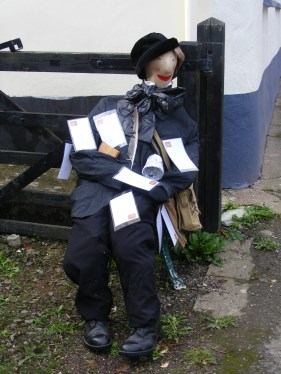
DSCF4227This year, some bright spark (could be a potential pun in there somewhere) decided that the village would have a guy competition, with each organisation creating an appropriate effigy, which was then to be displayed in the run up to bonfire night. After a bit of discussion, the history group chose local postman poet Edward Capern. I was proud that the letters he was holding were addressed to genuine village residents of the 1860s but I am getting ahead of myself. First, imagine the scene. Four ladies of a certain age attempting to stuff a pair of trousers with empty lemonade bottles (whose idea was it to create his limbs from bottles?) with slightly inappropriate results. We were a little early to put our creation in situ, so he sat in my kitchen for a week. No matter how many times I mentally warned myself that he was there, I never failed to jump in surprise when I saw him sitting in the rocking chair. Next was the hilarious attempt to install him in my neighbours’ garden. We accomplished a smooth lift from kitchen chair to garden chair (I’ve watched Casualty I know how these things work). Ok, so getting him out of the house was more of a challenge; his legs only fell off twice in the process. In the interests of the environment he is not being burned (too much plastic) so, now the day is passed, he will be dismantled into his constituent parts. Will all his limbs fit in my recycling box?
A Visit from Author Wendy Percival

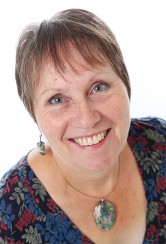
Today I have a visitor to my blog. Please welcome Wendy Percival, author of the Esme Quentin series of genealogical mysteries. Wendy featured in my historical novel advent calendar last December and you may have seen her article in Family Tree Magazine recently. Here is a chance to learn more about her and her work.

What made you decide to write about a genealogical sleuth?

Wendy Percival

I’d just stared researching my family history and I was also writing short stories at the time, but I wanted to start a novel. The idea of buried family secrets being at the heart of a story appealed to me and it made perfect sense that the central character who’d unravel the secret – whatever it was – would be someone with the knowledge to do so. Around that time, a call had gone out in the publishing press for older female protagonists, rather than the twenty-somethings which were dominating the market. So Esme was born.

The North Devon landscape features in your work; how important is the setting to your writing?

I always love reading books when I recognise locations I’ve been. But from a writer’s perspective, it helps, I think, for the setting to fit the story in some way.

The first Esme story, BLOOD-TIED, is set in Shropshire, where I began my family history research and the idea for the story evolved. The fictional town of Shropton was inspired by the historic town of Shrewsbury, with its fabulous old buildings and narrow alleys where many of my ancestors lived. It has a huge impressive park which became the setting for Esme’s sister Elizabeth’s attack. The beautiful Long Mynd, a heath and moorland plateau in the Shropshire hills, also featured and as Esme stands on the top, gazing into the mist and fog which has engulfed the area and obscured the view, it became a metaphor for Esme’s confusion in discovering her sister has a secret past.

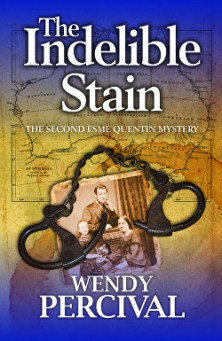
Book Wendy PercivalAs for the other books, the South West Coast is magical and having lived here for so many years now, I wanted to embrace it for its drama and atmosphere, so it was the perfect setting for the second story, THE INDELIBLE STAIN, where a museum ship, telling the story of 19th century Devon convicts “banished from British shores”, is moored in the harbour.

I used the north Devon coast again in the latest book, THE MALICE OF ANGELS, adding in another local landmark, with its true wartime history, while applying a little artistic licence by moving it a bit closer to the coast!

Tell us something about your own genealogical adventures.

The first “adventure” started with the discovery of a death certificate from 1868 in the proverbial “box of old documents in the attic” belonging to my husband’s late parents. At the top it read, “Paddington” but then we realised it was Paddington, New South Wales, not London, England! As nothing was known about any family member going to Australia, in modern times, let alone in the 19th century, it was very exciting. The steep learning curve to unravel the story behind it took several years but I found the process fascinating and I was hooked!

Since then, I’ve uncovered stories of illegitimacy, bigamy, convict transportation, many sad stories and some shocking ones. The latter being my 3x great grandfather who was hauled up in front of magistrates accused of “assault and cruelty” to my 3x great grandmother, in collusion with the housekeeper, with whom he was having an affair, resulting in at least one child.

I love using the process of family history research to learn more about social history of the times, and the thrill of uncovering “secrets” which our ancestors must have assumed would be long forgotten. One of those is the discovery that my maternal Great-grandfather was living a double life – two “wives” and two families – for several years in London in the 1880s, until my great-grandmother found out and he was given his marching orders. He and his “alternative” wife ran off to Australia and went on to have many more children.

It is exciting to hear that the third full length Esme Quentin Novel, The Malice of Angels, is now available. What can you reveal about the plot?

It begins with Esme being approached by Max Rainsford, an old colleague of her late journalist husband, Tim, who died years before in tragic circumstances while investigating a story. Max wants Esme’s help on a cold case murder of an old soldier that he and Tim had worked on when they were rookie reporters. Esme’s not keen to rake up the past so declines.

But circumstances force her to get involved when, while researching into the mystery of a friend’s aunt Vivienne, a nurse who disappeared during WWII, she stumbles upon a disturbing connection between Vivienne’s past and Max’s murder case, and its implication of a link to Tim’s death.

Esme has to decide which direction she wants to go – back away from her distressing past to avoid the hurt it will cause her? Or face her demons to discover the truth?

If you could go backing time, what period would you choose and why?

There are lots of periods of history which fascinate me – around the civil war, Tudor times (I loved C J Sansom’s Shardlake novels), early 1800s, 1920s – but with so much of my family history research taken from the Victorian period and feeling that I “know” those ancestors best, I’d love to go and “walk with them” in their time and develop that familiarisation.

Apart from writing and family history, what fills your time?

Reading, obviously! Gardening, catching up with friends, walking, especially the coast path and exploring the fantastic locations here in the South West in our campervan. Occasionally I have a sudden urge to be “creative”, usually with textiles or making jewellery with Fimo (a cross between plasticine and clay) and/or beads. And I’ve recently started to learn to play the ukulele!

Will we be hearing more about Esme in the future?

I’m sure I won’t be able to keep Esme down for long. She’s bound to stumble upon some buried secrets sooner or later – you know what she’s like! In fact, I’ve an idea brewing already…

Travels with a 3½ year old Day 5 Donkeys, Garlic and what came after

I am having to play a serious game of catch up with my blog posting. We return to the adventures with a 3½ year old to report on a trip to a donkey sanctuary, which was full of, needless to say, donkeys. I was clearly expected to know the names of every donkey present. This was followed by negotiating a ridiculous diversion in order to purchase many varieties of garlic at a garlic farm. You’d be amazed at what can be combined with garlic, with varying degrees of success: ice cream, chocolate and beer to name but three.

Day 6 found us minus the 3½ year old, who had departed for home. We fought the remnants of tropical storm Brian in the most exposed spot on the island. This sadly saw the demise of my Niagara Falls red plastic poncho, as it was whipped to shreds by the gale. I suppose I had done well to preserve it for two years.

Morian HelmetI finally reacquainted myself with my house for a couple of days. During which time I viewed some very interesting local history documents, chatted to my Writing and Telling your Family History students for the first time and gave a talk to a group of local metal detectorists (as opposed to a group of metal detectors – which is what I wrote originally – that would just be weird). We were billed to give our normal seventeenth century social history talk but decided to change the focus to concentrate on metal objects. This turned out to have more scope than you would think. We spoke of armour, of weaponry, of instruments surgical and of torture (fine line between the two anyway). We had cutlery, cooking pots, plates and mugs to allow us the opportunity to talk of the food of the time. All in all an interesting slant on what we do.

There was also the incident with the village guy (as in Fawkes) competition but I think I will save that until I have recovered from visiting a not yet 2 and a very nearly 4 year old and it is the appropriate day.

Reflections on being a (Rockstar) Genealogist – a Family Historian having Fun

Rock Star Genealogist Gold 2017.‘Is being a Rockstar like winning the Piston Cup Granny?’ asks the non-resident 3½ year old. Those who are unfamiliar with the Piston Cup have either not spent five seconds in Edward’s company, or the modern world of Disney has passed you by. I tell Edward that it is probably just as exciting, although I don’t see myself as Lightning McQueen.

I am taking a day off from finishing the Travels with a 3½ year old because I would like to pay tribute to all my wonderful fellow Genealogical Rockstar medalists. Congratulations to everyone who was awarded or nominated, you are all stars and I am proud to call many of you my friends. To say that I was incredulous, dumbfounded, astonished, all those things, when I heard that I had been awarded the UK gold medal for a second time, especially in such illustrious company, would be an understatement. It was several hours before I stopped expecting a message to say it had all been a mistake, in a similar vein to the Oscars.

There are of course more important things in life and work but inevitably you think, ‘Wow’ or even ‘Double wow’. Of course I am thrilled, honoured, grateful to have won. I am, after all, if I am honest, just the teensiest bit competitive. I am however seriously rubbish at self-promotion. I am indebted to those who voted for me and spread the word. Thank you. To think that people feel that I have made a significant contribution to the genealogical world gives me a warm fuzzy feeling and makes me very humble. Thanks to John Reid who undertakes the thankless task of organising the annual vote. See my post of 16 October for my comments on the process.

What I find more encouraging than the award itself are the private messages that people have sent, explaining why I attracted one of their votes. It has led me to reflect on my life as a family historian (still a more accurate term for what I do than ‘genealogist’ I feel).

It is 54 years since I drew up my first family tree.
I am now in my 5th decade of serious research.
43 years ago my school 6th form ‘liberal studies’ (you wouldn’t call it that now) led me to conduct my first local history project.
I have, so far, spent over 40 enjoyable years learning about history, heritage and related subjects, including, because I am officially bonkers, deciding that a PhD would be a good idea.
I have completed 35 years researching on behalf of others, often voluntarily but sometimes in exchange for money, yet I still can’t stop myself getting carried away and putting in far more hours than the client has actually paid for. I get every bit as involved in other people’s families as I do my own.
I have clocked up 35 years of inspiring my children (and now grandchildren) to take an interest in the past. This has extended to encouraging other young people to value their heritage.
I have spent 31 years serving on family and local history society committees at a village, regional and national level.
… and 31 years of teaching others about family, local and social historical topics. Tonight sees the first ‘chat’ with the latest cohort on my Pharos Writing and Telling your Family History course, so my role as an educator goes on.
Countless years of writing articles, books and random blog posts.
I’ve been on TV and radio several times.
It is 10 years this week since I was first Mistress Agnes.
Having administered a DNA project for 10 years, this year I finally took my own first DNA test, firmly entering the exciting world of genetic genealogy.

What will the future bring? Having only a few years left to retirement age (unless the government moves the goal posts yet again), I am beginning to be more selective about where I expend what is left of my energy. I can’t imagine ever ‘retiring’. Next year promises to be particularly exciting, with overseas speaking engagements and a novel publication date to look forward to, to say nothing of a whole new role in the job I must not mention.

Does this make me a rockstar? Not in the slightest and I certainly don’t do it for fame or fortune. It is what I love. My random historical life is still evolving and continues to be challenging, absorbing, all consuming. I often say that I either work 100 hours a week or just spend all my time enjoying myself. That others feel that they have benefited along the way, is gratifying. I am not a rockstar. I am merely one of many who are trying to encourage people to take an interest in their heritage. I am just an historian having fun and hopefully sharing my enthusiasm on the way.