A helpful receptionist connects my laptop to the internet. The electricity supply to our room is dependent on our key being inserted into a slot by the door. This means I can only charge my computer when we are in the room, which is a bit inconvenient. Most of our party are on a flight to view the Nazca lines but we have decided to obey the British government’s travel advice and give it a miss. Later, our fellow travellers suggest that we haven’t missed much and we are £100 each to the good. We sit by the pool. The water is a tad chilly but I briefly swim about a bit. I lounge back on the white plastic lounger, sat delicately on my new purple towel. It turns out that I have inadvertently turned the lounger purple. I saunter away nonchalantly, hoping no one will notice. The wooden railings outside our rooms are being coated with a powerful smelling varnish, which is a little off-putting.
Taking our lives in our hands, we wander round the town, chaperoned by Brian and Pam. We take a look at the square, it is just that. In the market, meat and fish products are on sale on marble slabs but the ambient temperature is about 75 degrees. Yellow, corn fed, chickens and mullet are on sale, if you can spot them under the pile of flies. Talk about salmonella on a plate. We return to our room to find that the ‘helpful’ cleaners have thrown away our empty plastic bottles that we were saving to decant water into. Bother.
Our afternoon trip is to the ancient pre-Inca desert cemetery site of Chauchilla. On the way we pass many roadside stalls and travel on the Inter-Oceanic Highway. Our guide for the afternoon, tells us that eighty percent of Nazca was destroyed by an earthquake in 1996. We see the replacement adobe dwelling, constructed from mud bricks. This is the second driest place in the world after Chile’s Atacama Desert. On average, they get half an hour’s rain every two years. Prickly pears are grown, partly for their fruit but predominantly because they are used as hosts of cochineal beetles, which are collected for dyes in cosmetics and textiles. Chauchilla means white hill and the sand dune is allegedly the biggest in the world.
 Along the track to the cemetery, we are excited to see burrowing owls. They do look jolly like rocks but can just about be spotted when they move. There was also another well camouflaged nesting bird and swallows swooping above the cemetery. We are here to see 1500 year old mummies. On a windy plain we see the twelve tombs that remain. It is estimated that there were originally 400-500 burials on this 1km x 250m site but the tombs were destroyed about 70 years ago by robbers looking for grave goods. This is fascinating but I must say it was a bit like death by mummy. It isn’t exactly seen one seen them all but…. The people were buried in a foetal position, mostly facing east and wearing many ponchos. These are made from the traditional Peruvian brown cotton. The corpse was then put in a woven basket and buried with items needed for the afterlife, including shells that were used as currency. The skin was rubbed with resin to preserve it and herbs were put in the basket to repel moth. Fragments of bone are strewn about the site. Our guide draws various styles of tomb in the sand for our edification. Each tomb has a shelter erected over it. Termites are making short-work of the uprights to these shelters.
Next stop is artisan’s pottery workshop. The original owner spent twenty five years experimenting in order to replicate the traditional Nazca pottery. The third generation are now demonstrating the techniques. The items have three purposes, some were used as part of religious ceremonies, there is domestic ware and items that are purely decorative. There are also impressive pottery instruments including very loud trumpets, pipes and ocarinas. Original 2000 year old pots are passed round. Fortunately we don’t drop any. Llama bones are used as tools to shape the clay. Minerals create the colours, including kaolin, manganese, iodine and copper oxide. These are painted on using brushes made from hair taken from a baby’s first haircut. There is a single firing. The coloured pots are not glazed but get their shine by rubbing a polished quartz stone across the oils on the forehead and then rubbing the pot.
On our way back to town the possible purpose of the Nazca lines are discussed. There are three main theories. One is that it is a form of calendar, as at the solstices and equinoxes the patterns are aligned with the sun. Others believe that they were created by aliens and another theory is that they had a religious significance, probably connected to sacrifices. Some of the creatures depicted are not native to this area, suggesting that the peoples travelled.
We drive a couple of miles up a rutted track to an isolated hotel in the middle of nowhere. Here we have a dinner that has been cooked using the thousand year old pachamanca tradition. The food has been cooked in a pit using the warmth from pre-heated stones. It is accompanied by a ceremony to thank the earth mother for providing the food. Chris and I volunteer to scatter the coca leaves and wine as a thanks offering. It is an early start and a long day tomorrow so we do not stay out late.
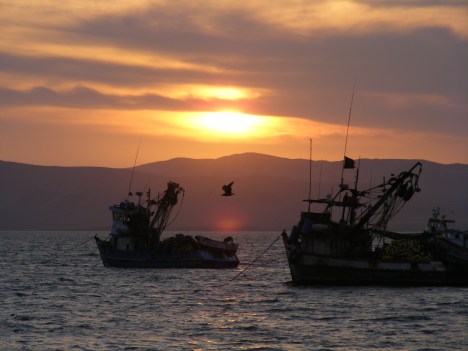 For our evening meal, I settle for a not very adventurous vegetarian pizza. Chris has sea bass in chilli and lime sauce. It really is too hot to eat much. We pay a sol (about 25p) to watch the sunset. We debate what happens if we do not pay – does the sun not set? It sets very quickly just after 6pm and the bay is beautifully peaceful. We have an early start in the morning so we settle down early. It is quite noisy outside and we can hear street musicians but this quietens down but about 10.30pm. We are keeping a tally of how many times we have to fish toilet paper out of the toilet.
 We manage to negotiate our way across Sao Paulo airport and their internet connection is slightly more amenable to my system, l though I am warned about ‘suspicious activity’ on my account, which is basically me trying to access my own emails. There is just time for me to learn that I am now a great aunt by marriage, which is very exciting but makes me feel even more antiquated than ever. We are called for our five hour flight north to Lima. We are given another breakfast. This is probably just as well as the previous plane had run out of our breakfast option of choice. It is now 9.00am Lima time but it seems it is time for us to go to bed again as all the lights are switched off once more. Is this some ploy to ensure that passengers are comatose and not causing trouble I wonder? I resort to playing umpteen games of Bejewelled on the in flight system, which is a bit tricky as there’s nothing to rest my arm on. I hope the person in front isn’t troubled by my continual jabbing at her headrest as I make my moves. I’d quite like to look at the land we are flying over. The woman in front has rebelliously opened her blind for a few moments. The world hasn’t ended, so I briefly do the same and glimpse masses of desert, with snow covered mountains in the distance. I am not by nature a rule breaker, so I close the blind and get back to Bejewelled.
 The upside of the conditions is that there is very little traffic on the road. The downside is that those who are stupid enough to venture out are reckless types who zoom along in excess of 70mph. After this the prospect of ‘feeling like I am having a heart attack’ as I tackle Peruvian altitude seems positively calming.
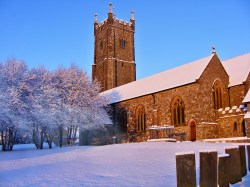 What about the snow? I hear you cry – not a flake. Although I did venture out to break the inch thick ice on what I laughingly call the pond and there was settled snow just five miles away. Not that I am really in the market for snowperson building or hurtling down slopes on a sledge but with everyone avidly sharing seasonal snaps on social media, I feel quite deprived. I shall have to settle for one from a previous year.
 Barefoot on the Cobbles
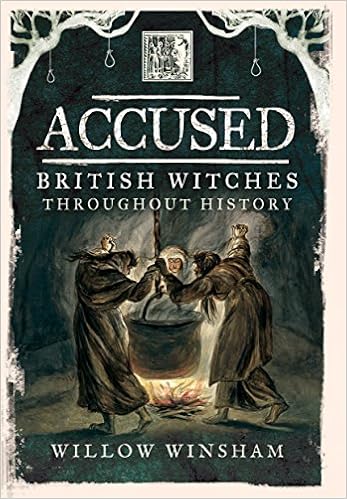 I’ll be honest, today’s offering has just arrived on my book shelf, so I have only had time to skim through it but it looks like a gem.
 ![How to be a Tudor: A Dawn-to-Dusk Guide to Everyday Life by [Goodman, Ruth]](https://images-eu.ssl-images-amazon.com/images/I/61blmkkyi%2BL.jpg) Behind today’s advent ‘window’ is a true social history by Ruth Goodman, of Victorian/Edwardian/Wartime etc. Farm fame. In
Behind today’s advent ‘window’ is a true social history by Ruth Goodman, of Victorian/Edwardian/Wartime etc. Farm fame. In 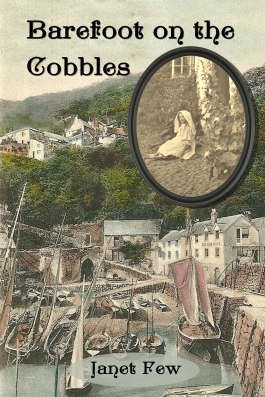 Yesterday I managed to complete a very harrowing chapter of
  The History Interpreter - Janet Few