Day 3 New Zealand at Last

We only have forty five minutes between our second and third flights so fortunately we land in good time. The Qantas lady whisks us through security without issues and we belt along the concourse, leaping on and off travellators, from one end of the airport to the other and breathlessly present our boarding passes only to be told. ‘We haven’t started boarding yet.’

When we are settled on board another half empty aircraft, we are presented with our third breakfast in succession. As aeroplane food goes, Qantas’ is not bad at all. The cabin crew on this flight, Belinda and Nathan, keep up a running banter and lighten our day (or possibly night – I have lost track but the lights stay on, so day presumably). Three hours later and we are in Christchurch. We run the gauntlet of immigration and security without being arrested, fined, deported or filmed for an episode of Border Force. No one questions why one of us has axes, saws and knives (albeit blunt ones) in our luggage. To top it all, our cases miraculously appear promptly on the conveyor belt. I did ask for clarification of a couple of questions on the immigration card and decided it would be prudent to declare my walking boots. I am sent behind some screens to present them. I fiddle around hunting for the key to one of my two bags. Inevitably, the boots are in the other bag. I should say that I have never before travelled with two items of hold luggage but half my belongings are seventeenth century outfits. As I scrabble for the second key, the customs’ officer decides it is all too much hassle and she doesn’t need to see my boots after all!

Next, to summon our courtesy car to take us to the camper van depot. This proves more troublesome, as no one answers the phone. We leave a voicemail and hope for the best. As instructed by the website, we assemble by Door 2. We accost every likely-looking shuttle mini-bus without success. After about twenty minutes I return to the lounge to phone again. I should say at this point that we have discovered, perhaps not unexpectedly, that Chris’ mobile does not work here. This time, I get through to a real person. I am not convinced they have a brain cell but they are at least not a machine. It seems that Chris’ rendition of his surname was not recognisable as any of those on their booking list. To add to the confusion, another party with a similar sounding name have arrived at the same time. I think they thought they were collecting them twice. The other party’s luggage mountain makes ours look insignificant. They have travelled from Hawaii for the surfing and have brought several gigantic surf boards with them. We join in the general fun, trying to wriggle these in through the side door of the mini-bus. It is a close run thing but they are in – it just means that all the passengers have to scramble over surf boards to get to their seats.

It takes an interminably long time to complete the paperwork for the van and Chris, who is chief in charge of all things van, is given what is known as a ‘walk through’. This familiarisation process seems to omit vital details, as we were to discover to our cost. We decide that we will save ourselves £100 and not hire a sat-nav. I am going to claim £100 for my map reading skills if we don‘t get lost. This could go badly. The first instruction on leaving the camper van depot was to turn right. I won’t comment on how we somehow ended up turning left. Let’s blame the jet-lag. We head west from Christchurch on the 73 and 77, along what is known as the ‘Inland Scenic Route’. It is winter here and overcast, so it is already beginning to get dark. This is when we discover the first thing that we don’t know about the camper van – how to turn the lights on. After much twisting, pulling and pushing of levers and even stopping in a lay-by to devote all our combined energies to the task, we have a very clean windscreen but have only discovered how to turn on the side lights. We do not linger, hoping to beat the dusk and fortunately there is very little traffic about. A thick mist descends. We have no hope of locating the fog lights. Fortunately, just in time, Chris discovers a well-hidden switch and we have headlights. We drive through several ‘blink and you’ll miss it’ places, including the prosaically named Windwhistle. The scenery is lush and green and the trees are beginning to turn. We pass a venison farm and the impressive Rakaia Gorge. Signs warn that roadworks are currently closing this road for twenty minutes out of every thirty. Either we have hit the favourable ten minutes, or the men have given up for the day. We see New Zealand falcons and large black and white Australian magpies, which I remember from our last visit.

001 15 May 2018 Rakaia Gorge

Rakaia Gorge

We find Methven camping ground without too much getting lost, then head off for a cunningly disguised supermarket. With the exception of meat, the food prices are significantly higher than ours, perhaps half as much again. Instant coffee doesn’t really seem to be a thing here and certainly not decaff. I will therefore be caffinated for the duration; you have been warned. As we try to connect the van to the electricity supply, we discover knowledge deficiency number two. Where is the magic master switch to allow us to see what we are doing? By this time it is dark, so Chris is trying to see minute labels on switches in a cupboard by the light of my Kindle and without the aid of his reading glasses. We do eventually get light and power but no hot water. We also can’t work out how to get the gas to turn on for the cooker, although that probably (hopefully) just needs daylight. The van comes complete with a three volume novel about how to drive it, ‘Drive on the left’ etc. etc. but absolutely zilch about the necessary information required to actually live in it. We rise to the challenge of making the microwave work and will leave the hob for tomorrow. By the time we call it a day I have been awake for about twenty four hours. Goodness knows how this will impact on the jet lag.


Day 1 To the Airport

jo-rutherford-photography_-3

Random irrelevant picture just because I can – picture credit Jo Rutherford

Reassuringly, this time, the holiday account actually does begin on day 1 as this is all our own doing and we don’t have to fit in with the itinerary of an organised tour. Having been too mean, or indeed too sensible, to pay £25 per person per flight (of which there are three each way) to reserve seats in advance, I had planned to check in at 9.15pm, when I had been advised I could choose seats free of charge. We really didn’t want to spend a total of twenty four flying hours sat in different parts of the plane. So what was I doing at the witching hour? I was distracted by the compelling weirdness that is the Eurovision Song Contest. So mesmerised was I by the warbling and chicken impressions of the eventual winner that it was 6.15am before I remembered. I hastened to the computer to see if there were any adjacent seats left and successfully secured us positions that did not mean our escape was blocked by an unsuspecting and knowing our luck, immovable, fellow passenger. This did involve telephoning my travelling companion at what he clearly thought was an unearthly hour to ascertain his passport number. To be fair, he would normally not be troubled by a call at this time of the day but he is recovering from some lurgy at present. I am keeping everything crossed that I am not incubating a similar ailment but hopefully the moment of infectiousness has passed.


Continue reading

Days 6-10 Loose in Lima aka the Great Escape

I must apologise, dear readers, for leaving you stranded in Arequipa. I finally feel able to put fingers to keyboard to relate what happened next. By Friday morning it was clear that my body could not cope at 2000 metres above sea level. All the remainder of our trip was to be at this level or considerably higher, so the common sense thing to do was to go home. We bade a fond farewell to our fellow travellers and got a taxi to Arequipa airport. It was all a bit manyana but eventually we took off, heading back to Lima. I start to feel a bit better, which was a relief. This was the easy part. We reclaimed our baggage and my case appeared wrapped in a polythene bag. The zip had come apart a little but it seems nothing was lost. We spent half an hour queuing and another half an hour at Lima airport’s Latam desk, trying to rearrange our flights home. There were no spaces before Monday. We needed to find somewhere to stay until then. Our guide had given us the name of a suitable hotel in case of this eventuality but neither of us could remember it. My internet security refused to let me access the airport wifi so I could look for something. A random taxi driver offered to take us to a hotel. It transpired he was one of the unofficial drivers we had been warned about, although not as unofficial as one we encountered later. He did at least have an ID badge and a certificate of something or other in his car. His choice of hotel would not have been ours but we were exhausted by this time and couldn’t think how else to find a hotel with vacancies. He also charged us significantly over the odds for the journey.

The one advantage of the hotel was that was cheap; our stock of sols was running low. We did have a travel card with US $ on but access to funds relied on us finding a reliable ATM, unlikely in this decidedly dodgy part of the city. Yuri’s comment that 9% of Lima’s population are criminals was ringing in our ears. Have we been sold into white slavery? Are we staying in a crack den? We have three days to spend skulking here. There is an on site ‘restaurant’. We do eat there on the first evening. Once was probably enough. No one spoke English and the menu seemed to be chicken, chicken or chicken. We had chicken. We feel it was probably purchased from a market similar to the one in Nazca. The hotel seems to be used by Peruvians on their way to and from the airport. They arrive and depart at all hours of the day and night, loudly. Some are unpleasantly unwell during their stay; those are the ones in the neighbouring room. Soundproofing is not a strong point.

DSCF0219[1]

From the Window of the Dodgy Hotel

We are by a main road and the hooting from the cars is constant. It is 32 degrees outside. We could at least open the window and the air conditioning was noisy but efficient. The hot water was slightly more reliable than in some of the more up-market hotels we had stayed in. We knew we needed water and food. We weighed up the twin hazards of braving the back streets and abandoning our belongings in our room. We hastily sneaked round the block and found a small food store. We were looking for things that were recognisable and not likely to give us food poisoning. We purchased a stash of water, Ritz crackers, cereal bars and wrapped cake. There was no fruit in sight. We lived on these for three days of our incarceration. Sufficient to say I probably don’t want any more Ritz crackers any time soon. Night three in this ‘delightful’ hotel and there was a distinct smell of burning. We were on the fifth floor. The chances of there being any kind of fire escape were somewhat less than nil. The hotel did not seem to be on fire.


I played endless games of patience, did a bit of proof reading and sorted out my holiday photos. There was intermittent internet access but the single plug socket was too far from the bed, which was the only place to sit. The plug socket also sparked alarmingly when it was used. There was a seriously unpleasant smell at night. Our room was not cleaned during our stay, remember what we are doing with our toilet paper in a windowless, fanless ensuite. To be fair, the smell probably wasn’t coming from our room. I am glad that the miasmic theory of disease has been discredited. We dream of Hotel Antigua Miraflores and realise how dependant we have been on our wonderful tour guide Yuri for keeping us safe.

I tried to check in for our rearranged flights online. It seemed that there was a problem. We have been recorded as US citizens. This despite my handing over our clearly UK passports. We hoped that this wouldn’t lead to yet more days stranded in Lima. Finally, Monday arrived. I must say that, for all its faults, this establishment did seem to have a more reliable hot water system than some we have stayed in and the towels were slightly larger. ‘Larger’ is a relative term. All the towels we have been provided with in the hotels here barely reach round me and I am hardly huge. In our haste to escape I forgot to apply deodorant. Not the best idea when I had 48 hours in these clothes and the first twelve were in a hot country. We mimed ‘taxi to airport’ at the front desk. This resulted in some passing chap off the street loading our cases in his car. Fortunately the zip on my case seemed to be fixed. We arrived at the airport in one piece and began the ten hour wait for our flight. We decided the airport was preferable to yet more time in the dodgy hotel and we also had the check in problem to sort out. Thankfully the mistaken nationality was not an insuperable problem and we watched the world go by, playing yet more games of patience. Our day was enlivened by the appearance of the bomb squad and explosives dogs. We were herded to one side of the airport and a fuse was laid in case the suspect package needed to be blown up. The dog gave it the all clear and we managed to retain our hard one seats, which are in short supply.

7pm and with great relief, we watched the lights of Lima recede into the distance. One skill I have acquired on this trip is the ability to get at least a little sleep on a long haul flight. This time our enforced sleep began at 10pm Lima time. Seven hours later we were allowed to wake up. A lady a couple of rows in front of us had problems with her Latam breakfast. She hadn’t worked out that she had been given a packet containing what passes for cutlery. She was using her fingers. That worked well for her toasted sandwich thingy but yoghurt – more tricky. Ah, she solved it by using the little stirry stick thing that she had been given for her coffee. Numerous games of Bejewelled later and we were at Madrid airport. The pilot said it was 45 degrees outside but it certainly wasn’t.

Then the joys of automated passport control. I have to take my glasses off to be recognised by the machine. This means that I then can’t read the instructions but we passed through unscathed. It was then time to get on the coach from Heathrow. I had rebooked this using the erratic hotel internet. I had no way of printing the ticket so I precariously waved my laptop under the nose of the driver. He peered at the teeny tiny print and informed me that in my stress I have booked us on a coach that goes …… tomorrow. I looked pathetic, I begged. He has room, he took pity on us, we were on our way. 1am and we were at home at last, five days after we left Arequipa. I slept until 9.45am! 9.45am! This is unheard of, I also slept through the night without waking, something I have only ever done a handful of times in my life. I did still have falling bejewelled jewels before my eyes but it was good to be home.

Intellectually and as a spurious geography teacher, I knew what I thought Peru would be like but you really do need to see it to comprehend just how different it is. Our tour was designed to give us an impression of the real Peru and was endorsed by National Geographic, as it supported local communities and industries and it was interesting and informative. Now I am home I am truly thankful for many things: a clean water supply, living somewhere where air con is not necessary, being able to understand what I am hearing/reading, rain, being able to cross the road in relative safety, the fact that I no longer need to continually apply hand sanitizer, silence! Do I wish I’d stayed at home? No. Would I go somewhere ‘adventurous’ again? Probably also no but it has been an experience. Next stop New Zealand!

Day 5 To Arequipa or toilets we have known

Today is the long drive south-east to the mountains of Arequipa. We set off at 6.30am. On leaving Nazca we see an Incan fort, marking their occupation as far as Nazca, where they benefitted from the Nazca people’s hydrological engineering expertise.

We learn that, in 1575, Spanish was made the first official language, with only Quechua, of the native languages, being allowed. It is still spoken. We see a windfarm. This and Hydro-electric power from the Andes make electricity very cheap. A home for four people pay the equivalent of about £10 a month. There are three main train lines in Peru, constructed in the early twentieth century. As they lacked suitable wood for railway timbers fast-growing eucalyptus trees were introduced for the purpose.

Most people have begun to take their altitude sickness medication, which is a diuretic, making frequent stops necessary during our twelve hour journey. The first is by a street olive stall, free samples are offered. Some of the olives have been stuffed with chilli. Brian discovers this the hard way. The olive trees were introduced by the Spanish and some of the trees are 400 years old. We purchase some honey coca sweets, allegedly helpful with altitude. Coca is the plant from which cocaine is derived. We are encouraged to chew the leaves but somehow sweets seem more innocuous. Our first toilet experience leaves some of us confused as the toilet paper is situated outside the cubicles. It helps to be aware of this before entering the cubicle. Not everyone was.

Most of the traffic on this stretch of the Pan-American highway is heavy commercial vehicles. There are a fair few hairpin bends and sheer cliffs but thankfully not quite as bad as the extreme roads television programme. We are assured that this is the ‘straight bit’. There are political slogans painted on the cliff sides. Toilet stop two incorporates ice cream eating. Ice cream, like ice and salads is something else you have to take care consuming here. We are opting for wrapped, branded ice cream and are surviving so far. So, this stop’s toilet – well there is certainly a toilet bowl. It and the accompanying basin do not however appear to be connected to any kind of water supply. Outside is a hose and bucket. Periodically, someone fills the bucket and flings water down the toilet bowl!

DSCF0207[1]We encounter toll gates along the Pan-American highway. We are pulled over by the police and our driver has to rattle off the nationalities of all on board. That seems to satisfy the officer and we are waved on our way. There is definitely more vegetation now and even rice fields, irrigated by the Cotahuasi river.

We stop for a lovely lunch, which is our reward for enduring such a long journey. It includes fritters, plantar (a type of banana, which tastes a bit like parsnip) and delicious cake. There are fully functioning toilets here. As we leave the coast, there is more vegetation and we see our first cows and sheep. Volcanic ashlar has been used for construction here. Arequipa is known as the white city, partly from the use of white ashlar and also because there were many light skinned people, due to intermarriage with the European settlers. It was founded in 1540 by Garci Manuel de Carbajal and is now Peru’s second city, having been the capital for part of the nineteenth century. At our final toilet stop we pay 1sol to be issued with our toilet paper; randomly, some of the cubicle doors don’t fit their respective door frames. We cross a bridge designed by Eiffel, of tower fame. We are now officially ‘at altitude’, as Arequipa is 2335 metres above sea level, although we will be going much higher. My chest is beginning to hurt. We reach the hotel, our second in the Casa Andina chain. I scoff a double dose of altitude tablets and drink quarts of the complimentary and seriously revolting coca tea. I had been warned that I might feel as if I was having a heart attack. In the hopes that I am not actually having a heart attack I settle down for the night. I am not scheduling this post ahead of time so, if it appears, I survived!

Day 3 Ballestas and Beyond

We arrive too early for the official start of breakfast at 6.30am but are able to eat none the less. Removing the butter from its packets is a challenge. Today’s cooked offering is fried fish and pancakes. The yoghurt here is sweeter and the coffee undrinkably strong, even considerably watered down. We sneak some fruit for later and return to our room to find that there is no water. Unlike some of our hapless travelling companions, we showered early enough to be clean, so are not greatly inconvenienced.

DSCF0077Our tour has a special ‘beat the rush’ boat trip to the Ballestas Islands, hence the early start. The islands are known as the poor man’s Galapagos and we are hoping for wildlife. We set off in the Carol 1, which is a speed boat but the shelter of the Paracas peninsula makes for a smooth trip. We spot a colony of pelicans, followed by Turkey Vultures, the only birds on the islands that do not eat fish. There are also Chilean Grey Gulls and Elegant Terns from further north. We stop to photograph the 170 metre high Candelabra geoglyph, carved in the hillside. It may be attributable to the Nazca civilization but others believe the style suggests it is post-Hispanic i.e. after 1532. We see some of the 20,000 seals that inhabit the islands, their pups were born a couple of months ago. Humbolt Penguins waddle along the cliffs and there are Inca Terns, with their distinctive red legs and beaks. Ballestas means ‘arrow slit’ and there are many crevasses and arches in the rocks. We also see large colonies of Boobies. There were those amongst our parties who had different expectations when these were mentioned. A rare Red-footed Cormorant is also spotted.

The islands are famous for their guano, which is still a valuable product. Years ago, many Japanese and Chinese came to harvest the guano. It is still collected every six years and the stench is impressive, as are the deep cries of the sealions. The islands are now a national nature reserve, with four resident wardens. This was a highlight of our trip and the many boats heading for the islands as we leave, underlines the wisdom of our early start.

We hear of more immigrant groups who have come to Peru, including Africans who arrived as slaves and who have influenced the music of this region. 16 July is a festival, when the Afro-Peruvian community eat cats. We learn about a traditional offal based dish that the native Peruvians devised in the times when all the better cuts of meat were consumed by the Spaniards. Pecan nuts, mangos and avocados are grown here.

We are heading towards Nazca. The Nazcan people worshipped the algarrobo, or carob, tree, whose 20 metre roots allowed it to grow where there was insufficient water for much else. We continue along the Pan-American highway, which is strewn with litter. We enter the wine making region, where there is a better water supply. An Augustinian order set up a communion wine producing business here.

We arrive for a tour of the El Catador vineyard, where wine and pisco is produced in artisan fashion, by stamping on the grapes with bare feet. The 160 year old wine press is striking. The traditional amphorae are carrot shaped, as they used to be ‘planted’ in the ground. They are about three feet high and weigh 100kg when full. These are now prized as the potters no longer make them. The wine ferments in them for a week and then the amphorae are sealed with clay or, traditionally, banana leaves, for a further week. Pisco is up to 48% proof but we test five varieties that are around 17%. The pisco sour was invented in the mid-nineteenth century in Hotel Bolivar, Lima, when the bartender ran out of whiskey sour.

DSCF0146After a tasty ice cream our journey continues. We pass a cart loaded with seaweed. Three different types are used for fertilizer, food and cosmetics. The next stop is Huacachina, an oasis in the middle of the Ica district desert. We are here for an ‘optional/compulsory’ ride in a sand buggy. These take eight passengers and career hectically up and down the dunes in an alarming fashion. Nothing ventured, I rashly agree to try these. My judgement may have been clouded by the amount of pisco I had consumed. I wedge myself in the back row between Chris and another sturdy gentleman of our party.  Maybe sitting in the back row was not so wise, as it seems that this is where you experience maximum bounce. I have my arms stretched out and am gripping the bar in front of me as if my life depends on it. Oh, hang on ……. My feet are braced. Occasionally I open my eyes and I am flung up and down in the air as we hurtle up and down the dunes at about 30mph. Believe me, it felt considerably faster. We make a few stops to photograph the view and the oasis below. Some of our party sand board down a couple of dunes, to be collected at the bottom. In places the gradient is 1:2. I wonder if this is a good point at which to mention my heart condition. Disconcertingly, the driver periodically gets out of the vehicle to fiddle with it and add more fuel. I don’t contemplate what happens if we break down out here. I mentally debate if this is more terrifying than being on the back of a Skidoo for 2½ hours at minus 23 degrees in Finland – it is a close run thing. At the end of the journey my fingers have to be prised off the bar. On balance, I am glad I went, although I am not likely  to repeat the experience. I should point out that I have never been on a roller coaster, which provides a similar ‘experience’ and I have only been down a playground slide a handful of times, so this was definitely out of my comfort zone. We have a very pleasant lunch in the hotel and paddle in their pool. Ok, so I had chicken and chips but it was lovely. This was accompanied by a complimentary pisco sour. I have probably had more alcohol today than in the past year.
As we near the city of Nazca, the road becomes steep and twisting, with sheer drops and ineffective looking crash barriers. Fortunately we are still on a two lane road and I am furthest away from the cliff edge. We stop off for a chance to see the Palpa geoglyphs. These are unusual because they are human representations. They are likely to have been created between 200BC and 700 AD and were probably linked to human sacrifices, possibly as a plea for water. These etchings are only about 10-15cm deep. There is an opportunity to climb a rickety looking metal tower in order to view them more clearly. I decide to remain on terra firma. The Nazca people produced beautiful pottery but had no written language, so the purposes of the carvings are a matter for speculation. A famous German mathematician, Maria Reiche, spent a lifetime trying to understand the significance of the Nazca lines. A little further on is another tower, where we can view part of the Nazca carvings. One of these has been bisected when the highway was constructed. Now all historic monuments are in the care of the National Institute of Culture. Again I remain on the ground but there is something special about photographing the sunset over the Nazca lines.

We arrive at Hotel Casa Andina in Nazca. It is a pleasant hotel but the rooms are arranged round an open courtyard, reminiscent of a prison. Time to collapse, rather irritated that I can’t access the free wifi.

Day 1 Surviving Miraflores

Today is officially day one, so that the diary coincides with our official itinerary. We awake to the sounds of strange bird calls. I hope we can see some of the wildlife. We follow a circuitous route to the restaurant for breakfast. Breakfast is the only meal that we are assured of each day but if they are all like this one we won’t starve. It is now over twenty four hours since we last ate, as we were too tired to seek food last night but surprisingly, I don’t feel particularly hungry. I sample some lovely fruit juice, natural yoghurt that is beautifully un-sweet and a rather dry granola that is probably better for me than the granola I have at home but not so pleasant. This is followed by fresh fruit and a cooked dish. I pass on the weird textured scrambled egg, which my companion assures me was very nice but I try the ‘fries’ which are sweet potato, this is served with cold ham and cheese and red pepper salad with cold mushrooms. There are also rolls and jam and I brave the very strong but lovely, caffeinated coffee, resolving to ration myself. My companion mutters about the lack of black pudding and bacon. I do sympathise with him over the ‘tea’ that he chose though. It was hardly traditional English breakfast tea.

To be honest, I would have settled for a relaxing day in the shade of the hotel but my intrepid travelling companion is of the opinion that we should brave the streets of Lima and who am I to gainsay him. We walk four blocks down to the clifftop overlooking Lima Bay. Miraflores appears to be one of the better cared for districts but each property has massive security gates and we spot discarded syringes on our walk. There is a pleasant park along the cliff top, with large numbers of dogs, mostly of breeds that are recognisable to us. We have been told to avoid dogs on account of deciding to forego rabies vaccines. Fortunately none of them seem to be foaming at the mouth or out of control! The park is set up like an outdoor gym, with appropriate equipment and there are plenty of joggers and a couple of exercise classes going on. One of these appears to involve waving unsheathed swords about. A man is hanging upside down on some parallel bars in a very insecure fashion. Underneath his head is solid concrete! We spot some drab birds with shrill cries and enjoy the warm temperatures. The cliffs are covered with purple morning glory. We chat to a retired American teacher who appears to now live in Lima, then it is back to the hotel.

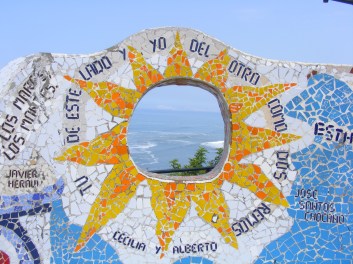
008 1 April 2018 Mosaic at the parkOur Australian friends, with whom we are sharing this adventure (we are blaming them for everything!), arrive. They have already spent two months in South America. We stroll back down to the park in the afternoon. There are street sellers trying to con gullible tourists; we do succumb to an official looking ice cream salesman, who is unperturbed by us paying with a 50Sol note. The lollies were unusual but refreshing and the ‘choc-ice’ was ice cream sandwiched between bourbon like biscuits. The extreme gymnasts and joggers have mostly given up due to the heat but there are tightrope walkers who have strung ropes between the trees. I have already developed some interesting blisters from my first walk in sandals for six months.

At 6pm we meet the rest of our select group of eleven and our effusive tour guide Yuri. I am thinking of renaming this blog ‘How to kill yourself in Peru’. We are on a G Adventures tour and I am trying to embrace the ‘adventures’ part, honestly I am. Poor Pam and Brian are having to act like nannys. I was feeling proud of myself for remembering to don factor 50 before our afternoon walk. I haven’t worn sunscreen since our neobuild adventure several years ago. Our insect repellent is not compatible with the sunscreen, so we will have to choose between sunburn and being bitten but there are no bitey things here. Then it turns out I shouldn’t have been drinking the tap water or cleaning my teeth with it. I do feel a bit naïve. I guess I thought that in an immaculate looking hotel in the capital city we’d be fine. Actually, to be honest, I hadn’t thought at all. There are warning notices everywhere but not one that says ‘Danger of death – don’t drink the tap water’. Does this means you can’t lick your arms after having a shower? Not that I do lick my arms – why would you? – but you get the idea.

Then I got locked in the toilet in the hotel lobby. Fortunately my banging and cries of help brought rescue. You know that thing about me not being fit to be let out! Yuri takes our party to a local open air restaurant El Parquetito. I judge that I haven’t eaten outside in the evening for more than 40 years. The musical accompaniment relies heavily on 1970’s British pop. It is very agreeable and we get to know our fellow travellers. Mostly of early retirement age, there are three are from Canada, two from the US, an Estonian, a Swede, Pam & Brian from Australia and us. We are given a complimentary Pisco Sour, the national drink, which is a brandy like spirit, with lemon and egg white. It tastes good but we are normally very occasional drinkers, so it will probably make the walk back to the hotel interesting. I resist the unadventurous temptation to order lasagna from the menu and go for something that is basically chicken and chips in a tomato and onion sauce. It does at least have a foreign sounding name. It is certainly edible but it is late for eating by our terms and our bodies still think it is 2.30am, which makes it even harder. Chris opts for a beef thingy.

We have been warned that we have to use copious amounts of hand-sanitizer so we don’t get something dire. We have no hand sanitizer. I have an allergic reaction to hand sanitizer, my hands will be raw by the end of the holiday. I guess raw hands are preferable to an unpleasant illness so we stop at a late night shop to buy some hand sanitizer and some water. There are several ‘flavours’ of hand sanitizer but the shop assistant makes the choice. I am given ‘Exotic Romance, Sensual Beauty’. I can’t read anything into this. The male American ahead of me in the queue has been given the same. Allegedly it is coins that are the danger. I resolve to let my travelling companion be the keeper of the coins. Why can’t we adopt the seventeenth century custom of passing them though buckets of vinegar in times of plague?

Day Minus 2 – To the Airport

True to form we begin our holiday in extreme weather conditions. It is 1O and thick frost. I am poised to freeze at the coach stop for an hour, surrounded by luggage, whist my travelling companion takes the car home and trots back down the hill. I attempt to quell the anxiety that he will not accomplish the fifteen minute walk in the forty five minutes we have allowed by researching for my next novel. I must apologise that writing news has been somewhat eclipsed by other matters in these blog posts but I will just say that Barefoot on the Cobbles is finished and is currently being read through for typos, repetitions and inconsistencies by several kind souls. Anyway, back to travelling. Apart from the effects of sitting on a metal seat I escape the worst consequences of the cold and we board the coach. Nobody bothers to check our ticket or hard won coach card.

The journey to Heathrow is uneventful. I remind myself the hard way that I really shouldn’t read on a coach but manage to stop before any dire occurrences. Once at the airport, we skim along the travellators until my shoelace, which, I hasten to add, was tied, is inexplicably eaten by the escalator. Fortunately I manage to jerk myself free and the shoelace gives way before I get sucked into the workings. I’ve watched CBBC’s Do you Know, with the slightly irritating Maddie telling us about how escalators work. In fact I have watched it several times. I emerge with a twinging ankle but otherwise unscathed. New hurdle is check in. I have done this online so there is just ‘bag-drop’ to negotiate. It is still nearly five hours until we take off and I worry that our bags will be whisked away on some earlier flight but it seems not. For some reason we have been guided to the ‘special assistance’ lane designed for the pregnant, disabled and elderly. I know I have put on weight but I don’t think anyone could believe that I was pregnant and my travellator incident induced limp is not that pronounced. Maybe my stress is showing! The stress levels were not helped by encountering a television programme whilst channel hopping last night. We alighted on The World’s Most Dangerous Roads. This depicted a coach travelling on a twisty road a couple of cms wider than the axles, with a sheer drop on one side. The cliff below the road was seriously undercut and bits seemed to be falling off the edge of the road with alarming regularity. Would you know, it turns out this was in Peru. One of our days involves ten hours of driving – oh dear! I am assured that our bags will magically find their way to Peru unaided, I am just a tad concerned that labels marked for our connecting airport in Brasil have been affixed to them.

We repair to a food outlet for sustenance. It is ten hours since we have eaten. News of our ‘special’ status has obviously preceded us as we are whisked past the tall bar stools to a table of a height more suitable to our aged forms. Then we run the gauntlet that is security. We try very hard to obey all the instructions. You obviously need to be an octopus or a whizz at Crackerjack (now I am showing my age) for this. I have to hold my hand luggage (if I let go of the handle it falls over), my bonus item laptop bag, my coat (I have two of these – I was equipped for the long cold wait), my passport and boarding card and then my laptop out of its bag. Thank goodness we don’t have any liquids as we prepared for this by putting them all in the cabin luggage. Then it turns out not only do I have to take my Kindle out and hold that (other e-readers are available) but my cardigan is allegedly a coat, so I have to carry that as well. My belongings, once I can start to let go of things, take up three trays. We don’t bleep and arrive safely at the departure lounge. Whoopee, free wifi, except my anti-virus security keeps telling me I shouldn’t use it. Unlike previous anti-virus software, there doesn’t seem to be a ways of telling it firmly that I don’t care, I want to communicate with my nearest and dearest and download today’s 100 emails. Randomly, the only website I can access is Twitter!

Once through security I attempt to refill the water bottles. The ridiculous fountain means that you can only fill them 1cm at a time, by decanting them from a cup, which fortunately we have. I return to my companion, ‘Make sure the top is on properly,’ I say, handing him his flask. It wasn’t. He now looks as if he has had an unfortunate accident. On the plane, we are provided with a superior looking set of headphones. They require a two pin socket. Cue a plane load of people fruitlessly searching for said socket. Turns out you sort of twist them sideways and just use one pin!

In the Footsteps of Paddington Bear?

Image used under Creative Commons, via Wikimedia Commons – in the public domain

As promised, here is the sorry tale of my attempts to survive my forthcoming trip in search of Paddington Bear. Firstly, I should point out that a trip to Peru has long been on my bucket list. I blame those distant days of standing on a table in the school drama studio declaiming Atahuallpa’s lines from Shaffer’s Royal Hunt of the Sun. There was also an inflatable green rabbit involved in this performance somewhere but that’s another story. Regardless, Peru was a destination of choice. Not so for my hapless travelling companion but he somehow got bludgeoned into the plans. Then our intrepid Australian friends got in on the act and we agreed to meet them there to share the trip.

This trip involved heights, considerable heights. I had already run the gamut of the travel insurance, a feat in itself and paid heavily to ensure that I would be recovered regardless of how many metres above sea level I was. The received wisdom was that we needed medication to ward off the likelihood of altitude sickness. Several weeks ago we set off in pursuit of the recommended drugs. It didn’t seem to warrant taking up an appointment with our hard-pressed GPs so we began by telephoning the surgery. ‘Put your request in writing.’ That was the easy bit. A few days later, the receptionist calls. ‘You will need a telephone appointment with your GP.’ She offers a date ten days hence. ‘Oh and make an appointment with the travel nurse.’ At this point I should say that my travelling companion received his medication after the telephone call. We are of an age to qualify for free medication but this counts as a private prescription so he needed to part with money but no suggestions of travel nurses for him. To be fair, I am glad my GP is cautious but each appointment was a few more days down the line and what started as being ‘in plenty of time’, was now less so.

I arrive for my appointment armed with a not very detailed map of where we are scheduled to go. I had already read the NHS advice, which mentions Hepatitis A (tick – had that to go to Russia), rabies, yellow fever and the altitude thing. So first rabies.
‘I promise not to go close to any animals that are foaming at the mouth.’
‘Ah,’ replies the nurse ‘but they may go close to you.’ It seems that, as long as I am within 24 hours of a hospital I will be fine(ish), so rabies is not needed.

Yellow fever is up for debate. There is conflicting advice as to whether where we are going is risky. The doctor is of the opinion that I should have the vaccination anyway. Forewarned is forearmed or some such.
Nurse: ‘You are on the borderline of the yellow fever area on this trip.’
Me: ‘Ok but there’s a vaccination.’
Nurse: ‘We caution people over sixty against having the injection.’
Me: *smiles winningly* ‘I am barely over sixty.’
Nurse: ‘It is a live vaccine, there are side effects.’
Me: (thinking, ok so I get a bit of a temperature) ‘What are they?’
Nurse: nonchalantly ‘Paralysis, inflammation of the brain and death.’
We resolve to forget the Yellow Fever vaccine.

Cue doctor to discuss the advisability of altitude with my slight heart issues
‘It is like everyone else is going at 50 in the slow lane of the motorway but for you it is 90 in the fast lane.’
Arggghhhh. I don’t even drive on motorways, not in any lane, not at any speed, well once by accident but no. I have to confess that I have spent the past few weeks seriously weighing up whether to abandon the whole thing. I have so many exciting things lined up for later in the year, should I be content with those? Oh and erm, well, staying alive a bit longer would be good. Next minute, I’d be chiding myself for being such a woose. Thousands of people do this trip and survive. Ok, most of them are twenty-somethings on gap years but hey. What happened to my ‘grasp every opportunity’ philosophy? I rather think it has been subsumed by my risk adverse gene.

An appointment with a private travel clinic is advised. A 90 mile round trip and the best part of a day is involved but as yet, I have no medication, as my GP feels he lacks the necessary information to prescribe. It turns out that the nurse I am scheduled to meet is local, he knows people I know and more to the point, numerous people of my travelling companion’s acquaintance. While all the ‘Do you know x, y and z?’ chit chat is going on, I am looking at the eclectic range of books on the mantlepiece. An ancient tome A History of the British Nation, probably left behind by the previous occupants of the office, think I. I am somewhat disconcerted by the presence of The Fatal Shore, a excellent book, I have a copy but I hope it is not prophetic. Eventually we get to the purpose of my visit. To be fair, I am now as reassured as I am ever likely to be (not very). No need for Yellow Fever, hurrah, one risk down. I am prepared to ‘feel like I am having a heart attack.’ Immediately, my mind is thinking, ‘But what if I AM having a heart attack?’ As for, ‘You will probably stop breathing at night’, slightly more scary. I have my prescription, which cost five times that of my travelling companion (not allowing for the petrol and parking to visit the clinic). Now to try to look forward positively to what everyone assures me will be a trip of a lifetime. I just need it not to be THE trip of a lifetime.


I will be blogging the adventure, should I survive, so stand by!

And in the next installment, exciting writing news.

Day 4 Moulin Huet Bay and Sausmarez Sculpture Park

After overnight rain, it is a beautiful day so we decide to tick off one of our guide book’s ‘must see’ sights and visit Moulin Huet Bay. We drive to Jerbourg and start walking eastward so we can say we have been to the easternmost point of the island – St, Martin’s Point. Today we are better equipped for walking, although I still have the wrong glasses and the new boots are digging into my ankles, or rather one ankle, in a weird way. Easternmost point reached, we turn round and head off along the coast path in a westward direction. I was of the opinion that Moulin Huet meant windmill and Google Translate agrees (must be right then) but not a one in sight. What we do have is spectacular scenery and all the clichés about white sands and azure seas really do apply, although the photographs do not do them justice. Everything is newly washed from last night’s rain and again the butterflies are out in force. We also see birds of prey wheeling that we think are peregrine falcons.

The terrain and the many inlets make this a rather longer walk than I and my new boots had anticipated but we make it to Moulin Huet bay and stop at a very welcome café there. We scramble down the cliff path and across the rocks to the bay below. Apparently Renoir walked two miles from St Peter Port each day to paint here during his stay in 1883. Apart from a solitary swimmer, the bay is deserted and we rest on the rocks and ease our feet in the sea. In a similar way to Scotland, the weather changes quickly here and I am soon sheltering from a very short shower under my handy saved-from-the-Victoria-Falls plastic poncho. At this moment, a bride and groom are attempting to get atmospheric beach photos. The bride has taken the precaution of changing into flat shoes but she is still trying to surmount the rocks with a train and bouquet, whilst holding the wedding shoes. It is a shame that the rain, which lasted no more than five minutes, coincided with the photo call, especially as the wedding dress was silk. The rain and an incoming tide prompt us to start to retrace our steps. To the relief of my ankle, we find a short cut along the road and return to the car.

There were glimpses of fishing boats in the distance when we decided our feet needed us to turn round. This is a great temptation for a fisherman of my acquaintance and I attempt to navigate to the distant bay by road. At this point I should point out that the antiquated sat-nav we have in this car does not cover the Channel Islands so we have me instead. I was a girl guide. I am actually quite good at map reading, even though I do have the annoying habit of turning the map round the ‘right’ way. There are a couple of drawbacks. Even with the varifocals I am unable to read the map easily with my glasses on, so I take them off. This means that a) I can’t see where I am going and b) I can’t read the road signs. In addition, the most detailed map we have is forty years old and anyway I have left it in the apartment. We do make it to Saint’s Bay. It is a good job that we are used to very narrow, steep roads. There is allegedly no parking at Saint’s Bay but this is obviously to fool the tourists. There were a few local cars parked there. Obediently though, we just go down to the harbour in order to turn round. With a very quick glance at the boats, we drive back towards St Peter Port.

025 Sausmarez Sculpture Gardens 17 September 2017We stop at Sausmarez Manor and yes it really is spelt differently from where we went yesterday. The guide book tells us the manor house is open. It isn’t. The lovely wooded trail through the sculpture gardens is however. There are huge, impressive stands of bamboo and the trail reminds us of New Zealand. We are a bit ambivalent about the sculpture. Are we admitting to being Philistines when we say we don’t really ‘get’ some of it, despite it being worth, according to the catalogue, thousands of pounds a piece? Although there were some ‘organic’ (technical term alert – to try to sound like I know what I am talking about) pieces that I quite liked, in general, I preferred the pieces that actually looked like something. Randomly, one path labelled ‘Way out for Wheelchairs’ is barred by a pole stretched right across the path, some two foot six from the ground. Clearly all those pushing wheelchairs have to be limbo dancers.

Also onsite is a copper smith and we spend some time chatting about his trade. Like most people we have met, he is very friendly. He did a traditional apprenticeship in the 1970s, primarily to make traditional Guernsey cans. These originated in Normandy a thousand years ago and the cows were milked directly in to the larger sized ones. The design allows for the most efficient use of the metal, giving a maximum capacity per square foot. The shape also reduces the likelihood of loss by slopping. Sizes vary from half a pint to ten pints but the standard ‘pot’ contains four pints. The craftsman we were speaking to is now the only person on Guernsey who knows how to make these cans. He is passing the technique on to his sons. They will not be taking up the craft professionally but at least the knowledge will not die out.

There was a minor incident involving an invisible tree as we left the car park. I probably won’t get thanked for mentioning this but I wish to report that no back bumpers or trees were harmed in the process.