Of Kindles, Witches and Poppies: or how to buy books

Amidst all the #100daysofbfotc blogs, it has been a while since I wrote of other things. Life has been busy; what‘s new? There have been visits to and with descendants, articles to write, courses to run and presentations to give. With All Hallows Eve in mind, my talk about Seventeenth Century Witchcraft has been requested a couple of times, always one that leads to fascinating audience discussion. Also with a seasonal flavour, my colleagues have been out and about recreating life at the time of the Great Fire of London; although I am never quite sure why schools think it is appropriate to book these sessions to coincide with Guy Fawkes Day!

On the subject of anniversaries, preparations for our parish commemoration of the centenary of Armistice day have reached fever pitch. Our village green is bedecked with knitted poppies, we have recruited volunteers to represent almost all of the 90 service personnel from the parish (and have hopes of getting the full complement before next week). Songs of the era are being sung, communal food is being prepared. Every service person has a mini-biography hidden on our history group website, ready to go live at 11am on 11 November (I hope!). I have been in to the local school to chat about Remembrance and the children have produced some wonderful art and written work. It has been four years in the making and next week, all that hard work, by many people, will come to fruition. Someone was heard to mention that next year is the 75th anniversary of D-day and should we be celebrating that? I did turn a deaf ear; someone else can organise that one!

Now to my own personal excitement. Although I finished writing Barefoot in the Cobbles in March, in the few weeks I have been at home since then, the time has been spent editing and marketing. This week, I conquered the learning curve that was necessary to convert Barefoot into Kindle format. I do hope I have got it right. It looks ok to me. So, you can now pre-order copies for your electronic device here. Having said that, I am really hoping that potential readers will opt for paper copies too. There are 54 boxes of books in my very small house. I do need to sell some – please. If you are thinking of buying this book I have been harping on about for forever, please do read a bit more about it first. It won’t be to everyone’s taste and I don’t want people to be disappointed.
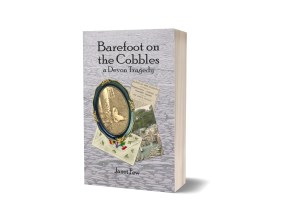
3dIf you still think you might enjoy my creation, can I make a plea that you purchase a copy directly from me, either at one of my many events or other talks, or by emailing me. Alternatively, I would encourage you to order online from my lovely publisher, Blue Poppy Publishing and for the next 13 days, you get £1 off and free postage to the UK. These options deplete my stock, as would ordering from your local independent bookshop. When buying my book, or indeed any other, please make the convenient ‘buy it now’ Amazon button your last resort. It is the easiest option and if you qualify for free postage, it has great appeal. In the past, I have been as guilty as anyone of taking advantage of this immediacy. In my case and that of many other authors who are not working with major publishing houses, it means that you will get a print-on-demand, slightly inferior quality, version and that the stock pile in my house remains the same. You don’t need me to tell you where almost all of the, already very meagre, profits go in this case. The position is obviously different for overseas readers, who will need to use the links on their own versions of Amazon to avoid the horrendous postage costs. Actually, at the moment, I am still struggling to upload a version for Amazon orders of the printed copy but hopefully I will get there by launch day, another learning curve. Two weeks to go!
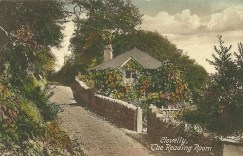
#100daysofbfotc Day 87: Clovelly Reading Rooms

Reading RoomsClovelly’s Reading Rooms feature in Barefoot on the Cobbles as the location for the initial coroner’s inquest. Although we have no evidence for where the actual inquest took place, several inquests were held in the Reading Rooms at this time.

In the late nineteenth and early twentieth centuries, as compulsory education increased literacy rates, many parishes established Reading Rooms. There were often sponsored or supported by local landowners and the Hamlyns of Clovelly Court were benefactors of Clovelly’s Reading Rooms. The rooms were certainly open by 1884, when a traveller recorded their existence. They gave those who might find the cost of newspapers and books prohibitively expensive an opportunity for self-improvement. The rooms also provided a quiet respite in which to read; a notable contrast to many of the crowded homes of the time. Newspaper reports suggest that various fund-raising events, in aid of the maintenance of the Reading Rooms, were held. The rooms were later used as a bank and doctor’s surgery. They are now a private dwelling.

‘Hesitantly, she walked down the wide, mossy steps to the door of the Reading Rooms. The last of the year’s reddened leaves still clung to the Virginia Creeper that crawled round the windows of the long, low building.’

Barefoot on the Cobbles will be published on 17 November 2018. More information about the novel can be found here. Copies will be available at various events in the weeks following the launch or can be pre-ordered from Blue Poppy Publishing or the author.


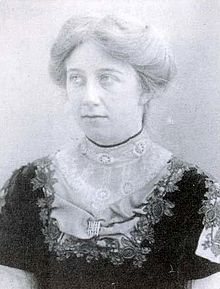
#100daysofbfotc Day 86: Elsie Howey

Elsie_Howey

Image from Wikimedia – Used under Creative Commons

Now it is time to meet the third of the suffragettes who appears in Barefoot on the Cobbles, Elsie Howie. Elsie’s full name was Rose Elsie Neville Howie and she was born on 1 December 1884 in Finningley, Nottinghamshire. She was the daughter of Thomas and Emily Gertrude Howey née Oldfield. Her father, the parish rector, died when Elsie was a toddler and the family moved to Malvern. She studied languages at the University of St Andrew and joined the Women’s Social and Political Union in 1907. The following year, along with her sister Mary, she was arrested for the first time. She was renowned as one of the most  militant activists and targeted the Prime Minister, Asquith, on several occasions. The incident in the novel was not the only time that Elsie worked with Vera Wentworth and Jessie Kenney to promote the cause of women’s suffrage. She gained notoriety by dressing as Joan of Arc and leading a WSPU rally on horseback, wearing armour. She reprised the role of Joan of Arc at the funeral of Emily Wilding Davison.

Elsie frequently went on hunger strike during her spells in prison and force feeding damaged her health. She worked for the cause in Plymouth and Torquay but never resumed her militant activities after they were suspended during World War One. She spent the rest of her life in retirement in Malvern, dying there in 1963.

 ‘Elsie Howey, now,’ muttered another. ‘Baint she the one that was in all the papers last month? Dressed as Joan of Arc on some great white ’orse outside a prison up London way she was.’ ’

Barefoot on the Cobbles will be published on 17 November 2018. More information about the novel can be found here. Copies will be available at various events in the weeks following the launch or can be pre-ordered from Blue Poppy Publishing or the author.

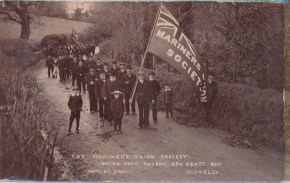
#100daysofbfotc Day 85: Mariners’ Union

Mariners' UnionThe Mariners’ Union was a Friendly Society, formed in Clovelly on 19 November 1792. Initially, they met once a month in the New Inn but later their club room was at the Red Lion, on the quay. A copy of the original articles of the society, together with the names of the first members, are held at the North Devon Record Office and have been transcribed here. Many of the surnames on the list are also found in Barefoot on the Cobbles. Whereas many members of the Rechabites were Methodists, the Mariners’ Union tended to attract the Anglicans, as they were not adverse to alcohol.

‘At that point, The Mariners’ Union parade, coming up from the quay, reached the New Inn. Billy hoisted the flag aloft and the Rechabites fell in behind, swelling the procession to nearly one hundred men.’

Barefoot on the Cobbles will be published on 17 November 2018. More information about the novel can be found here. Copies will be available at various events in the weeks following the launch or can be pre-ordered from Blue Poppy Publishing or the author.

#100daysofbfotc Day 84: Temperance Lloyd

Hanging WitchesIt is fitting that today we should mention Temperance Lloyd, noted as being one of the last people to be hanged for witchcraft in England, in 1682. Her name has echoed down the centuries and together with Susanna Edwards and Mary Trembles, she lives on in North Devon folklore. What is she doing in a novel set in the early twentieth century? She appears in Barefoot on the Cobbles as a reminder that elderly women, women whose names may well have been known to my characters, were convicted of capital crimes. Precisely what Temperance was, or was not, guilty of is debatable. Like Polly, hers too was a crime that hinged on the accusations of others. I do have another reason for mentioning Temperance, one that may become clear in the coming months but for now, that is a secret.

Here is Polly, on her way to court in Bideford: ‘Then there was the old cemetery, the school, and the site of the house where it was said the witches used to live. Polly was not the only parent who had threatened her recalcitrant small children with tales of how Goody Lloyd would cast a spell on them if they did not behave. Temperance Lloyd and her co-accused had been hanged outside Exeter jail. Reminders of capital punishment were hardly reassuring.’

Barefoot on the Cobbles will be published on 17 November 2018. More information about the novel can be found here. Copies will be available at various events in the weeks following the launch or can be pre-ordered from Blue Poppy Publishing or the author.

#100daysofbfotc Day 83: Postman Branch

BranchPostman Branch is somewhat of an interloper in Barefoot on the Cobbles as he did not actually live in Clovelly. As Leonard makes up his mind whether or not to join up, I used William Branch as a well-known local figure who was a prisoner of war.

William Henry Branch was born on 8 May 1888 and baptised at Northam on 21 June. He was the son of James and Mary Ann Branch née Heard. At the age of seventeen, William joined the army reserve as part of the 4th Battalion of the Devonshire Regiment. At the time, he was living at 6 Hazel Terrace Northam and working as a labourer for Mr Ashplant, a shoemaker. William was just under 5 foot 6 inches tall and weighed 129lb, with brown eyes and brown hair. He described himself as a Wesleyan Methodist. It appears that, six months later, on 19 June 1905 he was part of the regular army. 1911 finds William serving in India as a Lance Corporal in the 13th Hussars.

He married Ethel Mary Bowden in 1912 and they had one son. At some point, he was attached to the 2nd Life Guards. In the early days of the First World war he was taken prisoner. Whilst he was a POW at Wittenburg Camp, he was shot through the hand so that he would be unable to use a gun. He was discharged in July 1916 and awarded the Silver War Badge.

He became the local postman, walking the route from Bideford to Buckland Brewer daily. He used to stay in a hut at the back of the Methodist Chapel whilst he waited for the outgoing letters to return to Bideford. By coincidence, it may be that this shed is now in my garden, although other sheds are available! He also worked as the local lamplighter. By 1939 he was living at 3 Rickards Row in Buckland Brewer. He died in 1963.

 Now the old men pontificated about the war, what so-and-so should or shouldn’t have done, how our brave boys would win through and wasn’t it a pity about Postman Branch, who’d been taken prisoner.’

Barefoot on the Cobbles will be published on 17 November 2018. More information about the novel can be found here. Copies will be available at various events in the weeks following the launch or can be pre-ordered from Blue Poppy Publishing or the author.

#100daysofbfotc Day 82: Upton Hill, Torquay

Upton RoadUpton Hill features in Barefoot on the Cobbles as the home of the Cornelius family. In chapter ten, Daisy arrives at 48 Upton Hill, to take up her role as parlourmaid. Upton Hill rises steeply on the northern outskirts of Torquay and number 48 is in the middle of a short terrace. At the time of the novel, the end property of the terrace was a small grocery store.

‘Daisy’s box had been sent on ahead, so she was unencumbered by heavy luggage as she wound her way up the street above Torre Station. The steepness of Upton Hill caught many a visitor unawares but Daisy was accustomed to the Clovelly cobbles, so she was barely conscious of the gradient. Another glance at her instructions informed her that she would find number 48 on the left hand side of the road, three doors up from Bertram’s grocers’ shop.’

Barefoot on the Cobbles will be published on 17 November 2018. More information about the novel can be found here. Copies will be available at various events in the weeks following the launch or can be pre-ordered from Blue Poppy Publishing or the author.

#100daysofbfotc Day 81: Dr Toye

Capture

Western Times 28 January 1938

Dr Toye is one of several medical men who grace the pages of Barefoot on the Cobbles.

Edwin Josiah Toye was born at 8 Bonner’s Park, Bethnal Green, London on 3 November 1871. His father, another Edwin Josiah Toye, was a chemist. His mother was Jane née Buggel. Edwin trained at St Bartholomew’s Hospital and specialised in opthalmics but was also awarded a gold medal for his achievements in the field of obstetrics. He worked as a house physician at the Metropolitan Hospital before coming to Bideford as a locum to Drs Rouse and Gooding.

After the death of Dr Rouse, Edwin became Gooding’s assistant and later a partner in the practice. He is credited with owning the first car in Bideford, in 1902. Dr Toye was a leading Rotarian and served as mayor of Bideford in 1925. It was during his tenure that the building of the new Bideford Hospital was begun and Bideford Bridge was repaired. On 8 September 1903, married an older lady, Mary Ellen Keene née Greatorex, in Northam and they lived at Stanhope in Northam Road. She already had children but they had none of their own. Dr Toye died suddenly at Stanhope on 2 January 1938.

‘Dr Toye was a tall, brusque man in his forties. When Dr Kay called, you felt that he was visiting for a cosy chat, Dr Toye was very different; he was business-like, hurried, eager to give his verdict and to move on to the next patient.’

Barefoot on the Cobbles will be published on 17 November 2018. More information about the novel can be found here. Copies will be available at various events in the weeks following the launch or can be pre-ordered from Blue Poppy Publishing or the author.

#100daysofbfotc Day 80: Police Sergeant Ashby

Police Sergeant Ashby is the bearer of bad news when he arrives on Polly and Albert’s doorstep in chapter fifteen of Barefoot on the Cobbles.

CaptureJames Charles Ashby was born on 1 January 1874 in Holsworthy, the son of James and Grace Ashby née Jones. James followed in his father’s footsteps and began his working life on a local farm. In the mid-1890s he joined Devon Constabulary.

James married Hannah Mary Luscombe in Wolborough on 27 December 1899. They are believed to have had three children. In 1901, he was working as a police constable in Highweek, Newton Abbot, he is also known to have worked in Bishop’s Nympton and Dawlish. He was serving in the Bideford area at the time of the novel but moved to Budleigh Salterton before his retirement in 1922. In 1939 he was living at 7 Imperial Road, Exmouth and was working as a caretaker. He died in Honiton in 1959.

‘Polly was unable to raise her gaze above the middle of the policeman’s chest. Her mind was captivated by insignificant details, the shiny buttons that marched down Ashby’s tunic, the red weal on his neck, left by the chin strap of his helmet. Everything about the man’s attire seemed too small for his formidable frame. His collar was tight, the leather belt with its metal clasp, was stretched across his ample stomach, even his boots were taut and misshapen by the bunions that were a legacy of past years on the beat.’

Barefoot on the Cobbles will be published on 17 November 2018. More information about the novel can be found here. Copies will be available at various events in the weeks following the launch or can be pre-ordered from Blue Poppy Publishing or the author.

#100daysofbfotc Day 79: Nelson

Lime KilnNelson was the youngest of Polly and Albert’s four sons. He was born in Chapel Street Clovelly on 16 August 1908. Nelson’s story features in chapter four of Barefoot on the Cobbles and it would spoil the novel if I were to recount it any further here. So I will leave you with an extract from that chapter.

‘Bertie, with his younger brothers Mark and Nelson, had spent the long, light evenings after school scrabbling for rusty buttons or broken bits of plate and bickering with friends over who had spotted a particular treasure first. As they ranged across the beach, using old branches to make dens above the water’s reach, their unbroken voices mingled with the raucous cries of the gulls and echoed back.’

Barefoot on the Cobbles will be published on 17 November 2018. More information about the novel can be found here. Copies will be available at various events in the weeks following the launch or can be pre-ordered from Blue Poppy Publishing or the author.