Day 6 #bfotc sources

Day six of the ‘advent calendar’ focusing on some of the historical/genealogical sources that I used in the writing of Barefoot on the Cobbles.

PictureWriting a novel that is set in the early twentieth century means that there are a number of fascinating issues that can be explored; the fight for women’s suffrage is just one of these. By chance, suffragette activity in the area presented me with the opportunity to weave the campaign seamlessly into the novel.  The excellent Breaking the Mould, by Pamela Vass, describes the actions of the suffragettes in North Devon and kindly, Pam allowed me access to her appropriate chapter, which was still in draft at that point. This helped to make sense of the conflicting newspaper accounts of what happened in Clovelly in 1909. In the end, my interpretation is one that I felt best fitted the evidence but equally valid versions were possible.

More information about Barefoot on the Cobbles can be found here. Copies are available at various events and at all my presentations. You can order from Blue Poppy Publishing or directly from me. Kindle editions are available for those in the UK, USA, Australasia and Canada.

Day 5 #bfotc sources

Day five of the ‘advent calendar’ focusing on some of the historical/genealogical sources that I used in the writing of Barefoot on the Cobbles.

Capture

Dr Toye Western Times 28 January 1938

Several medical men grace the pages of the novel and in my quest to learn more about them, I came across Plarr’s Lives of the Fellows of the Royal College of Surgeons. Using their database, it is possible to search for RCS members and find details of their lives and careers. Plarr’s Lives started life as printed volumes, published between 1930 and 2005, the first of which were compiled by the then College librarian Victor Plarr. More recent obituaries have been added since. Entries vary in the amount of detail that is given and many are based on family contributions.

More information about Barefoot on the Cobbles can be found here. Copies are available at various events and at all my presentations. You can order from Blue Poppy Publishing or directly from me. Kindle editions are available for those in the UK, USA, Australasia and Canada.

Day 4 #bfotc sources

Day four of the ‘advent calendar’ focusing on some of the historical/genealogical sources that I used in the writing of Barefoot on the Cobbles.

Bideford Bridge

View from the Wharves

Two chapters of the novel are set in Bideford. The resources of the Way of the Wharves project were very useful. I was able to see one of their exhibitions, go on a guided walk and access their website, in order to learn more about the history of East-the-Water, where Polly was in service. The volunteers, who have been working with the help of Heritage Lottery Funding, have amassed a significant amount of material about the history of this part of Bideford. If you are local, I recommend joining one of their tours.

More information about Barefoot on the Cobbles can be found here. Copies are available at various events and at all my presentations. You can order from Blue Poppy Publishing or directly from me. Kindle editions are available for those in the UK, USA, Australasia and Canada.

Day 3 #bfotc sources

Day three of the ‘advent calendar’ focusing on some of the historical/genealogical sources that I used in the writing of Barefoot on the Cobbles.

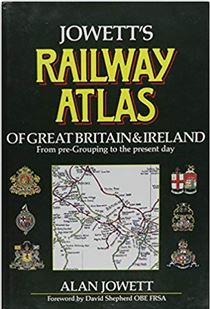
CaptureIn the novel, my characters take a railway journey. In order to make that section of the book realistic, I needed to research the routes that would have been available at the time. For this, I turned to the invaluable Jowett’s Railway Atlas. It seems that this is now out of print, which is a great shame but there are some second hand copies available online.

The book consists of beautiful, hand-drawn maps, illustrating when each particular railway line was open. By using this I was able to track the tortuous journey that Polly needed to make from Clovelly, via Bideford, Barnstaple, Exeter and Newton Abbott, to Torre Station in Torquay.

More information about Barefoot on the Cobbles can be found here. Copies are available at various events and at all my presentations. You can order from Blue Poppy Publishing or directly from me. Kindle editions are available for those in the UK, USA, Australasia and Canada.

Day 2 #bfotc sources and how not to write trip advisor reviews

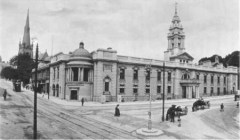
Torquay Town Hall Hospital

Torquay Town Hospital

Day two of the ‘advent calendar’ focusing on some of the historical/genealogical sources that I used in the writing of Barefoot on the Cobbles. When it came to the chapters set in Torquay, I needed a Voluntary Aid Detachment (VAD) nurse to befriend one of my main characters. I was able to use the excellent Red Cross website in order to choose my named character who nursed at the hospital in Torquay. This database contains details of 90,000 individuals who volunteered with the Red Cross during World War I. Normally, searches would be by name but it is also possible to search by location or hospital, which is what I needed to do in order to find those who were working in Torquay. In addition, the site provided me with valuable background information about the role of VADs. The index is also available on FindMyPast but as the Red Cross site is free to search and leads to images of the record cards, it seems sensible to start there.

And trip advisor? I hear you ask (mild gory details alert). What I was trying to write was ‘Our party of eight had six menu choices ……’. Inadvertently, one of the vowels changed, giving my post a very different meaning. I am still trying to live this down, although I am predicting that the venue will now be packed! I am blaming auto-correct. That and the fact that there was a contact lens related incident last week. On Monday, I removed a lens to find that only half had come away. I was in the car in the dark at the time and judicious poking about in my eye failed to reveal the other half of the lens. My house doesn’t do bright lights but in marginally better light and with the aid of a mirror, once home, I tried again, to no avail. The next day, with a fair amount of gunk emanating from my eye and the distinct impression that I had at least half a barrel of grit in it, it was off to minor injuries clinic. Yellow stuff was squirted in my eye and I was examined under special lights. Cotton bud-like implements rolled back my eyelids. The verdict was that there was no half lens in there but that I may have scratched my eye in an attempt to find it. Five days of ointment squirting pass with no discernible improvement. I write said trip advisor review one-eyed and shortly afterwards notice a ridge across my pupil – ah ha there is the rolled up lens that had officially been proclaimed to be no longer in my eye. I successfully remove it and instant relief!

More information about Barefoot on the Cobbles can be found here. Copies are available at various events and at all my presentations. You can order from Blue Poppy Publishing or directly from me. Kindle editions are available for those in the UK, USA, Australasia and Canada.

Day 1 #bfotc sources and other news

Well it is advent and I usually offer an ‘advent calendar’. After the 100 days posts, I am not sure I can commit to 24 ‘windows’ for you to open but we will see how we go. I have decided to focus on some of the historical/genealogical sources that I used in the writing of Barefoot on the Cobbles.

When you are trying to recreate a geographical past, old maps are invaluable. For the scenes set in Bideford and Torquay, I made use of reproduction, large-scale Ordnance Survey maps issued by Alan & Godfrey. Their output covers a range of British towns, with maps from the 1860s to 1910s. They say, ‘Most of the maps are highly detailed, taken from the 1/2500 plans and reprinted at about 14 inches to the mile. They cover towns in great detail, showing individual houses, railway tracks, factories, churches, mills, canals, tramways and even minutiae such as dockside cranes, fountains, signal posts, pathways, sheds, wells, etc.. Each map includes historical notes on the area concerned. We also publish a series of smaller scale Inch to the Mile maps.’ There are maps available for more than one date for some towns.

Using the 1904 map for Bideford, I planned a courting scene set in Victoria Park, clearly depicted on the map. Fortunately, I double-checked in the newspapers and discovered that the park was created for Queen Victoria’s diamond jubilee, not her golden jubilee. I was writing of the early 1890s; the park was not there at the time, so the scene had to go.

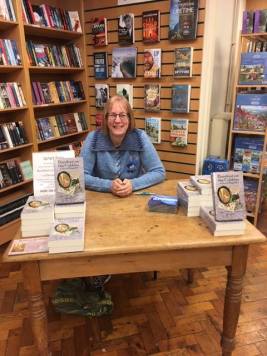
Walter Henry's 24 Nov 2018In what passes for normal life, I have been busy book promoting. This week has meant talks in five locations (who thought that was a good idea?) from Taunton, to Plymouth, to Bude. I have also sat in Walter Henry’s lovely bookshop signing books.

I have chatted to my lovely Pharos online students, giving advice on writing up their family history. Their course is coming to an end but January will bring the start of my course on tracing people and places in the early twentieth century, a period that I enjoyed focusing on for Barefoot. Family historians often neglect the twentieth century as being ‘not really history’ but there is plenty to be discovered about individuals and the communities in which they lived between 1900 and 1945. Twentieth century research brings with it the difficulties of larger and more mobile populations as well as records that are closed to view. This course sets out to provide advice for finding out about our more recent ancestors and the places in which they lived, so it is ideal for family historians and local historians alike. You will be surprised how much progress you make if you concentrate on a small time-frame.

More information about Barefoot on the Cobbles can be found here. Copies are available at various events and at all my presentations. You can order from Blue Poppy Publishing or directly from me. Kindle editions are available for those in the UK, USA, Australasia and Canada.


That was the Week …….

DSCF0978.JPGWow. Just wow. What a week. I have been a scarily large window display, taken part in a folk concert, stood on a very cold quayside surrounded by fish, popped up on various blogs and been interviewed on the radio. All this in aid of promoting Barefoot on the Cobbles, which has now been let out of the many boxes in my home. Launch day was exciting. Firstly, a rare visit to the hairdressers. I am seriously wondering if this expensive outlay is tax-deductable. Then back to Chris’ where I persuaded him to allow me to look for the missing photograph album. Before plumbing the depths of ‘the glory hole’ (a large walk-in cupboard that you can no longer walk in as it is crammed with things relating to the Braund family history) I suggested that I took a cursory look with his own albums and there was mine! I have promised to state publicly that this was not Chris’ fault. I had borrowed his, almost identical, album and he had taken mine back home with it. As soon as the book-promoting dust settles the scanning fest will begin. On the way back from the hairdressers, we drove past Walter Henry’s bookshop and there I was, filling the side window, which was lovely but a bit disconcerting!

Anyway, back to the launch. Devon Family History Society had kindly allowed me to hijack their regular meeting for this purpose and folk turned out in force. I was accompanied by the awesome Dan Britton and two fellow members of Govannen in a blend that the audience appreciated. Dan, Adele and Neil played the companion song to Barefoot on the Cobbles and other music inspired by North Devon. My lovely publisher Olli from Blue Poppy Publishing came along to offer his support and brought some of the children’s books from the Blue Poppy stable. This was important because I was collecting children’s books for distribution to homes where there are few books. People gave generously and despite excellent sales of Barefoot, I somehow now have more books in my home than I did on Friday!

Saturday evening belonged to Dan and Govannen, as they performed their regular annual concert at Meddon. I was able to read from Barefoot and together with fellow author and friend Liz Shakespeare, to skulk in a cupboard and sell books. An amazing evening.

Sunday was the herring festival in Clovelly and given that Barefoot’s cobbles are those in Clovelly, I was there to do readings and send more copies on their way to good homes. I woke up to see that the clock read 8.15am. 8.15 and I needed to leave the house by 8.30 at the latest! I rushed out of bed then wondered why it was still dark. Ah. That would be because it was actually 3.45am. Needless to say, it was difficult to get back to sleep. So, at the appointed time, there I was set up to sell books on a slightly windy but beautiful Clovelly quayside.

Then there was a minor incident with the Subway sandwiches. I was a Subway virgin but having won two vouchers in a raffle, we decided this was the occasion to cash them in. In an inexplicable fashion, the flask cracked and said sandwiches became somewhat soggy as a consequence. The flask contained coffee, the fisherman of my acquaintance (who had spent the weekend fishermanfully heaving boxes of books) is allergic to coffee. He nonetheless consumed the coffee-soaked sandwich without obvious ill-effects. Until mid-day, I basked in beautiful sunshine. Then, when I returned from doing my readings, the sun had dipped behind the cliffs and it was, quite frankly, freezing but fortunately, book-buyers braved the elements.

I have guested on the blogs of Pauline Barclay and The Glorious Outsiders. You can hear my podcast on Write Radio, where I chat to Jane Holland about my book and I spent an hilarious hour on The Voice FM chatting to Simon and Olli.

The week is not set to get any less hectic. Copies of Barefoot are winging their way across the world. I have reached pleasingly high levels in the Amazon charts and reviews are starting to come in. Warm fuzzy feeling alert. A lovely reader has put this on the Blue Poppy website, ‘I could not put this down. My head was spinning a bit with all the characters but a helpful list is found at the front of the book to keep you on track. Growing up in the middle of Devon and in Bideford descriptions of the settings brought back memories. The Devonian language was wonderful, just enough of it – my grandfather often called me ‘maid’ and referred to us children and our parents as ‘chill’. It manages to cover so many issues of the time -suffragettes, shell shock, the hardships of daily life as a servant or fisherman, the losses and mental distress experienced through a range of illnesses of the time, I could go on! The story is compelling, each chapter almost a story in itself, and I was definitely holding my breath for the verdict. I will be giving more than one as a Christmas present! PS also appreciated the good font size.’ Thank you.


#100daysofbfotc Day 100: Polly

02 Mary Elizabeth and Albert BraundThe final day has to belong to Polly, whose anguish reverberates throughout Barefoot on the Cobbles. She wasn’t intended to be the main character but I think most readers will identify her as such. It was meant to be Daisy’s story. In fact, before the novel got a title, I referred to it as ‘Daisy’. Daisy’s role however is reactive; it is Polly who plays a significant part in driving the narrative. Without doubt, Polly is the character with whom I found it easiest to identify. I understood her fears, her hopes and her despair. She is not a typical ‘heroine’; for most of the book she is elderly, prickly, diffident and not particularly sociable.  William Golding wrote, in Free Fall ‘‘My yesterdays walk with me. They keep step, they are gray faces that peer over my shoulder,’ and this sums up Polly. She is a victim of her life experiences, as indeed are we all. I am fascinated by human behaviour and what makes individuals act in a particular manner, especially if their actions are those that others find strange. Writing the novel gave me the opportunity to explore and attempt to explain, Polly’s motivations and those of the people she encountered.

Polly Wakely was born on 1 April 1872, in Peppercombe Valley, the daughter of a ship’s carpenter. The 1891 census shows that she was in service at Chudleigh Villas, East-the-Water, Bideford. In 1893, she married Albert and as the novel shows, they set up home in Clovelly and had eight children. Barefoot on the Cobbles is Polly’s story, I hope I have done her justice.

There is no quotation from the novel today because tomorrow you can read it in its entirity for yourselves. More information about the novel can be found here. Copies will be available at various events in the weeks following the launch or can be pre-ordered from Blue Poppy Publishing or the author. Kindle editions can be pre-ordered for the UK and also on Amazon.com.

#100daysofbfotc Day 99: Lily

scan0006

Lily on the left, with her sister Rosie

Lily, the seventh of Polly and Alb’s eight children, is another character who some might feel could have been dispensed with. She remains, not just because I did not want a large gap in the run of children, nor because I wanted to make sure that all eight children were remembered. Lily has a particular role to play, one which I don’t want to mention, in case it spoils the book. Some readers may not even spot my use of her in this way but to me, she was a vital to a certain section of Barefoot on the Cobbles.

Lily was born in Clovelly on 3 February 1911, exactly two years before her younger sister Rosie. I don’t want to say too much about her history but she spent her life in Clovelly, married and had one child.

‘ ‘Me and Lily, we’re going to the treat up at the Court tomorrow,’ Rosie said. ‘There’s to be tea and decorations and a big tree and presents and all.’ ‘

Barefoot on the Cobbles will be published on 17 November 2018. More information about the novel can be found here. Copies will be available at various events in the weeks following the launch or can be pre-ordered from Blue Poppy Publishing or the author. Kindle editions can be pre-ordered for the UK and also on Amazon.com.

#100daysofbfotc Day 98: Daisy

0U9A3415If you have been following these posts since they began in August you may remember that Daisy has already featured in a post, on what would have been her birthday. Today is the 100th anniversary of her death. Today has to be her post. She is a young woman without descendants, another generation and she may have been forgotten. I hope that, through Barefoot on the Cobbles I have helped to preserve her memory.

“Three days later, as the lingering stars were fading in the angry pink dawn, Daisy, alone in the borrowed bed, loosened her final, fragile grip on life.”

Barefoot on the Cobbles will be published on 17 November 2018. More information about the novel can be found here. Copies will be available at various events in the weeks following the launch or can be pre-ordered from Blue Poppy Publishing or the author. Kindle editions can be pre-ordered for the UK and also on Amazon.com.