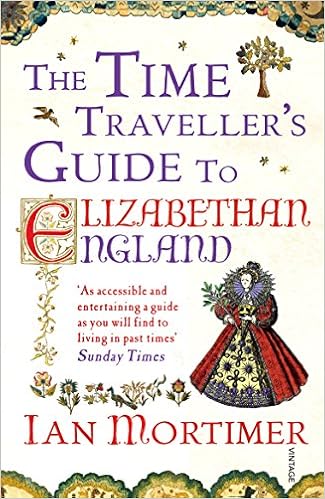
Social History Book Advent Calendar Day 18 – a trip to Elizabethan England

Another favourite pops out from behind today’s advent window, Ian Mortimer’s Time Traveller’s Guide to Elizabethan England. In a similar vein to Ruth Goodman’s How to be a Tudor, this guide takes you back, to explore ordinary life in the sixteenth century. Here are the sights and smells of Elizabethan England in all their raw glory. We learn what to wear, what to eat and how to keep healthy. There are hints on avoiding committing a faux pas in this religiously turbulent age, along with valuable advice on manners and travelling by road. We are regaled with likely punishments should we, the visitor, transgress in some way. Being a country bumpkin, I might have wished for a slightly greater emphasis on rural life but this is a very minor point.

There are coloured plates in the book but I did feel a bibliography would have been useful, even though there are many sources mentioned in the detailed notes. As an inveterate note reader I do find endnotes irritating and I am assuming that this would be even more tricky on an e-reader. To me, readers either look at notes or they don’t and if they do, flicking back and forth is a pain, even though it does allow me to utilise two book marks! Footnotes rule – ban endnotes!

This is yet another volume that demonstrates the fact that well researched history does not have to be boring. I enjoyed the time-traveller format. I do of course actually travel to the sixteenth century on a not infrequent basis. Next time I will take this as a guide. I once had to do a seventeenth century presentation in front of Ian Mortimer – that was daunting, all I can say is that he didn’t walk out!

I have chosen this particular book but there are similar volumes on Medieval England and Restoration Britain by the same author. His books, along with many others, feature on our website’s list of books about the sixteenth and seventeenth century.
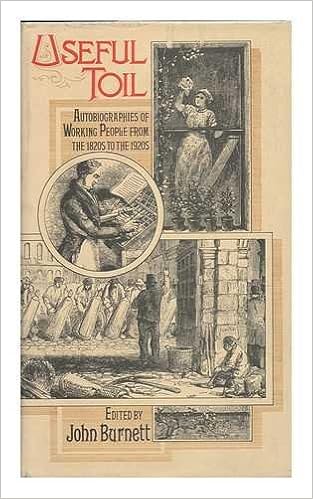
Social History Book Advent Calendar Day 17 – working lives

Useful Toil is a collection of autobiographies of working people, edited by John Burnett. There are narratives, diary extracts or interview transcripts from twenty seven individuals, whose working lives spanned the period 1820-1920. These include both men and women, labourers, domestic servants and skilled workers. One is Winifred Foley, whose books about life in the Forest of Dean are a delight. Although all are working people, they come from a range of social and geographical backgrounds, from Lancashire cotton weavers and workhouse inmates to professor’s sons. These first-hand accounts of the lives of miners, scullery maids, shop assistants and cabinet makers, to name but a few, are invaluable. There are also short biographies about each of the contributors. Burnett provides lengthy introductions to each of his three sections, which provide useful context for the specific memoirs. Here we learn more about wages, working conditions, industrial developments and the manage changes of the Victorian period.


Social History Book Advent Calendar Day 16 – History of Medicine

Product DetailsNow for the second offering from Sara Read, this one co-authored by Jennifer Evans. I would like to introduce you to Maladies and Medicine: exploring health and healing 1540-1740. After an introduction that explains the theories underpinning medical practices at the time, the book is arranged on an ailment by ailment basis. The authors look in turn at head complaints, abdominal maladies, whole body ailments and reproductive maladies. Each condition is discussed in terms of ‘causes’, as understood at the time, preventatives and ‘cures’. The authors have used a wide range of contemporary sources, medical treatises, letters, herbals, diaries and case notes, to help the reader understand attitudes to and treatments of, diseases and conditions in the early modern era. The book is enhanced by black and white illustrations and a bibliography of written and online sources.

This is another book that is comprehensible to the interested amateur, whilst being underpinned by serious academic research. The writing style is accessible and amusing at times, although perhaps not for the fainthearted, as historical medical treatments were not pretty. This book had obviously appeal to me in my Mistress Agnes mode and I particularly enjoyed writing the health and medicine chapters in my own Coffers, Clysters, Comfrey and Coifs and Remember Then. The former even has a medical procedure on the cover! When Maladies and Medicine hit the shelves earlier this year, I had no hesitation in adding it to the reading lists for the students on my online In Sickness and in Death – researching the ill-health and death of your ancestors course. It only doesn’t feature in Til Death us do Part: causes of death 1300-1948 (or for ebook fans) because I wrote it before Maladies and Medicine was published.

And in ordinary life, what ever that is, the great cover debate for Barefoot on the Cobbles continues. It now looks very different from yesterday’s version. Amidst addressing Christmas cards and anguishing over cover designs, I have been writing the Barefoot inquest scene and wishing there were forty eight hours in a day.

Social History Book Advent Calendar Day 15 – Tudor Women and the Anguish of choosing a Book Cover

How to be a Tudor: A Dawn-to-Dusk Guide to Everyday Life by [Goodman, Ruth]Behind today’s advent ‘window’ is a true social history by Ruth Goodman, of Victorian/Edwardian/Wartime etc. Farm fame. In How to be a Tudor: a dawn to dusk guide to everyday life, the author takes us through an average day for sixteenth century ordinary folk. From waking in the morning and washing – or not – Ruth moves on to getting dressed, eating meals, working life, for men and women and leisure before putting her Tudor folk to bed. The author’s experiences as an experimental historian mean that she has a personal, practical, knowledge of the processes that she describes. Her attempts at cooking, cleaning and living in Tudor times are described and it is clear that her insight into the period is far greater than that of most non-contemporaries. This book is grounded in serious historical study but it is written in a very accessible style. There are coloured plates but I don’t feel that these are really necessary, as inevitably, most of them portray life for a social strata that deviates from the focus of the book. The black and white illustrations are more relevant. The bibliography is also useful and will lead to yet more book purchases. This volume should be required reading for anyone setting a novel in this period. If your interests lie in a different era, then there is a companion ‘Victorian’ volume. Probably the greatest compliment I can pay this book is to say that I wish I had written it.
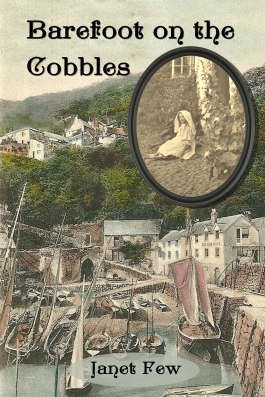
BotC-coveridea4-1Yesterday I managed to complete a very harrowing chapter of Barefoot on the Cobbles. Elation was short-lived with the realisation that there is still a long way to go. Then there was the thorny issue of the cover. I am well aware of how important this is and because Barefoot is so difficult to pigeonhole, conveying what is inside in a single image is particularly tricky. After a few preliminary attempts the publisher and I had a version we were pretty pleased with – for five minutes. I should point out that to get to this stage there had been plenty of ‘up a bit’, ‘down a bit,’ ‘make it bigger/smaller/darker’ moments. Then we threw the suggested design to the wolves of Facebook. Even though they don’t always make east reading, I am really grateful for all the comments. The fact that they weren’t all complementary, is exactly what we wanted. I was pleased that some of the themes were picked up by those looking at the cover. The consensus was though that these initial ideas were over complicated and that we need a slightly different font, which actually I was pleased with until someone pointed out that a key capital letter was ambiguous.

The rethink will be rather different and will incorporate the general feeling of those who expressed an opinion. It is incredibly difficult to come up with a design that will tempt the right readers (i.e. ones who will actually enjoy the book) to turn it over and read the blurb. It is all about managing expectations. I need the cover to be suggestive of the content. It is no surprise to me but if anyone thinks that being an author just means writing a book, you are oh so wrong!