#100daysofbfotc Day 35: The Western Front

Fromelles German Federal Archives This file is licensed under the Creative Commons Attribution-Share Alike 3.0 Germany license.

German Federal Archive Used under Creative Commons Attribution-Share Alike 3.0 Germany license

As a significant proportion of Barefoot on the Cobbles is set during the First World War, it needed to contain a scene from the Western Front. This was a challenge. I write by researching my characters’ geographical and emotional backgrounds, not in a vacuum. For the rest of the book, which all takes place in Devon, understanding the physical landscape, albeit with a twenty first century slant, was straightforward. Many of Barefoot’s main characters are female and although I am not a young female, I was once, so I can get inside their heads. I have never visited the battlefields, I have no experience of being on active service and I am not a young male. The thought of composing the battle scene was daunting.

I had already chosen the character, Abraham, that I would use for this part of the book and was interested to discover that he lost his life in one of the lesser known battles, a least from a British perspective (this particular battle has much higher prominence in Australian history). I had already formed an impression of Abraham’s personality but how would he respond to a war zone? I was unable to go to France while I was writing this novel but I read diaries, letters and memoirs written by those who took part in the battle. This gave me a much greater understanding of the landscape and help me to empathise with Abraham. I hope that I have created a believable character and a realistic environment. Despite having serious misgivings about my ability to think and therefore write, from the point of view of a First World War soldier, this is the chapter that I am most pleased with.

There are so many, oft used, words and phrases to describe the Western Front: horrific, damaged, muddy, bloody, terrifying, boring, a tragedy, ravaged; all those things. I think I will leave you with some words from chapter 8. ‘Across the plain where the purple clover once bloomed and the swallows used to dive, men prepared for death in a blood-stained ditch. The lurking mist that accompanied the persistent drizzle obscured the view but the deathly crumps of falling shells resounded as the wire-cutting party were sent into the abyss. From the vantage point of the higher ground, the Germans were set to defend the salient without thought for the cost in human pain.’

Barefoot on the Cobbles will be published on 17 November 2018. More information about the novel can be found here. Copies will be available at various events in the weeks following the launch or can be pre-ordered from Blue Poppy Publishing or the author.
#100daysofbfotc Day 34: Uncle John

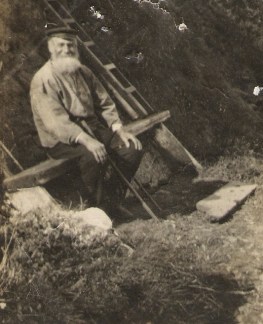
John (Kivell) BraundThere is a passing reference to Uncle John in chapter 4 of Barefoot on the Cobbles, when he assumes the responsibility for his sister, Matilda. Born on 6 October in Bucks Mills, John was the eldest of Albert’s surviving uncles. Like his father, grandfather and brothers, John was a fisherman. In order to distinguish him from the other Johns in the same family, who also lived in the village, he was known as ‘Johnny Kivell’. He took his wife’s maiden surname as a nickname, as opposed to her christian name, which was the method adopted by the other Johns. He was also called ‘Big Johnny Kivell’ and he was renowned for his strength. He allegedly carried a hundredweight of limestone up the street. This is undoubtably an exaggeration but nonetheless, a lifetime of hauling lobster pots obviously required plenty of muscle.

Johnny Kivell and his wife Susan had eight children and they also brought up a granddaughter. He lived all his life in Bucks Mills. After he married, John made his home at number 9, now known as ‘George’s’. In the 1890s he and his growing family moved next door, to number 10, which has now been amalgamated with the adjacent cottages. The family were devout Methodists and John was instrumental in the building of the new Methodist Chapel in the village in 1907. John died on his 91st birthday, in 1930.

 ‘Uncle John says her [Matilda’s] language is something shocking. Her excuse is the devil’s got her tongue. Sounds like she’s gone proper mazed. She used to go to chapel regular, now she’s saying she’s going to hell. Uncle John’s been having a right time of it.’

 Barefoot on the Cobbles will be published on 17 November 2018. More information about the novel can be found here. Copies will be available at various events in the weeks following the launch or can be pre-ordered from Blue Poppy Publishing or the author.

#100daysofbfotc Day 33: Bideford Bridge

Bideford BridgeIn Chapter 2 of Barefoot on the Cobbles we cross Bideford Bridge with Polly, as she goes to begin a new life on the eastern side of the River Torridge. In 1280, the ford that is thought to give Bideford (By the ford) its name was replaced with a wooden bridge, to enable pack-horses to cross the river. At 677 feet, it is thought to be one of the longest medieval bridges. The twenty four arches are of uneven width and there are several theories as to why this came about. It may be that each arch was funded by a different gild and the disparity in their donations meant the arches were not a uniform size. Alternatively, it could be because the available oak beams were of different sizes, or that the piers were placed on firmer ground and the stony outcrops were not evenly spaced. There is also a legend that the piers were set on bales of wool, a symbol of the town’s wealth.

The original wooden bridge was subsequently encased in stone. The bridge was widened in the 1790s and again in 1865, twenty six years before Polly makes her crossing. It was to be further widened in 1925. There were attempts to run a permanent railway track across the bridge but the only time a train crossed the bridge was during the First World War, when temporary tracks were laid. In 1968, a section of the bridge collapsed and one of Barefoot’s characters, Leonard, was to man the safety boat whilst reconstruction took place.

‘Unusually, there was not a gasp of a breeze coming from the river as Polly turned to walk across Bideford bridge, narrowly avoiding the brewer’s dray that was heavily laden with barrels for the inns on the quay.’  

Barefoot on the Cobbles will be published on 17 November 2018. More information about the novel can be found here. Copies will be available at various events in the weeks following the launch or can be pre-ordered from Blue Poppy Publishing or the author.


#100daysofbfotc Day 32 Ada Wakely


Ada

Ada Wakely grew up in the fishing hamlet of Peppercombe, the fourth of five sisters. She appears in Barefoot on the Cobbles as an acolyte to her elder sister, Polly. It is Ada who travels to Bideford to attend Polly’s wedding and Ada who is in Clovelly to assist when her sister gives birth to her firstborn.

One of Ada’s personal tragedies is alluded to chapter 4 of the novel. After marrying a cousin of Polly’s husband Albert, Ada settled in Bucks Mills as a fisherman’s wife. Her son was born after seven years of marriage. Sadly, he was severely disabled and died at the age of twelve. This was not to be the only misfortune in Ada’s life but you will have to wait for the post about her husband, George, to learn more. Ada herself lived to the age of 105, dying in 1981.

‘Ada arrived from Peppercombe on the Friday bringing family news.

‘Ma sends her love,’ she said. ‘She wishes you well, ’tis in part the journey, you know she’s never liked the town. ’Tisn’t that ma hasn’t taken to Albert so much but he is from Bucks and that’s hard for her to swallow. She wants us all to settle down in Peppercombe and not go no further.’

‘And shall you?’ asked Polly.

Ada reddened.

‘Well,’ she said hesitantly, ‘who knows? Maybe I’ll be wed to a man from Bucks too one day.’ ’

 Barefoot on the Cobbles will be published on 17 November 2018. More information about the novel can be found here. Copies will be available at various events in the weeks following the launch or can be pre-ordered from Blue Poppy Publishing or the author.

#100daysofbfotc Day 31: Percy Cornelius

Capture

Western Daily Mercury 20 January 1912

We only meet Percy Cornelius when the other characters, who share his Torquay household, mention him. You would be justified in asking why he appears in Barefoot on the Cobbles at all. He is included because his existence and his subservient attitude towards his wife, help to explain her attitudes and behaviour.

It appears that Percy lived in Torquay all his life. He was born in July 1881 and baptised at Upton parish church. Percy lived with his family in Market Street, Torquay and attended the local infants’ school. As a teenager, Percy, a butcher’s assistant, was summonsed for leaving a horse and trap unattended. The horse wandered off. The police had warned Percy about not securing his trap on previous occasions and he was fined ten shillings, or seven days’ imprisonment.

In 1912, when he was working as a manager for Messers Nelson of 186 Sidwell Street, Exeter, he was fined again, this time for adulterating sausages with boric acid. This was used as a preservative but could have harmful effects. Its use was not banned but it should have been labelled. The sausages had actually been made in Bristol but Percy was fined £2 plus costs for allowing them to be sold. This incident was referred to in an early draft of chapter 11 but suffered under the delete button’s mighty power.

Percy married in 1913 and he and his wife had two further children after Kathleen, who is mentioned in the novel. By the outbreak of the Second World War, Percy was a bus cleaner living in Chatto Road, Torquay. He died in 1967.

‘I don’t suppose it affected you in the countryside but we’ve had trouble obtaining foodstuffs here. Of course, there’s never a problem with meat, Mr Cornelius being a butcher but we’d like to have a few more vegetables for the table.’

Barefoot on the Cobbles will be published on 17 November 2018. More information about the novel can be found here. Copies will be available at various events in the weeks following the launch or can be pre-ordered from Blue Poppy Publishing or the author.

#100daysofbfotc Day 30: Mr Tuke

Picture1At the time of Barefoot on the Cobbles, Harry Tuke was the head gardener at Clovelly Court. We meet him in the summer of 1909, when Daisy has just come to work for him as a live-out servant. I wanted to explain Daisy’s move to Torquay and her rather unusual role there as a gardener. To place her as the Tuke’s employee not only help to do this but also gave me the opportunity of making the Tuke’s son a love interest for Daisy.

A Yorkshireman by birth, Harry was in Clovelly in 1893, when he married Eliza Brenchley from Kent in Clovelly church. By this time, Harry was in his thirties and it seems likely that he had just taken up his post at the Court. The Tukes had just one son. As head gardener, Harry’s home was Gardener’s Cottage, close to the church, the Court and the gardens that he tended. He worked for the estate for over forty years, retired to rooms over the stables and died there in 1936. He was involved in the life of All Saints Church, being both a sidesman and a member of the Parochial Church Council.

Harry Tuke’s role as a senior servant to Mrs Hamlyn and his home, which was away from the cobbled street, set him apart from Clovelly’s fishermen. His family were consigned to an ambivalent social milieu, not quite a villager, yet lacking the status of the respectable middle-class.

‘Mr Tuke had noticed the allure that the garden held for Daisy and the thoughtful gentleman had begun to tell her more about the plants and how to tend them.’

Barefoot on the Cobbles will be published on 17 November 2018. More information about the novel can be found here. Copies will be available at various events in the weeks following the launch or can be pre-ordered from Blue Poppy Publishing or the author.

#100daysofbfotc Day 29: Albert

Albert

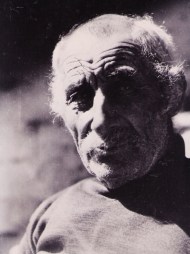
Albert allows us to view the events that occur in Barefoot on the Cobbles through masculine eyes. His reactions are very different to those of his wife, Polly. Throughout the book, the relationship between Albert and Polly develops and changes. We are introduced to Albert in the first chapter, when he is the shy young man, wondering how to approach the feisty girl from the neighbouring village. Albert’s tender relationship with his young adopted sister, Eadie, is an interesting insight into his character. He is a taciturn, hardworking fisherman, yet he has a tender side and we observe this in his interactions with his own children. It is largely through Albert that we understand the struggles of the Clovelly fishermen and the impact of a life that is circumscribed by the vagaries of the sea.

We follow Albert through the comparatively peaceful early years of his married life, then watch as tragedy touches the family. With Albert and Polly’s lives spiraling terrifyingly out of control, we find Albert desperately trying to understand his wife’s actions. As Albert strives to support Polly, we empathise with him in his impotence.

Born in Bucks Mills into a fishing family, Albert spent his married life in Clovelly. He lived until the age of ninety four and continued fishing until just a few years before his death.

‘In the bay, the herring were running and Albert and Bertie were making the most of the season, silver darlings shimmering in their nets. They would fling open the cottage door at the end of each day, bringing in the scent of the cold sea, fish scales sticking to their oiled-wool jumpers and to the backs of their scarred hands.’

Barefoot on the Cobbles will be published on 17 November 2018. More information about the novel can be found here. Copies will be available at various events in the weeks following the launch or can be pre-ordered from Blue Poppy Publishing or the author.

#100daysofbfotc Day 28: Joe Prance

Capture

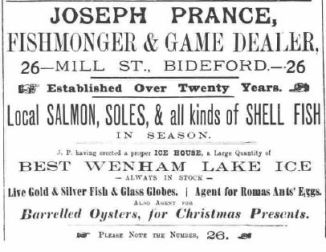
North Devon Gazette 22 December 1896

Joe Prance appears in Chapter 2 of Barefoot on the Cobbles, when the action moves from the rural tranquillity of the North Devon coastline to the bustling town of Bideford. He was primarily a fishmonger and game dealer, with a shop at 26 Mill Street but he also sold dried goods. He had been born in 1834 in the fishing hamlet of Peppercombe, where his father was a fisherman. He was involved in a childhood accident, which left him with one leg longer than the other. Perhaps surprisingly, in an era before compulsory schooling, he received a good education. The 1861 census finds him lodging in Bideford in order to attend school. He returned to fish from Peppercombe and married a local girl, Susan Found; they had eight children, two sons and six daughters.

In the 1870s, the family moved to Bideford and initially the fishmongers was at 25 Mill Street. It appears that at some point during the next decade, the business absorbed the greengrocer’s at 26. In old age, Joseph and his wife lived at Lower Meddon Street with their married daughter. Joseph died in 1912.

‘Uncle Prance was at the counter arranging the dried goods to his satisfaction and awaiting the delivery of crabs, lobsters, and shimmering bass to lay temptingly in the window.’

Barefoot on the Cobbles will be published on 17 November 2018. More information about the novel can be found here. Copies will be available at various events in the weeks following the launch or can be pre-ordered from Blue Poppy Publishing or the author.

#100daysofbfotc Day 27: Holidaymakers

Capture 3Holidaymakers who ventured to North Devon’s coast were welcomed and dreaded in equal measure. By the time in which Barefoot on the Cobbles is set, the income from tourists was an increasingly important part of the local economy. For those who lived in Clovelly in particular, money gained from providing for visitors enhanced the precarious living scraped by the fishermen. Some visitors took up residence in the local guest houses, many others were interlopers for a fleeting day. They came by sea from further up the Bristol Channel and were ferried ashore by the fisherman. Others arrived by charabanc from the station at Bideford. Still others were transported by horse-drawn vehicles, to be disgorged at the top the cobbles, so they could descend into a different world, stumbling in their unsuitable shoes.
Through the pages of the novel, we arrive in Clovelly when everything is changing. Soon, it will no longer be a fishing village, with holidaymakers providing a secondary revenue stream; before long tourist vessels will eclipse the fishing boats in the harbour. Folk from ‘up-country’ may pass through, leaving little of themselves behind, or they may dislocate the lives of the inhabitants forever. Welcomed or despised, holidaymakers were needed and they could not be ignored.

‘In half-forgotten pre-war holiday seasons P & A Campbell’s steamers had brought hundreds of day-trippers from Ilfracombe, or even South Wales. Tourists were tolerated. They spoiled the solitude, the silence and the regular rhythm of the fishing year. Yet with them came colour, diversion, bustle, excitement.’

Barefoot on the Cobbles will be published on 17 November 2018. More information about the novel can be found here. Copies will be available at various events in the weeks following the launch or can be pre-ordered from Blue Poppy Publishing or the author.

#100daysofbfotc Day 26: Edward Collins

Without Edward Collins’ actions Barefoot on the Cobbles would not have been written. He embodies human frailty, as do we all. His complexities are hinted at in the very brief glimpses of him that have been found in the records. He was key to my story, yet, of the main characters, he was the one about whom I could find least. As I sought to uncover a sympathetic, yet believable, motivation for his somewhat strange behaviour, a three-dimensional individual began to emerge; one who had experienced his own trauma and tragedy. Mainly due to his common surname, I was unable to contact any family members. Should they read the novel, I do hope that they feel the conclusions I have drawn from the meagre facts are not illogical. Despite the appalling, albeit largely unintentional, ramifications of his actions, I wanted the reader to be able to empathise with Edward Collins, who was, in his own way, a victim. I hope I have succeeded.

We meet Edward Collins in Clovelly, where he is staying for the benefit of his health. From the outset he is an enigma. He and his wife can clearly afford expensive hotels, what then are they doing in a small guest house on the North Devon coast? He is comfortably off, a professional, a university man. How will he interact with Clovelly’s down-to-earth fishermen?

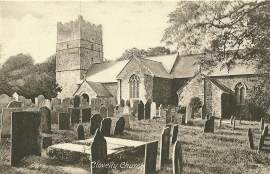
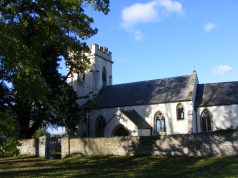
Thornfalcon Church burial place of Edward Collins

Thornfalcon Church

Edward Laurence Collins was born on 1 May 1880 in Liverpool. He gained an MA from Cambridge University and became a consulting engineer. Although I have been unable to positively identify a role for him during the First World War, I think that it is likely that he saw action in some capacity. He married Amelia Martha Hutson in 1915. It seems unlikely that the couple had any children. It also appears that his two sisters died unmarried, hence the lack of living relatives. The Collins remained in Clovelly for some time after the events described in the novel. Edward then travelled widely, probably in the course of his work, going to Gibraltar in 1926 and Chile in 1936. He had plans to live in the Channel Islands but I have no firm evidence that he did so. Edward Collins died on 17 January 1953 in Somerset and is buried in Thornfalcon Church.

‘Clovelly slept. There were no sounds from the cobbled street but the night and its attendant horrors, closed in on Edward Collins. Even eighteen months spent embraced in the village’s serenity had not banished the terrors that darkness could bring. He awoke from the recurring nightmare, shaking and sweating. Curled in a foetal position, clasping his knees, he silently sobbed.’

Barefoot on the Cobbles will be published on 17 November 2018. More information about the novel can be found here. Copies will be available at various events in the weeks following the launch or can be pre-ordered from Blue Poppy Publishing or the author.