What’s all the Black Friday Lark? contains family history related offers

Today may or may not be Black Friday. I can confirm it is a Friday for all you retired types who aren’t quite sure. Black Friday now seems to last several weeks so if it is THE Black Friday is debatable. It is something that has spread from America and in the interests of imparting some history, it seems that the term originated in September 1869, when James Fisk, a railway magnate and Jay Gould, a financier and railway speculator, together with Abel Corbin, brother in law of US President Ulysses S Grant, forced up the price of gold by cornering the market. This was followed by a slump and panic in the gold market, with many people losing money. The US economy was already under pressure following the cost of the Civil War and the gold crash led to financial chaos.

There is another, largely discredited, theory that Black Friday referred to days when enslaved people were sold for a reduced price. This clearly has nothing to do with every retailer offering us deals in the run up to Christmas, so when did that start? In the 1960s, the police in Philadelphia used the phrase ‘Black Friday’ to refer to the increase in crime and social disorder during the pre-Thanksgiving holiday shopping rush. It seems to have been the 1980s when US retailers began using ‘Black Friday’ to refer to slashing prices and the UK followed suit. Now Black Friday seems last for weeks and to morph into January sales, which of course start on Boxing Day.

I am rubbish at marketing but I thought I’d point out a few Black Friday family history related offers that I am involved in. Pharos Teaching and Tutoring are offering 15% off all their online courses this weekend. Two of mine which are very popular start in the new year, Discovering more about your Agricultural Labouring Ancestors and Putting your Female Ancestors into Context. There are others later in 2026 that you can book now and claim the discount. These include Are you Sitting Comfortably: writing and telling your family history in April; First Steps to a One-place Study in September and In Sickness and in Death; researching the ill health and death of your ancestors in October. There are a load of great offerings from my colleagues too.

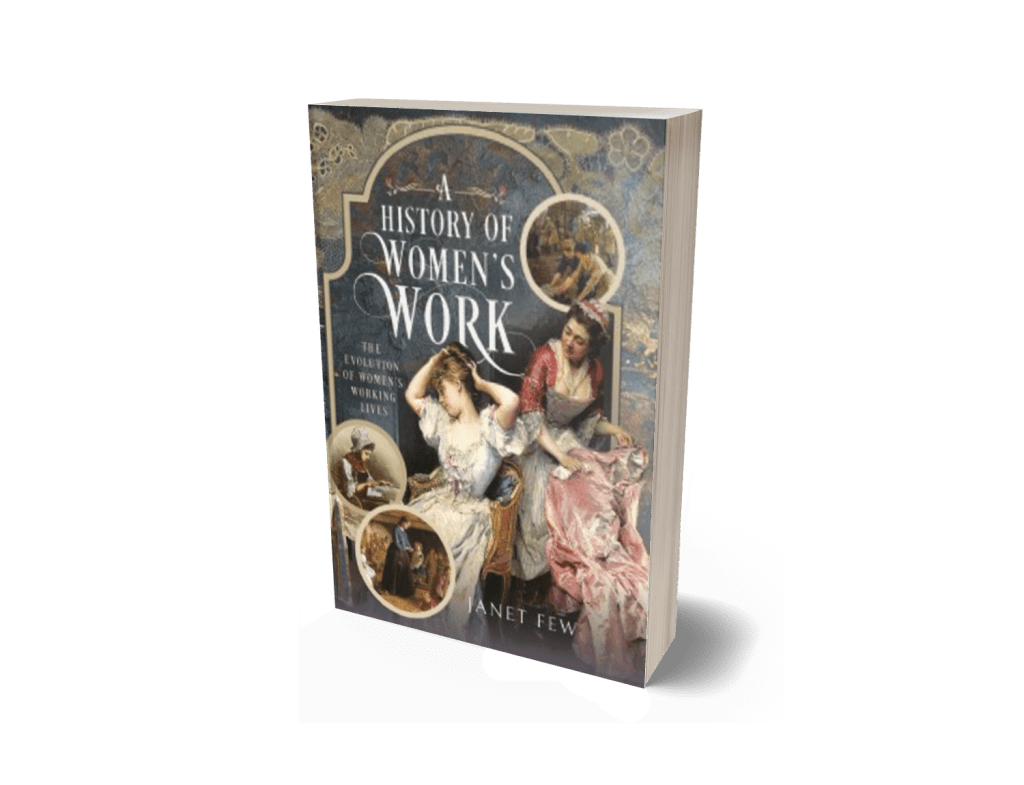
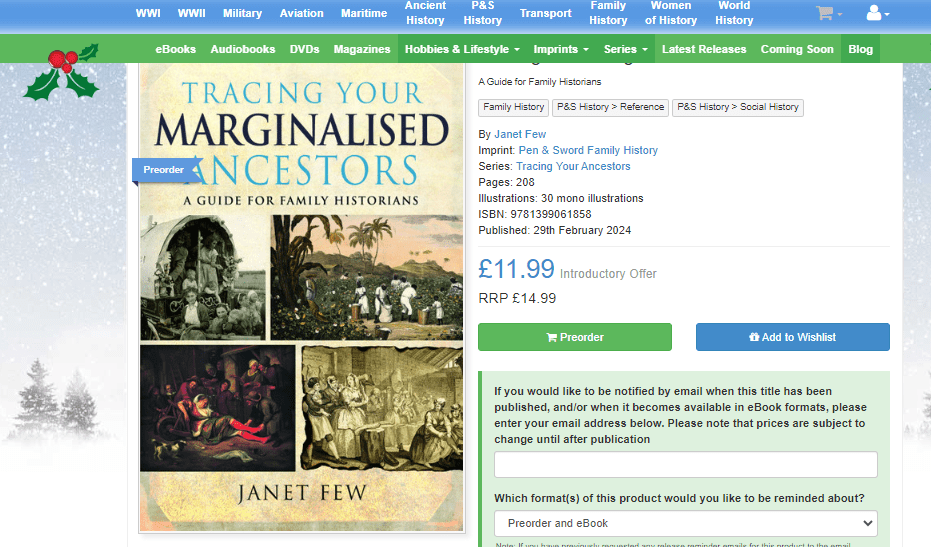
Pen and Sword have 30% off their prices, again this weekend only. Here you can buy my Women’s Work book or Marginalised Ancestors. I am offering Coffers, Clysters, Comfrey and Coifs: the lives of our seventeenth century ancestors for £5 plus postage to a UK address. From now until 8 December, you can have Remember Then Women’s Memories of 1946-1969 and how to write your own for £8 plus postage. Both of these have a cover price of £12.95. If you prefer fiction, then Sins as Red as Scarlet is on offer for £8 plus postage (cover price £9.99) for the next week too. There is more about the books on my website. Contact me using the box on the home page for details if you want any of these. If you don’t fancy any of this for yourself, they are also gift giving opportunities. Advert over.

A Deep Breath and Another Brick Wall with Structural Damage

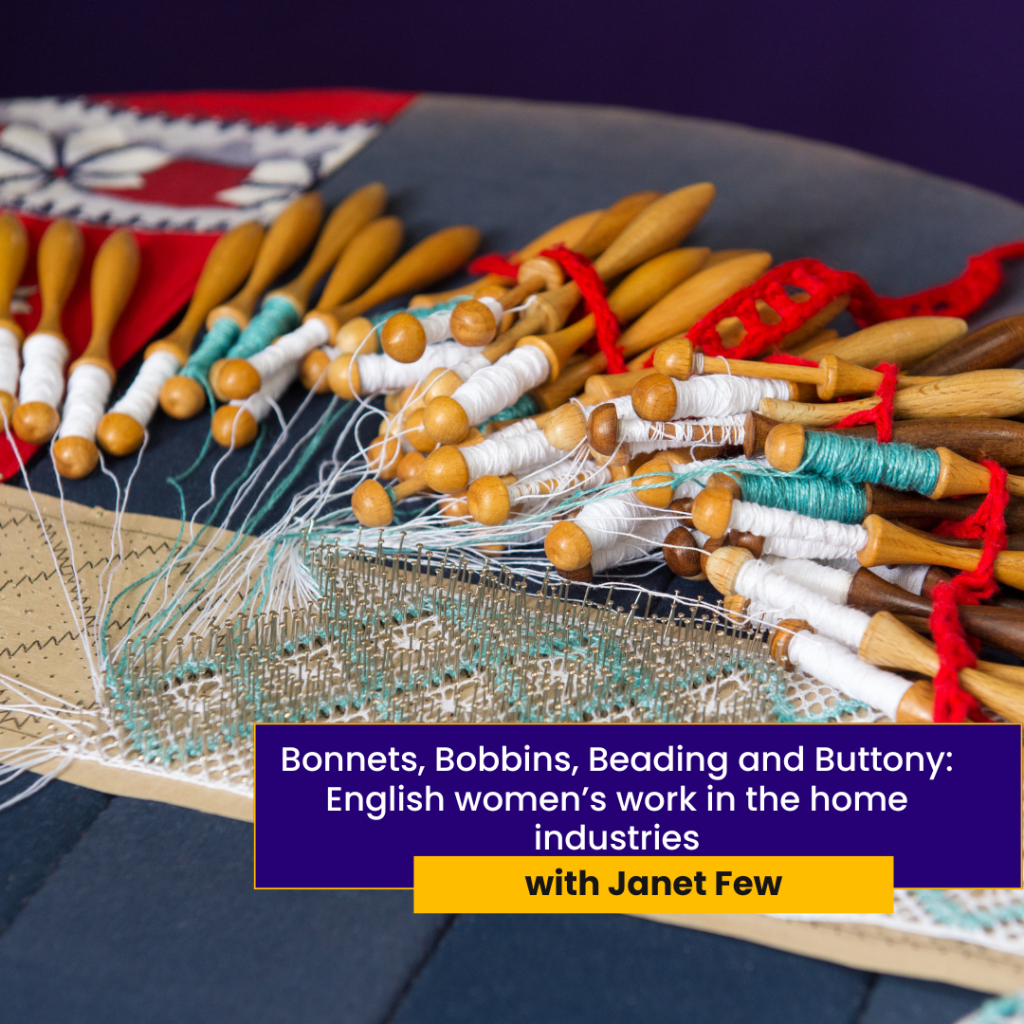
Time to take a deep breath as I launch in to the next few weeks. Not only is the job I must not mention about to hit with a vengeance but at some point long ago, I decided that it would be a good idea to cram the next few weeks full of presentations. So in the calendar for the next two weeks I have, Women’s Life  on Farms, the story behind my novel Barefoot on the Cobbles, Mistress Agnes talking about life in the seventeenth century and Researching in the Twentieth Century, swiftly followed by looking at cottage industries. If you want to know more about straw-plaiting, lace-making, glove-making or button-making, as well as home working in general, you can book for that one here. All those topics get chapters of their own in my new book A History of Women’s Work and straw-plaiting and gloving are two of the sections that are accompanied by case studies. It is currently at its introductory price of 20% off, which means you can get a hardback for a paperback price and not have to wait two years for the paperback to be issue. The ebook will follow at the end of next month. I am humbled by the lovely reviews that have been coming in.

Today is also the final Zoom for my Pharos ‘Writing and Telling your Family History’ course. What a lovely cohort of students and such fascinating stories to be told. If you are sorry you missed it, it runs again in April, or you can sign up to research and tell the story of a female ancestor in September.

As this post in in danger of sounding like an advert, on to other things. In the interests of writing and telling my own family history I have been getting my pick axe out and working at my own genealogical brick walls. I have two stories to share with you when I get the time to draw breath and write them up for public consumption. Having decided that Mary Newlands is indeed my 3x great grandmother (see previous post), I am now pushing back to try to confirm that her family are of Scottish origin, as seems almost certain. So one brick wall crumbles and another looms.

News too on the second of my three ‘big’ brick walls. I’ve been working on the family of a different ‘almost certainly my 3x great grandmother’; oh wow, what a story. At the moment the ‘proof’ is based on rigorous documentary research but a missing baptism means two of the jigsaw pieces are DNA matches that are so small even I am reluctant to entertain them and hereditary large ears – yes, best not to ask. In a quest for more evidence, I launched into researching the wider family. I am back to the sixteenth century in Gloucester and Upton on Severn and have had plenty of palaeography practice. I do realise my missing link won’t be found in Tudor times but the rabbit warren (too big to be called a rabbit hole) sucked me in and there I was, head first in the throes of a virtual one-name study. It is an unusual name but beset with spelling variations and the use of contractions to add spice to my journey. There may be a connection to a seventeenth century barber surgeon. An added excitement is that my children also have paternal ancestry in Upton on Severn. I just may have to revisit that branch in search of a link. I am in the area in September. Do I wait patiently, or do I spend a small fortune ordering copies of wills? So many ancestors, so little time.

Sadly now back to the day job and three meetings Monday.

The Year so Far – a Family History Whirlwind

The year began with family visitors, which is always very special. As a bonus, this year they didn’t include any lurgies amongst their seasonal gifts. The new year also means paying the tax bill. This wasn’t a surprise and the money was put aside but it is always a bit of a shock to see the bank balance suddenly depleted by what seems to be an eye-watering amount. Added to this, it seemed I needed to pay a different HMRC bank account, which meant setting up a new payee. I have one of those little card reader things that gives you a secret code to verify that you are not a fraudster. I’ve had the thing for ages, which is probably why it chose this moment to decide that its batteries had had enough. Before these obscure-sized and expensive batteries died a final death, they gave me a partial glimpse of the vital number. Could I guess what figures they were striving to reveal? It turns out that I could. Hurrah.

It has been full on family history on many fronts since the visitors departed. I’ve finished a magazine article. My new book is signed off and is due out in May, pre-orders should be opening up soon. I love they cover that Pen and Sword have chosen. I’ve also, rashly, signed a contract for another one. Will I ever learn? Not totally unrelated, is the work I’ve been doing towards the next Forgotten Women Friday collaborative research day for the A Few Forgotten Women project. This one is to be about women associated with Dorchester Prison.

My Pharos Agricultural Labourers online course has started again this week with a full, enthusiastic cohort. Next up on the Pharos front will be the first presentation of ‘Putting your Female Ancestors into Context’ in March. This filled up so quickly, that I agreed to take more students than usual. This means that there are still just two spaces left, if you want to come along for the ride.

I’ve have been giving talks like, well, like someone who gives an awful lot of talks I suppose. I’ve been out and about in person chatting about herbs and plague and online with the history of prostitution, marginalised ancestors and writing your family history amongst other things. This has taken me to Northern Ireland, to Surrey to Lincoln and other points in between. I have also recorded talks for future broadcasts. Rootstech is on the horizon. The pre-recorded talks have not yet been announced but there will be a short session from me in there, when I will be talking about British administrative units, do you know your townland from your wapentake, or your riding from your peculiar? If not, seek out my ten minute chat when Rootstech opens next month. Even better, online attendance is free. Legacy Family Tree Webinars have announced this year’s programme and I will be popping up there too later in the year. It is a fascinating programme, well worth the subscription.

The volume of talks in a sort space of time has obviously been getting to me, as on the night before two talks Monday I had a bizarre dream in which I had double booked myself and my mother was going to deputise for me. A couple of issues with this. She isn’t actually alive and she’d decided she was going to talk about red wine, a subject about which she knew nothing in life.

A little late to the party, I’ve been playing with Family Search’s full text search facility, which is in experimental mode and can be accessed at https://www.familysearch.org/en/labs/ once you are signed in to Family Search, which is free. This allows you to use AI generated transcriptions to search for names within the body of a document, such as the beneficiaries in a will for example. My take on this is that there is loads of good stuff on there and this has the potential to be brilliant but as yet there are still some drawbacks, which is understandable, as this is still being trialled. AI’s palaeography skills are pretty basic and mistakes are made that would not be made by a human, such as ‘Michael wears’ for Michaelmas,, rendering the sentence nonsensical. Searching is clumsy. It is very difficult to narrow down the results. You need to ignore the headings, which are often very misleading. Documents labelled Warwickshire, for example, turn out to also include many other counties. Having said that, it is definitely worth a play but make sure you have a few hours to spare first.

I’ve even found time for some of my own research and am deep down a rabbit hole following the story of a several greats uncle who was transported. It will be coming to a Granny’s Tales site near you shortly.

Commemorating the Marginalised

Rootstech is round the corner and with it the option to see if I am related to any of the many lovely fellow-attendee family historians that I have got to know over the decades, both in person and online. Along with thousands of others, I am attending the mega international conference virtually, from the comfort of home and I’m looking forward to learning new things. As well as the ‘Relatives at Rootstech’ fun, there are options to see if you are related to famous people. Allegedly I have connections to a few. Most of these relationships are based on some seriously speculative genealogy. So, although I probably am Winston Churchill’s tenth cousin three times removed, I have serious doubts that the late queen is my 14th cousin, at least not in the way that is suggested. I suppose it would be mildly interesting to find that ‘Gateway Ancestor’ that leads back into royalty but even though I am about to enter my 48th year of serious research I have never found that connection. Do I care? Not in the slightest. My interest is in all those ordinary ancestors whose stories will never be told unless I tell them.

I find marginalised ancestors the most fascinating of all. What circumstances led them to become stigmatised, or to find themselves on society’s fringes? Was this down to their own actions, or society’s attitudes? I love to find the lawbreakers, the sick, the poverty stricken and the ostracised on my family tree. Not in the slightest because I want to reveal their stories in some kind of version of the sensationalist press but because their lives are so caught up in the social history and mores of their times. They become much more ‘real’ as their lives are revealed and of course they may leave traces in the documentary record.

It was this interest in those that history forgets that led me to give talks on the subject and my Rootstech presentation this year is about just that. Entitled ‘Tracing your Marginalised Ancestors in Britain’, I will be delivering this remotely but live at 8.30pm GMT (London Time) on Friday 1 March. If you register you can listen for free from anywhere in the world. I believe the session may be available afterwards too but that is still to be confirmed.

A couple of years ago, as a result of a magazine article I wrote on the subject, I was delighted to be approached by Pen and Sword to write a book to help others trace their own marginalised family members. It seems like forever since I finished writing it last March but it now exists as an actual book and those who ordered pre-publication copies should be receiving them any day now. If you have ordered a copy, please do post a photo on social media when it arrives, as I love to see where in the world my books end up. I am supposed to take a photo of me with the book for publicity purposes. This endeavour is hampered by the fact that I am the least photogenic person in the world. To detract from unphotogenic me, I decided it would be a good idea to utilise some of the spectacular landscape that is on my doorstep. This of course means it needs to be dry and ideally sunny. The first attempt was Monday. Bright, rather than sunny but unfortunately also windy. My fine, baby soft hair looks windswept when the Beaufort Scale is at zero. Let’s just say this photo shoot was not a success. It may have to be the ubiquitous, in front of the library shelves shot. You can order copies directly from Pen and Sword.

On the upside though, I have just signed a contract to write another book that may be out next year, or the one after; the writing is well underway.

The study of the marginalised ties in very well with my work with the A Few Forgotten Women Team and I am looking forward to talking about Forgotten Women, in person this time, at the Alfred Gillette Trust in Street, Somerset, to celebrate International Women’s Day on 8 March. A Few Forgotten Women will also have a small exhibition, tickets are available here.

Memorials to the Marginalised

Most of you who are reading this will know that I am part of a team who aim to tell the stories of women of the past, who might otherwise be forgotten, on the A Few Forgotten Women website. As a family historian, I believe that all those on the family tree deserve their place in history, even if their lives encompass some challenging issues. If we just tell the success stories, the stories of the heroic, the popular and the blameless, what an inaccurate portrait we are painting and what unrealistic expectations we are setting up for those who come afterwards, who can only feel inadequate in the face of all those ‘perfect’ ancestors.

My fascination for aspects of the past that are not exactly filled with sweetness and light, led me to give talks on Forgotten Ancestors, or Ancestors on the Margins, those who are often discriminated against or stigmatised by society and forgotten by history. This led to me being asked to write an article for Family Tree Magazine and subsequently, I was approached by Pen and Sword to write a book, helping others to trace their ancestors on the margins. This all seems like a very long time ago now but I had great fun writing about how to trace the criminals, the illegitimate, the poor, the prostitutes, the witches and many more on you family tree. I tried to provide plenty of social historical context and each chapter finishes with a case study. Finally, the book is now in the late stages of gestation. Publication date is 29 February but pre-orders, at a reduced price, are already available here.

Of course, women have often been marginalised by history and I am excited that my final presentation of 2023 will be a Maternal Line workshop for the Society of Genealogists, when I will be encouraging participants to investigate their female ancestors in more detail. Bookings for this are still open.

What about moving house? I hear you barely dare to whisper. Well some slight bumps in the road but we are at least still on the road. I will reveal the whole ‘you couldn’t make it up’ story when it is all over. As an aside, I am, for reasons that will be explained in future posts, currently living like my ancestors with no central heating as the snow flurries descend – thank goodness for the woodburner. I am not convinced said ancestors also lived with half empty cupboards and shelves and a obstacle course created from boxes in every room but there you go.

Some years I have provided an advent calendar of blogs on historical or book related subjects but I am a bit pushed for blogging time at the moment – maybe next year when the chaos has (I hope) abated. You can always look back on calendars from previous years.

The alphabetical Christmas advent posts start here December 2012.

Historical Novelists starts here December 2016.

Social History books advent starts here December 2017.

In December 2018, each day I blogged about a different source that I used in the writing of Barefoot on the Cobbles.

There wasn’t a complete calendar in 2019 but there was a series of posts about favourite family history websites starting here December 2019.

Looks like I have had a few years off! Good intentions for 2024.

People and Places of the Past

Most of the month has been taken up with family visits and being weirdly unwell, with a return of the mystery allergic reaction I had three years ago. Maybe I am just allergic to August, who knows? Anyway that is receding now and I am trying to take my mind off the fact that no one who wants to buy my house can sell theirs. There’s been plenty to keep me busy. As two Pharos courses draw to a close, I am already preparing for the next one: Discovering Your British Family and Local Community in the early 20th Century. I particularly like leading this course, as it combines both family history and one-place studies. It starts in October if you want to come along for the five week online ride. Following my own advice and immersing myself in early twentieth century family history, my granny’s biography has now reached the outbreak of the Second World War. The story so far is available here.

The recent Forgotten Women Friday also led to investigating women who reached adulthood in the early twentieth century. More than fifty volunteers have been looking at the lives of the first cohort of women to train as teachers at Cheshire County Training College in Crewe. The finished stories are starting to be uploaded to our website. It is hard to believe that in less than nine months we have preserved the memories of more than two hundred women.

On the one-place front, the revisions for the second edition of Putting Your Ancestors in Their Place are done and that should be available in the new year. So many URLs have changed and I have added some more suggested sources for one-placers. More one-place news; I am excited to be joining a stellar cast for the All About the Place event. My ten minute slot is recorded and I have also done three short readings about places. This promises to be a great collaboration.

Dinosaur Poo, Milking Pigs and Being Me

I apologise for yet another post with poo in the title. This stems from the great discussions I’ve been having with my current cohort of Pharos students on the Discovering more about your Agricultural Labourering Ancestors course. They are a brilliant bunch and our chats range far and wide, including, yesterday, investigations into the use of coprolite (that’s the dinosaur poo) for fertilizer and whether it is possible to milk a pig. The jury is kind of out on that one. Obviously pigs do produce milk but milking them is not generally advised, although there are some ‘interesting’ YouTube videos. Don’t be distracted by the possibilities of milking Minecraft pigs however, that’s another thing entirely.

So someone has decided they’d like to be me. Well, I know I am pretty cool and all that but seriously, although I enjoy being me, it is a bit of an acquired taste. What appears to be (and hopefully is) a very restricted portion of my friends and colleagues have received emails from a spurious email address that does not include my name but is signed with by me with the title of one of my volunteer roles. After a full investigation it has been confirmed that this is not hacking or a virus but identity theft and there’s not a lot I can do. If you get one of these weird emails, check with me on an email address you know is mine and then, if it isn’t me, forward the offending message to report @ phishing.gov.uk. On the upside, as I am now two people, I will race through the to do list at the speed of light. The other me is a little tardy doing the washing-up though.

Excitingly, the first proofs of Marginalised Ancestors have arrived. Less excitingly, that means the dreading black hole that is indexing is looming. Hey, maybe the other me could do that part.

New Book, New Ventures and a Random Shopping Order

Firstly, I am now allowed to tell the world the exciting news that my next book is at the publishers. This is a non-fiction volume, commissioned by Pen and Sword, about tracing Marginalised Ancestors. So, my usual fare of tragedy and trauma, with chapters on Poverty, Criminality, Illegitimacy, Mental Health, Sickness, Prostitution, Witchcraft and more. Each chapter includes a case study and they were such fun to research. I can’t wait to introduce you to Sarah and Joseph and Charity and Harriet and Frederick and co.. Don’t hold your breath though. I am hoping that this may be out by the end of the year, so in your Christmas stockings but it could be 2024. This isn’t exactly a cover reveal as it is still provisional but I have been given the green light to share.

Then two new ventures that will also involve writing. I am to join The History Girls as a reserve blogger. This blog contains a fascinating range of posts on all things historical and is billed as ‘A blog from great writers of historical fiction’. I am having a serious bout of imposter syndrome but it should be fun. As I clearly don’t have enough to do, I applied for and have been accepted as a contributor to the Mass Observation Project. This is particularly exciting as my mother was a contributor in the early 1960s. The website does say that the original project ran from 1937 to the early 1950s but does also mention some material from the 1960s and I distinctly remember my mother having to write down what was on her shopping list. They have asked for a biography ‘it can be as long or as short as you like’. Do they realise that I have an 80,000 word, as yet unfinished, auto-biography stashed away? I am assuming they don’t want all of that. On the other hand ……….

Last week, I encountered that thing when you accidentally click on the wrong day for your T****s order without realising (meant to be next week) and just bung all the favourites in the basket regardless to hold the order, thinking you’ll sort it out and delete stuff a couple of days before. Then you get an email confirming that goods to the value of twice your normal shop are on their way and you have no space in the freezer, because obviously the order is the following week and you daren’t even look at what you’ve ordered, as probably it includes stuff that your daughter, who eats funny modern stuff, ordered when she was here and a load of random things you don’t want. I never did look at the order, so Mr T****’s delivery man turned up with quite a lot of trays of stuff. Well, it could have been worse. Not too much frozen stuff, no weird modern stuff but I have all the ingredients ready for next year’s Christmas cake and puddings!

Of Books, Toots, Discoveries and Photographs

It has been a while since my last post but I have not been idle. Buckland Brewer History Group published a book last month and I’ve been frantically wrapping and posting, watching the pile in my kitchen diminish as orders come in from hither and yon. This was a joint project, involving contributions from fifty people and we are very proud of it.

I’ve been really knuckling down to my writing project and now have nearly half the chapters completed, with several others well on their way. I don’t want to give too much away but let’s just say, in line with many of my talks, this book does concentrate in the grittier side of life. It has led me to some wonderful online sources. Following an excellent talk about the Temple Lodge Home for Inebriate Women that was given to Devon Family History Society by Liz Craig this week, I decided it was time to tackle the scheduled chapter on the inebriate. Liz had pointed us to The Birmingham Black Books, what a treasure trove. This is a record of ‘habitual drunkards’, complete with photographs, who were identified in the early years of the twentieth century. The book was issued to local publicans so that they would not serve those who were included. My work-in-progress book includes a series of case studies and I have spent most of this week following the life of one of those black-listers, Sarah Grosvenor, who chalked up over 200 drunk and disorderly charges. I am really frustrated that I can’t identify her during the first forty years of her life as I feel that might shed some light on why she ended up on this path.

There have been exciting family history discoveries of my own too. Access to the 1921 census as part of my FindmyPast subscription means I have been following up the extended family and I have discovered another relative who spent time in a mental hospital, then known as an asylum. I have been able to access the case books and – cue really exciting bit – letters survive between the sister on the patient and the institution. I am able to have copies of these letters, which I hope a lovely researcher will get for me next month – watch this space.

I have also revisited the family history of the fisherman of my acquaintance, looking at a branch that hadn’t been examined for several years. Newly available records did reveal the need for a bit of tree surgery. The branch that was lopped off were his geographically further flung ancestors – they came from a parish seventy miles from where he was born. Now I have identified the correct Elizabeth Nicholls, every one of his direct ancestors, on all lines, was baptised within fifteen miles of where he was born. Is this some kind of record? I also managed to crack a persist brick wall finding, that his 3x great-grandfather invented a surname. You can’t fool me Robert, I know who you really were.

The Cornish Adventure continues – more of that in a post of its own soon. Most of yesterday was spent biting the Mastodon bullet. As people seem to be deserting Twitter in droves, I’ve joined others in the genealogical community who have set up accounts on this social media platform that pretty much no one had heard of three weeks ago. Here one Toots rather than Tweets and it proves that there are new learning curves to be mastered and that every day is a school day. You can find me on Mastodon here.

The other bandwagon on which I have jumped is the new app from MyHeritage, which using AI to turn you into a Viking, a Green Goddess, a Punk Rocker or even a cyborg. This is free to try for a limited period. I do have a few reservations about this, particularly regarding creating ones that lead you down the path of mis-appropriation of ethnic identity and then there is the whole issue of tampering with the evidence that is original photos. I do think it might be something that would be a way of interesting young people in the past, although there is a strict ban on using this with photographs of minors. So how does it work? ‘Upload 10-25 photographs of yourself’. Do I even have 10-25 photographs of myself that don’t go back decades? I managed to scrape together ten by dint of lopping off the other people in them. Then the weird and wonderful images were created. Some are decidedly odd and distorted, probably because I only uploaded the minimum number of photos. In some I look like the late Queen but others have said the same, perhaps this is a default. I leave you with (allegedly) me as a Celt, in the 1950s, the 1970s and the 1980s. I think the 1970s one is my favourite as that does actually look like me in the 1970s. I have spared you the cyborg.

My Books of the Year

As I haven’t done an ‘advent calendar’ on my blog this December, I thought I’d share my top fiction reads of the year. I have read seventy novels in 2020. With a week to go I might manage a couple more; this is about the same as in a ‘normal’ year. I know some people’s reading habits have changed in favour of ‘feel-good’ books during the pandemic but I have stuck to my usual fare. There is a bit of a witchy theme, perhaps because I was writing about witches myself at the time. These books do obviously reflect my own interests, that’s why they are my top ten but I hope you might be tempted to give some of them a try. I decided not to rank them 1-10, so here they are in alphabetical order of author. I have deliberately only provided links to the authors’ own websites, where I can find them. As an author, I know how important it is to encourage you to buy directly from authors, publishers or independent booksellers, rather than from major online retailers but if you want e-reader versions, or if you really must, you can find them there too.

Moreton in Lockdown – Nathan Dylan Goodwin

I am a great fan of genealogical mysteries and Nathan is one of the best exponents of this genre. During the first lockdown he created a choose your own adventure for his long-running character Morton Farrier. This is a work of genius, as it is read online and you can follow Morton’s research via links to genuine documents and websites. I can only imagine how much effort it took to construct the story and create all the conceivable choices. I loved the topical references as Morton and his family struggled with food shortages and virus restrictions. Even better, you can read it for free. If you enjoy this and Nathan’s books are new to you, then there are plenty more Moreton adventures for you to enjoy.

Tidelands – Phillippa Gregory

I do prefer Phillippa Gregory’s books about ‘ordinary’ people to those whose main characters are royalty and this is one such. It is the story of Alinor, a wise woman who lives in 1648, when England is in the grips of the Civil War. At a time of turmoil, neighbour begins to turn upon neighbour and Alinor is in the line of fire. As you’d expect, it is well-researched and well-written. This is the first of a series and I am looking forward to the sequel.

Killing the Girl – Elizabeth Hall

An absorbing psychological thriller in which the lead character, Carol, is forced to revisit incidents from her past. It is difficult to say very much without spoilers but I was immediately drawn into the story. Some of it is set in a realistic 1970.

The Familiars – Stacey Halls

I usually try to avoid ‘Best Sellers’ that everyone will have heard of but I couldn’t ignore this. Set as it is against a background of the Pendle witch trials, this was likely to hold my interest. Stacey Halls has taken real people as her main characters and has created a plausible story about Fleetwood and Alice, who come from different walks of life.

The Physick Book of Deliverance Dane – Katherine Howe

This book was previously published as The Lost Book of Salem. It is set during the Salem witch trials, with a more recent strand. In 1991, Connie comes across the physic book whilst researching for a PhD and sets out to discover more about the life of Deliverance Dane. In the process, the reader is given an insight into the world of late C20th American academia.

A Kind of Spark – Elle McNicholl

A neurodivergent lead character, historical witchcraft and a struggle for acceptance. This had to be on the list. A coming of age story in which Addie comes to terms with who she is and how others perceive her. Elle McNicholl has used her own experience of neurodivergence to craft a compelling novel, which draws links between past instances of intolerance and bullying and Addie’s own life. Definitely a must read for anyone who wants to understand the overwhelming nature of neurodivergence and to rejoice in Addie personal triumphs.

The Fear of Ravens – Wendy Percival

Another of my favourite authors of genealogical mysteries. This is the latest of a series of books featuring genealogical sleuth Esme Quentin. Set in North Devon and featuring, yes, you’ve guessed it, more witches, as well as a curse and a mystery to uncover. Wendy’s, or rather Esme’s, genealogical research is believable and I enjoy learning more about Esme with each book Wendy writes. Although this is one of a series, you don’t need to have read the others but having read this one, you will probably want to.

The Gossip’s Choice Sara Read

More seventeenth century (inevitable really). Sara Reed has used her academic research about the history of early modern midwifery and crafted a fascinating account of Lucie Smith, who practices her craft of midwifery as London begins to be gripped by the plague. I like my historical novels to be rooted in sound research and this certainly is. A fascinating story.

The Song of the Skylark – Liz Shakespeare

A story set in my home village and based on real nineteenth century events. Liz has set her characters against a carefully researched background and I was quickly absorbed in the story of the Mitchell children. A beautiful evocation of the Devon landscape and a wonderfully detailed portrayal of Victorian rural poverty. It is difficult to write a convincing book for adults with children as the main characters but Liz has achieved this with admirable skill.

Who’s There – Karena Swan

A compelling read this one and a little different from the historical novel fare. We follow the story of Arnold, a young man with learning difficulties who is taking his first steps towards independence. Sadly, there are always those who seek to exploit the vulnerable and the plot takes a sinister turn. The characters were convincing and portrayed with empathy. A gripping recounting of how terrifyingly easy it is to become a victim.