S is for Smith’s Crisps and the Spanish Armada – family rumours – are they true? #atozchallenge

Those rumours – every family has them. Frequently they seem to relate to money in Chancery or Coats of Arms (almost certainly, if you are entitled to these you would know about it). Then there is the three brothers story. This one usually involves them all adopting slightly different spellings of the same surname. Well it happens but rarely as the result of a conscious decision by the individuals involved. Oh and the ‘came over with the Conqueror’ story. Maybe your ancestors did. Are you likely to be able to prove it? – No. When manning (or womanning) a family history stall you can pretty much guarantee that you will get at least one claim of descent from the Normans who arrived with William I. A late dear friend even had a sweatshirt made with the slogan ‘I have Norman Ancestors’ on it. In his case I had no grounds to disagree – his surname was Norman!

Smiths advert c 1920sTwo of the stories in my own family both begin with S. Firstly, my great grandfather, or maybe his father, was supposedly offered a half share in Smith’s Crisps for £50 and turned it down saying it wouldn’t catch on. Likely to be true? Well the surname was Smith – that’s a start. We certainly didn’t inherit Smith’s Crisps millions and in any case they long since sold out to a conglomerate. The Smiths were corn factors, grocers and tea dealers, sounds promising. For years I traced my own Smith ancestry. I discovered who founded Smith’s Crisps and I traced his ancestry too, as best I could. Geographically the families were close but I could not nail the link. I turned to other lines. Then when my daughter, at the time aged twelve, was in hospital she wanted to do some family history so together we revived the Smith research. It was at this point that I had another conversation with the friend I mentioned under ‘K is for Kinship’. Instead of saying ‘I am related to the Smith’s of London’, this time I added the Smith’s Crisps connection. Back came the reply ‘That is my Smith line.’ One of her relations, who fortunately had an unusual surname, was married to the Smiths of Smith’s Crisps and she had the vital piece of documentation that allowed me to make the connection. I can’t actually prove the £50 part of the story but my great grandfather and the founder of Smith’s Crisps were first cousins.

The other rumour is one that has been perpetuated in many branches of the Braund family. Allegedly the Braunds were of Spanish descent and arrived in Devon following the wreck of a Spanish Armada ship. This story appeared in the Evening Standard in 1928 and is dragged out by the media every silly season. It is even mentioned on interpetation boards in the North Devon village of Bucks Mills, home to many Braunds. True? No, total bunkum. There were no Braunds in Bucks Mills until the nineteenth century. ‘But’, say those who rather like the sound of this story, ‘The Braunds are quite swarthy and Spanish looking.’ Well, perhaps Braunds from elsewhere then? Nope. Braunds can be found in North Devon more than a hundred year before the Spanish Armada and in Lincolnshire for 300 years before that. Added to this, no Armada ship was wrecked of that part of the coast, despite ‘Armada’ cannon (that look distinctly Napoleonic in date) in a local park.

Do you have family stories? Often there is a grain of truth in these. They are certainly worth investigating, as long as you do not have great expectations of them being accurate in every particular. The fun is in the chase not the outcome. I greatly enjoyed unearthing the truth behind a friend’s family rumour that she was connected to the chocolate making, prison reforming Quaker Frys. If you want to hear that story you will have to wait until I am giving my ‘From Darlington to Wellington: the sad story of Isabella Fry’ talk!
R is for Referencing #familyhistory #forensicgenealogy

Under ‘E is for evidence’ I wrote about the importance of evidence for historians. Diligent historians not only seek sources that will provide corroborating evidence for statements that they make but they will cite those sources equally diligently. In the world of family history there should be no vital event on a pedigree, or statement in a family story, that is un-attributed. You may know where a piece of evidence came from but does anyone else? When you are no longer the custodian of your family history, someone else should be able to follow your research trail. References serve to authenticate your work and enable others to understand how you reached your conclusions. Without references you might as well write a work of fiction. Without evidence you probably are writing a work of fiction!

Lately there has been a upsurge in courses and articles stressing the need for genealogical proof and this is laudable. The phrase ‘forensic genealogy’ has being bandied about, as if this were some form of elite genealogy. There is even a Council for the Advancement of Forensic Genealogy. What is forensic genealogy? It appears to mean the creation of a pedigree backed up by evidence and cited references. I certainly have no argument with this methodology, which is one I both advocate and adopt. In 2010 Colleen Fitzpatrick wrote ‘Forensic genealogy has established itself as the modern approach to family research, for hobbyists, for the legal profession, and for law enforcement.’ This approach is not new, it is not ‘modern’, it is merely common sense. Forensic genealogy is in fact just good genealogy and many of us have been practising it for decades. Surely forensic genealogy should be the only form of genealogy – we are back to John Titford’s ‘genealogy for grown-ups’ (see ‘I is for Internet Genealogy’). Why would anyone want a pedigree that is based on guesswork?

There are those who say that all this obsession with evidence and with original sources and their citation makes a hobby seem like a great deal of hard work. Thoroughness is a necessary part of the process. Anyone who sets out to trace their family tree surely wants just that – their family tree, not someone else’s, not one that is inaccurate or cobbled together.

The sad thing about the advocacy of forensic genealogy and the provision of courses about genealogical proof is the accompanying suggestion that there is another sort of genealogy. ‘Hey, I’m only an amateur, I’m not one of these forensic guys, I don’t need to worry about evidence/sources/citations/proof.’ Well sorry but yes you do. If you want a pretty chart or that work of fiction I mentioned, go ahead, create your pedigree without reference to your sources, write a family history lacking in citations but this is not genealogy, forensic or otherwise.

Q is for Quotes and Language of the Past #family history #socialhistory

Those who have looked at other pages on my website may have noticed that many of them are topped and tailed by quotes relating to history. One of my favourites is ‘Those who cannot remember the past are condemned to fulfil it’ (George Santayana). A couple more to save you searching every page ‘If you want to understand today you have to search yesterday’ (Pearl Buck) ‘What is the fire in our belly but the eternal flame of a thousand ancestors’ (Robert Brault).

Having cited the telling words of others, let us think about words in general. Those of us who are interested in the past often do not consider how our predecessors spoke and sounded. This is not just about regional accents, although these are important and sadly, rapidly being eroded. It is about the words and phrases that were used. I work in the seventeenth century as an historical interpreter and we do attempt to change our phraseology to sound other than twenty-first century. We do not speak as people would have four hundred years ago. To begin with the only evidence we have for seventeenth century language comes from the literature of the time; Shakespeare being the most obvious example. Studying his language and that of his fellow writers, helps but this is of course the ‘dramatic’ language of the literate and may not reflect how your ancestors would have spoken. Anyone who has studied Chaucer will know that Medieval language would be almost unrecognisable today. Luckily recordings survive for language and dialects of the last century but much of this is in ‘BBC’ English and not everyday speech. Records in the vernacular do survive and the advent of YouTube means that they are become more easily available outside of sound archives. Do take the trouble to seek them out.

More recently, it is about the use and meaning of words. The linguistic differences between English speaking nations is significant. We all know that English English needs translating for Americans and vice-versa. The differences between English English and Australian English are less marked (perhaps because colonisation came later) but they are there none the less. Anyone aged forty or more can think of words that have changed their meanings within our life-time. Each generation has its own cult or slang words. New words come into our vocabularies and regrettably, many more drop out of use. If we are writing our own memoirs, or the story of our families, we should also include a flavour of the words that were used. So ‘groovy’ of my 1970s teenagerhood has gone but ‘cool’ has recently been revived. What phrases or sayings do you remember from your childhood? Are there words or expressions that were unique to your family or area? Preserve them while you can.

P is for Patchwork and other Heirlooms #family history #atozchallenge

The history of our families comes down to us through documents that we may need to seek out, through memories (our own and those of others), through places and through objects. Many of these artefacts are only significant if their stories are known, preserved and perpetuated. You may be aware of the significance of various ‘heirlooms’ but do your nearest and dearest? Items that may seem of no value, financially or aesthetically, become precious if their background is recorded. Do therefore take time to make a note of why objects in your possession have a family significance. At least then, when you are no longer their custodian, your descendants will be conscious of what they have inherited. Any decision that they then make to keep or discard items will be an informed one.

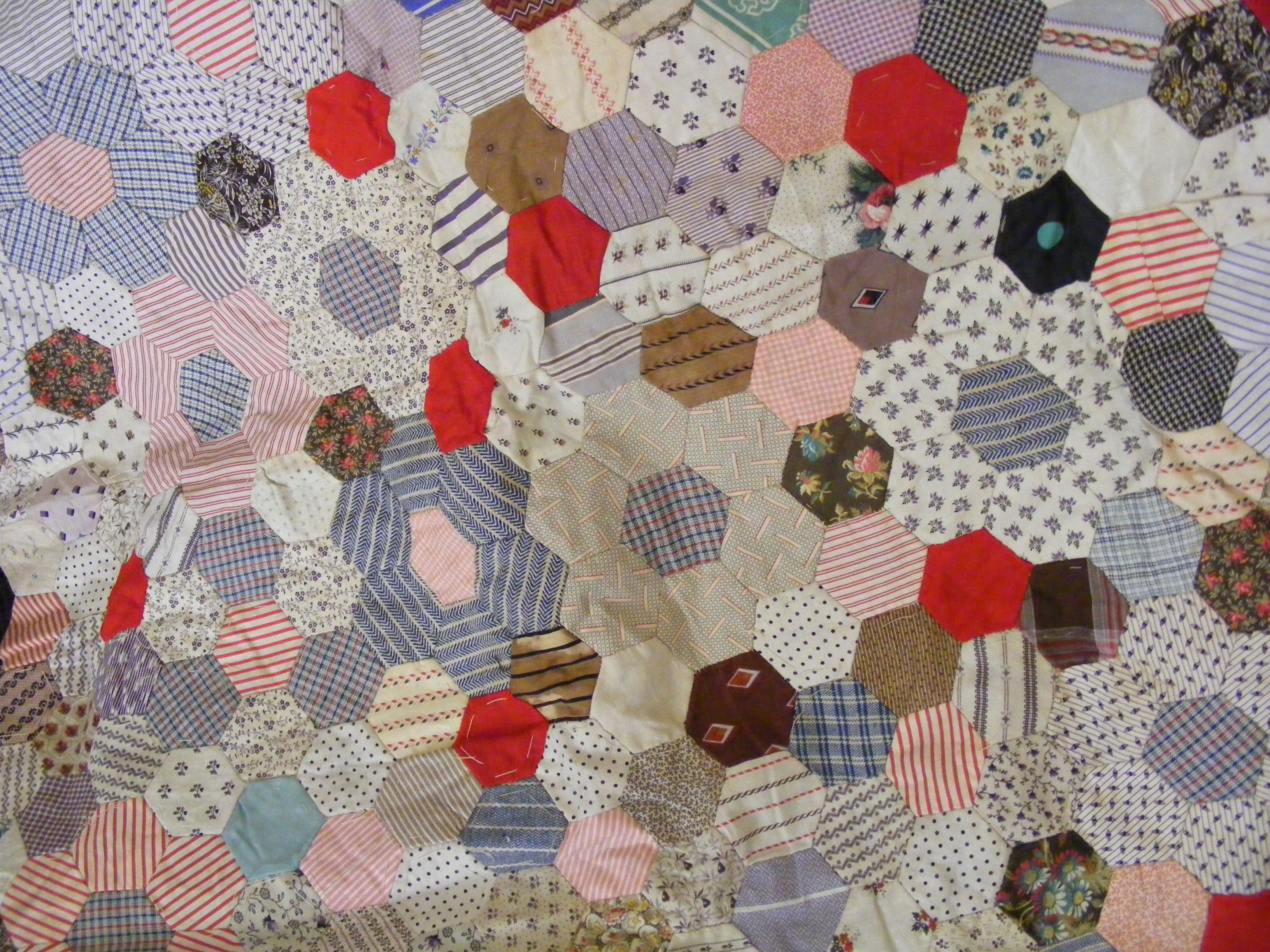
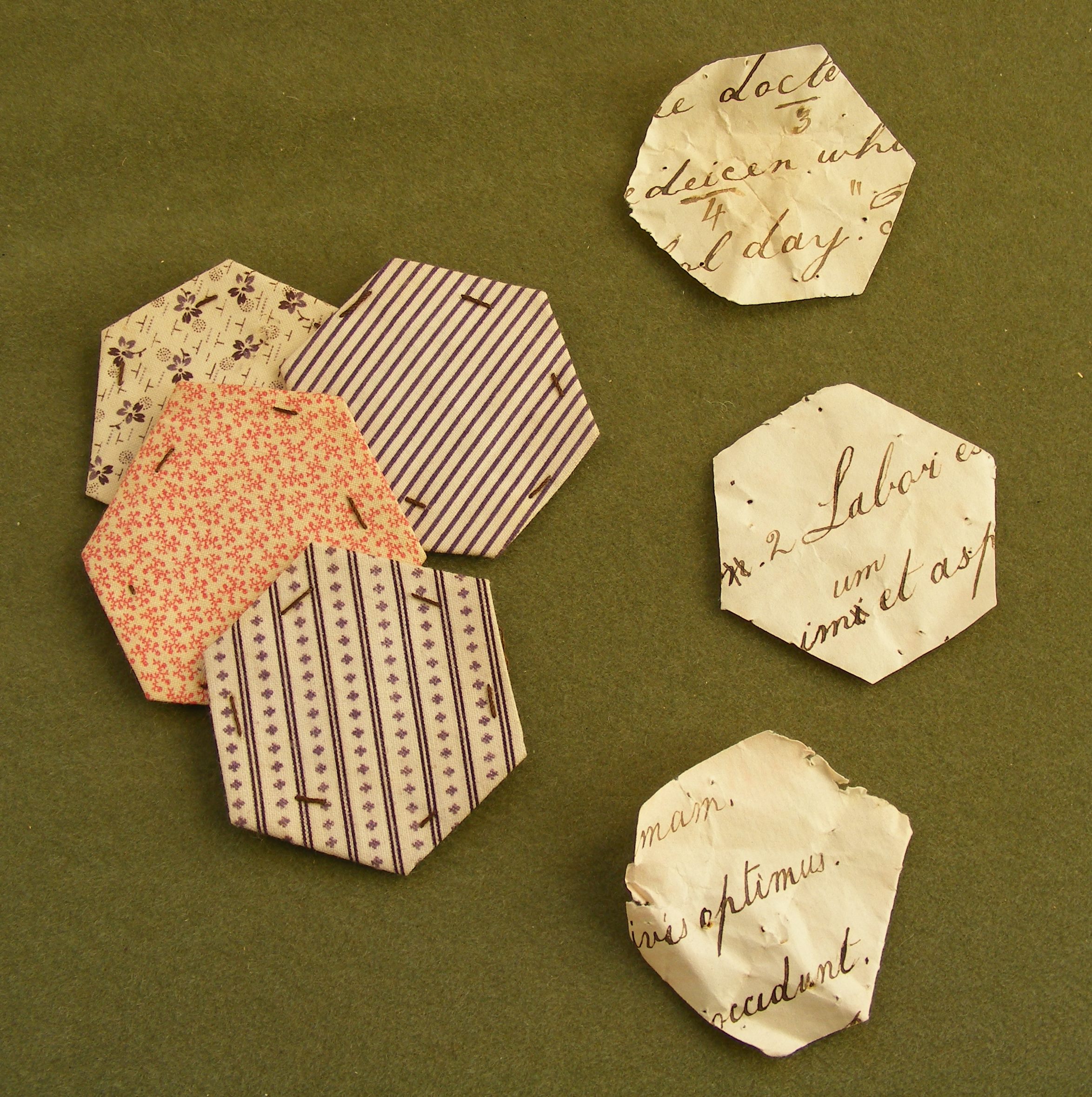
DSCF1583I am fortunate enough to have inherited two patchwork quilts, neither of which is quite complete. One was made by my mother in the early 1960s. It contains many materials that I remember from my early childhood. The other is much older, begun by my great grandmother in the 1880s. Most of the fabrics are tiny, floral, Victorian prints. Some of the papers are still within the hexagons; these have been cut from an exercise book of a similar era. My grandmother and mother also contributed to this quilt and I have begun to finish it by hemming round the edges. DSCF1588I shall deliberately leave a little undone, allowing my children and grandchildren (okay so the grandchildren have to get a little older before we trust them with a needle!) to work on the quilt too. That will make six generations working on one object and providing I record its story, it will be a true heirloom.

O is for Ownership – do you own your family tree?

Recently Dick Eastman commented on ownership of family trees, berating those who complain if their family information is ‘stolen’. Dick wrote, “Many genealogists think the information they collect becomes private for some reason and that no one else has a right to view the info. They collect information about names, dates, and places throughout history and then seem to believe that they “own” the information, even though they obtained all that from publicly-available sources. I believe they are wrong, both for legal and for practical reasons.”

In my opinion, there is a distinction here between genealogy and family history. Genealogical facts are primarily in the public domain and do not ‘belong’ to anyone. The synthesis of that information in order to produce a true family history, complete with national and local context, memories and social historical comment is very different. This is your personal family story.

I don’t consider that I ‘own’ my ancestry. I have shared genealogical and family historical information for nearly four decades. I do so by email but not online because I want a genuine two way dialogue with people who may have information to offer in exchange. I also want to be able to explain exactly how I reached my conclusions. I accept that people with whom I have shared family trees may pass them on and publish them online. They may be ‘stealing’ my interpretation of the data but others could come to the same conclusions give the same facts. I am however far less accepting of those who take lengthy portions of text that I have written and incorporate them in their websites or other ‘publications’, frequently without consultation or acknowledgement. I believe that the in-depth research and the synthesis of material from many sources that I have done in order to create my family history is indeed my own.

My sources never include ‘I got this from an online family tree’. That is not and never should be, a source. Work that others have done may be a guide but it is not family history (yours or anyone else’s) unless it has been verified in original sources. As I commented under ‘I’, the internet has given us ease of access to records in an undreamed of way. Equally, it has encouraged ‘short-cut’ genealogy, where the family trees of others, however poorly researched, are imported into the family tree of those name hunters eager for the largest family tree; a tree that will be in severe need of pruning.

When people learn that you are researching your family tree they inevitably ask you, ‘How far back have you got?’ The sooner we promote the alternative, ‘How much do you know?’ outlook the better. A family tree with names but no places, occupations and sometimes even lacking in dates, is not a family history, it is a diagram. It is not a substitute for a personally researched ancestral story. You may not own the genealogical data but you can own the fully fashioned family story.

N is for National and Local Customs and Traditions

Whether you are interested in Local or Family History it is interesting to find out about the customs and celebrations of the past. Some of these, such as Maypole Dancing on 1st May are countrywide, others are much more localised.

I have described some of my favourite celebrations here but there are many more. For its name alone Whuppity Scoorie, which takes place on 1st March in Lanarkshire, Scotland, has to be included. It involves children running three times round the church, wielding balls of paper on the end of a string. The origins are unknown but it probably relates to the coming of spring.

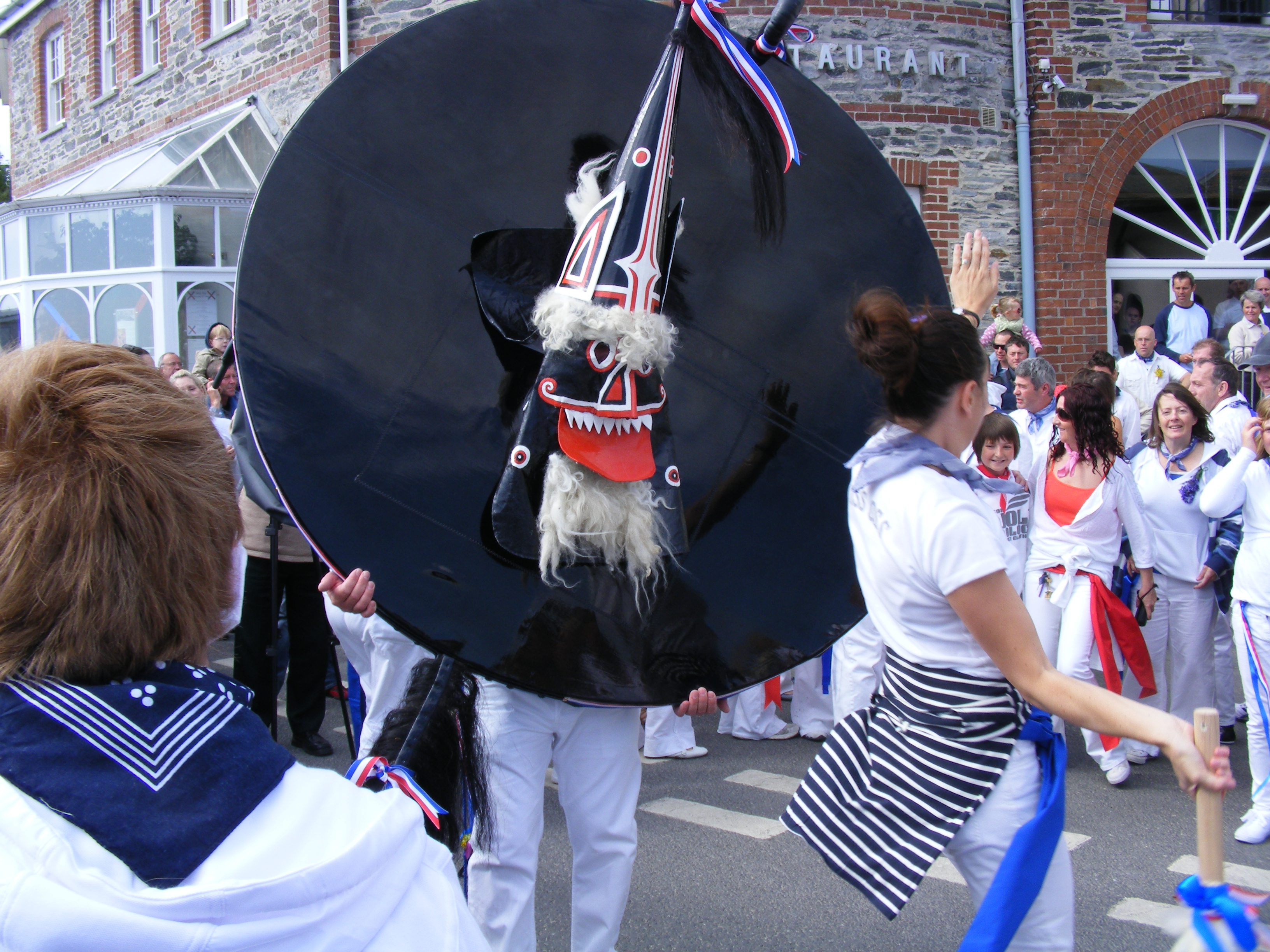
2 May 2011 Obb Oss Day teaser and blue oss 3

Padstow ‘Obby ‘Oss Day 1st May

Then there is Beltane. This is a pagan fire/fertility festival is celebrated on 20th April. Two Cornish celebrations next. Padstow ‘Obby ‘Oss Day on 1st May, when the blue and the red horses parade round the town, followed by their supporters. Followed by Helston Furry Dance or Hal an Tow, popularised by Terry Wogan as Floral Dance. Both are fertility festivals.


At Coopers Hill, Brockworth, Gloucestershire cheeses are rolled down the hill. This is another long standing tradition that has alternative suggested origins. This also take place in May. On 25th July, in Ebernoe, Sussex, the Horn Fair is celebrated. Currently rams horns are awarded to the highest scoring batsman following a cricket match. Nottingham’s October Goose Fair has a history that goes back 700 years. The November Lewes Bonfires, another Sussex celebration, commemorating not just the gunpowder plot but seventeen Protestant martyrs of the sixteenth century. Christmas Eve in Dewsbury, involves Tolling the Devil’s Knell. It was critical to appease the devil at the darkest time of the year.

For more customs see here, or read Ronald Hutton’s Stations of the Sun: A History of The Ritual Year in Britain. Think about the celebrations or customs that might have been part of your ancestors’ lives, or may have been traditional in the place where you now live. Try to attend some of these festival, the atmosphere is usually something special. For an interesting discussion on this subject watch this video.

M is for Memories

Under this heading it is only natural that I should mention my current project, encouraging a lovely group of ladies to record their memories of the period. 1946-1969. The project is about life in Britain but my volunteers are currently as far apart as Australia, Greece, USA and the British Virgin Islands. Some ladies went to boarding schools, some to grammar schools and some to secondary moderns. Some are only children, some had large extended families and some grew up in care. Some experienced this era as teenagers and others as married women with families; my oldest participants are in their nineties. I have sisters taking part, mothers and daughters and groups of friends. About half my volunteers have joined a Facebook Group dedicated to the project and this has taken on a life of its own, as members share memories. The participants are hugely supportive of each other and are genuinely enjoying the experience.

4 April 1958

Write About the Clothes that you Wore in the Past

Although writing one’s memoirs could be seen as self-indulgence it can also be cathartic. Not only that, even people who think their lives are intrinsically boring have plenty to offer. I am greatly enjoying reading each and every one of the memoirs that I am sent. I am humbled by how grateful the participants are to be taking part. If you have ever thought about writing your life story, don’t hesitate, make a start. If possible, chat with someone else about the era. Even if they did not share your life at that point in time you will spark off memories. Don’t worry if you feel you are ‘no good’ at writing or if you think you have nothing to say. Look through old photographs to help the reminiscences flow. If you are not fortunate enough to have photographs, take a look at books that cover the time that you are writing about. There are some suggestions for 1946-1969 below. In any case make a start, your descendants will thank you for it.


Feeney, Paul A 1950s Childhood: From Tin Baths to Bread and Dripping The History Press (2009)

Feeney Paul, A 1960s Childhood: from Thunderbirds to Beatlemania The History Press (2010)

Opie Robert The 1960s Scrapbook Pi Global Publishing (1999)

Pressley, Alison The 50s and 60s The Best of Times: Growing up and Being Young in Britain Michael O’Mara Books (2003)

Those starting to write their memoirs may also be interested in The Book of Me

L is for Local History

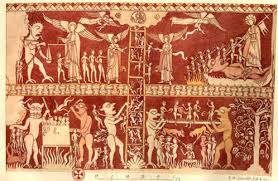
imagesHaving discussed Communities and Community History when I got to C, is there more I can say under L is for Local History? My introduction to local history was during ‘Liberal Studies’ in the sixth form. We had to spend a few hours a week doing different courses that were not examination related. This gave the staff a chance to share their expertise. Most of these courses have slipped from my memory but I know I did one about the origin of place names and another on local history. I don’t know how I arrived at the decision to study the history of a church that was two bus journeys away. I have no recollection of having visited before the advent of the course. Nonetheless I embarked upon compiling a history of St Peter and St Paul’s Church in Chaldon, Caterham. This church is famous for its twelfth century mural. On a recent visit to the haunts of my childhood I also renewed my acquaintance with Chaldon Church.

At this point my research never got me to a Record Office, I wasn’t aware of their existence at this stage. I did however spend time in a local studies library and from then I was hooked. I shall be discussing the importance of teachers when we get to T and there will be more about young people under Y but this does illustrate the benefits of the ‘catch ’em young’ policy.

When I started my local history career no one could have imagined the internet, or how our living rooms could become libraries or record repositories. Forty years on I am in a position to be able to share some of my favourite local history websites with people around the world, many of whom I shall never meet. I am deliberately not describing what these sites contain – that way you will look for yourselves!!

Society for One-Place Studies

The Family and Community History Research Society

British Association for Local History

Community Archives and Heritage Group

English Place Name Society

Local Population Studies Society

The Cambridge Group for the History of Population and Social Structure 

Scottish Local History Forum

Local History Online

Urban History Resources Hub

The Centre for English Local History

K is for Kinship #familyhistory #atozchallenge

Having dealt with journeys and migration yesterday ‘K’ gives me the opportunity to write about another of the themes underpinning my ‘emigrants’ research – kinship. What role does kinship play in migration choices? Certainly there is plenty of evidence for chains of migration, where one family member goes overseas and is followed by siblings, cousins or other relatives. This leads us on to wonder how strong family ties were for our predecessors. Particularly in a small rural community, where many inhabitants were related in some way, how aware would our ancestors have been of those relationships? Unless they are family historians, many people in today’s world would struggle to name all their first cousins, let alone be in contact with them. How much is this due to the fact that many families are now widely geographically dispersed, whereas a century ago they might still be living in close proximity? In the days when families were larger, did cousins become insignificant because siblings were numerous?

Many celebrity tree hunters are keen to link two disparate celebrities on the same pedigree. If we try hard enough and follow many ancestral lines we can probably link ourselves to someone famous, to royalty, or to a number of our friends and acquaintances. There was a dear family history friend whom I had known for many years. We had long since had the conversation ‘I am descended from the Smiths of London’. ‘So am I! Ha! We must be related!’ A considerable while later it turned out that we were indeed related (more of that story when we get to S).

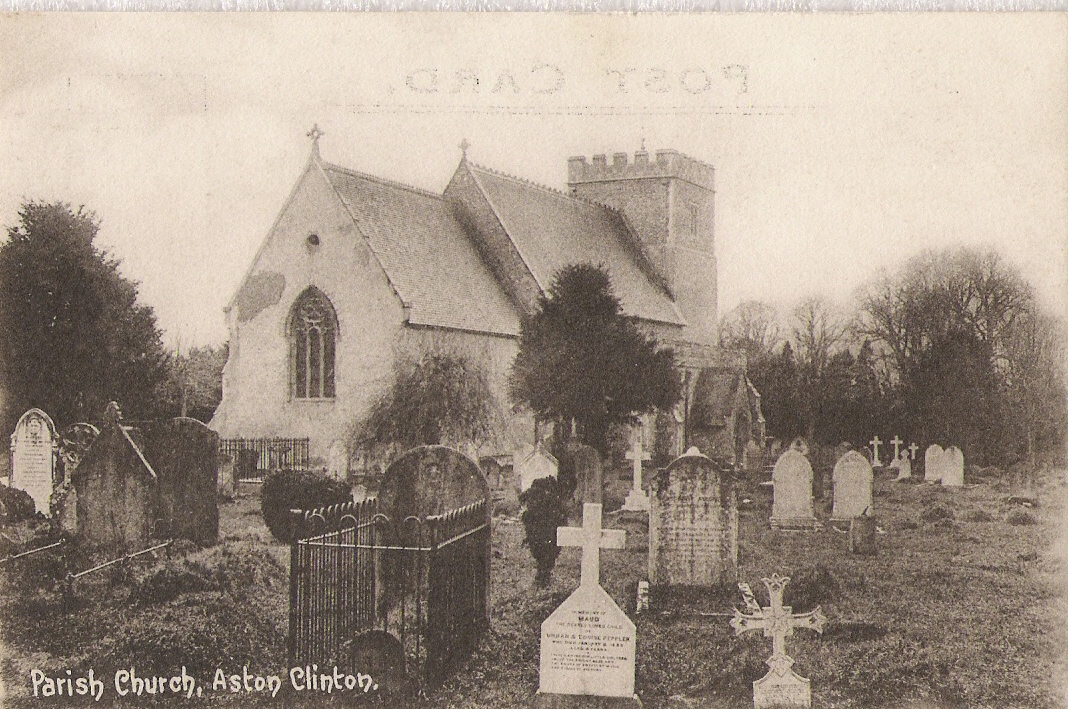
Aston Clinton Church

The Church where my great great grandmother and also my daughter were baptised

Equally we can probably connect ourselves to many places through our distant kin. So, for example, my four times great grandfather, William Braund, had a sister called Betty. Betty’s husband was Gamaliel Bartlett, whose father was, in 1735, baptised in the parish where I now live. Convoluted I know but the connection is there. More eerily, I moved to Buckinghamshire in 1982, believing myself to have no ancestral connections in the county. After I moved away I discovered that not only had my grandmother been born in Buckinghamshire, despite her family living in London but that my great great grandmother had lived in the same road in which I was make my home.


J is for Journeys

One of my research interests is migration, specifically emigration of the nineteenth century. I enjoy finding evidence of individuals relocating elsewhere, be it to a neighbouring parish or somewhere abroad. For the last ten years I have concentrated on those who left North Devon for overseas destinations. I want to know more about these people who were willing to make such drastic and to all practical intents and purposes irreversible, life choices.

According to Mark Brayshay (‘The Emigration Trade in Nineteenth-century Devon’, in Duffy, Michael; Fisher, Stephen; Greenhill, Basil; Starkey, David J. and Youings, Joyce (eds.) New Maritime History of Devon Volume 2: from the late eighteenth century to the present day, Conway Maritime Press (1994) p. 108), 434,806 people left Britain via a Devon port between 1840 and 1900. Some of those leaving, especially from Plymouth, may have been Cornish but equally, Devonians left from ports outside Devon. Some of the emigrants I have studied left from Liverpool, Bristol, Southampton and even Padstow. Nationally, 75% of Victorian emigrants went to America. In Devon however only 1·1% to America. Instead Devonians headed for Australasia and in the case of North Devon, predominantly for Canada. Nineteenth century emigrants from North Devon appear to have chosen routes and destinations that were familiar to them, if only through oral traditions which persisted from the eighteenth century, when there were regular transatlantic cod fishing expeditions. Whereas earlier travellers to North America had been motivated by economic pressures and were, in the main, not permanent emigrants, by the 1830s, individuals were influenced by other factors and were setting sail without intending to return.

What prompted these life changing journeys? When trying to ascertain the motive behind any movement, it is useful to consider the migrant’s life stage, their migration companions, if any, their occupation and what is happening in both the sending and receiving communities at the time of the move. As it turned out, in the case of my Devon emigrants, I also needed to look at religious belief. The religious climate of North Devon was far more akin to that of Cornwall than it was to that of South Devon. The 1851 religious census shows a very high number of attendances at Bible Christian Chapels in March 1851, notably in Devon’s north-westerly parishes. The Bible Christians were a Methodist offshoot, formed in 1815 by William O’Bryan. The first two circuits were at Shebbear and Kilkhampton. Emigration was a significant part of the Bible Christian way of life. In 1832, 1·1% of total membership left Britain. By the 1860s, the high emigration levels amongst the Bible Christian community were having a detrimental effect on their following in this country. Members of this church were attracted by the prospect of helping to establish circuits abroad. In addition, some were meeting with hostility at home. The emigrants to Canada, in particular the area round Port Hope, in what is now Ontario, formed part of an intricate network of kin who left North Devon during the nineteenth century. Research shows that virtually all of these emigrants belonged to the Bible Christian Church.


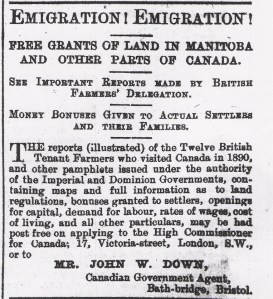
emigration advert 1892More information about the North Devon Exodus can be found here.

For those with little to do and the patience to wait for the file to download, Chapter 6 of my thesis deals with emigration.

You may also be interested in learning more about the Bible Christian Church.

The list of emigrants from North Devon, whose stories I am currently researching are listed here.