I’ve been here, there and almost everywhere over the last few weeks. Trying to find various far flung places is not always easy and sometimes our not so trusty sat-nav fails us (see below for some of the gory details). Mapping our ancestors and the communities of the past is just as important as knowing where we are going in the present. Although it is not a course of my own devising, I am pleased to be tutoring the ‘Maps and Surveys – Locating your Ancestors’ course for Pharos Tutors, starting on 9th August. There may still be spaces, so please do book. The course is primarily about British sources but it is all online, so those of you with British ancestors can study it wherever you are in the world. Apart from a general overview, we shall be looking in detail at one of my favourite sources – the 1910 Valuation Office Survey, as well as the tithe maps and apportionments and enclosure maps. Do join me!
I certainly needed a map on several occasions recently. When we go out swording and spindling, which we’ve been doing a great deal lately, we take a vehicle of suitable dimensions – you try getting eighteen pikes (no not the fish) into a Nissan Micra. So not in the Nissan Micra then but for reasons we won’t go in to, in a vehicle with no way of charging the sat-nav. This means that, in fear of the battery running out, we delay turning on the sat-nav until we get to the point where we are almost lost. Sat-nav set for a school in south east Devon, via Crediton, to avoid as much rush hour traffic as possible and we are on our way. We get well beyond Crediton before we feel the need to turn on the sat-nav for advice. We follow Sally sat-nav’s exhortations to go right, left and ‘turn around where possible’ with only a few slight hiccups when we reach roads that have been built since she was last updated. Suddenly we appear to be miles away from where we should be. I resort to a map (once a girl guide …..) and we arrive with minutes to spare – good job I am genetically programmed to leave what is normally ridiculously early for any event. Later we realise the problem. Even though we were well past Crediton, we had asked to go via Crediton and that is what the sat–nav was trying to make us do – lesson learned.
Amongst all the school bookings have been talks to grown-ups. One was at Devon Rural Archive. We needed a map to find that one too but what a gem. A really great set up, a full house and a very appreciative audience for my seventeenth century gardens presentation. A visit is definitely recommended. Then there was a talk to a Somerset WI who were celebrating their 85th birthday, a yummy birthday tea as well on this occasion! We decided to combine this trip with picking up a ‘collection only’ chest of drawers that I had purchased on eBay. Again we have the large pike-carrying non sat-nav charging vehicle. First finding the industrial estate where the chest of drawers is hiding, comparatively straight forward. Next, getting the chest of drawers into said vehicle – Ah. I had sensibly measured the space at home where it was to go and it fitted. Had I measured the vehicle. Err…. that would be a No. Well, in the end, with much manouvering, we inserted said chest of drawers into said vehicle. Had it been a centimetre larger in any direction we would have been in trouble.
Our local history society has been on display at various events in the village and beyond lately. A few days ago we were part of an open day at a nearby iron age hill fort. Actually getting to the display area by the fort was a logistical nightmare. We needed to get a table, display boards and various books and papers to what was effectively the middle of nowhere. You will note also that this was a hill fort, the clue is in the name. Our Iron Age forebears liked to have a commanding view. We did find the nearest point on the road with the aid of maps, directions and signs erected by the organisers. Sat-navs are no use for hill forts surrounded by woods. We then had to get our equipment along the footpaths to the hill fort. Chris manfully agreed to risk life and vehicle by driving along a bridleway but it was still a jolly long way to transport our belongings. I can verify that I am just too short to comfortably carry a pasting table half a mile without it banging on the uneven ground. Having been blown away at the recent Buckland fete, on this occasion, we were adamant that our display needed to be under cover and out of the wind. Sure enough, we were provided with a large tent, with jolly, retro curtains. Unfortunately, this was a hot day with no sign of wind or rain, so any perusal of our display was limited by how long the public could endure the heat and humidity in the tent! Luckily, we were helped by landrover transport on the way back to civilisation.
We now seem to have summer at last, just as I planned to do things to the house and garden that require temperatures of under 30 degrees, not that I am complaining. I also have visits from small persons to look forward to over the next couple of weeks – hurrah!
 hings have taken a bit of an Australian turn lately. I spoke to the
 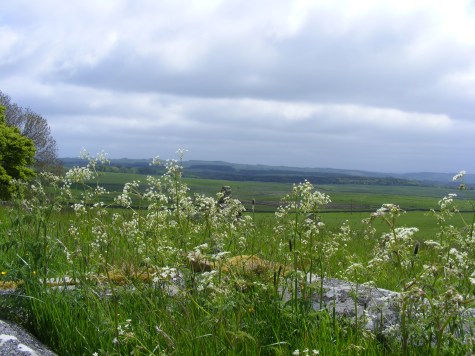 We are heading for Thockrington where the Hogg family lived in the eighteenth century. I am 99% certain that my great great grandfather was baptised here. The grain of doubt comes from the fact that gg grandfather changed his age and birth place at every conceivable opportunity and even swaps John for George on one occasion. Despite having two ‘wives’ one of whom he acquired during the period of civil registration (whoopee, a marriage certificate with a father’s name you’d think) no marriage records have been found. Anyway back to Thockrington. This is an amazing place with views that are virtually unchanged since the Hoggs were here (as long as you stand with your back to the wind turbines). Here you are on top of the world, absolutely the right place to build a church and a truly spiritual place, whatever higher being you might subscribe to. I maintain that everyone should visit here but not all at once, obviously and not when I am here. If you take my advice be prepared for driving a fair way along single track road, possibly across cattle grids, depending on your direction of approach, driving through a farmyard and finding a church, a farm and absolutely nothing but awe inspiring scenery as far as you can see in all directions. Do it, it is worth it. Just to add to the glory the sun comes out.
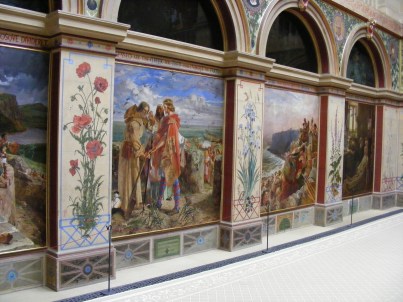 Scotland is apparently bathed in sunshine. Typical, here we have drizzle and falling temperatures. Time for another National Trust property near you visit, this time to Wallington House near the weirdly named Cambo. The house was built for William Blackett in 1688 and then passed into the Trevelyan family, who, as the name suggests, originated in Cornwall. The most notable feature of this house is a central courtyard, which was covered over in the 1850s and decorated with murals depicting the history of Northumberland, for which the artist, William Bell, was paid £100 a panel. We are supposed to spot stuffed squirrels in the various rooms. I clearly need a two year old with me for this. Mind you I was not helped by the sample squirrels being three times the size of the hidden ones. There is a group called Robson’s Choice playing the Northumbrian pipes in the hall. These are very different from Scottish bagpipes and are much more suited to an indoor performance. They are not blown but the air is injected by squeezing bellows strapped to the elbow. My favourite features are once again the kitchen and also a series of photographs of former servants that are on display as part of a ‘Silent Voices’ project.
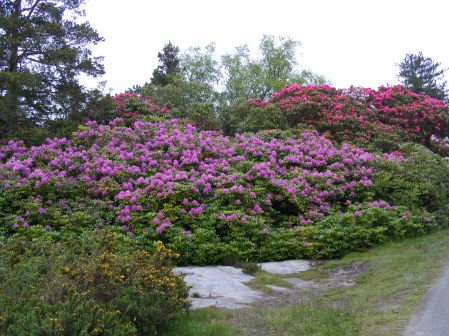 Cragside has plenty of opportunities for outside exploration, with gardens and extensive grounds. Given the temperature, we opt for driving along the six mile estate drive, which commences by driving under an arch through the house. This is obviously the right time for a visit as the rhododendron lined woodland paths are spectacular. It is a shame that we have neither the time, energy, or the warmth, to explore on foot. Home then via a quick shopping stop at Rothbury.
 The main product that was smuggled was tea, which in Nisbet’s time attracted 119% tax. The house includes a hidden chute where large quantities of tea could be stored, a hidey hole under the floorboards, capable of concealing three men and warren like cellars, where our tour began. The top floors were not finished for twenty years, by which time a tenant, John Stewart, was in residence. The house was sold to rival merchant and smuggler, Alexander Robertson, to pay debts and then passed to the Home family. From 1906-1965 the house was run as a guest house by the Dougals. It then did time as a clubhouse for golfers and was finally acquired for restoration by the trust in 1998. In fact very little had been altered by the succession of owners. Pleased with our choice of ‘bonus’ visit, we return to Berwick Seaview site, which is by then living up to its name.
 The weather is much better today. Not as much better as some of the locals, with their bare chests and shorts, are implying; I still have my coat and jumper on. We can at least see the view over the Firth of Forth as the mist has lifted. The castle fire a cannon at 1pm daily, except Sundays, so we shall miss that. St Margaret’s Chapel is the oldest part of the castle. It was built in memory of Margaret, the mother of David I. It is very tiny and although it is still used for weddings, you are limited to 25 guests. After our tour we wait for an excellent presentation by an historical interpreter, representing Sir Thomas Randolph, Earl of Moray who, in 1314, was charged with recapturing the castle from English occupation. It was one of three castles in English hands at the time. Roxborough was re-taken by men disguised as cows. Randolph, whose half uncle was Robert the Bruce, climbed the rock using a secret path revealed to him by the son of a former castle governor and got inside the castle with thirty men, whilst others created a diversion at the gates, so the castle was recaptured from inside. It is great to chat to the interpreter and try his weaponry. The chain mail is seriously heavy and the full face helmet certainly restricts the field of vision. He has a fiendish looking mace, which was designed for use by churchmen who were not allowed to let blood, although bashing people over the head was fine!
 On the way back to the van we call in at Currie, where my granddaughter’s ancestors came from but no luck with the graveyard here. There are some very unusual stones there though.
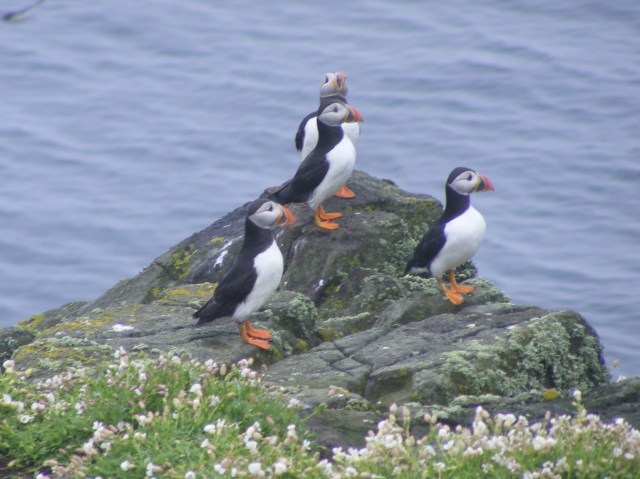 We start to see more and more seabirds through the mist and drizzle, including my first ever puffin! As we near the island the water is thick with guillimots, razorbills and more puffins. We have three hours to spend on the island and we walk most of the pathways. Departing from the marked routes is strictly forbidden in case puffin burrows are damaged. Even with my very basic £100 camera I manage half decent, recognisable shots of the islands birds. Apart from the puffins, razorbills and guillimots there are, oystercatchers, shags, fulmars, black-backed gulls (lesser and greater), fulmars and kittiwakes. There is also an active tern colony and the terns dive bomb the visitors making their strange ticking cries (that would be the terns’ cries, not the visitors). Eider duck nest right by the pathways; I had forgotten that the females were a drab brown, in contrast to their gaudy husbands. A tremendous plus for having had to do this part of the trip two years later than originally planned is that, had we made it here as intended in August 2014, there would have been far less to see. Despite the chilling wind I am having a great time, though I agree that slightly warmer weather would have been the icing on this particular cake.
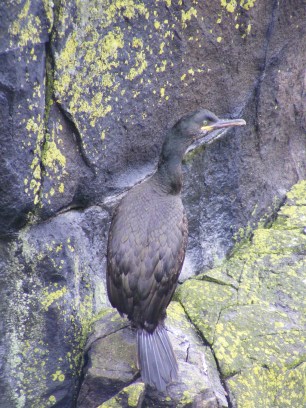 A great deal of what is known about sea birds and migrations patterns is thanks to data collected on May. Only the researchers live on the island as the lighthouse is now automated. It is 200 years old and was built to replace the oldest lighthouse in Britain, which was a coal fired beacon tower dating from 1636. This took between one and three tons of coal a night to maintain, all of which was brought from the mainland and hauled to the top of the tower. The island used to be a monastic foundation, with St Ethernan’s shrine attracting pilgrims since the seventh century. The island was home to St Adrian until he carelessly got murdered by the Vikings in 875. In 1500, James IV had a picnic on the island, because he could I guess. After the 1715 Jacobite rebellion, three hundred fleeing Jacobites somehow got stranded on May for eight days without food.
 The History Interpreter - Janet Few