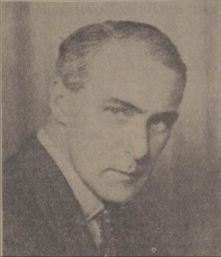
#100daysofbfotc Day 28: Joe Prance

Capture

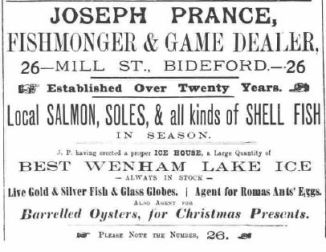
North Devon Gazette 22 December 1896

Joe Prance appears in Chapter 2 of Barefoot on the Cobbles, when the action moves from the rural tranquillity of the North Devon coastline to the bustling town of Bideford. He was primarily a fishmonger and game dealer, with a shop at 26 Mill Street but he also sold dried goods. He had been born in 1834 in the fishing hamlet of Peppercombe, where his father was a fisherman. He was involved in a childhood accident, which left him with one leg longer than the other. Perhaps surprisingly, in an era before compulsory schooling, he received a good education. The 1861 census finds him lodging in Bideford in order to attend school. He returned to fish from Peppercombe and married a local girl, Susan Found; they had eight children, two sons and six daughters.

In the 1870s, the family moved to Bideford and initially the fishmongers was at 25 Mill Street. It appears that at some point during the next decade, the business absorbed the greengrocer’s at 26. In old age, Joseph and his wife lived at Lower Meddon Street with their married daughter. Joseph died in 1912.

‘Uncle Prance was at the counter arranging the dried goods to his satisfaction and awaiting the delivery of crabs, lobsters, and shimmering bass to lay temptingly in the window.’

Barefoot on the Cobbles will be published on 17 November 2018. More information about the novel can be found here. Copies will be available at various events in the weeks following the launch or can be pre-ordered from Blue Poppy Publishing or the author.
#100daysofbfotc Day 27: Holidaymakers

Capture 3Holidaymakers who ventured to North Devon’s coast were welcomed and dreaded in equal measure. By the time in which Barefoot on the Cobbles is set, the income from tourists was an increasingly important part of the local economy. For those who lived in Clovelly in particular, money gained from providing for visitors enhanced the precarious living scraped by the fishermen. Some visitors took up residence in the local guest houses, many others were interlopers for a fleeting day. They came by sea from further up the Bristol Channel and were ferried ashore by the fisherman. Others arrived by charabanc from the station at Bideford. Still others were transported by horse-drawn vehicles, to be disgorged at the top the cobbles, so they could descend into a different world, stumbling in their unsuitable shoes.
Through the pages of the novel, we arrive in Clovelly when everything is changing. Soon, it will no longer be a fishing village, with holidaymakers providing a secondary revenue stream; before long tourist vessels will eclipse the fishing boats in the harbour. Folk from ‘up-country’ may pass through, leaving little of themselves behind, or they may dislocate the lives of the inhabitants forever. Welcomed or despised, holidaymakers were needed and they could not be ignored.

‘In half-forgotten pre-war holiday seasons P & A Campbell’s steamers had brought hundreds of day-trippers from Ilfracombe, or even South Wales. Tourists were tolerated. They spoiled the solitude, the silence and the regular rhythm of the fishing year. Yet with them came colour, diversion, bustle, excitement.’

Barefoot on the Cobbles will be published on 17 November 2018. More information about the novel can be found here. Copies will be available at various events in the weeks following the launch or can be pre-ordered from Blue Poppy Publishing or the author.

#100daysofbfotc Day 26: Edward Collins

Without Edward Collins’ actions Barefoot on the Cobbles would not have been written. He embodies human frailty, as do we all. His complexities are hinted at in the very brief glimpses of him that have been found in the records. He was key to my story, yet, of the main characters, he was the one about whom I could find least. As I sought to uncover a sympathetic, yet believable, motivation for his somewhat strange behaviour, a three-dimensional individual began to emerge; one who had experienced his own trauma and tragedy. Mainly due to his common surname, I was unable to contact any family members. Should they read the novel, I do hope that they feel the conclusions I have drawn from the meagre facts are not illogical. Despite the appalling, albeit largely unintentional, ramifications of his actions, I wanted the reader to be able to empathise with Edward Collins, who was, in his own way, a victim. I hope I have succeeded.

We meet Edward Collins in Clovelly, where he is staying for the benefit of his health. From the outset he is an enigma. He and his wife can clearly afford expensive hotels, what then are they doing in a small guest house on the North Devon coast? He is comfortably off, a professional, a university man. How will he interact with Clovelly’s down-to-earth fishermen?

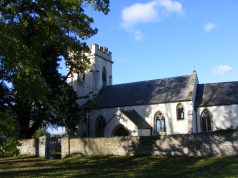
Thornfalcon Church burial place of Edward Collins

Thornfalcon Church

Edward Laurence Collins was born on 1 May 1880 in Liverpool. He gained an MA from Cambridge University and became a consulting engineer. Although I have been unable to positively identify a role for him during the First World War, I think that it is likely that he saw action in some capacity. He married Amelia Martha Hutson in 1915. It seems unlikely that the couple had any children. It also appears that his two sisters died unmarried, hence the lack of living relatives. The Collins remained in Clovelly for some time after the events described in the novel. Edward then travelled widely, probably in the course of his work, going to Gibraltar in 1926 and Chile in 1936. He had plans to live in the Channel Islands but I have no firm evidence that he did so. Edward Collins died on 17 January 1953 in Somerset and is buried in Thornfalcon Church.

‘Clovelly slept. There were no sounds from the cobbled street but the night and its attendant horrors, closed in on Edward Collins. Even eighteen months spent embraced in the village’s serenity had not banished the terrors that darkness could bring. He awoke from the recurring nightmare, shaking and sweating. Curled in a foetal position, clasping his knees, he silently sobbed.’

Barefoot on the Cobbles will be published on 17 November 2018. More information about the novel can be found here. Copies will be available at various events in the weeks following the launch or can be pre-ordered from Blue Poppy Publishing or the author.

#100daysofbfotc Day 25: ‘Johnnie Adelaide’

Malcolm Langford cards (8)

The home of ‘Johnnie Adelaide’ (right hand cottage)

‘Johnnie Adelaide’ is so called to distinguish him from another John, who lived at the other end of Bucks Mills village. Both men had their wife’s christian name appended to their own, becoming ‘Johnnie Adelaide’ and ‘Johnnie Lydia’. ‘Johnnie Adelaide’ is mentioned just once, in the first chapter of Barefoot on the Cobbles, along with two of his daughters Norah and Gertie. As inhabitants of 4 Forest Gardens, ‘Johnnie Adelaide’ and his family were Mary and William’s neighbours. John’s wife, Adelaide, had lived in the cottage with her widowed mother, Mrs Dunn and continued to bring up her family there. 4 Forest Gardens eventually passed to ‘Johnnie Adelaide’’s daughter, Louisa.

Like most of the men in Bucks Mills, ‘Johnnie Adelaide’ spent his working life at sea, combining fishing with engagement in the merchant service. He had been born in the village in 1847. At the age of thirty three he married Adelaide Dunn and they had four daughters and a son.

‘Firmly and before she could be gainsaid, Mary answered, ‘She be staying put. There’s too many of them down at Ivy. I could do with some help in the house now me arthritics be so bad and she will walk up to school with Johnny Adelaide’s girls. Norah’s about her age and Gertie can keep an eye on them both on the way. She won’t be no trouble.’ ’

#100daysofbfotc Day 24: Bucks Mills, The Coffin Arms

Coffin Arms 1928By the time that it is mentioned, in the first chapter of Barefoot on the Cobbles, it has been twenty years since the Coffin Arms closed its doors. Its unusual name comes from the local landowners, the Pine-Coffin family. The Coffin Arms served the fishing village of Bucks Mills as an ale house for fifty years before the licence was transferred to the Coach and Horses at Horns Cross. Bucks Mills has been a dry village since that time. It is likely that it provided off sales rather than being an inn.

The cottage formed part of the Pine-Coffin estate and was almost certainly built, along with most of the other dwellings on that side of the Bucks Mills road, in the 1810s. The earliest known tenants were the Bale family. During the 1840s the Coffin Arms was taken over by Samuel Harris, who combined beer selling with lime burning. Thomas and Thirza Webb were in residence in the 1860s, until Thomas transferred the licence to his brother-in-law, Joseph Dark.

Once the Coffin Arms became a private residence, it was the home of the Steer family for fifty years. Jane Steer took four orphaned nieces and nephews into her home. This brought the total number of inhabitants in 1871 to fourteen.

In the 1920s, with new owners, the name was changed to Woodlands. The house has lain semi-derelict for decades. More information about Bucks Mills can be found here.

‘He had signed the pledge at a young age of course but did not find abstinence irksome. Since the Coffin Arms closed to customers decades ago, there was no ale-house in Bucks Mills, so alcohol was not a temptation.’

Barefoot on the Cobbles will be published on 17 November 2018. More information about the novel can be found here. Copies will be available at various events in the weeks following the launch or can be pre-ordered from Blue Poppy Publishing or the author.


#100daysofbfotc Day 23: Dr Crew

Dr Crew

Unattributed newspaper cutting

Much of the incidental information about Dr Crew, that appears in Barefoot on the Cobbles, is based on fact. He really was the local scout master and he was indeed fascinated by chicken genetics. He breezes into the lives of the novel’s main characters when they are in crisis and there is only scope to portray the brief essence of a fascinating man, who spent just a short time in Devon.

Dr Francis Albert Eley Crew was born in 1886 in Tipton, Staffordshire, the son of a grocer. Frank was the only surviving child of five siblings. He was educated at King Edward VI School in Edgbaston and his interest in breeding and showing poultry began at an early age. His father changed careers and became the manager of a brick works; the family lived in Stourbridge at this time.

Frank went to Edinburgh University to study medicine, graduating in 1912. He married fellow student, Helen Campbell Dykes and together they set up a practice in Hartland and Clovelly. Quite what the inhabitants of rural North Devon felt about the ministrations of a female doctor is unrecorded.

A keen member of the territorial army, Dr Crew also ran the local scout troop. This allowed me to make a brief reference to a recently founded, yet significant, institution, which helped to evoke an essence of the era. The Bank Holiday camp in East Devon, to which Dr Crew alludes, is reported in the local press. Dr Crew was also an honorary member of the Mariners’ Union, along with Mr Caird, Clovelly Estate’s Land Agent. When the First World War broke out, Frank was attached to the 6th Battalion of the Devonshire Regiment. He gained the rank of major, serving with the Royal Army Medical Corps in France and India. The Crews had two children.

Dr Crew did not return to Devon after the war; instead, he went back to teach at Edinburgh University, becoming a leading authority on animal genetics, particularly chickens. During the Second World War he was in charge of the military hospital at Edinburgh Castle and was inspired by the many Polish prisoners of war to set up a Polish School of Medicine in Edinburgh. He gained the rank of brigadier and became the director of Medical Research at the War Office. After the war, he abandoned genetics in favour of concentrating on the development of nursing training. He made several overseas trips in connection with the World Health Organisation, including visits to Egypt, Canada and India. He worked for several years in Burma and India before retiring to Sussex.

In 1972, the year before his death, Frank remarried to Margaret Ogilvie Withof-Keus, with whom he had worked in the Army Medical Corps. More information about Dr Crews can be found here.

‘The doctor looked at Bertie appraisingly.

‘Hello young man,’ he said. ‘You look just the age for my Scout Patrol. Have you heard of the Boy Scouts? I am sure you would enjoy the jolly times we have. We are off to camp in a week or two. What do you think of that?’ ’

Barefoot on the Cobbles will be published on 17 November 2018. More information about the novel can be found here. Copies will be available at various events in the weeks following the launch or can be pre-ordered from Blue Poppy Publishing or the author.

#100daysofbfotc Day 22: Mrs Gilley


Capture

Torbay Express and South Devon Echo 12 August 1939

Although we first meet Mrs Gilley in the gardens of Clovelly Court, she is more at home in her home town of Torquay, where she is a lynchpin of the town’s genteel elite. It is through her character, amongst others, that Barefoot on the Cobbles can explore the intricacies and constraints of the early twentieth century social class system. We are allowed through the doors of her home to glimpse an opulence that is alien to most of the others who inhabit the novel’s pages.

Born Mary Elizabeth Angel in 1859, the future Mrs Gilley grew up in the comforts of an upper middle class household in Torquay. She and her sisters were educated at home by a governess. In 1882, at which time her family were living in Castle Grove, Torquay, Mary Elizabeth Angel married the widower, Tom Henry Gilley. Their early married life was spent at Kenwyn, Wellington Road, before they moved to Aylwood in Newton Road, Torquay. Mr Gilley established a flourishing railway cartage business and they associated with the cream of Torquay society. The Gilleys had eight children, two of whom died in infancy. Mary Gilley died in Paignton in 1939 and is buried in Torquay cemetery.

 ‘Mary Gilley was small and solidly built. Despite her greying hair and a slight stoop, she was impeccably and fashionably dressed; her speech underlining that she was a woman of some refinement.’

Barefoot on the Cobbles will be published on 17 November 2018. More information about the novel can be found here. Copies will be available at various events in the weeks following the launch or can be pre-ordered from Blue Poppy Publishing or the author.

#100daysofbfotc Day 21: Leonard

Leonard Braund c 1916Leonard’s story forms a sub-plot in Barefoot on the Cobbles. We follow his adolescent romance with the girl in the local tea-shop; one of the lighter moments in the story. As the First World War tightens its grip, Leonard has important decisions to make regarding his future. The dangers of his life in the merchant service create another concern to be heaped on the burden carried by his mother. A local fishing tragedy unfolds through Leonard’s eyes.

After the novel finishes, Leonard returned to the merchant service. He followed generations of his forebears fishing in local waters and was to man the safety boat during lengthy repairs to Bideford Bridge. He married and had four children, two of whom died in infancy, succumbing to the same condition that took his young brother. He spent his married life in Bideford and passed his love of the sea on to future generations.

‘There would be no fishing again today, thought Leonard. The sea, its vagaries, its beauty and its menace was the counterpoint to his life; an all pervading rhythm to which his body and his soul must respond.’

Barefoot on the Cobbles will be published on 17 November 2018. More information about the novel can be found here. Copies will be available at various events in the weeks following the launch or can be pre-ordered from Blue Poppy Publishing or the author.

#100daysofbfotc Day 20: Eli

Stan Flo and Stella, children of Eli and Maggie

Elis children

Eli has a role in Barefoot on the Cobbles as Clovelly’s carrier, primarily taking goods and passengers from Clovelly to the main town of Bideford. He is still using his horse and cart, in the face of competition from motorised alternatives. Born in 1871, Eli grew up in a Bucks Mills’ fishing family but moved to Upper Clovelly in his teens, to become a carpenter. In 1899, he married the daughter of the family with whom he lodged. They moved to Independent Street, in the village of Clovelly and later to The Bow. Eli’s father became a fish merchant in his later years, taking fish from Bucks Mills to market and perhaps this motivated Eli to become a carrier. As the twentieth century progressed, Eli moved with the times and worked as an attendant at the visitors’ car park in Clovelly. He died In 1955.

‘It was New Year’s Eve when Captain Jenn sent word for Eli to bring out his cart and collect the Clovelly crew members from the train.’

Barefoot on the Cobbles will be published on 17 November 2018. More information about the novel can be found here. Copies will be available at various events in the weeks following the launch or can be pre-ordered from Blue Poppy Publishing or the author.


#100daysofbfotc Day 19: Clovelly Quay

10393817_343879402427231_2897722245522442543_nThe quayside at Clovelly is the lifeblood of the village and it is a location that forms an integral thread in the fabric of Barefoot on the Cobbles. Here, the fisherman put out to sea, risking their lives for an uncertain harvest. When the weather is inclement, they mend their nets or weave lobster pots on the quayside, eager to get back in the tiny wooden boats and seek the shoals that are their livelihood. Holidaymakers alight here to exclaim over the village’s quaintness and to swell the coffers of the inhabitants. Anxious watchers line the quay scanning the waves for the returning lifeboat.

In the time of the novel, it was a bustling, working quay, with a fishing fleet unloading its daily catch and men now too old for the rigors of the sea, watchfully reliving their youth. Thus the quay is the social hub of the village, a focus for gossip and the comfort of old friends. Barefoot on the Cobbles is set at a time when the tourism was just beginning to compete with fishing as the lynch pin of the village economy.

‘For years he had sat on the quayside, listening to the old men yarning about their younger days. He had envied their memories, stories of travel and exploits that became more far-fetched with every telling but which awed the small boys whose lives had yet to unfold.’

Barefoot on the Cobbles will be published on 17 November 2018. More information about the novel can be found here. Copies will be available at various events in the weeks following the launch or can be pre-ordered from Blue Poppy Publishing or the author.