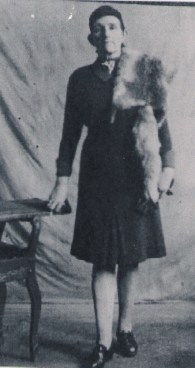
#100daysofbfotc Day 58: Torre Station, Torquay

Torre StationIn Barefoot on the Cobbles Torre Station in Torquay is both a gateway and a meeting point. It is here that Daisy alights to begin her new life. It is here that the many wounded soldiers arrived for transfer to the hospitals and nursing homes of Torquay; in this way it is where Daisy’s world collides with the horrors of the Western Front. Torre Station is also where Polly passes through on her way to confront her feelings for her daughter.

I studied the early twentieth century railway network, to try to get details of Polly’s journey to Torquay correct. I even used genuine train times, although I suspect that these may have been disrupted by the needs of the war. I was writing about an era when the railway was the predominant means of transport. So it was important that there should be train journeys in the novel. The journeys I describe were taken in real life and would have been lifechanging for the characters that undertook them.

‘Torre Station was small, more like Barnstaple but it still pulsed with hectic life, hypnotising Polly into inaction. Reminders of the war were ever-present. Each person carried with them the scars of the past four years; the age had marked them all. Anonymous, khaki-clad Tommies, with their old men’s unfathomable eyes staring from the bodies of boys. Bold young women, their shorter hem-lines and bobbed hair, reflecting a new freedom.’  

Barefoot on the Cobbles will be published on 17 November 2018. More information about the novel can be found here. Copies will be available at various events in the weeks following the launch or can be pre-ordered from Blue Poppy Publishing or the author.

#100daysofbfotc Day 57: Annie

Barefoot on the Cobbles is emphatically not a romance, yet it is a novel about people and people have relationships. Annie appears as a love interest for Leonard. There is an argument for removing the whole story of their courtship from the novel but I feel that it needs to be there. Leonard is not a principal player in the main events and as such, can give a different perspective. Annie is the vehicle for exploring a relationship that contrasts with Daisy’s association with Abraham.

Mary Ann (Annie) Stoneman was just a Victorian, being born twenty days before the death of Queen Victoria. She was the fifth child in a family of ten and five of her siblings died as infants. Her father, Sidney, was a labourer and the family moved frequently. Annie was born at Bulland in Parkham and as a small child spent time living with her mother’s grandmother in Clovelly. She later went to school in Monkleigh. In 1909 the family spent a few months living at Rakeham Toll House, near Torrington and Annie transferred to Frithelstock School. A family story relates that a tramp was found on the doorstep of the Toll House with his throat cut. This may be why they only spent a few months there before before moving again to Bideford, where they lived at Brookfield Terrace, East the Water.

Image (3) - CopyWhen her step grandfather died, Annie was sent to Clovelly to help her maternal grandmother, Mary Ann Smale, in her Clovelly tea-rooms. It is here that we and Leonard, first meet her. I don’t want to give away too much of her story but she did marry and brought up her family in Bideford. She died there at the age of 97.

‘As Leonard drew level with the small panes of blemished glass his eye was drawn by a sudden movement within. Enveloped in a large, wrap-round apron, a slender girl was in the window, dusting the deep sill and readying it for the day’s display of cakes.’

Barefoot on the Cobbles will be published on 17 November 2018. More information about the novel can be found here. Copies will be available at various events in the weeks following the launch or can be pre-ordered from Blue Poppy Publishing or the author.

#100daysofbfotc Day 56: Louisa Taylor

Western Times 2 September 1915

Western Times 2 September 1915

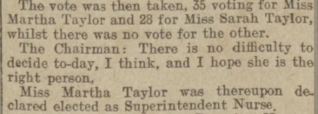
Louisa Taylor was the superintendent nurse at the infirmary attached to Newton Abbot workhouse. It is her attitude that contributes to Albert’s sense that everything is slipping terrifyingly out of control. Although we know some of the actual words that she spoke during the trial, we know very little about her. So few clues and the surname Taylor make her very difficult to research. Although the newspaper reports of the incident that leads to her appearance in Barefoot on the Cobbles consistently refer to her as Louisa, she was probably Martha Louisa Taylor and was appointed in 1915, three years before her appearance in the book.

It is likely that she was born in Bitton, Gloucestershire on 1 January 1876 to George and Mary L Taylor; her father was a coal miner. In 1911, Martha Louisa was working as a charge nurse at the workhouse in Kenninghall, Wayland, Norfolk. She remained at Newton Abbot workhouse until at least 1929 but she later retired to Keynsham, Somerset, where she shared a home with two other retired nurses. She died in Somerset in 1958. She is just the sort of character who it is a privilege to have included, as she as no descendats to honour her memory.

‘Louisa Taylor, the superintendent nurse at the infirmary, took Albert into a cramped office. Black-covered ledgers lined the walls and untidy papers trickled over the desk. The nurse, in her sharply starched uniform, moved a pile of books from a chair and bade Albert sit down. She was a woman past middle age, with a plain but pleasing, lined face and iron grey hair. Her brisk efficiency was at odds with the state of her surroundings.’

Barefoot on the Cobbles will be published on 17 November 2018. More information about the novel can be found here. Copies will be available at various events in the weeks following the launch or can be pre-ordered from Blue Poppy Publishing or the author.

#100daysofbfotc Day 55: Clovelly Church

1 April 2012 Clovelly ChurchyardDespite many of the main characters being Methodists, Clovelly Church appears in several key scenes in Barefoot on the Cobbles. It is here that the incident involving the suffragettes begins and here that we witness two funerals. On New Year’s Day, All Saints was also the venue of the annual ‘Club Service’, attended by members of the Friendly Societies.

This twelfth century church is at the top of the hill, away from the cobbles and close to Clovelly Court. There had been a timber-built place of worship on this site before the current church was built. The impressive roof is part of the renovations that took place in the fourteenth century. Further additions took place in later centuries.

‘Leonard shifted his body to gain himself a few extra inches of space and clutched the slightly damp, well-worn hymn book. The distinctive smell of steaming wet worsted pervaded the air. Reverend Simkin sonorously announced the first hymn. Tom Finch, during the week the rector’s gardener but proud organist on a Sunday, began to play, with more regard to volume than melody. Oh God our Help in Ages Past, comfortably recognisable to Methodists and Anglicans alike.’

Barefoot on the Cobbles will be published on 17 November 2018. More information about the novel can be found here. Copies will be available at various events in the weeks following the launch or can be pre-ordered from Blue Poppy Publishing or the author.

#100daysofbfotc Day 54: Mr Lefroy

Scales_Of_Justice.svgGeorge Frederick Lefroy appears in the court scenes at the beginning and end of Barefoot in the Cobbles. He is the solicitor for the defence, so plays a significant role in determining the outcome of the trial.

He was born in Bristol on 15 February 1882, the son of Reverend Frederick Anthony and Henrietta Lefroy née Gurney. By 1904, George was serving with the 1st Gloucesters, Royal Garrison Artillery Volunteers as a Second Lieutenant. George married Isobel Elaine May Beaman in Eastbourne, Sussex in 1908 and had one son. In the First World War he was a Lieutenant in the Royal Field Artillery. He was invalided out and was awarded the Silver War Badge. The Lefroys lived at Orchard House, Pilton in Barnstaple and he set up in partnership with Mr Seldon. He died in 1938.

‘Mr Lefroy rearranged his papers. He wanted this strange little lady to go free and not just because it would enhance his professional reputation. He prided himself on his ability to represent and take seriously, the cases of the downtrodden and Polly was certainly that.’

Barefoot on the Cobbles will be published on 17 November 2018. More information about the novel can be found here. Copies will be available at various events in the weeks following the launch or can be pre-ordered from Blue Poppy Publishing or the author.

#100daysofbfotc Day 53: Ivy Cottage, Bucks Mills

Malcolm Langford cards (19)

Ivy Cottage (top left)

Ivy Cottage was almost certainly built in the 1830s and is set back from the road on the coastal path to Clovelly. Like most of the cottages in the village, it was constructed of cob, with a thatched roof. In Barefoot on the Cobbles it appears as the home of Eadie and her family. Today known as ‘Crippetts’, the cottage, was occupied by the Harris family in the 1840s. They were followed by the Penningtons and it is likely that Eadie’s parents, Thomas and Ellen, moved in in 1874, the year after their marriage. They had nine children and although they did not all live at Ivy Cottage at the same time, the four rooms would have been very crowded. The family remained in the cottage for over sixty years and after Eadie’s father died, in 1938, it was taken over by Mr and Mrs Bergg. During the Second World War, the intrepid Mrs Bergg used to descend the cliffs on the end of a rope in order to destroy falcon’s eggs as birds of prey were attaching the carrier pigeons that were vital for wartime communications.

‘There were five girls in Ivy Cottage, where Eadie lived, the stairs leading directly on to the bedroom that she shared with her sisters.’

Barefoot on the Cobbles will be published on 17 November 2018. More information about the novel can be found here. Copies will be available at various events in the weeks following the launch or can be pre-ordered from Blue Poppy Publishing or the author.

More information about Bucks Mills can be found here.

#100daysofbfotc Day 52: Jessie Kenny

Jessie Kenney 2Jessie Kenny was one of three suffragettes who played a key role in an incident that is described in Chapter 5 of Barefoot on the Cobbles. Jessie was one of twelve children; she was born on 1st April 1887, in Springhead, near Oldham and she worked in the local cotton mills. Together with her elder sister, Annie, she was inspired to take up the cause of women’s suffrage after hearing Christabel Pankhurst speak in 1905. The sisters joined the Women’s Social and Political Union. At this time Jessie was still in her teens but having learned to type at evening classes, she was soon serving the cause as secretary to Emmeline Pethick-Lawrence. A month in prison in 1908 damaged Jessie’s health, yet she continued to be active within the movement, which is how she came to be in North Devon in 1909, haranguing the Prime Minister, not for the first time.

After re-couperating in Switzerland, she reputedly had a lung condition, Jessie spent time in Paris, living with Christabel Pankhurst. She also went to Russia to help Emmeline Pankhurst mobilise Russian women to contribute to the war effort. When the First World War was over, she worked for the American Red Cross in Paris. She went to North Wales Wireless College and qualified as a ship’s radio officer, the first woman to do so however women were not allowed to take up this role. Instead she worked as a steward on cruise liners. Later she took up a post in the office of a school in Battersea. She died in Essex at the age of 98.

‘Suddenly the sharp-eyed police constable noticed the three women. Blowing his whistle and calling to his colleague, he made his way towards the suffragettes at a trot. The young ladies leapt up. With hats falling and hair flying, they headed for the cliffs. As the constable set off in pursuit, the women wisely dispersed in different directions.’

Barefoot on the Cobbles will be published on 17 November 2018. More information about the novel can be found here. Copies will be available at various events in the weeks following the launch or can be pre-ordered from Blue Poppy Publishing or the author.

Days 8 & 9 – On the Way Home

We are up early and all is bustle in the Windjammer. ‘Washy washy’ has been promoted and is today on duty as ‘Dishy washy’, clearing tables. She will work on-board for eight months without a whole day off. More goodbyes before a very long wait in the queue for our pre-booked airport shuttle. Annoyingly, we could have booked an excursion that showed us round Seattle and deposited us at the airport but unfortunately, I didn’t realise this until I had booked flights that were too early for this, another opportunity missed.

There are no problems boarding the plane for Washington Dullas; not to be confused with Dallas. Once again the plane is full and cabin luggage is being prized from people’s hands to be stashed in the hold. I inadvertently push in front of a formidable American lady who was standing in the group 4 queue. Apparently I was supposed to intuit that she was actually part of group 3 and thus entitled to board before me. We are again issued with pretzels and Sprite, so it seems they are standard fare and not just a bonus because of our delay outward bound. There is an airport shop at Dullas that is clearly not afraid to display its political leanings. There are various anti-Trump items, ranging from rubber ducks to uncomplimentary colouring books.

094 14 September 2018 From the Plane.JPGOur changeover goes without a hitch this time and our luck is in as we have an empty seat beside us. Once again I am struck that aeroplane food involves a ridiculous amount of plastic packaging. Airlines seem to be missing a green credentials USP here. I fail to achieve more than level 6 on Bejewelled; so my level 12 on the journey out must have been exceptional. I am slightly concerned to find water dripping on my head. Is this something I should be panicking about? Is something leaking from the luggage compartment overhead, or is it more sinister? Whatever it is does not seem to have dire consequences and we disembark from our fifteenth flight in the last six months, thankful that there are no more planned.

Once at Heathrow, it takes an hour, travelling up and then down again on various lifts to get to the Central Bus Station for our coach. Here our luck ends, as it is full, so we are unable to sit together. I am not sure who has the shortest straw. My seat mate has some unpleasant lurgy but I do at least have my fair share of the seat. Chris is perched on the edge of what little his generously proportioned seat mate has left him. It is quite difficult to doze off delicately sat next to a stranger. Bar a short doze on the second plane we been awake for twenty four hours. Home then to try to catch up on all the emails that have arrived whilst I have been in this internet black hole. Until next time.

#100daysofbfotc Day 51: Eadie

EadieEadie is another character who had to undergo a name change to avoid confusion. She appears in only three chapters, near the beginning of Barefoot on the Cobbles, yet her role is an important one. It is through Eadie that we first glimpse how Albert might react to parenthood. Her story has been handed down through the family and is told in the novel with little elaboration.

Eadie was born on 14 May 1884 into a large family, who lived in what was then called Ivy Cottage, Bucks Mills; the history of the cottage will be posted in a couple of days’ time. Her father was a fisherman, known as ‘Crumplefoot Tommy’. Her mother, Ellen, struggled to cope and when Eadie was about six, she was informally adopted by Ellen’s brother, William and his wife Mary. From that point onwards, Eadie spent her whole life living in Rose Cottage in Bucks Mills. She married her first cousin, Walter in 1908, amidst a certain amount of disapproval because of their close kinship; they were in fact cousins several times over as Eadie’s parents were also first cousins. Eadie cared for William and Mary in their old age but somehow found room for eleven children in the tiny four-roomed cottage. Walter died in 1938, when the youngest child was only eleven and Eadie died in 1955.

‘On the step of Captain Joe’s substantial house sat a weeping child, dishevelled and dirty, her tears tracked by the grubby smears on her sun-stained cheeks. A young fisherman was walking towards her, on his way up from the shore. As Albert approached, the girl’s hand scrubbed across the bottom of her nose and she sniffed heartily. The other hand failed to push her dark hair from her eyes. Her faded ribbon had long since ceased to perform its duty.’

Barefoot on the Cobbles will be published on 17 November 2018. More information about the novel can be found here. Copies will be available at various events in the weeks following the launch or can be pre-ordered from Blue Poppy Publishing or the author.

More information about Bucks Mills can be found here.

Day 7 – Victoria

Today we are in Canada and we disembark in Victoria. The security point exhorts us to ‘declare all weapons including firearms’. By what stretch of the imagination are firearms not weapons, even if they are used for sport? Most of the tours on offer include Butchart Gardens, which are lovely but we’ve been before, so we choose one that goes somewhere else, in this case Craigdarroch Castle. It is of course not really a castle at all, not even in the sense of a folly. It is however a stately home of impressive appearance. Our coach driver, Bob, keeps telling us how unusually cold it is; thanks for that one Bob, it makes us feel so much better.

Part of our excursion is a ride round ‘scenic Victoria’, before arriving at the Castle and we drive through Beacon Hill Park. A regulation prevents people from beating their rugs in the park; so that’s another activity I’d planned that won’t happen then. We also see the tallest free-standing totem pole, erected to commemorate the first nations’ contribution in World War 2. In summer, 70% of Victoria’s population are employed in tourism. Many have more than one job as the cost of living is high here. There is a memorial to Terry Fox who was the inspiration for the worldwide fundraising Marathons of Hope. There are also some interesting, painted telegraph poles.
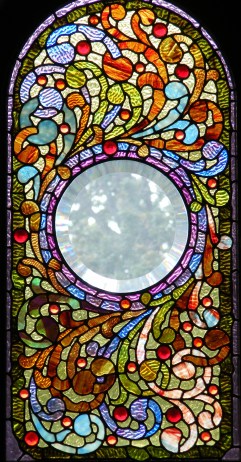
091 13 September 2018 Craigdarroch CastleRobert Dunsmuir made a fortune from the coal industry. Initially he came out from Scotland to work for the Hudson’s Bay Company, travelling via South America and up the west coast. He soon set up on his own, having found a rich coal seam. He set out to build Craigdarroch Castle but died before it was finished in 1890. His widow did not like it so moved out in 1908, since which time the ‘Castle’ has had many uses. These include a military hospital for ‘incurables’; it is patently unsuitable for this as it is built over four floors. It has also been a College, a Music School and offices. It is now run as a tourist attraction, with 100,000 visitors each year. One of the most impressive aspects of Craigdarroch is its stained glass. Typically of cruise excursions, we don’t have anything like long enough there, so rush round before re-boarding our coach. Once back on board, we had planned to sit on deck but the unseasonal weather makes this less than pleasant, so we force ourselves to make the most of the Windjammer’s offerings. We are invited to clap the staff as they parade round the dining area.

Somehow I seem to have missed out on most of the things that this trip is renowned for. Maybe it is because I don’t feel very well, or because I was seriously jet lagged until the cruise was almost over. Barely a glimpse of whales, no northern lights, no brown bear spotting, not making the most of the icebergs. Nonetheless, it has been a wonderful opportunity to meet up with many worldwide genealogical friends and to make some new ones.

In the evening, Maurice gives a hilarious talk entitled ‘How I Nearly Cloned Myself over a Couple of Martinis’. This involved mention of a crowd-funding project to clone Joseph Smith, which has attracted a fair bit of support. I think I’ll just leave that one with you. There are photos, prize givings and fond farewells. The week has gone far too quickly and many of us are looking forward to next year’s cruise to the Mediterranean.