Books, books and more books – or ideally fewer books

So still no progress on the moving house front. While I wait for a chain to complete underneath my potential buyer, I am trying to simultaneously put it all to the back of my mind and do something, so that I don’t feel totally impotent in the whole process. This means that I am working round the house triaging my possessions, in the hope of being less crowded in a new property and saving the removal men from having to lug a load of stuff, at my expense, that I really don’t need. The progress so far is: garden sheds tick, bathroom (not much of a challenge) tick, conservatory (apart from the children’s books which are awaiting said children) tick, my bedroom tick. This week it was time to start on the difficult stuff, the two bedrooms that contain between them eleven full height book cases (well, actually ten and two half width ones). That is an alarming sixty six shelves worth. Two of these bookcases are built in and I’d like to lose the two narrow ones, or relegate them to the garage. That means I need to find eighteen shelves of books that I can live without.

First stop the history books, six shelves of these. I tried to take a critical look. Most were acquired in the late 1970s and early 1980s they have accompanied me on three or four house moves. The vast majority of them haven’t been opened for at least forty years and if I am honest, some of them weren’t read even then. Why am I giving them house room? That’s one and a half shelves gone. Next half bookcase, local history of places other than Devon. This was harder but some more joined the ‘to be disposed of’ pile. Two book cases didn’t make much of an impact as one narrow one is seventeenth century social history and I need those. The other is family history research files rather than books, so that all stays. That left two book cases in that room still to do.

Two shelves of social history first, reduced to one and a half. Now it was getting really tricky. Next were family history books and the Devon local history books. I decided that I really didn’t want forty six years of back numbers of a family history society journal. I don’t think I have looked at back numbers more than once. Fortunately someone else was pleased to take these off my hands. Another, shorter, run from a different society also hit the ‘to be humanely disposed of’ pile. A bit of rearranging and one of the narrow bookcases was now empty, the equivalent of three shelves. I am trying not to think of the other fifteen that I need to free up.

Many of the family history books are 1990s vintage. Although the sources don’t change, the techniques do. More of these have been referred to in the past few years but some, like other items consuming shelf space, have not been opened since they were unpacked from my previous house move seventeen years ago. Out they go. I am on a roll. Still to do, the two shelves of Devon local history, I suspect I will be keeping most of those. Then it will be on to the six bookcases in the spare bedroom. These were culled during lockdown but I have hopes of significant weeding when I get to the three and a half book cases of fiction. I know some date from the sixties and early seventies, when there was a fashion for very tiny print that I can no longer read. If I started now I doubt I have enough life left to read all these again. I will be seriously asking myself how likely I am to read each one and hopefully there will be a pile to move on to charity shops.

There are of course also two banana boxes of children’s books under the spare bed. I haven’t even thought about what I do with those. Many are paperbacks that have lost their glue so the pages are loose and my grandchildren have very different reading tastes. I know that these really should go too but I may not be in the right frame of mind for that just yet. I will report on my progress – just wait until I get to the extremely full loft!

Image Peggy Marco Pixabay

Things or Heirlooms?

Two things have prompted this post. Firstly, today and tomorrow I have two rather different, yet similar, presentations to give about heirlooms. The first is a 15-20 minute conference paper for the Family Archives and their Afterlives conference. Wednesday is a 90 minute heirlooms workshop for the Society of Genealogists. The clue is in the title. Workshop means that I will be putting the audience to work. The second thing is that I am embarking on the inevitable ‘you might be going to move this year/next year/who knows’ cull of possessions. Incidentally, because I know people don‘t like to ask, the position is that someone is desperate to buy my house but is waiting to sell theirs, so I may be here some time.

I am faced with the accumulated ‘stuff’ that survived my major downsize seventeen years ago, augmented by the additional stuff that I acquired when my mother died. Why are some items more precious than others? What has prompted me, my mother and in some cases preceding generations, to keep x over y and z? What do I keep or discard and why? Many of these things have no aesthetic qualities and serve no practical purpose, yet they ‘need’ to be kept. They have moved beyond the realm of being ‘things’ to be heirlooms. I don’t envisage that I will be disposing of anything that has a family significance. If it has already been treasured for two, three, or more generations, then it is my role to continue to do that, even if I feel that the generations that come after me may not wish to do the same. I hope to persuade them to keep at least some of these treasures. That is part of the aim of the Treasures section of my Granny’s Tales website. It is the stories that turn things into heirlooms, so I need to tell the stories. It will be a long job, I just need to last long enough for all the stories to be told. At least I have made a start.

Then there are the things that have a personal significance for me, important of course but somehow perhaps on a lower rung than the items that stretch back to touch the past. At the moment, I can’t be sure how much space I will have when I move. The aim is not to have less than I do currently, so in theory I could keep everything. In practice, it is a good opportunity to reduce the task that my descendants will face when I go and join the ancestors. I’ve made a start. I’ve done the bathroom. Not much of a challenge there. I did throw away manky looking products that have been around for years. I even threw away a few stiff flannels. My bathroom is officially the second smallest in the world (ironically larger than the one I had in my previous 5 bedroomed house) so there were only two small cupboards to go through.

Slightly more demanding were the two sheds, although the majority of the contents of one contained the possessions of the fisherman of my acquaintances (who has four garages a barn and a shed of his own and those are the ones that he admits to). I decided that I really didn’t need 200 plastic flower pots or a dozen tins of solid paint. Easy this throwing away lark isn’t it? I am actually very pleased with the shed clearance. A trailer load disappeared to the tip and more to the owner’s barn.

Moving inside, the conservatory is also done. Well, it is awaiting visits from my descendants to triage the children’s books. That will be trickier. I know most are now too young for my grandchildren but they have seen two generations and some three. What will stay and what will go? I know we will be keeping some that probably no one will read in my lifetime. I do hope my body will keep working to read them to a fourth generation but realistically, it probably won’t. I don’t see my grandchildren being likely to have children young. So they will sit in a box in a loft, in an as yet to be identified property, until my children have to repeat the triage in the future.

The conservatory also contains many inherited ornaments, some dating from my great-grandfather’s trip to India and China. They stay, waiting to appear as one of Granny’s Treasures; another culling decision deferred.

Today maybe I’ll start on the bedroom. The clothes part is easy. I do an annual cull and in any case, as anyone who has met me will know, I am not a clothes person. But and there’s a huge but the bedroom also contains a china cabinet, itself an heirloom, inherited from my mother’s cousin and we believe, made by my great grandmother’s brother. It holds more ornaments, ornaments that I have known all my life. They have sat in the china cupboards of my mother and grandmother and now they sit in mine. A few of the items reach back to touch my great-grandparents’ lives. Then there are the photograph albums. Many of these are the sticky plastic variety, containing colour photographs from the 1980s. Photographs that are fading into weird and wonderful versions of their former selves. I did have a spell of remounting these and scrapbooking them in new albums. Maybe I will have time to continue that process. Do I now take the opportunity to be selective? Shall I retain the images of people and remove the pictures of random stately homes and scenery? I have yet to decide. In any case that is for that dim and distant time labelled ‘later’. Unless my worst moving nightmares are realised and it takes years rather than months for me to complete a chain, they will move with me in their current state.

With the honour of being the custodian of the family archive, comes the responsibility for its curation and care. I also need to be its interpreter. What I should be doing of course is writing those stories, preserving those memories, making sure that I am not the only person who understands the significance of these items. Some already have partial or damaged stories. There are things that I know belonged to my mother’s grandparents but which grandparents? I am committed to making sure that the items I pass on are real heirlooms, with what is left of their stories intact.

A Few Yorkshire Days with a Family History Twist

Last week, we made a whistle-stop trip to York. This was mainly so that I could take part, along with the rest of the A Few Forgotten Women Team, in the York Festival of Ideas. We were working with The Mount School and The Rowntree Society to raise the profile of women’s history. After a panel discussion, we helped attendees to research a woman or girl who was associated with The Mount School, either as a pupil, a teacher, or another member of staff. The school is a Quaker foundation, so there was some delving into Quaker records and some fascinating stories emerging. With the aid of our team, other researchers worked on a Voluntary Aid Detachment nurse. If this sounds like your idea of fun, you can join in. For details see here.

York isn’t exactly next door, 335 miles to be exact, so we went a couple of days early to spread the driving load. The journey up was protracted, not least because of the ten mile/one hour tail-back on the motorway as people tried and failed to exit on to the gridlocked slipway at Castle Donnington for something called the Download Festival.

We decided to steer clear of the city on our two days ‘off’ and visited the lovely gardens at Beningbrough Hall. The Georgian house itself, former home of the Bourchier family, is closed for refurbishment until next month but the gardens were beautiful and we did an extended walk round the parkland by the River Ouse. In the evening, I was virtually chatting all things ag lab with Wiltshire Family History Society. The next day, we opted for Kirkham Priory and another riverside walk. The priory was founded in the mid-twelfth century and was an Augustinian foundation. Dissolved with other monastic foundations by Henry VIII, Kirkham fell into disrepair. Unusually, it was used for military training purposes in the run-up to the D-day landings.

After the research day in the beautiful surroundings of The Mount School library, Mistress Agnes and Master Christopher were on parade, extoling the delights of life in the seventeenth century. With soaring temperatures, it was just a little cosy being in the seventeenth century, especially as I had neglected to bring my thinner bodice. Good fun was had nevertheless.

We left at very silly o’clock to try to beat the forecast heat and fortunately, were driving towards the cooler (when cooler is a relative term) part of the country. The homeward journey was not beset with festival goers and as a bonus, none of my plants seem to have died during my absence. Now to the rigours of the job we must not mention; I may be quiet for a while.

Beningbrough Gardens

From Elusive Ancestors to Ag Labs

Amidst a quick trip to Yorkshire (of which more another time) and the uber frustrations of fourteen tedious hours attempting (and mostly failing) to get access to vital software for the job we must not mention, I have been spreading the family history love with my latest cohort of Pharos family history students. Unbelievably, I have been teaching online family history courses for Pharos Tutoring and Teaching for seven years now. Last night saw the first presentation of a new course draw to a close. The learners have been investigating ancestral migrations. Those pesky ancestors who won’t do the decent thing and spend their whole lives living in one place lead us a merry dance as they trip from one area to another, often leaving gaping holes in their life stories in their wake. This course was designed to help the students tell those migration stories, investigate possible motivations for movement and hopefully come a little closer to tracking down their elusive ‘brick wall’ ancestors. Unfortunately, I don’t have a magic wand, otherwise I wouldn’t have any brick wall ancestors of my own but it was pleasing to find the students reporting that they had to change their case study elusive ancestors as they had found them!

No sooner does one course end than another begins, or, in my case, two begin. Next up, Agricultural labourers, a five week course that starts on 17 July. We all have them don’t we? The ubiquitous ag labs who drip from every branch of the family tree. Do we dismiss them as somehow more boring than the sagger-maker’s bottom knockers? Not such a great job tile of course but ag labs are fascinating in their own right. What I love most about leading this course is seeing the students create stories about their own ag lab ancestors, stories that I then sometimes see published in family history society journals or online. Sometimes I join in with the students and use the course as an opportunity to tell an ag lab story of my own. The job I must not mention won’t allow it this time around, so, just to prove that I do sometimes practice what I preach, here is one I prepared earlier (you will also need this outline pedigree to follow the twists and turns). This is the story of a Wiltshire ag lab filled family, or series of families, who, like many others, ended up abandoning the countryside for life in Reading and later Croydon.

My second course for July is for those starting out on the all-absorbing branch of research that is one-place studies. They have such an adventure ahead! To add to the excitement, Pharos have a brand new shiny website, which not only looks good but make life easier for students and tutors. Most importantly, it is stuffed full of exciting and absorbing courses (not just mine) to help you hone your family history skills. I recently had a discussion about the importance of getting the balance right between learning more about how to do family history and actually doing it. Even if you’ve been a researcher for years there is always more to learn and joining a group often provides great encouragement. Important though gaining new skills is, you need to keep this in proportion and allow time to actually put it into practice. I do try to bear this in mind when I am writing courses and make sure that students can learn more about their own families as they work their way through the suggested exercises. Why not come along and join me for the ride? Last time I looked there were still spaces on the Ag labs and One-place studies courses. If you want to track down elusive and migratory ancestors, you will have to wait until next year.

The (Family History) Story of Alice and May or don’t believe all you hear

This week, amidst obsessively checking for houses coming on the market and trying to stop myself mentally moving in to one I like, I have been researching the lives of Alice and May. The full story will appear on Granny’s Tales shortly. Alice and May are not newcomers to my family tree; I have known them all my life. I should qualify that, they both died before I was born but their photographs are in the treasured family album and they formed part of the lexicon of family lore that was repeated by my mother and great aunt. ‘Auntie Alice’ was one of my great grandmother’s sisters and ‘Cousin May’ was her daughter. The stories went something like this:

Alice’s first husband was a Mr Fludder, who was May’s father. Alice then married Mr Hart. May married a William Pleoney or Fleoney. Auntie Alice died in a fire when home alone in Whitstable, Kent. Normally, the family stories that were passed to me have proved to be pretty accurate when placed under the scrutiny of documentary family history research; not so these ‘facts’ about Alice and May. Decades ago, I established that almost everything I’d been told about Alice and May was wrong.

May was illegitimate. Her birth was registered as May Bula Dawson. Although there were Fludders in the area, there is no evidence that Alice was ever in a relationship with on of them and she certainly didn’t marry one. When Alice married Thomas Sanders Hart, a widower, nine years after May’s birth, May took the surname Hart and was to claim that Thomas Hart was her father when she married. Married that is to a William Dear. Goodness knows where Phleoney came from. Who was May’s father? For a long time I suspected the solitary Mr Bula who could be found in the census closest to May’s birth. Was it indeed a Mr Fludder? Was it, as May claimed, Thomas Hart? I am now, thanks to help from another researcher, pretty sure I know which is correct but I am afraid you will have to wait for the release of Alice and May’s story to find out.

Then there was the ‘burnt to death in a fire’. Well not unless she caught pneumonia as a result she wasn’t, as pneumonia, coma and thrombosis is what is on Alice’s death certificate. I looked in the newspapers, for mentions of a fire in Whitstable around the time of Alice’s death to no avail. This week I tried again. Additional newspapers have been made available. Yes, there was a fire, yes someone died whilst home alone but it wasn’t Alice. Who lost their life? Why did the family think it was Alice? Stand by for the big reveal, although diligent researchers might be able to get there first, even with just the few clues that I have given you here.

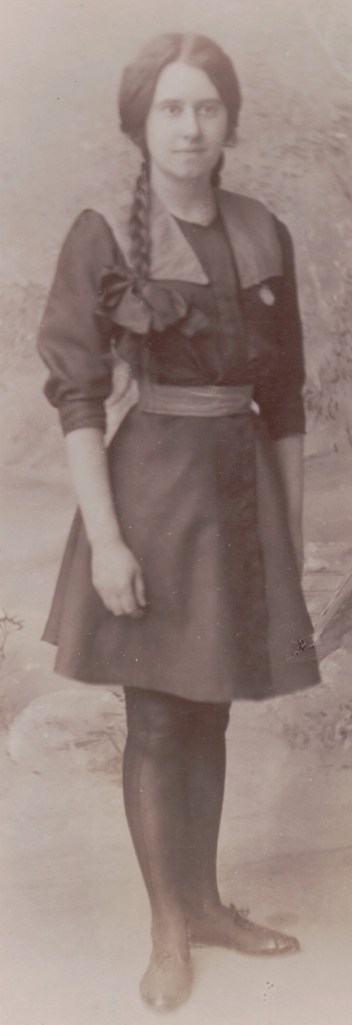
Finally, I’d welcome comments on May’s attire in this photograph. She was born in 1889, surely this is shockingly short. Could it be some kind of theatrical costume? The never-ending hunt continues.

Moving up, Moving out, Moving on

Seventeen years ago this week I fell in love with my house. After a very protracted moving process during which my chain free, mortgage free, in a hurry  buyer turned out to be none of those things, six months later, I moved in. It has been an honour to be the custodian of such a special property but for various reasons, none of which are connected to the house or the wonderful friendly village in which I live, it is time to go.

What will I miss most? The garden, the woodburner, the privilege of living in a cottage that is almost certainly four hundred years old and belonging to a community. I will miss waking up to the sound of birdsong and occasionally sheep baa-ing but it is time for the next phase of my life.

My house is on the market – if anyone wants a seventeenth century cottage in north Devon, complete with a documented house history back to 1750, now is the time to say. It is in the centre of a village, yet intriguingly hidden away, it is quirky, it is home. I’ve lavished time, effort, love and a significant amount of money on it since I have been here. It might have been my rest of my life home but I have decided otherwise. It is a weird feeling. Mentally I have had to move on but I am still here and may be here for some time, waiting for that special person who will also fall in love with this unique property. I am trying to put the whole horrendous process that is moving home in the UK to the back of my mind, whilst making sure the house is looking its best and obsessively checking Rightmove to see what is currently top of my to buy list for when that right person comes along.

As I am giving up such a lovely place I need my new home to be special too, so I need to find something I will love but not fall in love with it quite yet, in case someone else buys it before I can, or I am gazzumped. I need to think about what I might get rid of before I move but not yet, as I don’t know what I might need or have room for. So there’s an awful lot of ‘not yet’ and even more trying to convince myself that what is meant to happen will happen and everything happens, or doesn’t happen, for a reason. This is, of course, interspersed with raised stress levels and convincing myself to stop mentally redecorating the current favourite to buy property.

Much as I don’t want to wish my life away, it would be good to just jump to moving in day in a few months (please don’t let it be years) time. Oh, to save you asking, I won’t be going far.

Photo credit Harding and co

A Few Welsh Days

Having left Sheffield we headed for Tredegar House caravan site, where we have stayed before. Turns out it isn’t in Tredegar, who knew? In my defence I wish to put it on record that it wasn’t me who left the book with the directions in at home. To add to the problem, we had accidentally pressed mute on the new satnav without realising it (this probably was me), so lacked verbal instructions. The Welsh detour was to see the Strictly Professionals Show (this time I was delivering a birthday present), so more angst about finding the venue. I was a little less concerned about accessing tickets via my phone this time, having cracked it in Sheffield. Instead, the major stress factor was, will there be a parking place? This was exacerbated when we learned that Beyonce was playing to a 74,000 strong crowd in Cardiff on the same evening. We did have to wind our way up to the sixth floor of the multi-story car park but we did find a space. The main drawback of the evening was the people sitting next to me who chatted in very loud voices the whole way through. Perhaps they thought they were auditioning for Gogglebox. Hard stares from all around made no impact. They also decided they couldn’t wait until the interval to get drinks – cue squeezing past from the middle of the row along the very narrow gap between seats. This was followed by the slopping of cider over a few hapless audience members on their return journey and yes, the inevitable results of copious amounts of cider consumption, which couldn’t wait until the interval either. Maybe people should have to sit an etiquette entrance test before being allowed in to theatres, sporting or concert venues.

Concert over, we went to play find the car. The lift queues in the multi-story car park were impressive, so we opted for the stairs. By the fourth floor this seemed like a less good idea and I debated whether it was time to remember that I allegedly have a heart condition. Fortunately we weren’t amongst those who didn’t realise that you had to pay on the ground floor before finding your car.

Time in Wales allowed us to pay some return visits, first to Tredegar House, which was on our doorstep and was home to the Morgan family before more recent generations squandered the assets on partying and the house became home to a convent school. Not sure how well the ‘classical’ wall paintings would have gone down but apparently they remained on view.

We also went back to St Fagans. You really do need more stamina than we have to see all it has to offer in one day, so it was a good opportunity to see bits we missed last time. There was an excellent exhibition about Welsh life, with artefacts representing several thousand years of history. Next we went to the weaving shed, where today’s activity was spinning on a loom that spun and wound eighty bobbins at once. We walked round the lovely gardens and looked at several of the reconstructed buildings that have been brought on site from all over Wales. My favourites were the row of miners’ cottages that were each furnished to represent a different era. Now home and with a busy time ahead.

Visiting Homes of Status and Power

Are you still there? I hear you cry. Well, actually I don’t but yes, I am still here. There’s been a lot going on lately, of which more another time but for now, I thought I’d share some details of a few days we recently spent on the Yorkshire/Derbyshire borders.

We travelled via grandchild sitting to a quiet caravan site just outside Sheffield. This was in part to deliver a Christmas present in the shape of attendance at an André Rieu concert. Inevitably, this was accompanied by the usual angst – will we find the venue? Will we find the car park? Can I make the app work to display our tickets? Come back actual printed tickets, all is forgiven. It turns out that all the fears were unfounded and the concert was safely attended.

We also took the opportunity to meet up with family, which was lovely and do some touristy things. First stop Hardwick Hall, home of formidable Tudor woman Bess of Hardwick, familiar to me from the exam syllabus. Hardwick Hall was built in the sixteenth century to showcase the power and status that Bess accrued, largely due to four advantageous marriages. Our visit coincided with a parade by the parachute regiment, who were stationed at Hardwick during World War 2.

The Earl of Shrewsbury, one of Bess’ husbands, was responsible for Mary Queen of Scots during her house arrest and although Mary was never in residence at Hardwick there are artifacts that are believed to have belonged to her. The many tapestries are a feature of the house and adorn almost every wall. The gardens were lovely too.

Next stop Bolsover Castle, where I fell out with the audio guide, which kept defaulting to the introduction rather than the area we were in. Bolsover was the home of the Cavendish family and another symbol of wealth and power, this time of William Cavendish, Marquis of Newcastle, grandson of Bess of Hardwick. The seventeenth century castle was built on the site of a Medieval fortress and has some impressive views.  The late C11th castle was owned by William Peveril and its ruins were the inspiration for Cavendish’s ‘Little Castle’, built in the early 1600s. Charles I and Henrietta Maria were entertained at the castle. The Cavendishs suffered for supporting the king during the Civil War but returned to the castle after the Restoration and commenced a programme of building and rebuilding. The riding house and stables are a reminder of Cavendish’s passion for equestrianism. There are some unusual wall and ceiling paintings that have been preserved. William met his wife Margaret whilst taking refuge in Europe; she was maid of honour to the exiled queen Henrietta Maria. Margaret was a prolific writer and philosopher who challenged the female stereotypes of her time. Her eccentricities meant that she was later known as ‘Mad Madge’ and described by Pepys as ‘mad, conceited and ridiculous’.

When the male line died out the castle became little more than a holiday home and gradually fell into disrepair. The opening of the nearby mines in 1889 were the death knell of the castle as it suffered from subsidence and the associated pollution. It was given to the nation in the mid-twentieth century and further decay has been prevented.

Family Stories, Family Treasures and some Memories: a task for the family archivist

For the past few months, I have been trying to discover that useful commodity ‘spare time’ and use it to create a small website to be the repository of all the family stories that run round my head. This is rather different from the family history accounts that appear on this website. These are mostly uninspiring narratives, designed to record all the facts that I have found for that branch of the family. The new website is for stories rather than accounts and in future, these will vary from long biographies to short paragraphs about particular anecdotes from the past. There is also a section for my own memories, taken from my auto-biography. In particular, I wanted a vehicle for the stories of the family treasures that I am privileged to have in my temporary care. Without the associated narratives, these heirlooms become mere ‘things’; I feel the need to explain their significance and let others know why they are precious. Artefacts also provoke memories; memories of their owners, memories of occasions when they were in use and associated narratives.

All this may this seem self-indulgent and perhaps it is but I am the only person with most of this knowledge; it is my responsibility not to let it be lost. If I were able to see my descendants more often these would be the accounts that they would hear verbally from me but there may be more stories than there is time, so I decided that I would make a start. The website is tiny at the moment. I plan to add more stories on a regular basis but I didn’t want to begin with an overwhelming number. The intention is that my descendants will actually read this and I thought that they might be put off if I inflicted too much on them at once.

I am not expecting hundreds of hits on the site, or anyone outside the immediate family to read it much, although you’d be very welcome to do so. In fact, I may be optimistic thinking that my descendants will read it but at least now they have the option. What I hope may happen, is that others will take a quick look and be inspired to tell their own family stories. So, if you have five minutes, pop across for a brief glance at Granny’s Tales and then go out and do likewise.

A Genealogist’s Nightmare: tracing the Smith Family in London

A few months ago, I was invited to give a talk to  London, Westminster and Middlesex Family History Society. They particularly wanted something with a London flavour. Nothing in my repertoire quite fitted the bill so I suggested, rashly, that I could put together something based on my Smith ancestors of London. These things always seem like a good idea from the safety of several months away. It should be easy. I’d already written the Smith family story. I even had a short power-point about them. I ‘just’ needed to pull together all the detail about the sources I’d used for the genealogy and the context and I’d be away. I set out to do ‘just’ that very thing. Perhaps, thought I, this would be a good opportunity to revisit that branch of my family, as I do periodically, in case anything new could be found. Forget rabbit holes. I descended into a pit roomy enough for a decent-sized elephant. It is one of those scenarios where the brick wall seems paper thin but is nonetheless impenetrable. Surely x must be the father of y but how do I confirm that, especially with a name like Smith in a highly populated area?

A saving grace for my Smith family is that they like marrying ladies from the Seear family. My three times great grandfather John Jeremiah Smith married Charlotte Seear, his son, my great great grandfather William Joseph Smith married his first cousin, Charlotte’s niece, Eliza Seear. Their son, Herbert Havet Smith, my great grandfather, married Eliza’s niece, Catherine Seear, who was simultaneously Herbert’s wife, his first cousin and his second cousin. I do hope that you are following this. You are probably thinking that it accounts for a great deal. It certainly makes DNA research on this branch ‘interesting’. You’d think Seear would be easy to research. I’ll own that it is an improvement on Smith but there a list of variants longer than several arms and once you stray into Hertfordshire/Buckinghamshire/Bedfordshire there are probably more of them than there are Smiths.

You are probably waiting for me to tell you that, as a result of taking another look at the family, there was a eureka moment and I added several generations to my family tree. Sadly, no but there are fewer bricks in the wall. I was looking for an example to use for the talk and decided to input Seear rather than Smith. This led me to a will that I hadn’t looked at before. A will that should crack my Seear brick wall but doesn’t, still, I now have the names of the siblings of my Seear brick wall ancestor and John Jeremiah Smith featured as a beneficiary. I also reread a will for a John Smith, someone I felt should be John Jeremiah’s father (I knew his father was John). I had previously dismissed it as there is no mention of John Jeremiah, or those I had identified as his likely siblings. Paring this will with marriage witnesses in the family, it now looks as if it is indeed the will of my 4x great grandfather and that the children he does mention are his oldest children, who I had not previously noted as potential siblings for John Jeremiah. I even have three teeny tiny DNA matches to descendants of one of these older children. Is this proof? Of course not but this John Smith of the will has moved from ‘probably not my ancestor’ to ‘almost certainly my ancestor.’ Will he ever be inked in as my 4x great grandfather, probably not but I can hope.

Oh and if anyone is reading this who is expecting me to give a talk on the Smiths in a few days’ time, never fear, I climbed out of the elephant pit eventually and there is a talk prepared.

My Smith Ancestors