Is it Time to get the Kilt Out?

In a few months’ time I will be embarking on my 48th year of serious family history research. In all that time, all but one of my lines can be taken back into the eighteenth century, several into the seventeenth century and a few to the sixteenth century. My direct ancestors are spread across nine English counties, from Northumberland to Cornwall, with an additional three counties if I count where I am pretty certain brick wall lines came from. Every single one of all those direct ancestors and there are well over two hundred of them, that I have identified, was born or baptised in England. Until perhaps now. I have been whiling my waiting to move time away by revisiting my Northumbrian ancestry. Part of the story has already found its way on to my Granny’s Tales website. Incidentally, I decided to splash out and convert Granny’s Tales to a paid website so it now has a new URL, although the old one will still work.

Northumbrian ancestors then. This is an eighth of my ancestry, so there’s a lot to tell, even though great great grandad is a brick wall. I sorted the Hoggs and the Pearsons to the best of my ability, so it was time to turn to the Eadingtons. The Eadingtons are tricky; partly because there are so many spelling variations and partly because every last one of them, well almost, is called Patrick, David or James. Except of course when some of the Patricks decide to call themselves Peter just to add to the fun.

My earliest Eadington ancestor is 5x great grandfather David Eadington who married in Embleton in 1756, had some of his children baptised about ten miles from Embleton in Warenford Presbyterian Chapel and had some more children who he didn’t baptise at all, or whose baptism records don’t survive, then ended his days in Alnwick. His gravestone gives his age at death, which suggests that he was born in 1731 or January 1732. Of course, ages at burial are notoriously inaccurate but that’s all I have to go on. Conveniently though, David left a will and this includes mention of several nieces and nephews, children of his late, unnamed, brother. Following up these nephews and nieces, one of whom was also David’s daughter-in-law, at least some of whom have baptism records, revealed that the brother was called James. James married on Holy Island in 1768. James too has a convenient gravestone that leads to a birth between October 1729 and October 1730; so I was now looking for two brothers. There the research sat for several years.

If you believe the ‘wisdom’ of online trees (I don’t), David was baptised in Earlston, Berwickshire, Scotland in 1738, the son of Robert. Not only does these mean he was probably only eighteen when he married but there isn’t a single Robert in my Eadington family, nor was there a brother James. Although this was possible, I remained to be convinced. Investigating the Eadingtons of Holy Island, I discovered an Alice, or Alison Eadington who had an illegitimate son Patrick in 1763. It is almost certain that this Alison was the daughter of Patrick and Alison Eadington née Allen, who moved from Coldingham, in Berwickshire, to Bamburgh, Northumberland. Better still, this Alison had a brother James baptised in 1730. There is no David in the family but the family are on the move between 1729 and 1740 and there is a ten year gap in the children’s baptisms after James. The naming patterns of James and David’s children are a good match for this family; Alison Allen’s father is called David. Even supposing I adopted Patrick and Alison as my 6x great grandparents and I really feel I need more than this, there is another unanswered question. My ancestor is David’s son Patrick (when he isn’t calling himself Peter). He is mentioned in David’s will and on his gravestone as ‘son’ but there is no baptism. He was born c.1762/3. Alison’s son Patrick has no future as Eadington, Chirnside (his father’s name) or Anderson (his step-father’s name). Did David bring his sister’s illegitimate son up as his own child?

Scottish research is not my area of expertise. If anyone has any idea how I might find more evidence that would support or refute this theory I’d be very grateful. I really would like to be able to confirm my Scottish ancestry and get my kilt out.

Memorials to the Marginalised

Most of you who are reading this will know that I am part of a team who aim to tell the stories of women of the past, who might otherwise be forgotten, on the A Few Forgotten Women website. As a family historian, I believe that all those on the family tree deserve their place in history, even if their lives encompass some challenging issues. If we just tell the success stories, the stories of the heroic, the popular and the blameless, what an inaccurate portrait we are painting and what unrealistic expectations we are setting up for those who come afterwards, who can only feel inadequate in the face of all those ‘perfect’ ancestors.

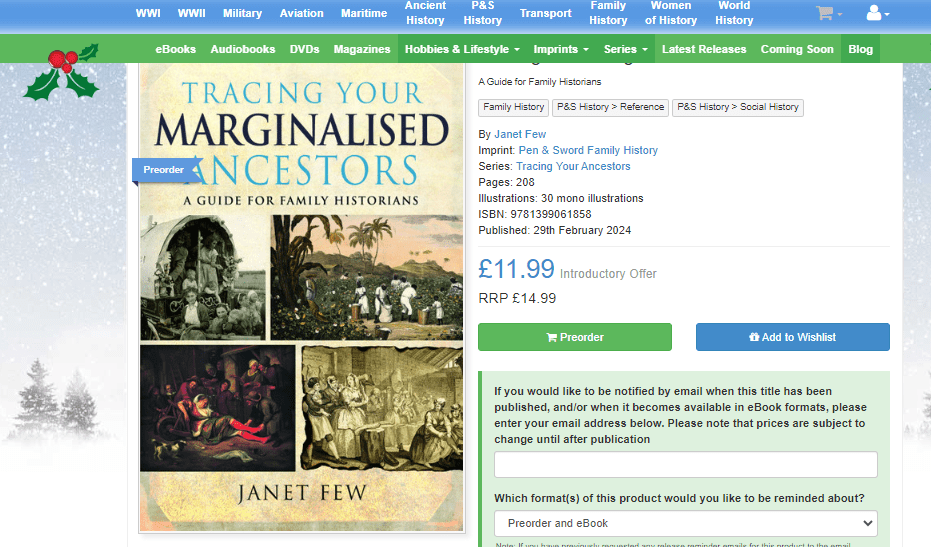
My fascination for aspects of the past that are not exactly filled with sweetness and light, led me to give talks on Forgotten Ancestors, or Ancestors on the Margins, those who are often discriminated against or stigmatised by society and forgotten by history. This led to me being asked to write an article for Family Tree Magazine and subsequently, I was approached by Pen and Sword to write a book, helping others to trace their ancestors on the margins. This all seems like a very long time ago now but I had great fun writing about how to trace the criminals, the illegitimate, the poor, the prostitutes, the witches and many more on you family tree. I tried to provide plenty of social historical context and each chapter finishes with a case study. Finally, the book is now in the late stages of gestation. Publication date is 29 February but pre-orders, at a reduced price, are already available here.

Of course, women have often been marginalised by history and I am excited that my final presentation of 2023 will be a Maternal Line workshop for the Society of Genealogists, when I will be encouraging participants to investigate their female ancestors in more detail. Bookings for this are still open.

What about moving house? I hear you barely dare to whisper. Well some slight bumps in the road but we are at least still on the road. I will reveal the whole ‘you couldn’t make it up’ story when it is all over. As an aside, I am, for reasons that will be explained in future posts, currently living like my ancestors with no central heating as the snow flurries descend – thank goodness for the woodburner. I am not convinced said ancestors also lived with half empty cupboards and shelves and a obstacle course created from boxes in every room but there you go.

Some years I have provided an advent calendar of blogs on historical or book related subjects but I am a bit pushed for blogging time at the moment – maybe next year when the chaos has (I hope) abated. You can always look back on calendars from previous years.

The alphabetical Christmas advent posts start here December 2012.

Historical Novelists starts here December 2016.

Social History books advent starts here December 2017.

In December 2018, each day I blogged about a different source that I used in the writing of Barefoot on the Cobbles.

There wasn’t a complete calendar in 2019 but there was a series of posts about favourite family history websites starting here December 2019.

Looks like I have had a few years off! Good intentions for 2024.

Mostly about Packing and Presenting

Just a short post so that you know I am still here. It has been all go lately, although not in the sense of the moving house type of going. I don’t want to say too much on that front but things are looking positive. I am at least on the hunt for packing boxes and realising that I do seem to have an awful lot of stuff. In case anyone needs to know this, bedding is surprisingly ‘big’ and tricky to stuff into bags or boxes. I just discovered a box that I don’t believe had been opened since I moved in 17 years ago. Its contents can best be described as ‘eclectic’. A pile of family history notes, a set of scales dating from the 1940s, a pair of bookends, a pair of compasses (the sort that tell you which way is north), a pair of compasses (the sort you draw circles with) and some random ornaments, some of which will not make the cut to be moved on again.

Mostly life has been about giving and preparing various talks and leading back to back courses for Pharos Tutors. We are currently in the midst of Sickness and Death but will be moving on to look at Agricultural Labourers after Christmas. If you have ag labs on the family tree you’d be welcome to join in. Today is about the Really Useful Show, when I shall be listening to the presentations of colleagues and friends and chatting about Misfortunate Women. In between, I have a talk to host for Devon Family History Society. Coming up, amongst other things, I have a short presentation about websites for London research to record for Rootstech 2024. That will have to wait until my voice sounds less croaky. If you haven’t registered for the free online event that is Rootstech, you can do so now. I also have a workshop on researching the maternal line to give for The Society of Genealogists, which I hope will be fun. Another red letter day in the diary is the next collaborative research event with A Few Forgotten Women, this time we are investigating students who attended a Somerset school of housewifery. I’ve also been looking at the alleged trip that my great grandfather made to the far east, or did he? You can read about that over on Granny’s Tales under ‘Eastern Artefacts’

This month, two organisations that I have been involved in celebrate their tenth birthdays, our local history group and the Society for One-Place Studies. Where has that ten years gone? It is good to reflect on the fun we’ve had, what we’ve learned and what those organisations have achieved, as well as looking forward to future plans.

Having not been up to speed on where to visit in Ireland that might link with my grandchildren’s Irish ancestry, I am getting in ahead with their Scottish ancestors, as I plan next year’s trip to Scotland. I even managed to add a couple more generations to that tree and have discovered that my daughter and my son in law’s ancestors were both in the same tiny Scottish parish at the same time. In fact, if you believe 300 online trees, they share common ancestors but sadly 300 people can be badly wrong.

I leave you with an elephant, which fortunately I don’t have to pack, as I am no longer its custodian.

An elephant acquired during ancestral travels to the East

Autumnal Musings

‘Tis the season of mists and not so mellow busyness. With the Irish holiday now a dim and distant memory, what have I been up to over the past month? The problem with extended holidays is that the work gets squeezed into the days when I am home. This means that I have been giving talks almost daily since arriving home. This included a plagues and epidemics session for the Society of Genealogists’ ‘Sick London’ course. Having spent a few days with the descendants, I was generously given some real germs, so was able to add verisimilitude by coughing and spluttering my way through this one. For those wanting more germs, my Sickness and Death online course for Pharos Tutors starts soon and there room for more to join in the fun. Next year is already looking ridiculously busy, with forty five talk bookings and I have even taken a booking for 2025. It is all a bit ‘stop the world, I want to get off’.

It has also been Christmas cake and pudding making time. I will draw a veil over why we ended up with industrial amounts of ground almond, which I don’t even like but we did. I offered to donate some of the excess to the descendants. This meant travelling with small bags of white powder and hoping the car wouldn’t need to be searched for any reason.

Now this year’s holiday is past, it is time to look to next year, when we hope to plan to return to Northumberland and Scotland. Cue revisiting my children’s Scottish ancestry and managing to add a couple of new generations. If I were to believe umpteen online family trees, I too have Scottish ancestry but I don’t feel I have enough evidence to make that link. Right (fairly unusual) name, rightish date, no other candidates, seventy miles away – could be him give me something linking these two men somewhere please and as for the longstanding ‘almost crumbling’ Northumbrian brick wall…….. I may never know if my John Hogg is the John Hogg I am almost certain he must be. Still, it wouldn’t do if it was all to easy would it.

Irish Adventures Days 33-35 The End!

Yes, this really is the end of the adventure.

Day 33

The sun was back with us for our last full day so we set off for Kinsale and were only slightly fooled by the new road layout on the outskirts of Cork. Finally at Kinsale we were able to find some working fishing boats for a fisherman of my acquaintance to study. Ireland does seem to have a shortage of public toilets but we located one in Kinsale. It was one of those pod type ones and cost €1 for twenty minutes. We won’t go into why anyone could possibly want twenty minutes but I know some people take an inordinately long time; I am usually standing behind several of them in a queue. €1 did seem rather a lot and we only had one 1 euro coin between us. We hoped that if I went in first and came out again within the allotted twenty minutes the other member of our party could follow me in. Unfortunately, it didn’t work like that and you couldn’t reclose the door for a second person. I’ll just leave that there. Just outside Kinsale there were mud flats with some wading birds for me to take fuzzy photos off. In my defence I was about 100 metres away and the sun was in the wrong direction.

Day 34

We weren’t due at the ferry terminal until the evening but with a long drive ahead we didn’t want to go far, especially as it was raining again. We drove to nearby Ballycotton where there were more fishing boats to examine. One thing we have noticed is that gardens here are usually fairly plain but virtually every one has hydrangeas, if nothing else.

Packing up the van was quickly accomplished, we are dab hands at this and we set off for the ferry terminal. We were directed to lane 19. We joined the end of the queue in lane 19, which was full. An excitable terminal employee braved the driving rain to let us know we were about to head off to Dunkirk; we were in fact in lane 20. The final lane 20 car was across two lanes obscuring the numbers. Adjustments made, we ended up in lane 19 next to a convoy of jeeps taking aid to Ukraine. I attempted to access the limited (20 minutes) free wifi on the ferry. This proved impossible. After I had taken up four minutes of my allotted time complying with repeated requests to put in my details, without actually being connected, I gave up. The driver amongst us was supposed to be sleeping. He normally sleeps as soon as he sits down but because he needed to sleep this time he was remarkably wakeful.

Day 35

We arrived in Pembroke at 1.15am and headed for home, planning to stop at any sign of tiredness from the driver; there was none. Bless him, we arrived home at 6.48am having done 3630 miles since we left. There are thirty two historic counties in Ireland. We stayed in nine, visited another nine and travelled through four more, which isn’t a bad haul.

I promised you my top ten days out and it was a difficult choice but here they are:

Ulster American Folk Park 

Strokesdown Park House and Famine Museum

Ring of Kerry with Dunloe Gap (only this high because of Dunloe Gap)

Irish National Heritage Park

Dingle Peninsula 

Donegal

Connemara and National Museum of Rural Life

Newgrange 

Rock of Cashel 

Giant’s Causeway

And that’s the lot, thanks for coming along for the ride. Normal ramblings of an historical nature will resume shortly, if anything about my life can actually be called ‘normal’.

Irish Adventures Day 32

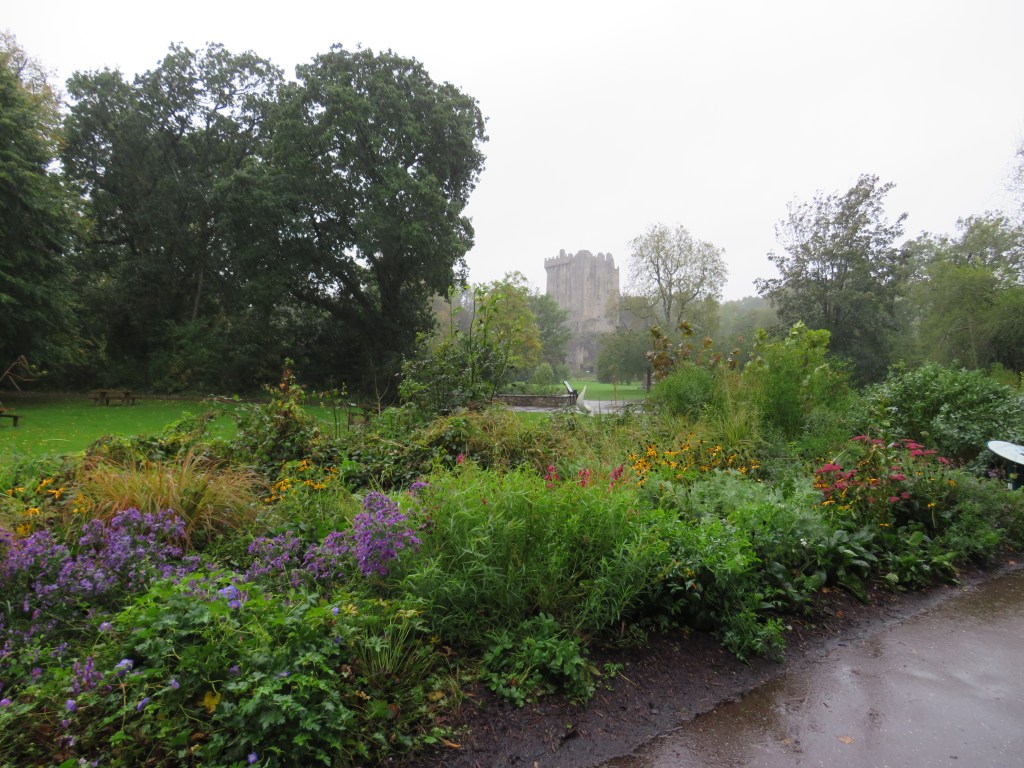
This was not really a great day for going anywhere weather wise. Undaunted, well may just a little bit daunted, we set off for Blarney Castle. In the early thirteenth century a stone structure replaced the tenth century wooden hunting lodge on the site. The stone building was demolished in the mid fifteenth century, so Dermot McCarthy could use the stone for the current tower house or castle. Like so many others, the castle fell to the Parliamentarians in the English Civil War. Although the castle  was restored to the McCarthys by Charles II, it was once again confiscated by William III, as the Catholic McCarthys supported James II. Caves beneath the tower are known as the Badger Caves and several legends are associated with them, with tales of prisoners being thrown into a pit in the caves and passages from the caves leading to Cork and Kerry. The inhabitants are supposed to have escaped with their valuables down these passages in Cromwell’s time, leaving little for his troops to loot.

We thought that the entrance fee was a bit on the steep side, especially as you would normally have to pay to  park as well. The machines were out of order so we escaped this. Of course the tourist honey pot here is the Blarney Stone, which has been kissed by tourists for over two hundred years, in order to be rewarded with the gift of the gab. Allegedly Queen Elizabeth I associated the word Blarney with smooth talking flattery because the then lord of the castle Cormac MacDiramada, tried to persuade the queen of his loyalty to prevent her from seizing Blarney for the crown. She shrewdly saw through his sycophancy.

There were signs warning visitors of the ‘arduous’ climb to the stone, which is at the top of the castle on the battlements. They aren’t wrong about this. Clambering up what I think was four floors worth of very narrow spiral steps that were slippery with rain was possibly not one of my better ideas. Be warned, this is an all or nothing climb, once you are on the path to the top there doesn’t seem to be any option to bail out half way. We passed on the kissing the stone thing, not least because I talk too much anyway, although I don’t think I am guilty of ‘smooth talking flattery’. Kissing the stone involves taking off glasses and emptying pockets in case anything falls out, false teeth weren’t mentioned but maybe those are in peril too. You then lie down on what was on the day of our visit a very soggy mat and bend backwards with your head considerably lower than your bottom, supporting yourself by gripping on to metal bars. The men who were disinfecting the stone between kisses and hanging on to people to stop them plunging head first to their doom had prominently displayed bowls for tips and then you could pay more for photos (I heard the sum of €10 mentioned) that were taken of you in a very strange position. It all seemed a bit like fleecing gullible tourists to me. To be fair, the gardens and grounds were extensive and we did explore a little. I was particularly keen on the poison garden. Blarney House, built in 1874, is on the site but is not open to the public. In half decent weather woodland and riverside walks would have given us better value for our entrance money.

Irish Adventures Day 31

As we were unable to go to Craggaunowen because it had shut for the season before we got near enough and we combined Rock of Cashel and Kilkenny in one day, we were left with two spare days. The original plan was to visit Waterford on the way to the ferry but now we were able to give it a day to itself and just as well as we could never have parked the car and caravan. We opted to avoid the toll road again and after a sunny drive, approached Waterford via an industrial estate. We found a car park but were only able to park for two hours, which was a shame as Medieval Waterford had a great deal to offer. Understandably, they make a great deal of their Viking heritage. There were also several building with murals.

We had a variety of museums to choose from; these were clustered together close to the cathedral. Should it be the Time Museum, The Irish Wake Museum or the Silver Museum? I was tempted by the virtual reality Viking experience but I am not sure how well virtual reality goggles go with glasses so we went for the tamer option of the Medieval Museum, which was very good. You are able to buy combined tickets for more than one museum, which seems like a good idea for those who want to go to more than one. We had already passed the Franciscan friary that Henry III agreed to the build in 1241. Richard II stayed here when he visited in 1394. After the dissolution, Henry VIII allowed a Catholic alms house to be built, where prayers were said for Henry VIII’s soul until the mid twentieth century. William III encouraged the Huguenots to settle in Ireland and there was a community in Waterford who used part of the friary as their church.

Inside the museum, photography was tricky as, understandably, light was low, no flash was allowed and there was reflection from the glass cases. We saw the cloisters and the wine cellar, which had a wattle and daub roof. There were many of the city’s charters on display and a list of mayors dating back to 1284; the first female mayor was not elected until 1991.

This part of Ireland was one of the first to be settled and it is believed that the Mesolithic settlers came from Wales c.7700 BCE. 10,000 artefacts were found in Bally Lough during a project in the 1980s and 1990s. The Medieval city was walled, with several towers, of different dates, along its length. Reginald’s Tower, which is mentioned as a stone structure in 1088, was where the city’s Viking leaders were taken during the Anglo-Norman invasion of 1170; two were executed there. The tower was rebuilt by King John and an additional two floors were added in the fifteenth century.

In the thirteenth century, Waterford was granted a monopoly for the importation of wine, so all wine imports in southern Ireland had to come through the port. This led to great rivalry with the neighbouring port of New Ross and smuggling took place. Initially, the wine came from France but during the Hundred Years’ War, Iberian wine predominated. The Great Charter Roll, which was on display, was put together to convince the king of the city’s long standing association with the crown and to ensure that it continued to be favoured over New Ross. The main exports were woollen rugs and cloaks. In 1566, woman were forbidden from being wine taverners or drawers (the equivalent of barmaids) because of their bad reputation in the taverns. ‘Naughty corrupt women’ were leading ‘honest damsels into folly’.

Apparently, Perkin Warbeck, a pretender to Henry VII’s throne, besieged the city in 1495, supported by the 9th Earl of Desmond, from Cork and foreign mercenaries. Cannon in Reginald’s tower fired on the invaders’ ships and two were sunk. This is the earliest record of cannon being used in Ireland. After eleven days the besiegers were defeated and Warbeck escaped; Desmond was pardoned. Although Waterford was the only town not to succumb to Cromwell himself, it was taken in 1650 by Cromwell’s son-in-law Henry Ireton, when the citizens were weakened by plague. The city was looted but incredibly, fifteenth century vestments survived because they had been hidden in a secret chamber under the cathedral’s floor. They were not rediscovered until 1773 when the medieval cathedral was demolished and the current one was built. These were on display in very dim light but were intricately and lavishly embroidered and must have been very heavy to wear. We saw the Great Parchment Book of Waterford, chronicling activities in the city from 1356-1649. The entry declaring Charles II to be king upon the execution of his father was erased when the city was taken by Cromwell’s New Model Army.

We travelled back along the small coastal roads in order to have some different scenery for part of the way. Our sojourn at the Victorian Farm is over, so we began to work our way through the first series of Coast in the evenings.

Irish Adventures Day 30

We seemed to have survived Storm Agnes unscathed so headed off for Cobh, which I was pronouncing Cob but is apparently pronounced Cobe, to rhyme with robe. The railway station at Cobh aka Queenstown has been converted into a heritage centre that commemorates Irish emigration; over three million people left from Queenstown between 1815 and 1970. We were attracted by the signs to a free car park, which looked like it was going to be a fair way from the centre but turned out to loop back so as not to be, so we were glad that we resisted the lure of paid for on street parking.

There is a statue outside the centre that commemorates Annie Moore, a fifteen year old girl from Cork who was the first person to go through the immigration centre at Ellis Island, where there is also a statue of her. You can book a hour’s consultation with a genealogist at the centre for an eye watering €80. I need to put my prices up! We’d barely got through the door when Chris somehow got into conversation with someone who had been at the same school as he had and knew people he knew. I am used to this happening at home but this did seem to be quite a coincidence.

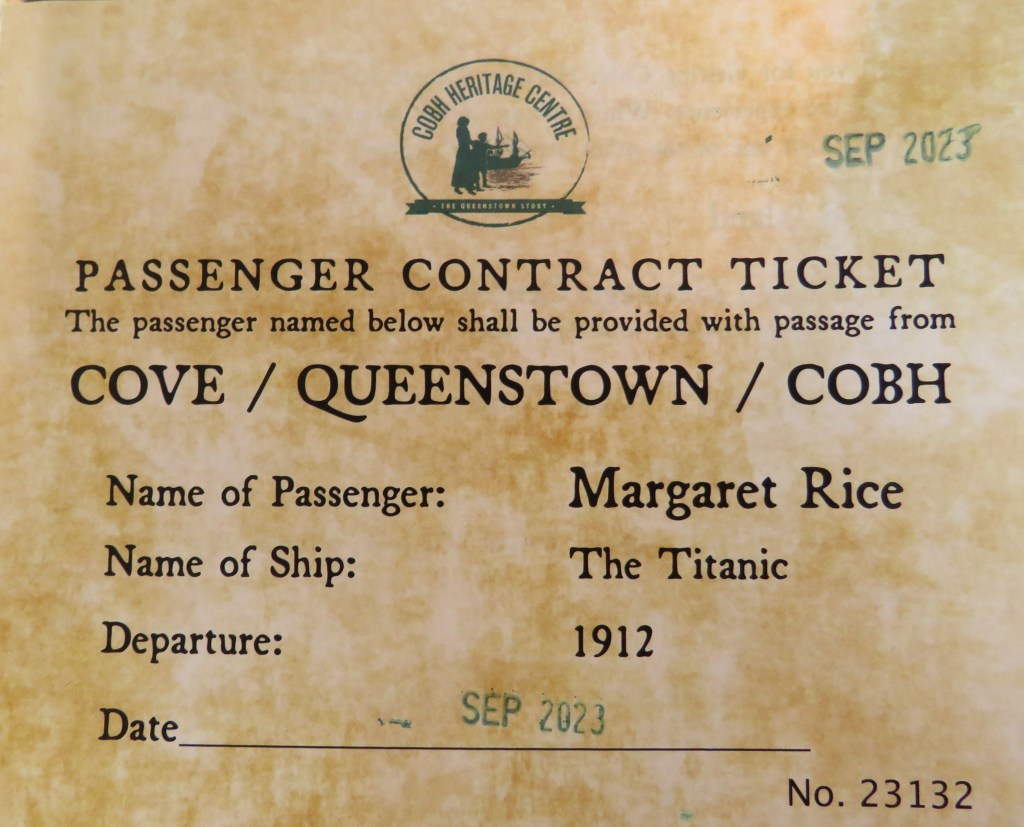
On admission to the centre we were given tickets bearing the name of a real emigrant and the actual ship on which they sailed. These emigrants left Ireland and different times in history and we were told that we would find out their fate as we went round the museum. We were both given tickets for the Titanic, so realised that this probably wasn’t going to end happily. Chris’ character was a twenty year old who eloped with a young eighteen year old to avoid being shot by her disapproving family. It is allegedly their story that inspired the film Titanic. I on the other hand was a widowed mother of five, Margaret Rice, who had been back to Ireland on a visit following the death of her husband with whom she had emigrated in 1899.

The exhibition was very well done and the personal stories were an effective touch. Several waves of emigration and emigrant ships were highlighted. Two hundred political prisoners were sentenced to transportation to Virginia in 1620. They had marched to Dublin to protest at being dispossessed of their land when Sir Arthur Chichester ‘planted’ Protestants in Wexford. From the mid-seventeenth century, Spike Island was used as a holding centre for those awaiting transportation. Many were also leaving as indentured servants. Cromwell was responsible for sending huge numbers of men, women and children to America and the West Indies, many of whose only crime was to be Irish. Kidnappers were offered substantial rewards for everyone they delivered for transportation. With around 50,000 people sent overseas in this way and sold to plantations between 1652 and 1659, in total it is estimated that Cromwell removed half a million Irish people through transportation, murder and starvation, in what was effectively an ethnic cleansing measure. In 1798, over six hundred United Irishmen were transported to Australia following an uprising. I was aware of the Roses from the Heart project to commemorate female convicts to Australia by embroidering bonnets in their name. 25,566 bonnets have been made and some were on display.

The emigrants who left from Cobh in the 1820s, many of whom went to Canada, were also part of the story. Cobh was, of course, the last port of call for the Titanic before she sailed and there was a memorial to all those from Ireland who embarked, the vast majority of whom perished, including our characters. I was pleased to see a photograph of my Margaret and her five sons. I wonder how that survived as the whole family were lost. Only Margaret’s body was recovered; she is buried in Halifax, Nova Scotia. The Lusitania, torpedoed off the Cork coast during the second world war was another disaster that was commemorated in the exhibition. 1198 of the 1959 passengers died and survivors were cared for in Queenstown and Kinsale.

Next was a bit of a drive to the supermarket of our choice. Slightly more of a drive than we’d intended because the satnav was fooled by the new road layout. We did pass some mud flats, where I glimpsed birdlife, including egrets, snipe and oyster catchers, which has been sadly lacking on this trip. On this day we clocked up more than 3000 miles since leaving home.

Irish Adventures Days 28 & 29

Day 28

Fortunately, the predicted overnight storm wasn’t too bad so we could begin our day’s adventures. Another day, another ring, this time the Ring of Beara but first to travel south to reach it. We, ok I, decided to cross the Kerry peninsula, rather than going round the main road, which we had travelled on before. In order to do so I set the satnav to follow the shortest route instead of the fastest. Do we want it to warn us of unsuitable roads? Yes, probably. The satnav makes a bleeping sound. Turns out that was it warning us, who knew? We wound our way up into the mountains until the road gave out. In theory it was a road, both map and satnav were agreed on this but it was a very narrow, bumpy, unmade-up track. Allegedly it went on for at least three miles. Having not realised this was a mistake in time to reverse back out of our predicament, we persevered amidst mutterings about the impact on the suspension. It was a mile before there was space to do a many point turn without falling over a cliff or in a bog. We took a slightly less short route but one that had the advantage of tarmac. This led us past Lough Caragh and across what is allegedly Ireland’s highest mountain range. The sum total of traffic that we encountered in an hour’s driving was one tractor. A rough road (but a least it was a road) and a series of tunnels took us to the eastern edge of the Ring of Beara and into County Cork.

The Ring was another scenic drive, similarly devoid of suitable places for comfort stops as the Ring of Kerry. There were lovely views over Bantry Bay. Many houses were painted yellow, perhaps there was a job lot of paint going cheap. As we reached the north coast, there were large mussel farms. I had hoped that our route would take us along the small portion of the Ring of Kerry that we missed in order to go through the Dunloe gap but by this time the satnav was firmly set to fastest, so we ended up going a different way. In the absence of an alternative on the Ring of Beara, we returned to Muckross for refreshment and their irresistible cakes. Their gift shop’s winter sale had started, so I was able to pick up a couple of much reduced jumpers.

Day 29

It turned out that Storm Agnes, which we thought had been and gone was here right now. We were due to travel a hundred or so miles south to our final site. Should we go or should we stay? It was pretty windy. Once the wifi decided to wake up I found a decent weather tracking site. It looked like the worst of the storm was likely to be about 1pm and it would be more severe in Kerry, where we were, than in Cork, where we were going.

Should we wait until 5pm to travel, when it looked like things would calm down? It was by this time 9.45am, should we go and hope to get there before Agnes did her worst? We ummed and ahhed a bit. I left the decision firmly in the hands of the driver, on the understanding that whatever he decided would become our joint decision and there would be no recriminations! We lurched from one alternative to another and finally decided we would go for it, stopping if necessary. We are dab hands at packing the caravan up quickly and were on the road by 10am. Apart from fording a few flooded patches of road there were no real issues and it wasn’t even raining for the first hour. We did notice that Killorglin was in darkness as we passed through, with the shop and traffic lights out, so it seemed they had no power. We felt that the potentially dodgy bit of the journey might be the Derrynasaggart Mountains but we passed through these without incident. The satnav was a tad fooled by the new N22, which she didn’t recognise but which made our journey quicker, even though this was the most exposed part of the route.

At last we neared Youghal. Should this be pronounced You-gal or Yog-hal? I am not convinced by the satnav’s version of Your. Interestingly, occasionally, the satnav lapses into Irish, so we were heading for Corcaigh, rather than Cork; she did a similar thing for Limerick but Your doesn’t seem, by any stretch of the imagination, to be an approximation of the Irish for Youghal. We arrived at 1.10pm and the last ten minutes had seemed to be windier, so the 1pm predictions were about right.

Accessing the site was ‘interesting’. First, there was a van in the entrance, so we had to wait in the road whilst I paddled across a waterlogged site in a howling gale to find out what we should do. Once the van was out of the way, we were directed up a narrow drive in the hopes we could drive out of a different gate to get where we needed to be. It turned out that this was too narrow and we couldn’t fit the van round the corner. Cue reversing the caravan back round the corner and back up the narrow entrance way. One of the site owners/staff offered to do this for us. Much to my surprise Chris, who would have been capable of these manoeuvres, agreed. I guess then the driver would have been responsible for damaged walls or caravans. Fortunately there was none. In the end the van was turned through 180 degrees and manhandled into position by site staff.

Next to set up as the wind got a little fiercer. When there is a storm force gale going on one thing you need is for your caravan legs to go down for stability. These are electronic ‘automatic’ legs that do have their moments. This was one of those moments and they were on strike. Fortunately we were able to coax them into action and we were able to balance on four legs and two tyres to weather the storm.

Irish Adventures Day 27

With the forecast half decent for once, we set off for a clockwise ride round the ring of Kerry. Having skirted part of the Killarney National Park already, I thought that we would cut off the easternmost part of the ring and drive through the Dunloe Gap instead, as I had planned to do before rain stopped play yesterday. As we began to drive through the gap between MacGillycuddy’s Reeks, we reached Kate Kearney’s Cottage, a large car park and café where plenty of coaches were gathered. A sign suggested that the road beyond this point was for walkers, horse-drawn carts and cars if they were accessing accommodation. A couple of other cars were launching themselves into the abyss. We rashly decided we were ‘accessing’ our route home via the Dunloe Gap. If we thought that driving through the Dingle Peninsula was a challenge, that was nursery slopes compared to today’s route. A ten mile journey, a seven foot wide road (and that’s being generous) winding and I do mean winding, its way up the side of a cliff, with sheer drops in many place. Horse drawn-carts to negotiate, travelling in both directions, as well as the occasional oncoming car. What might just be called passing places were infrequent but fortunately, most people were going in the same direction as us. It took us an hour, which will give you an idea of how carefully it needs to be driven. The visibility wasn’t perfect but was good enough for us to appreciate the spectacular scenery. My advice: travel this road, it is most definitely worth it but don’t attempt to do so by car unless you are bonkers/an extremely good driver, or probably both. On no account try to drive this in anything larger than a standard car, even a small camper van would be impossible. Hiring a jaunting car will probably cost an arm and other appendages, prices start at three figures but that is definitely the way to go and will be a highlight of your trip. My driver claimed that he was enjoying the challenge but it is very unlikely that most drivers would feel the same.

We continued round the rest of the Ring of Kerry. This is number one in our guide book. It was lovely and I was making allowances for the less than optimum visibility. It is a long drive and although there are stretches that are awesome, some parts are a bit mundane. There weren’t many opportunities for toilet/refreshments stops; plenty of restaurants that looked much too upmarket for us but very few open cafés. The best part was the Dunloe Gap, which isn’t part of the official Ring, for obvious reasons. So, yes, do this but I think number one is over-egging it.

We’ve finished our DVDs about farming in the seventeenth century and are now working our way through Ruth Goodman and co. slaughtering animals nineteenth century style.

Yes that is a road you see, not a river.