An Elusive Great Grandmother

Fanny Thomasine Bishop was my great grandmother on my paternal grandfather’s side. I feel like I ‘know’ my maternal great grandmothers; there are photographs and my mother shared memories of these two women. In the early 1990s, I was in contact with Fanny’s granddaughter but their lives didn’t overlap and she could not contribute anything. Fanny lived until 1921 and even though the family were very much working class, it seems usual that not a single photograph has survived, or at least not one that I have been able to locate. Everything that I know about Fanny has had to come from documentary research. She does flit in and out of the records, largely through the lives and many deaths of her children but to me, she remains a shadowy figure. Yet she intrigues me and I would love to know her better. In an attempt to understand and appreciate the life of a women who experienced many tragedies, a woman who struggled with poverty, a woman who must have possessed incredible resilience and who only legacy is her descendants, I decided to try to write her story.

I can only imagine what she looked like. Although I don’t have a photograph of her, I do have photographs of two of her children and three of her grandchildren. I also have photographs of her father and his siblings, her grandfather and, incredibly, her great grandfather, who lived to be ninety two, dying the year after Fanny was born. I am ambivalent about the use of AI. I have serious concerns about its impact on the creative industries and on the environment. I do however acknowledge that it is here and here to stay and perhaps I should be trying to understand it and through that understanding, be aware of its uses, its pitfalls and the ethical connotations. I can use those photographs of Fanny’s relatives and ask an AI agent of choice to create a period photograph that, in its opinion might be consistent with what the daughter/mother/niece of the uploaded photos might look like. Confession time, I tried this. The result was unnerving. Physically I strongly resemble my mother but I could see a resemblance to me. I asked someone who they thought the AI generated image looked like (without telling them that it was potentially anything to do with me) and they immediately named one of my daughters and not the one that looks most like me. I am not going to upload the result here, not even clearly watermarked ‘created using AI’. It isn’t something that I feel comfortable doing.

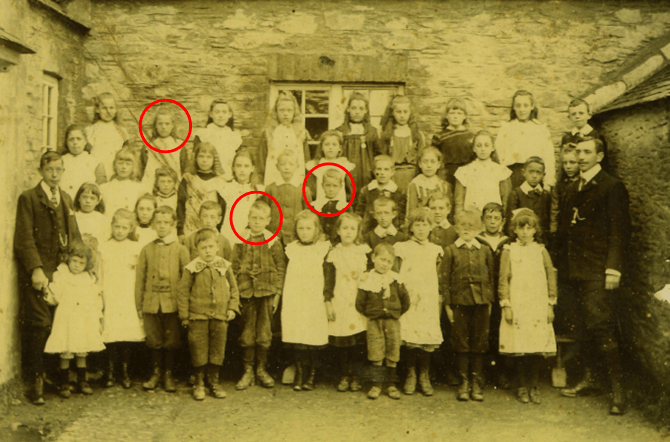
As part of investigating Fanny’s life, I considered her schooling and remembered that I did have a school photo that was given to me in connection with Fanny’s husband’s family, who lived in the same village. There was no date on the image and no names but it was meant to include the grandmother of the person who sent it to me and she was two years younger than Fanny. I investigated the schoolmaster, who was in post from at least 1871-1901. In this picture he looks to be in his late thirties or early forties, making the picture about 1870-1880. Unfortunately, school photographs look fairly similar from 1870-1910 and I don’t have the original to examine photographic techniques, or to enable me to research the photographer’s name. Fanny was likely to have been at the school from 1874-1882. So I have scrutinised this photo and if she’s in this photo I know which girl I would vote for. I would bet on which ones were her younger brothers too but I could be totally wrong. The resemblances I think I am seeing and resemblance is a tricky thing, might be because members of Fanny’s husband’s family would have been at the school at this time. So, are the circled children below my great grandmother and her brothers? I wish I knew.
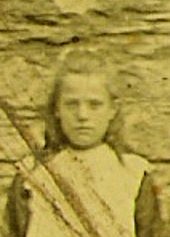
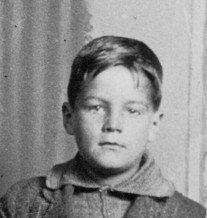
I did enhance the child who could be Fanny, or indeed any number of other people and compared it to a picture of my father, her grandson, at a similar age. It has made the girl very blurry but I am happy with my guess, even though the words ‘clutching at straws’ come to mind.
What Comes Next for me in the Family History Part of my World?

I often write about what I’ve been up to in the previous few weeks and sometimes get the response ‘I wish I’d known you were doing x’, so I thought I’d look ahead for a change.

Today, yes, today, I am starting a new presentation of my ‘Putting your Female Ancestors into Context course. This is five weeks of online study, almost all of which can be done in your own time. You haven’t missed anything if you want to jump in and come along for the ride. Here where to find out more. There’s a similar course about writing up your family history, starting on 20 April too.

On 26 February, I’ll be running a workshop for the Society of Genealogists that is designed for those who are interested in rural communities, or who have ancestors who were rural dwellers. We have a whole two and a half hours so, after an introduction, participants are let loose in small groups to research a specific community and its inhabitants. The techniques can then be applied to your own ancestors. I’ve done a shortened version of this before and it was great fun but we didn’t have long enough, so this is an extended version, with different geographical areas to investigate. You can book for this here.

Early March brings the annual extravaganza that is Rootstech and the online version is free to attend with hundreds of speakers from across the world, speaking on a wide variety of topics. You’ll find me speaking  live but remotely at 3pm on Saturday 7th about researching British ancestors in the Twentieth Century. I’ve also done a recorded short presentation about using Timelines for Genealogy, which should be available from 4pm on 5th March. Recordings of talks I’ve given in previous years are also available. Do register to attend, there’s so much to learn.

April is going to be busy with the Really Useful Show in St. Ives (the one near Peterborough) and the Guild of One Name Studies Conference in Portsmouth. Bookings for this are remaining open for a few more days. I have a new talk to give for this ‘Preserving the Past for the Future’, about memories, heirlooms, family stories and photographs.

Also available to book is the Society of Genealogists’ Mental Health and Family History Day on 11 May, when I am joining some very talented colleagues to explore different areas of family history and mental health. I will be sharing some case studies of those who spent time in an asylum. If you’ve heard me talk on similar subjects before, I have found some new stories to include for this one. This is how to book for that one.

Looking ahead to the end of the year, on 13 November, I’ll be giving a talk about researching in Devon for Legacy Family History Webinars. You’ll be able to join me live for free but you might like to take out a subscription and view other talks that are part of Legacy’s “Year of the Genealogy Deep Dive”, featuring over 220 talks. Check out the full 2026 schedule and register here

I also have far too many other talks to give to various groups, both in person and online. In between all this I have two exciting trips away and a ‘big’ birthday to celebrate. Apropos of that, I just had to apply to renew my driving licence. Good grief, honestly, if you are ten years away from this milestone, start now. It took forever. I made the mistake of doing it online, as I thought this would be easier and quicker than filling in the form on paper. Don’t, just don’t. Four one time pass codes to negotiate. Mid-way through I had to swap to my phone and download an app. I hate trying to do things on my phone. Then I had to answer a load of questions I’d already answered. The grumpy old woman hat was very firmly on by this point. To top it all, my application failed as they didn’t like my photo and I had to encounter yet more one time passcodes.

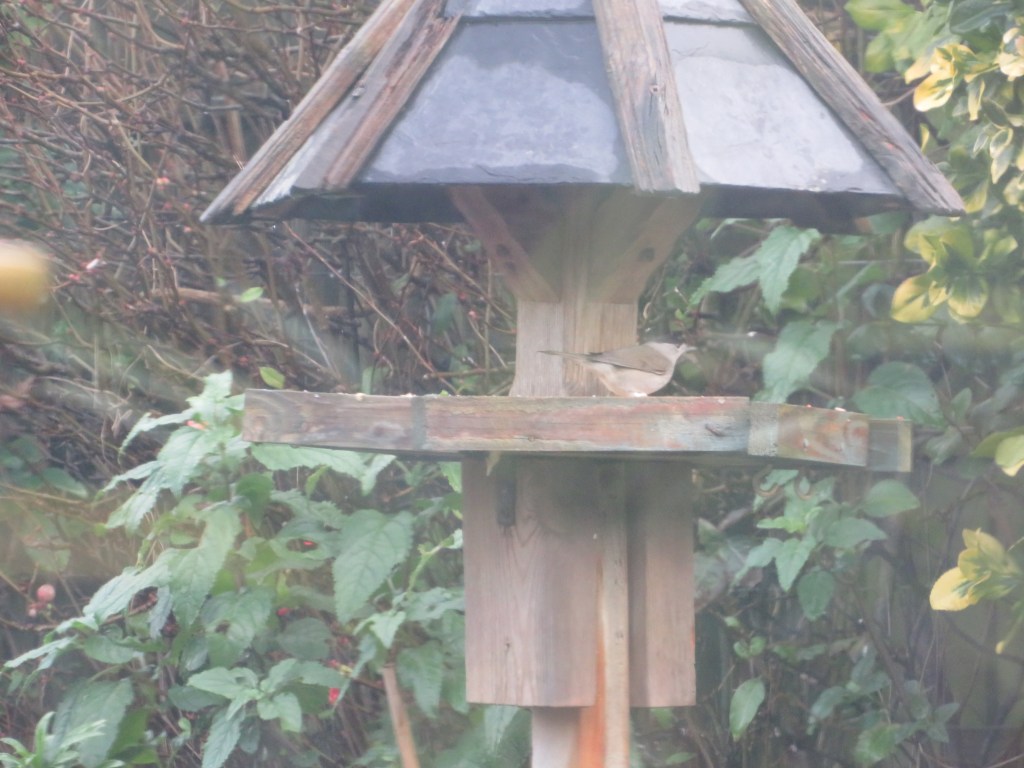
Because peace and mindfulness is needed to restore balance, I am excited to report that I have a pair of blackcaps, that have been seen several times in my tiny, concrete infested garden. Here’s a hurried, blurry photo, taken through two panes of double glazing, to prove it.