The Last of the Cornish Saga

Posting these accounts from the comfort of home always makes holidays seem like such a brief interlude but I didn’t want you to think that I was still stuck in the midst of Cornwall.

Day 7 Round and About

Initially, we thought we’d go to Marazion Nature Reserve but on the way, remembered that this was somewhere we’d been before, so we had a change of plan and headed to Trengwainton, which turned out to be closed. Never fear, we thought, we’d go on to Carn Euny Iron Age Village, open at all times. We followed the signs, we drove for a mile up a single track no through road. We were in the right place but the car park was full. Annoyingly, inconsiderate parking, meant that fewer cars could park than the space warranted. It looked like most of those parked were locals rather than visitors. It also made it extremely difficult to turn round but after a several point turn we escaped. At this point, we decided that we would chalk the day up as ‘a nice ride round the far south west’ and we headed back to the site.

So we weren’t sat down all day, we went for a walk from the site. Still mapless, we had to be careful not to get lost. We followed what was signposted as a footpath. I don’t think anyone had walked part of this for some considerable time as it involved battling through stinging nettles. Bit of a shame I’d decided to put shorts on. We passed a lavender farm and went downhill until the path turned into a steam. A series of well-spread-out stepping stones reached into the distance. We watched a man and two teenaged boys leap agilely from stone to stone. We asked where the path led to. It seemed nowhere much, at least not for a couple of miles. We decided our leaping days were over and retraced our steps.

Day 8 Windmill Farm Nature Reserve

The nature reserve of choice was one nearby at Windmill Farm. It turns out that it was nearer by than the sat-nav would have us believe and we had to give up and use Google maps instead. We headed off across a field of cows, having carefully read the instructions to chat to said cows so they knew we were on our way. The trouble with cow fields that are usually muddy but have been baked dry for a fortnight, is that they are full of potential ankle twisting ruts.

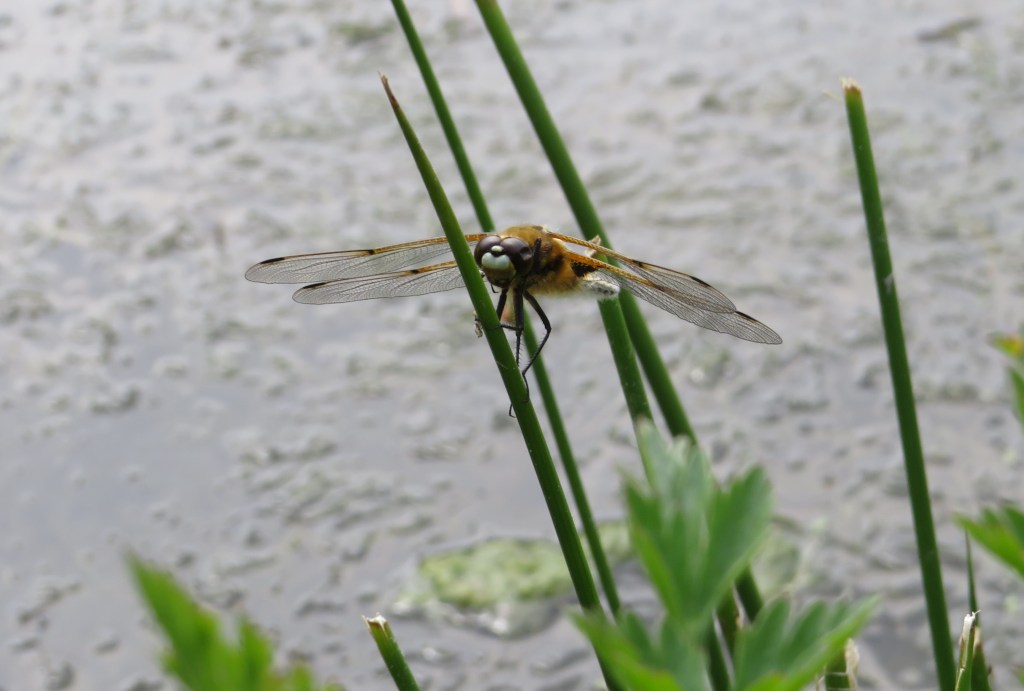
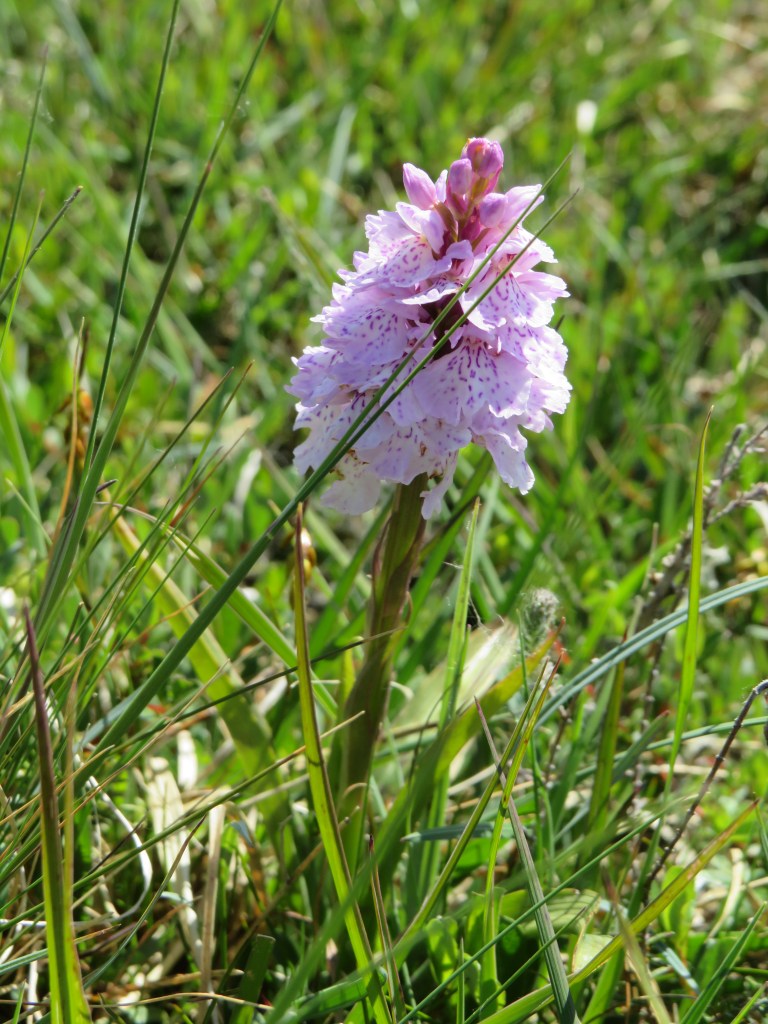
In theory, there was a way-marked route but we somehow missed this and ended up in a field of fennel. Retracing our steps across the cow field we reconnected with the white painted posts that marked our way. Inevitably, there wasn’t much fauna but a variety of flora was a little more in evidence, including heath spotted orchids. We finally came across a couple of drying out ponds, one at least of which looked newly dug. There were dragonflies but little else.

Next, the windmill from which the reserve takes its name. Originally called Lizard Windmill, it is referred to in a document of 1695, although has probably been rebuilt since then. It no longer has sails and ceased working in the 1840s. In the nineteenth century, the notorious Windmill Gang of footpads and sheep rustlers were active in the area. Two members were drowned when trying to escape pursuit.

It is possible to climb to the top of the windmill. My height-hating brain surveyed the see-through metal spiral steps with caution. There might be a good view from the top, thinks I, having read that the windmill was used as vantage point by Home Guard in the Second World War and became part of the RAF base at neighbouring Predannack Airfield. I began to climb. This, dear reader, was a mistake and previous experience with similar scenarios should have been enough to warn me that I would find this terrifying. Locals believe that the windmill is haunted. I often sense when this is the case but in summary, my opinion was – scary staircase yes, haunted no.

Day 9 Monday Minack Theatre

This was the day when we were booked to see Seth Lakeman at the Minack Theatre. I’ll be honest, this was a second best when we failed to get Fisherman’s Friends tickets for the first time in several years. As the campsite is thirty miles from the Minack, I was a little disconcerted when my travelling companion’s remark as we went to leave was, ‘where did I put the car keys?’. Keys located and we were on our way. We were slightly early, what’s new, for the stated ‘car park opens’ time but being a matinee, were let in. We sat in the sun eating ice cream and were within the first fifty or so (of five hundred) in the queue. This is the point at which I panic. Normally, I would have back-up printed tickets but by the time they were emailed, we were in a field miles from any printer. Will my fully charged phone somehow fail to display said tickets when required? Will the back-up fully charged battery pack similarly suddenly be empty? Will I not be able to get a phone signal? None of these unlikely eventualities occurred, although the staff’s scanning machines were being temperamental. We, along with most, people had zone A tickets. As we got to the front of the queue, I was asked to make a snap decision. Did we want to sit on the stone tiered seating, or on a chair directly in front of the stage? Errr, no brainer. Weirdly, some people were opting for stone seats.

The concert was excellent with some virtuoso musicianship from Seth and the other two-thirds of his trio, who had sixteen different instruments between them. There was even a guest appearance from Seth’s father, Geoff, showing just how to play the spoons. All in all we were well pleased with our ‘second best’ choice.

Access to the Minack is ‘interesting’. You don’t want to be trying to head towards the theatre as a show has just ended. Unfortunately, as we and many others wended our way down the single track road both a coach and a tractor were rashly attempting to make their way up the hill. Couple this with a high percentage of drivers who are used to motorway driving, rather than west-country roads and there was somewhat of an impasse for quite a while.

Day 10 A Day of Two Gardens

As it was only half a mile away, we decided we should visit Bonython Gardens. We often stick to places we can get in ‘free’ with my array of life memberships (National Trust, English Heritage, RSPB and RHS) but this was billed as ‘a great garden of Cornwall’, so it seemed like a good investment. This proved to be the case. With the help of two gardeners, the owners have crafted a beautiful landscape, including a walled garden, lakes and a fascinating yew chapel. There was a laid-back refreshment system, where you helped yourself and put the money in an honesty box. The orange cake and fruit cake both got a mark of approval. On the subject of honesty, I also purchased some honesty plants, which have been on my wanted list for a while.

The afternoon was reserved for meeting up with friends of long-standing and we had a lovely wander through the National Trust gardens at Trelissick, reminiscing and catching-up on the last twenty years or so of our lives. As my age advances, far too rapidly, I am on a mission to see in person, as many friends as I can, particularly those who I’ve exchanged Christmas cards with for the last fifty years but rarely see, so I am looking forward to more reunions such as this.
More Meandering

Day 4

Another day and yet another short drive, this time to Helford, as we remembered that as being an attractive section of the coastal footpath. After a bit of a diversion down to the river ferry terminal we headed round to the tiny St. Francis’ Chapel, where St. F’s main animal of choice seems to be a German Shepherd. Then on along the path towards Frenchman’s Creek of Du Maurier fame. We got to the point where we were overlooking the creek and decided that it was quite a long way down, which would, of course, mean quite a long way back up, so we turned round and retraced our steps.

Day 5

The short walk of choice today was round Goonhilly Nature Reserve. We have come to learn what to expect from nature reserves and Goonhilly lived up to expectations – an almost total absence of wildlife. We did hear a cuckoo but not a great deal else. Here we were close to the tracking station, which sits incongruously against the Cornish landscape and occasional menhir. We may also have deviated from the waymarked route a tad. This involved climbing over gates, which fortunately held our weight and did not mean we ended up in a field with a bull. We also had a choice between being up to our ankles in water, or up to our ankles in mud. This despite it being the driest spring on record. We opted for mud. The advantage of this walk was that it was relatively flat and underlined the fact that it is hills that I have issues with, rather than walking itself. Still, we think ourselves lucky that we can walk as much as we can, as we approach our eighth and nineth decades.

We went on to Cadgwith so that the fisherman of my acquaintance could get a fishing boat fix. This also involved passing some free-range geese and observing two delivery lorries trying to escape and turn on the extremely narrow road, which, in addition, was partly blocked by a scaffolders’ lorry. We didn’t stay to see the resolution of this. From the look of the way things were going, despite some seriously skilled reversing up very narrow alleys, they may still be there.

We were visited by the site’s friendly collie, who came into the van calling for Chris. Balls were thrown and the neighbouring horses chatted to.

Day 6 Penrose and Poldu Cove

We drove to Penrose, a National Trust estate that we hadn’t visited before. This was a pleasant walk that took us to where we could overlook Loe Lake, the largest freshwater lake in the county. There was a very acceptable café where we availed ourselves of ice cream. The walled garden, designed by John Rogers when he inherited Penrose in 1772, is being restored by volunteers. We then decided to drive down to Mullion; another day another cove. We stopped off at Poldhu, a cove we remembered from our walking round the coastal footpath days. Mullion, despite the sat-nav, proved elusive, so we decided to leave that for another time.

Meandering in Cornwall Part 1

As usual, you are not getting these reports in real time but I’ll catch up eventually.

Day 1

Having spent the past days soaking my garden plants with water and moving most of what turned out to be nearly fifty plant pots to the shady part of the garden, I felt relatively ready to go away. Turns out there were to be a few hitches. I arrived at Chris’ to be told that he was waiting for roadside recovery as the caravan-towing car wouldn’t start. Fortunately, this was speedily resolved. By this time, I was starting to remember the things that I had forgotten. The list included a belt and the trousers I was wearing were the sort that descend, taking one’s knickers with them. I was able to borrow a belt from the fisherman of my acquaintance. Even better, it looked like I’d borrowed it before, as it had had a me sized hole added to it.

My travelling companion had to stand in for a holidaying churchwarden but I decided to forsake the church with the second most uncomfortable pews in the world and walk down Clovelly High Street instead. I was hoping to get some photos suitable for advertising next year’s Devon Family History Society conference but scaffolding and a dull day put paid to that. I am sure the street is steeper than it used to be; despite not going right down to the harbour, the slog back to the top was a bit of an effort.

We were finally on our way just after midday. I then realised that I hadn’t brought the maps with me. These weren’t needed for finding our way (or so I thought – see below) but I do like to follow along on a map. We arrived at our site not far from Helston, Cornwall. We were the only van on site, with rabbits for company and horses from the neighbouring field and the farm’s resident dog coming to say hello. This was meant to be a restful holiday, so we did just that.

Day 2 Kynance Cove

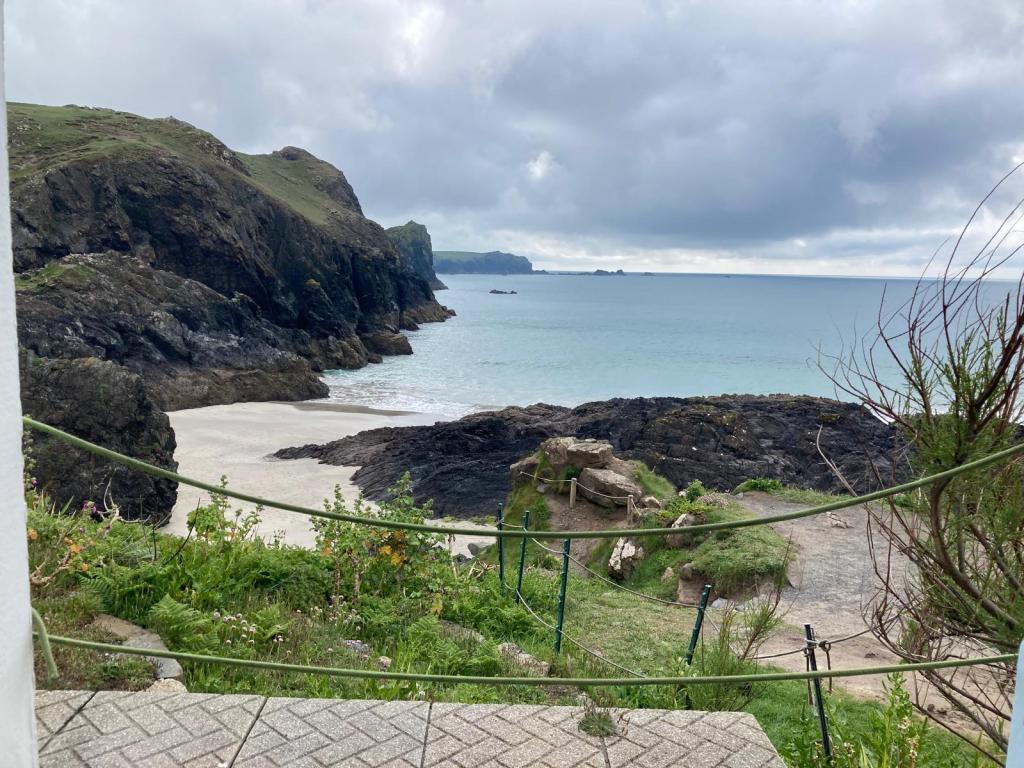
After a short drive, we availed ourselves of the free members’ parking at the National  Trust car park and prepared for a short walk along part of the south-west coastal footpath near Kynance Cove. We have previously walked the whole of the Cornish section of this long-distance path but it was soon obvious that we are not as young or fit as we were. If this section of the path isn’t described in the book, which I have also forgotten, as strenuous, then it should be. We scrambled down the cliff side, wandered across the sand at Kynance Cove then struggled back up the other side. One excitement was not only hearing but seeing a cuckoo; I’ve never seen one before. Sadly, I wasn’t swift enough with the camera.

We went  a little further on then, being well aware that every step further on also meant an additional step to retrace, we turned round. We treated ourselves to a drink at the café on the way back and I felt that it would be rude to refuse the carrot cake.

Back in the car, we took a short journey to Landewednack to look at the new Lifeboat Station which seems to have some kind of life down to the shore and then for good measure, the old Lifeboat Station at Church Cove. This involved parking under a very noisy rookery and hoping that the car wouldn’t need too much of a clean afterwards. That being enough exercise for one day, we went back to the caravan, where we lazed the rest of the day away.

Day 3 Godolphin

Another short drive, this time to visit the National Trust property, Godolphin. We knew the house itself wouldn’t be open but planned to explore the estate. I cleverly, or so I thought, photographed the map of the various coloured footpaths before we started. I did this on my camera; fail. I should, of course, have photographed it on my phone so that it could be enlarged. We completed most of the not terribly inspiring yellow route through fields and woods, alongside the River Hayle. The plan was to transfer to a short part of the pink route to the house, garden and café. Somehow we ended up on the purple route. Nonetheless, I was pretty sure which way we needed to go. It turned out that I was right. Unfortunately, I decided I should check the map. Finding a landmark on the opposite side of the road to the one I expected, we turned round and walked and walked some more. If only we had a proper map. Never fear we had phones with apps including Google maps and what the family call the spooky stalking app. What we didn’t have was anything resembling a phone signal. We approached a small settlement that boasted a post office, hurrah someone we could ask for directions. Said post office was only open one day a week, inevitably not the day we were there. Finally a passer-by. Better still, one who used to work for the National Trust. She set us on our way, retracing many steps. This also involved scaling walls using a strange for of style, some of which had ‘steps’ that were a very long way apart. She did also admit that the map left much to be desired and it appears that the key landmark was indicated on the wrong side of the road.

We finally approached the house/café/toilets (in reverse order of importance). We felt that we had earned our orange cake and lemon meringue donut. We looked at the C17th exterior of the house, which apparently has a colonnade that is unique in the country. The house and estate were developed by the prestigious Godolgun (later Godolphin) family, who acquired it in the C12th. They made their fortune from mining copper and tin. The mining landscape in the area is a UNESCO World Heritage site. The farm buildings are particularly superior and were built with stone from a former house. There was an interesting film show about dairying in the dairy.

We looked round the grounds and spotted what looked like a water trough. It had inexplicable notches of different depths, set at irregular intervals round the edge. We speculated what it might be used for. Enter stage left my former colleagues on the experimental archaeology course. Something very similar on the continent is described as a Roman olive mill. Another suggestion is that it was used by a blacksmith and cooling irons could be rested in the notches. The jury is still out; further suggestions welcome – answers on a postcard.

A Week in the Life of an Everyday Historian

Lots of family history bits and pieces on the agenda lately. My article on Surviving the Seventeenth Century has appeared in Who Do You Think You Are? Magazine – full of handy tips about how not to die from the various hazards that beset our seventeenth century ancestors. I’ve chatted to Radio Devon about family history. You can catch this here at about one hour ten minutes in. I’ve helped to set up a VE Day commemorations exhibition. I’ve written up and published the story of my father’s wartime experiences, which you could read here. It is a bit of a different account as he started the war by continuing in his civilian job as a cinema operator. He worked for the small south London Granada chain and as luck would have it, Guy Morgan wrote a history of that chain in 1948. This book now retails for silly money but I borrowed it from the library twenty five years ago and it was just what I needed to understand what my dad was up to. Then he joined the RAF Regiment, serving in southern Italy and Sicily. Towards the end of the war he was one of the RAF personnel who was transferred to the army and he peeled a lot of potatoes in Ireland. Then he agreed to sign on for a further term of service, this time attached to ENSA (Entertainments National Service Association). In this capacity, he returned to Italy as a cinema operator. If you are interested in writing family stories my Are you Sitting Comfortably?: writing and telling your family history course starts this month. It is online so you can join in from anywhere.

I’ve got ready for this weekend’s one-name family reunion, as the Braund clan make their annual pilgrimage to North Devon. I’ve done lots of behind the scenes preparation for next year’s residential family history conference in North Devon, with a few more speakers announced and more lined up to reveal. It is going to be a great weekend in such a beautiful part of the world. I’ve taken advantage of said beautiful part of the world with early morning walks. Now I really do need to unearth the hoover.