Up the Garden Path 12

It has been a while since the last gardening update but that probably reflects the time of year and the fact that I was away for the whole of September. As I hadn’t asked anyone to water the garden while I was away, with much of the garden being in pots, I was wondering what would survive a month of neglect. Every pot was moved to the shadiest part of the garden and stood in an old paddling pool and other similar, water-filled receptacles, as my fingers remained firmly crossed. I think I must have done too good a rain dance, as Devon was deluged in September, which was good for my plants, as everything survived but less good for my local friends and neighbours. By contrast, I had lovely weather in the north.

I have now almost seen the seasons round in this garden and the winter jasmine is starting to bloom again. The robin has returned to the garden and I have had solitary glimpses of a great tit and a wren. The potato crop has been harvested. ‘Minimal’ is the word that springs to mind. The geraniums have been moved into the summerhouse for the winter and the garden chair has been dismantled and squeezed into the shed.

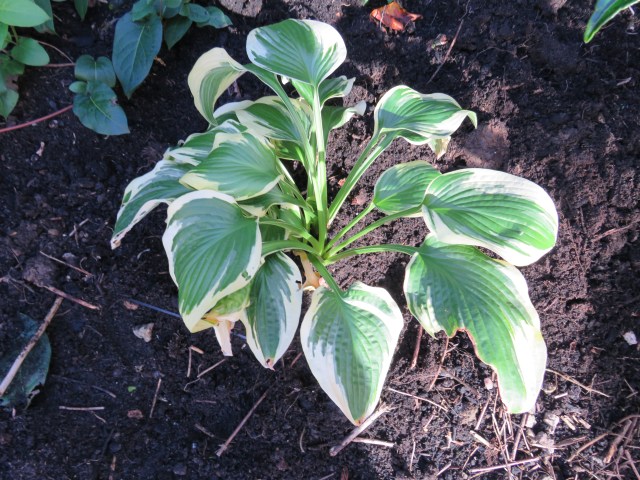
The three large chrysanthemums in pots, that I mentioned last time, have flowered. They were sold as being white, yellow and rust coloured. I guess one out of three isn’t bad, as I have rust, paler orange and dusky pink. They are past their best now but have been glorious. A piece broke off the rust coloured one and we shoved it in a pot. It has rooted and is now flowering! I also have yellow and white chrysanthemums in a hanging basket. Other additions include a Capsicum, a Hosta and a Michaelmas daisy, which I brought back from holiday, along with some rue. The Michaelmas daisy isn’t looking too healthy but maybe it will revive.

There’s been some more moving. One of the many sheds is an unsightly plastic affair that houses the bins. It was on view from the conservatory, so we moved it to the other side of the tarmacked area. It is now on view from the converted garage room but you win some you lose some. Fortunately, this was a great deal less effort than other shed moving escapades. In the place where it once stood is a new plant trough. This was bought especially for a climbing Josephine Bruce rose. In truth, I am not generally a great roses fan, well only the chocolate sort but I particularly wanted this as it was my father’s favourite flower and it climbed all over an arch in my childhood garden. I had been told that it was also the rose in my mother’s wedding bouquet but it seems that it wasn’t bred and introduced until three years after they married, so maybe it was just a similar rose and they thought it was the same. Said rose arrived in the post as a ‘bare root’ specimen. This basically means that it has to be planted straight away. ‘Straight away’ turned out to be the coldest day of the year, when much of Devon was under several inches of snow. Fortunately my little corner had escaped with just rain, although it was pretty jolly chilly and not ideal for any kind of gardening. Now I just have to work out how to keep it alive.

Up until a few weeks ago, my garden was 100% not overlooked. Then an over the back neighbour dug up a large buddleia, giving me just a tiny corner view of their conservatory and vice versa. Just at this time, the fisherman of my acquaintance acquired an eight foot high evergreen tree thing, species unknown, in a pot, that was surplus to someone else’s requirements. ‘We could stand it in that corner’, he says. Not really my choice of plant but I thought it might serve a purpose at least for now. I particularly wanted to keep it in the pot, partly because it may be a temporary acquisition and also to stop it growing much more. The corner in question in on the raised bed. We then had to get a very heavy, eight foot high tree up on to a two foot high raised bed. Undaunted, scaffold boards were arranged to provide a slope up to the raised bed. The plan was to lay the tree down and roll the pot along and up the boards. The trouble was that the pot was not cylindrical but was noticeably wider at the top than the bottom. This, of course, means that, when rolled, it went round in circles and not in a straight line. By dint of ‘roll a little, straighten, repeat’ the tree was elevated into position. It doesn’t completely block the gap left by the buddleia but it helps. I am a fair weather gardener so it may be spring before the next gardening update.

What Janet did Next

Time for a bit of a round-up of recent events, both in the family history world and beyond. Let’s start with the beyond stuff. It was time for one of my infrequent trips to the hairdressers. I engender despair in all those who attempt to do things to my hair. “It is HOW long since you last had your hair cut?” I am asked in incredulous tones. Then having established that I just ‘wash and go’ she asked if I blow-dried my fringe to give it more volume. Lady, you are talking to someone who hasn’t owned a hairdryer for fifty years!

As a non-cook Christmas cake and pudding and occasionally chutney are pretty much my only forays into cooking (beyond shoving things in the oven and taking them out again) but it was time to undertake the annual challenge. Goodness, this actually involves weighing stuff and mixing stuff together. No longer having a Rayburn to assist, I decided, for the first time ever, to cook puddings in the slow cooker. My recipe makes three puddings. Realistically, even accounting for visitors, I really don’t want more than two but three it always has been, so three it is. The slow cooked ones did need finishing off on the hob but they were looking really good. The cakes, yes two of those too because well because there always are two, not so much, well, more of a disaster actually. In my defence, I have a new-to-me oven, although I really can’t blame the results on that. I cooked them for the prescribed time. I cooked them some more and then for several more hours but they remained in an oily uncooked state. I risked taking them out of the tins and they slumped gracefully into a heap. I fear mixed peel was to blame. I am quite a fan of mixed peel so for the last 45 or so years that I’ve been cooking these, I always add extra mixed peel. Ok, so I’ll concede that four times what was required by the recipe was an expensive mistake but we live and learn. The end product is edible but cake it is not, not by any stretch of the imagination. A fisherman of my acquaintance is manfully working his way through two cakes worth of fruity blob, heating portions in the microwave and adding ice cream.

Next, the saga that was trying to renew my house insurance. There’s a ‘new system’, requiring answers to questions that haven’t been asked before. This means that, on the renewal notice, they have basically made up a load of ‘average’ answers to fill in the blanks. Having got over the issue of nothing on the system even vaguely resembling my occupation, I corrected a few things. These included “When did you move in?” – their answer 1900; must say, I feel pretty good for 124. “How many storeys do you have? 2 (yes it says it is a bungalow etc etc). New killer question, “Are you less than 400m from the sea, a river, or a water course?” I had the devil’s own job trying to work this out. Point 1, where do you count the sea from? High tide? Low tide? and then high tides vary. Point 2, even if you know where the sea starts how the ***** do you measure because they obviously want the answer as the crow flies and even the most detailed map really isn’t going to give me an accurate enough measurement. If the distance was 200m or 600m I’d know the answer but 400m is pretty much exactly how far I am from the sea, sometimes. In the end I had to say I was nearer, as I could just imagine them refusing to pay out on a burglary because I’d said I was further away and it turned out that I was 398m away. After a load of faffing and trying to find out on useless websites it turned out not to make a difference to the premium anyway. Half an hour of my life I won’t get back. At least I have no longer lived in a two story bungalow for 124 years with a mythical husband.

I’ve also spent a wonderful eighteen hours in an idyllic location, eating good food and trying to solve a murder mystery set on the French Riviera. It was exceptionally well done and although we didn’t identify ’im wot dun it, we came very close, largely because the people on our table spent ten years living in the location where the story was set.

On the family history front, The A Few Forgotten Women Team, of which I am a proud member, have held another very successful collaborative research day, this time looking at women who can be found in refuges for fallen women in a census return. I did the example biography for this, a lady called Lucy Adderley; she certainly had a story to tell. Then my allocated lady for the day, Fanny Sophia Austen, who was a staff member in the institution, turned out to be a niece of THE Jane Austen.

I’ve recorded and uploaded my presentation for Rootstech 2025. Just a short recorded session from me this year about UK places, distinguishing your lathes from your hundreds and your tithings from your townlands. I, deliberately, haven’t taken on any paid research for quite some time but this week, I was tasked with untangling two people of the same name and establishing how they were related. It turned out that there were actually several more people with the same, unusual, name, all related and the inevitable total nonsense on a plethora of online family trees, which I studiously avoided. It was great fun and I was able to confirm for the client that the two individuals were first cousins.

My online Pharos course about twentieth century research is drawing to a close and a new course about the ill health of our ancestors has just begun. You’ve barely missed anything if you want to join in with In Sickness and and Death. The course last five weeks and the lessons are sent to you as pdfs that you can follow when it is convenient to you. There’s an optional weekly online chat and a student forum.

Time I think for a comment about FindMyPast’s (FMP) new subscription structure. This has created a cheaper, tier of subscription, where you can’t search for anything but you are dependent on hints that their algorithm suggests may be the person that you want. In general, I am a fan of FMP and have used it continuously since before it was even called FMP. I much prefer it to their main competitor. I am also in favour of making genealogy more accessible, which some would argue cheaper subscription can do. Having said that, I can’t see that this is going to do anything but encourage shoddy research. Maybe it is meant to be a carrot to encourage full subscriptions but so many will just do what a prominent family historian (pretty sure it was Dave Annal) called ‘click and collect’. For me, the fun is in the research in any case. I’d rather have my properly researched tree of about 3700 (and that has taken nearly fifty years to amass and includes my grandchildren’s families too) than 70,000 people in five minutes that I know nothing about, many of whom will not actually be my relatives at all. I guess it is a hobby and each to their own but I have to say that, in my opinion, this is not FMP’s brightest idea. If it encourages more subscribers I suppose the silver lining is that there will be funds for the digitisation of more records for those of us who want to do it properly.

It occurs to me that I haven’t blogged about family history since the excellent All About That Place event. If you want to hear me chatting about my straw plaiting ancestors in Buckinghamshire, or the General View of Agriculture, just click on the links.

Finally, because I have gone on for far too long, I have joined the eXodus, as it is being called and am enjoying the unpolluted social media waters over on BlueSky, where a rapidly increasing number of my friends and colleagues can be found.

Mostly about Mull

You will be relieved to hear that this is the end of the Scottish jaunt. It seems like a lifetime ago! Firstly our trip to Mull.

We are pretty keen on islands and this trip will tick two more off the list. The first concern of the day is, will we find anywhere to park, ideally somewhere free. We had identified a possibility yesterday and do manage to locate a spot a shortish walk from the ferry terminal. The next stress inducing issue is that we have had our coach tickets for some time and I have printed these out at home but the ferry tickets, which I need to produce on four occasions, have only just arrived by email so rely on me having a workable phone. Too late, I realise that I could have forwarded this to my companion, so that we had access in two places. It isn’t even just an email, you have to open the email and then download something. This I can accomplish but my phone has days when it decides that the battery life is about five minutes. I spot a USB charging point in the terminal but for some reason this doesn’t work.

First ferry boarded and on the most beautiful, sunny, calm day we sit outside on the ferry to Craignure on Mull. The crew wear hard hats but none of these are fastened, surely that renders them next to useless? One of the deck hands serenades us with Mull of Kintyre. He really should stick to the day job.

We board a double decker bus, securing upstairs seat and with Andrew as our driver, set off for a thirty seven mile drive along a single track road to Fionnphort. It is an enjoyable drive with plenty of information supplied by Andrew, as well as comments on the inadequacy of the driving of other road users. This is the new road, built between the 1960s and the 1980s and halved the previous journey time. There is plenty of reversing and pulling in to passing places. Some of the other drivers appear to be in vehicles that don’t have reverse gears.

Mull’s population is about 3,000, with 200 on Iona. We spot one of the 8,000 deer on the island; there are also fallow deer. We see evidence of the mussel fishery, a seaweed farm and a forestry industry. Travelling in the coach proves hazardous and I manage to bang my head three times and whack my upper arm into the half raised arm rest.

We leave the bus to take the ferry to Iona. A notice tells us to turn our phones off. a) Why? And b) How is that going to work when our tickets are on our phones then? I have tried charging my phone on the bus, that charging point didn’t seem to work either. So far I am two ferries down with more than half my battery left.

After a short trip we alight on Iona and the first stop is the nunnery, founded in 1200. There is allegedly a carving of a naked women over the window of the refectory that was intended as protection from evil but we don’t spot it. Next, St Ronan’s Chapel, which was built about 1200, although there is evidence of an earlier chapel, dating from c.700. Interestingly, all the skeletons that have been found in this area are female.

Unfortunately, the heritage centre is not open but we probably wouldn’t have had time to explore it. We are still able to find out about the island’s history as a centre of religion. Columba, accompanied by twelve monks, arrived on Iona in 563 and founded the monastery, which would have been a timber construction. An account of Columba’s life, written by Adomnan, Iona’s abbot in the 690s, provides details of the early years of the monastery. It became a Benedictine foundation in 1200, which survived until the Reformation. What we see today is a reconstruction of the abbey as it would have been under the Benedictines. This was accomplished by the Iona Cathedral Trust in the early twentieth century and funded by the Duke and Duchess of Argyll.

Iona was famous for its scriptorium, where monks produced beautifully  illustrated religious manuscripts, including the Book of Kells, created about 800, which we saw in Ireland last year. Remnants of a path, dating from 700, survive. This ‘street of the dead’ was used as a processional route, passing the monastery’s holy places and leading to the shrine of St Columba. Crosses were erected on the route to mark places for contemplation. Viking raiders plundered the abbey from 795. In 806, sixty eight monks were killed. This led Abbot Cellach to take the monastery’s treasures and most of the monks to Kells in Ireland. Some monks remained on Iona. There were strong sea links between Iona and other religious houses in Scotland and Ireland. Viking raids continued for two centuries. In 825, Abbot Blathmac was killed when he refused to give raiders the jewelled casket containing St Columba’s bones. The abbot and fifteen monks were killed on the beach on 25 December 986.

The museum on site of the abbey contains many ancient carvings dating from the early 600s onwards, including huge crosses and tomb tops. In Medieval times many  of those from high society were brought here for burial. The twelfth century St Oran’s Chapel is the burial places of The MacDonalds. The site is home to St John’s Cross, thought to be the first Celtic Cross of its type.

We partake of lunch at the St. Columba Hotel, a little upmarket for us. We decide that we should have something regional, so Cullen skink for my companion and haggis, goat’s cheese and onion marmalade quiche for me. I wouldn’t normally eat haggis but the other options didn’t appeal. We sat outside and observed a cucumber eating dog on the next table. The owner had ordered a whole cucumber that he cut up and gave to the dog as treats.

The return journey passes without incident and we opt to stay  inside on the ferry to Oban as the temperature had dropped. We exited the ferry terminal in a different place, leaving us with a route march back to the car. It has been a lovely, if long day and we couldn’t have hoped for better weather.

The next day, the weather had turned grey but an improvement on what those further down south were experiencing, where there are severe floods. We picked a Scottish National Trust property that isn’t too far away and go to Arduaine Gardens. The coastal garden was created by James Arthur and Ethyl Campbell, who purchased the land in 1897. The garden suffered severe storm damage a couple of years ago, with many trees being blown down, so there is much restoration underway. There are some lovely views of the coast, although the visibility isn’t great. We don’t fancy the cake on offer in the neighbouring hotel, so it is back to the van via Lidl’s, who sadly, don’t have any tiramasu muffins this time. The afternoon is spent enjoying the sea views from the van and tomorrow we begin to wend our way home.