Ancestral Ramblings in Northumberland

With visibility as bad as ever, this time accompanied by rain, it was a day to choose a largely indoor activity. We opted for a return visit to nearby Cragside, so my still ailing travelling companion didn’t have far to drive. Little did he suspect that I was softening him up for tours of ancestral parishes, which often involve traversing routes that many might consider do not rate the status of a road. Miraculously, the rain had stopped by the time we arrived so we had a quick look at the Pinetum and a scramble through the perilously steep rock garden. Probably not recommended after rain and when wearing varifocals, so you can’t focus on which slippery rock you are placing your feet.

Cragside was built in 1863 by arms manufacturer William Armstrong and it became known for its many innovative feats of engineering; it was the first house in the country to be lit by hydro-electricity. Other attractions for Victorian and Edwardian visitors included central heating, a hydraulic lift and a water-powered roasting spit. I quite liked the heated seats in the billiard room. When Edward VII and Queen Alexandra were due to visit, an impressive extension was built, complete with a massive marble fireplace that stretched from floor to ceiling. Some of the rock face had to be blasted away to make space for the additional rooms. William Watson Armstrong, great nephew of the original William Armstrong, lived in the house in the 1890s and conducted all kinds of experiments with electricity.

It was refreshing to see that there was a quiet room set aside for those who were finding the visit overwhelming.

We opted for honeycomb ice-cream as our midday treat, then set off round the six mile carriage drive. This is at its best when the many rhododendrons are out but was still a diversion on a wet afternoon. We did make the obligatory trip to the antiques centre near to the site before calling it a day.

Finally, a day when there was some visibility, so we set off to visit some ancestral parishes. The issue with ancestral parish visiting, particularly in what is officially the middle of nowhere, is the potential lack of toilet facilities. Undaunted, away we went. First on the list was Alwinton, home of ‘almost certainly my ancestors’ the Newlands and Corbitt families. We were fortunate to be able to actually see the spectacular scenery on the way. On to nearby Elsdon, where the village hall open up to provide toilet facilities, tick. On through Rochester to the little chapel at Byrness. I’ve been here before and was hoping that my some miracle a gravestone that was illegible in vital places four years ago, would now magically be readable.

First problem find the gravestone. The churchyard is on a steep slope and had been ‘rewilded’ with wet grass higher than the gravestones. Unsurprisingly, I failed to find the stone. I looked inside the chapel and discovered a grave plan and gravestone inscriptions that were done more than fifty years ago! Result. Gravestone found and a little more that was readable when the transcription was done in 1973 suggests the ‘almost certainly my ancestor’ must have had an additional marriage. Annoyingly the absence of online registers, or indeed I think any surviving registers, means I am none the wiser. His previous wife certainly isn’t the one eleventy billion people on Ancestry claim as his. At least unless he was a bigamist. The eleventy billion conveniently kill off the ‘almost certainly my ancestress’ in order to make sense of these two marriages. Here is her gravestone, she had several children after this so called second marriages. In any case, this gravestone suggests that he had children before he married my potential ancestress. Did he come from Jedburgh as some evidence suggests, or had the family lived in this area for generation but no records have survived?

Not my ancestor’s gravestone
Actually Northumberland this Time

It was time for the holiday proper to start as we headed north in the footsteps of the Romans on what is now the A1. Roadworks made the journey more protracted than we might have hoped but we arrived in Powburn in the early afternoon. Having spent five hours sat in a car, we went for a quick walk round neighbouring Branton lakes. ‘Lakes’ there certainly are but sadly, vegetation means that glimpses of said lakes are few and far between.

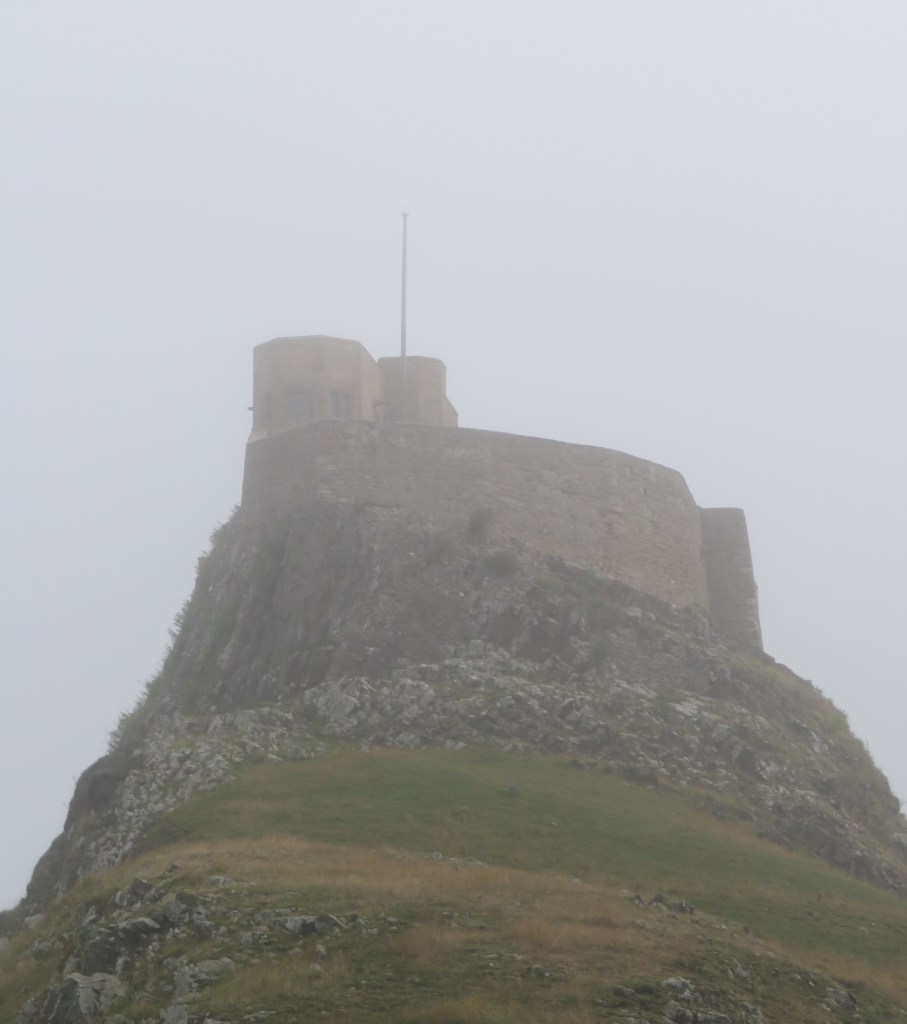
The next morning’s weather was not so much fog on the Tyne but fog across the whole of Northumberland. Undaunted, we set off to Lindisfarne admiring the hedges as we passed, which was about as far as we could see. We crossed the causeway to Holy Island just after it opened. We walked round the island past the old boats that have been upturned to use as sheds, then doubled back to walk toward the Castle. We had to get pretty close before you knew there was a castle and could see it looming through the mist. Built as a fort, the castle was converted into a holiday home by Edward Hudson, showcasing the work of Edward Lutyens as he did so. The garden was designed by Gertrude Jekyll. We had visited before and as one of our party was not in full health we decided to give climbing to the top to not see anything but fog a miss. We did look round the ruins of the priory and the accompanying exhibition.

Holy Island’s first monastery was found by  St Aiden from Iona in 635. In the 670s, Cuthbert became the prior and the island developed as a destination for pilgrims visiting Cuthbert’s shrine. It is perhaps best known as the place where the beautifully illustrated Lindisfarne Gospels were created about 1300 years ago. A Viking raid in 793 resulted in the monks leaving the island, together with Cuthbert’s remains and the monastery’s treasures. They settled, first in Chester-le-Street and finally in Durham. Lindisfarne was still revered as a holy site and was probably the burial place of Northumbrian nobles. It was reinforced by a community from Durham Cathedral, who built the priory that can be seen today in the style of Durham Cathedral. In medieval times cattle were farmed on Lindisfarne, perhaps so that their skins could be used as vellum. Holy Island remained as a centre for religion until the Dissolution of the Monasteries in the 1530s. Unlike many religious houses, the priory was not destroyed on the orders of Henry VIII because he wanted to use the building for defensive purposes. This was largely because of its proximity to the Scottish border. With the fog starting to lift, it was good to see some wading birds as we re-crossed the causeway.

A supermarket stop was next on the list, so we drove down the coast road to Alnwick, where I was pleased to remember exactly where the supermarket of choice might be found. In the absence of having coffee and cake out, I treated myself to a most acceptable Lidl’s tiramisu muffin.

More Travelling Adventures

I always write these holiday posts with a time lag, so I am home before you even know I’ve gone, which is why my comments about the weather don’t always tie up. So here is the first part of our most recent travels.

Having spent a morning in the seventeenth century, it was a rapid turn around and a quick change before setting off on our way to Lincoln. After an uneventful journey, it was time for a late meal and watching some Paralympics.

The opportunity for a day with the family and looking through multiple boxes of stuff in a garage, deciding what needed to be kept and what could be humanely disposed of. The miscellaneous items that have been designated for me will be collected on our way home and I fear for the suspension.

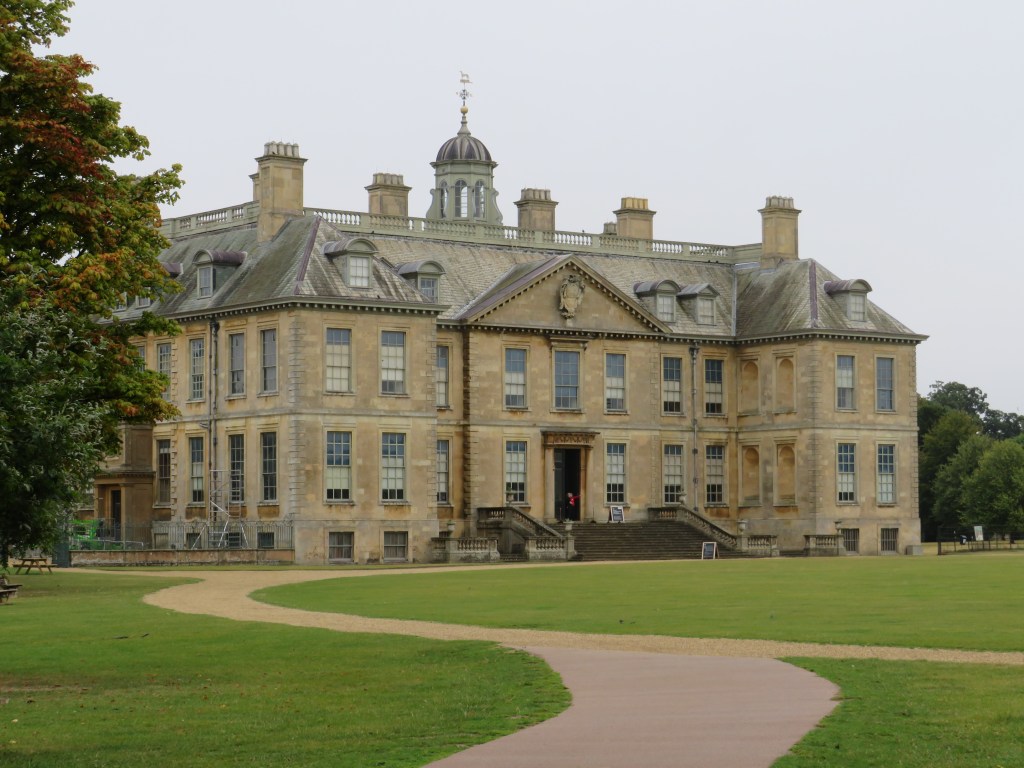
We set off in the drizzle for Belton House. Built in the reign of Charles II, this is a house that is very much influenced by the Baroque style, with plenty of decorative flourishes and impressively high ceilings. It was built for Sir John Brownlow and remained in the family for three hundred years but was predominantly used as a holiday home.

Grinling Gibbons carvings, mostly involving deceased game, provide a dusting nightmare. There is an interesting painted floor showing heraldic symbols and overall there is plenty of evidence of the family’s greyhound symbol. The house is home to 20,000 books, the earliest dating from 1493; one wonders how many remain on the TBR pile. Queen Adelaide, wife of William IV slept here, as did the future Charles III when a young Prince of Wales. It was good to see plenty of signs of ongoing conservation and preservation.

I have to say this is probably not the most inspiring National Trust property I’ve visited but I suspect the real gem is the fifty acres of garden and further 1300 acres of grounds. Unfortunately, it was not the weather for exploring the typically seventeenth century garden, perhaps that’s for another visit. The herd of fallow deer were much in evidence, although not easily captured on camera, with stags in full antler ready for the rut and including those with white, dark and dappled coats.

The younger members of the family joined us for the afternoon, by which time it was at least dry but more reminiscent of late October than early September. Autumn has certainly arrived early with falling leaves and autumnal fogs. The impressive adventure playground went down well but I have doubts about the advisability of the oldest member of our party testing the zip wire.

Up the Garden Path 11

Autumn is just around the corner. Surely it should still be about April. I went on a buying spree intending to get things to fill the newly cleared side bed. Annoyingly, most of the things on the list weren’t available. For now, I have put a net up as the climbers, that were cut back pretty much to ground level, start to regrow and have planted some bulbs. In fact, the main consequence of the plant buying trip was that I somehow lost my debit card. I got it ready as I approached the checkout. As if by magic, by the time I reached the checkout it had disappeared and was nowhere to be seen. The twenty something on the checkout was very impressed that someone as ancient as I had an app and (after a bit of faffing) was able to use it to block said card within five minutes.

The pond does now have water and plants. It looks a bit murky but some insect life seems to like it. I’ve tidied up the large raised bed, which was looking very much past it best. The olive tree now has a larger pot, as well as a few tiny olives. I picked the single apple that was my apple harvest.

I acquired some wallflowers and chrysanthemums. I also ended up with a sunflower that was self-seeded from the birdseed. Apart from sparrows, I have been deserted by smaller birds, I hope they return in the spring. I always knew that moving house would deplete my supply of garden birds. I do still get visits from jackdaws, magpies, wood pigeons and herring gulls, so I have to make do with those.

Unless I can get any of the plants on the wanted list, there will be a lull in gardening over the winter. It will just be the continuation of the convolvulus wars and a bit of tidying. It is still very much a work in progress and I am still not completely happy with it but it is on its way.