Family History Round-up

I have been hidden down so many rabbit warrens with family history research this week that I may have grown long ears and a fluffy tail. I’m definitely in full on family history mode. I’ve attacked three major brick walls with a wrecking ball but still they stand, although in one case, I am tempted to climb over the rubble and add the ‘almost certainly my 3x great grandfather’ to my tree.

Problem one, Josiah Lamball, great unusual name you’d think wouldn’t you but no. Every last cousin for generations in and around Bampton, Oxfordshire called their child Josiah. Forget being called Lamball, let’s just throw in a Lambert or Lambeth for good measure. Definitely let’s ignore eleventy billion online trees who are convinced my Josiah descended from another specific Josiah. He didn’t. Look at the original records guys. This Josiah witnesses his father’s will with a totally different signature to the one on my Josiah’s marriage. I am pretty sure I know who his grandfather was and teeny tiny DNA matches agree but as they are all related anyway ………..

Leaving Oxfordshire (virtually) I travel to Northumberland, where I will shortly be literally, hence revisiting these branches now in case I want to add any places to my must visit list. Here, I am still frantically trying confirm my hypotheses that will take me back to my first non-English ancestor. The Elliotts first, who, lovely people, help by leaving wills. Sadly though, these rule out the strongest candidate for the father of Mary Elliott of Chollerton. I am now pinning my hopes on two wills that are not online via the wonderful North East Inheritance Database. I have taken out a second mortgage to order these from the Borthwick.

Don’t get me started on John Newlands who married Ann (Nanny) Corbit in Alwinton. Helpfully, this marriage is also recorded in the register for Oxnam in Roxburghshire, where it seems banns were called. Mortgage for Scotland’s People alert. I’ll give you that this entry says he married Bettie Corbit (Ann’s mother’s name) but it also gives the name of the farm where she lived in Alwinton, so it is the same couple. No burial record for John but I do have a photograph that I took of his gravestone. It has his age and date of death but despite all the photo manipulation in the world I can’t read it. Can I hope that it will have miraculously become legible five years further down the line when I visit? There’s even a highly likely looking baptism, naming a patterns fit etc. etc.. Those eleventy billion people with online trees of epic proportions would agree that this is the one. Except, there’s a much more plausible marriage for this John Newlands. No problem, say the eleventy billion, we will kill off wife number one so he can marry twice. Except, she is still alive, well and bearing children for the next ten years. There are no alternative likely baptisms. Could he have been ‘married’ to two women, one either side of the border at the same time? I suppose so but pretty unlikely. Firmly stuck here.

Aside from all this, I’ve been giving my ‘Researching your British Ancestors and their Communities in the early Twentieth Century’ online course a revamp ready for its next presentation. Unlike Paddy McGuinness in this week’s episode of Who Do You Think You Are? I expect you know the names of your grandparents but how much do you actually know about their lives and the communities in which they grew up? This course is a great springboard for telling the stories of those ancestors. Yes, I know my granny’s biography has been stuck in 1939 for far too long. It is on the to do list I promise. Read the story so far here. Why not join me on the course and find out more about your own grandparents? It is also a great chance for all those One-place studiers out there to focus on their places in the years 1900-1945.

Then I’ve been working on the background to Homes for ‘Fallen Women’ for A Few Forgotten Women, who will be looking at this in November. Next Friday, we are researching pupils from schools for the deaf but that’s another story. Anyway, fallen women. I was seeking a suitable case study, whose story I could record for International Day of the Girl in October. I spent literally a whole day false starting numerous girls before I found one that involves accusations of murder and four generations of illegitimacy. She’s the one!

The All About That Place excitement is hotting up and they now have a website. I have a list as long as my to do list of talks I want to listen to. Many are by friends, others will be new to me speakers with fascinating topics. My own two contributions are an Introduction to the General View of Agriculture, which I try to drag into every talk I give and Over One Under Two – the story of my straw plaiting great great grandmother Anne Stratford from Aston Clinton in Buckinghamshire. She is always up there among my favourite ancestors since I discovered that she grew up in the road where I lived for three years, although I didn’t know I had any connections to Buckinghamshire at the time. This was over forty years ago, I was still being fooled by my uncle saying they were from Cumberland! Ann will also get a mention in the online talk I am giving Women’s Lives on the Farm which is part of the Society of Genealogists ‘Was your Ancestor an Agricultural Labourer? Day There’s still time to sign up for that one.

In other matters. I now almost have shelves so I can unpack the last two post move boxes (not counting the things that live in boxes). I don’t know who needs to know this but if you move a heavy dresser there’s the likelihood that the doors won’t shut when you move it back. I have been risking fingers trying to shove bits of cardboard under one corner whilst the trusty assistant manfully lifts one corner. Dear reader, my fingers survived.
Up the Garden Path 10

What has been going on in the garden over the past few weeks? you ask. Well, you probably don’t but I will tell you anyway. The most noticeable difference is that we’ve cleared the bed down one side of the garden. This isn’t quite the undertaking you might think as my garden is tiny and much wider than it is deep. The whole of this side was occupied by a very dead bush. It did have the advantages of being a home for birds and the support for some pretty honeysuckle-like climber but it really did have to go. We unearthed a ridiculously leggy hydrangea that had been struggling to reach the light. The bonus is that the soil is good, or it is now we have removed a ton of dead bush roots. What remains is a camellia, that was severely pruned to make room for the shed, a random hollyhock, which seems to be in a very odd place as that bed gets virtually no sun. Mind you, said hollyhock is only about nine inches high and has no flowers. We’ve left the remnants of the honeysuckle-like thing and another climber that may revive and so far planted a Michaelmas Daisy and some white daisies that were donated following their role as a wedding decoration in a local church. The fence behind the bed has been painted to match the one on the other side.

The new water butt is on hold as I may be going to do something with the tarmac in that bit of the garden and don’t want to move a full water butt. The pond now holds water but I haven’t had the chance to acquire any plants for it yet so the water is pretty murky. Despite this, there is evidence of insect life. The vegetable harvest has been unspectacular, although it is always fun to grow them. The pea harvest was minimal, the strawberries even more so, with most of the strawberries being smaller than the peas. The bean succumbed to black fly but I still have garlic and potatoes to harvest. There is a solitary apple on the newly planted apple tree and excitingly, some mini olives on the olive tree. No one actually likes olives but that isn’t the point.

We bumped up the electricity and water bills by power washing the patio. It does look good but there is little grout (if grout is the right term) between the slabs, so plenty of weed growing opportunity. I don’t want to fill the gaps as they prevent the garden turning into a swimming pool when we get heavy rain.

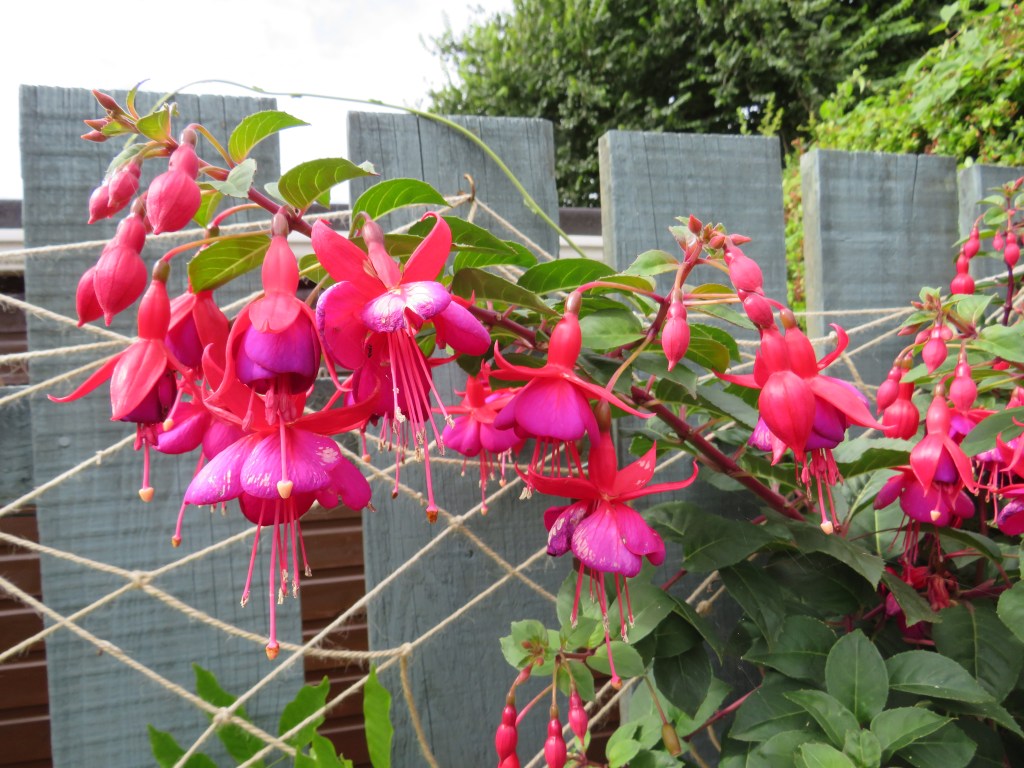
I have been a bit ruthless and taken out the cape fuchsia, which was spreading all over the place. I have shoved some in a pot but that’s its lot. Some of the garden is looking a little tatty as things start to die back, I am leaving some things to go to seed deliberately. I am a bit worried by the white lilac, which looks less than healthy. I have also realised that I have put some things in in the wrong places. I have a massive rudbeckia growing in the planter, which I might attempt to move when it has finished flowering.

I have finally hung the pretty solar lights that were a Christmas present. Now all I have to do is stay up late enough to admire the effect. Mind you, with the nights drawing in (sorry to point that out) it will soon cease to be a problem. Convolvulus wars continue. How can something grow so fast? Hopefully off to buy plants for the newly cleared bed this week. I must practice practicing restraint – hmmm.

All About Places – well mostly

What with the job I must not mention and visiting family, I have been a little quiet lately but behind the scenes things have been as hectic as usual. Firstly, I have been writing and recording my contributions to All About That Place. This is a free online extravaganza of short presentations, all loosely associated with family history places. It runs from 27 September to 6 October. You can find out more and sign up here. There is an international line-up of speakers and there will be so much to learn and enjoy.

Both of my presentations are on 1 October, which is the day dedicated to Town and Country. I chose to record my sessions and you will be able to access them after the event if you can’t make it live. If you do want to watch live, 11am (UK time) is my first slot, when I will be telling the story of my great great grandmother, Anne Stratford. Anne counts as an ancestor that I am particularly attached to. After I had moved away, having spent three years living in Buckinghamshire, I discovered that the road I’d been living in was the road where Anne lived as a child. Until that time, I had no idea that I had any connections to Buckinghamshire. If that doesn’t make the hairs stand up on the back of your neck, nothing will.

The talk is about Victorian life in rural Buckinghamshire and the dependence of the community on the straw plait trade, with a bit of Swing rioting thrown in for good measure. Inevitably, the original talk was far too long, despite my talking very fast. I will also be mentioning Anne when I am talking about the role of women in farming communities for the Society of Genealogists on 30 August. You can join this day, which includes other excellent presentations about researching agricultural labouring ancestors, online, though this one is a paid event.

What is lovely about All About that Place is that so many of my friends are also presenting. Seven of the A Few Forgotten Women team applied to speak and all were accepted, so we have nine talks on the programme between us, most of which are Forgotten Women based. We are also frantically getting ready for the next Forgotten Women communal research day, known as Forgotten Women Friday, on 24 August, which focusses on pupils from two schools for the deaf.

Talk two for All About that Place is at 2.00pm and is an introduction to The General View of Agriculture, an invaluable series of books that don’t get anything like enough prominence. Come along, or listen after the event, to find out what you might learn about your rural ancestors from these volumes.

There are various hazards when recording talks. Now that I have no landline, I can at least turn the phone off but I am left with the seagulls, which are fine in winter when you can shut doors and windows but in summer you have to hope they are elsewhere or boil.

More online fun starting next week with another run of my course for Pharos Teaching, which helps set folk on the right path to writing and interesting family history. This comes with the (optional) opportunity to have a short family history story critiqued. The prospect of this always engenders mild panic but basically I just comment on particular strengths and make constructive (I hope!) suggestions for improvement. Last time I looked there were still spaces, so why not decide that now if the time to put fingers to keyboard and make some sort of coherent end product from all those research notes.

I also have edits of my next book about the history of women at work to work through – busy times.