Up the Garden Path 5

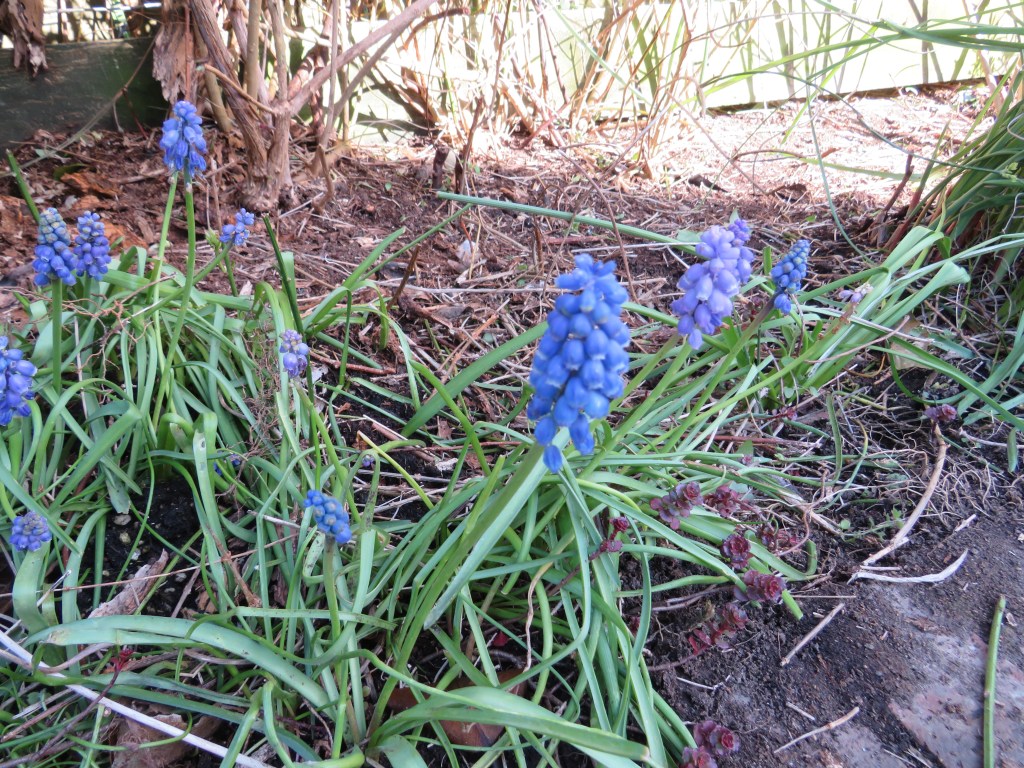
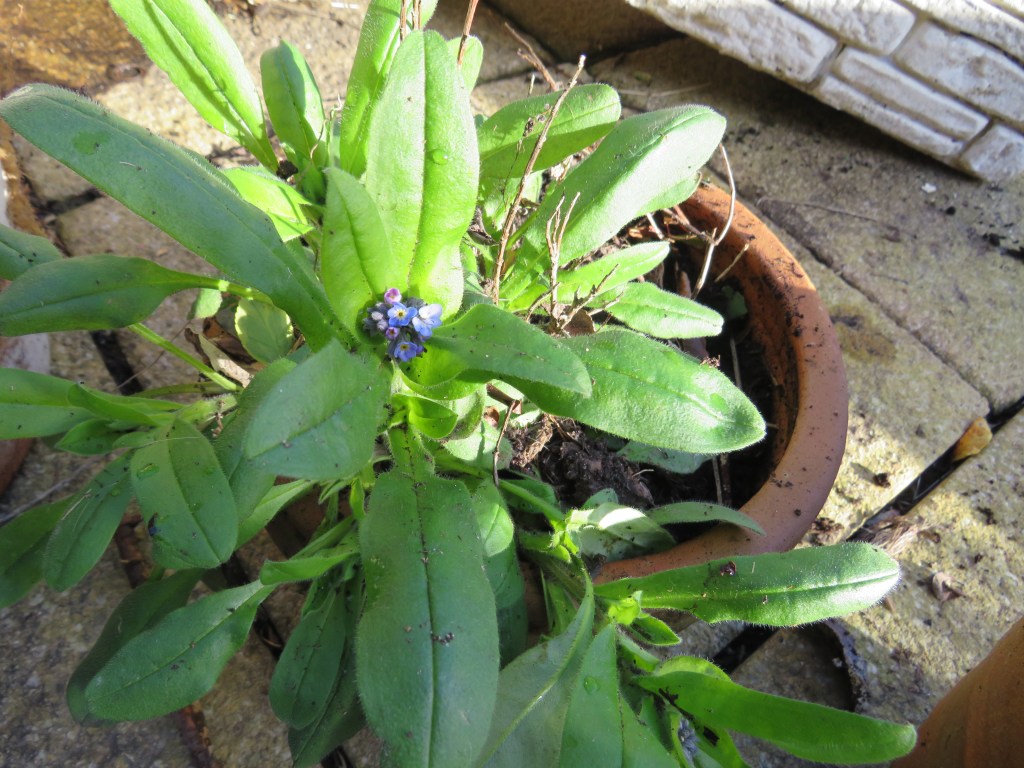
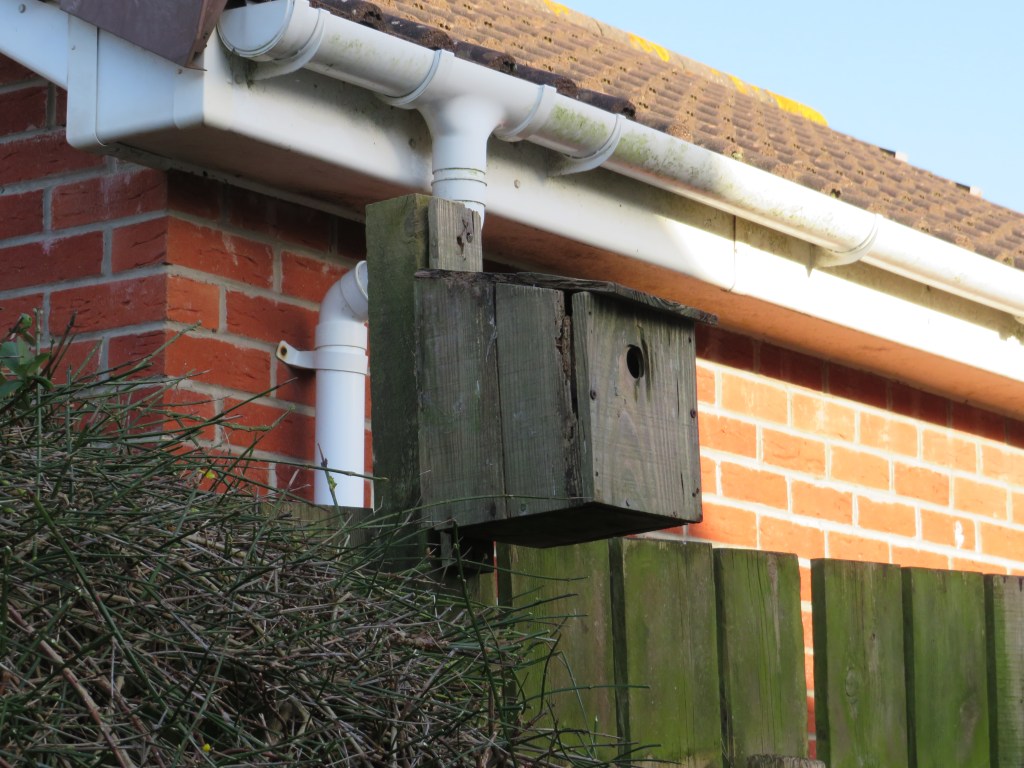
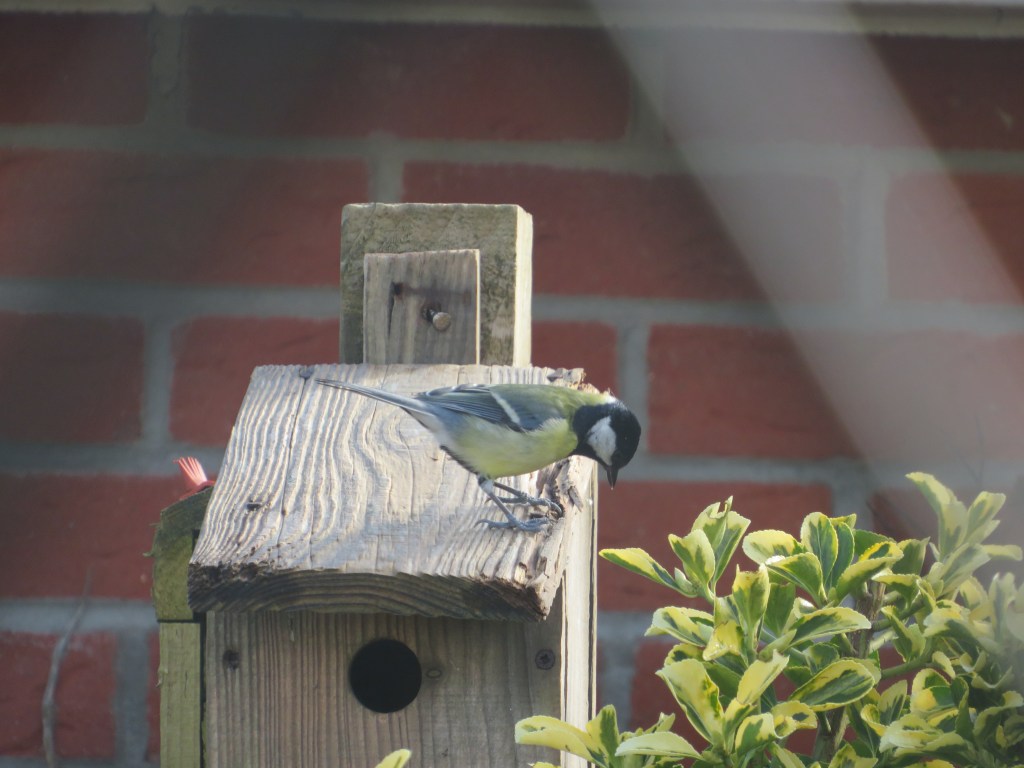
This is mostly the tale of two sheds but first, the other gardening news. I’ve been working on keeping the flowerbed, that has been cleared so far, in a reasonable state and I am pleased to relate that the bird table is back in situ and can be seen from my settee. The snag is that, now that it is sometimes a little warmer, I am opening the door between the living room and conservatory, which creates a different ‘view of the bird table’ obstruction. Not sure if it is best to move the bird table again or the settee. On the subject of birds, there’s been a great deal of interest in the two, very much past their best, birdboxes. I am optimistic that the great tits will be nesting in one.

I foolishly decided that it was warm enough to put the geraniums out. I don’t think I was wrong in terms of temperature. I planted them in extremely heavy concrete planters that came with the garden. Then I decided they’d prefer to be in the front garden where it is sunnier. We just about managed to move two out of three planters to the front. This was accomplished by my partner in crime lifting the ridiculously heavy planter and me running back and forth with the two concrete planter supports that each trough required, which had to be done one at a time because of their weight. This, dear friends, was not a good plan. Sunny the front garden may be but it is also exposed to easterly gales, of which we have many. Not sure about the survival rate for said geraniums and we can’t face moving the troughs back at the moment. I may be replanting any geraniums that have made it thus far.

There seems to be little professional interest in shed moving or grass reinstating and I am having second thoughts about the latter. It is very damp and shady and I fear any grass would quickly be reduced to moss or mud, so that idea is on hold. As I’ve mentioned before, removal of the wooden shed was a priority because the rain running off the roof ended up on the wall of the bungalow (for those in Australia, that’s a single story, brick-built house, not a glorified cabin). You’d think shed removal could be quite fun wouldn’t you? A few bashes with a sledge hammer and Bob’s your uncle. No such luck, my trusty assistant decided that one can never have too many sheds (note to reader – he has too many sheds) and decided that he wanted to preserve it for re-erection in his own garden. Taking it apart in a state that would potentially allow re-erection was not so simple. It seemed to have been very firmly erected, with every screw tightened with an electric screwdriver. Still, after much effort, there was a not shed where the wooden shed used to be.

At this point, in the absence of the ‘getting a man in’ option, moving the six foot by five foot six ‘tin’ (aka plastic) shed was going to wait until we had help in the form of muscles that hadn’t seen the best part of seven decades’ use (me), or eight decades in the case of the trusty assistant. We both claim that it was the other person who suggested this but somehow the sun came out this morning and it was decided (I am sure it wasn’t me) that, with the aim of some sturdy bits of tubing, we could move the ‘tin’ shed. I was particularly keen to see what was behind it and had envisaged moving it three or four feet forward so that I could investigate. Before I could draw breath, the plan changed to moving it fifty feet and turning it round through 180 degrees, so that it was almost where it needs to end up. It can’t yet be exactly where it needs to end up because it is a different shape to the now ex wooden shed and some work has to be done on a base.

Operation move the shed began. The first thirty feet were on paving slabs. Not too tricky once we’d moved random plant pots, the bird bath and various inherited garden ornaments out of the way. The shed was tipped back slightly, I risked life and fingers shoving a pipe under it, then we rolled it forward on said pipe, inserting an additional pipe when necessary. ‘This is how they built Stonehenge’, I remarked. We even managed the 180 degree swivel without too much of a problem. Then we reached the gravel. This was more complicated. As we pushed the shed forward it basically ploughed gravel up before it. It required a double tipping back whilst shoving manoeuvre. The garden now looks a total mess up one end but significantly larger at the other. The tin shed is now abandoned at the right end of the garden, waiting to go a further ten foot back and fifteen feet to the right behind the conservatory, when the base is ready. It is also on top of the hole for the rotary washing line. As I line-dry all my washing, it can’t stay there for long.

Whilst on the subject of sheds, there is also the rather battered summerhouse. I am debating whether repairing it, to give is a few years’ additional life, is worthwhile, or if I would be better going for a replacement straight away. I’ve been investigating possibilities. It seems that the same structure varies wildly in price depending where you purchase it; I some cases it can be ten times as much from one source compared to another. Some offer an installation service, which in many cases is more than the cost of the summer house. I was going to consider biting  this particular bullet but despite having had to swear never to by any more flat pack furniture ever again, it seems building a flat pack shed/summerhouse is a different matter and should be ‘simple’. Watch this space.
Reading the Signs – a family history story

This story relates to my 4x great grandfather William Seear. Marriage of cousins in two successive generations not only accounts for a great deal and makes DNA research ‘interesting’, it also means that William is my 4x great grandfather three times over. He is also an insurmountable brick wall and has been since I first discovered him more than forty years ago.

So what do I know? Ten children were baptised to William and his wife Mary between 1782 and 1797, nine in Stoke Newington, London and one middle child in neighbouring Hackney. Two of these children are my 3x great grandparents (one of them twice over). Some of the baptism records tell me that William was a shoemaker. I have William’s burial in 1821. He was buried in Stoke Newington but ‘of Hackney’ and his age at burial suggests that he was born about 1753.

There are issues with researching the Seear surname as there are so many variations. Firstly, there are the spelling variants, Sear, Seer, Seare, Seere, Seeare and all those with an ‘s’ on the end. William though rarely uses anything other than Seear. Then there are the mistranscriptions and mis-indexing errors result from reading a capital S as an L or T, giving us Leear, Teear etc. etc.. Then there are the ‘e’s that turn into ‘c’s and the ‘ee’s or ‘ea’s that become ‘u’s, so we get Scurr, Secar and other delights.

So could I find William’s marriage? The earliest baptism for one of his children, was Sarah, on 11 August 1782. There was however a burial in 1784 for a Sarah Seer, daughter of William, a shoemaker and Mary his wife, which stated that the child was seven years and ten months old, meaning that she would have been born in July 1776. Did this push the likely date of marriage for William and Mary back a few years, or did Sarah’s late baptism suggest that her parents weren’t married at the time of her birth? With Sarah’s birth established as being in 1776, there was a large gap between Sarah and the next eldest child in 1783. There was however a Thomas Seear who had been born in Stoke Newington about 1780, for whom no baptism has been found. I had long suspected that Thomas was another of William and Mary’s children and he would certainly help to fill that gap.

There is other evidence that Thomas belongs to this family, as a Thomas Seear is the witness to the marriages of two children of William and Mary, Thomas’ probable siblings. This signature is very similar to that of Thomas of Stoke Newington when he married in 1806.

According to a family bible, that is not in my possession, a T Seear was godparent to the children of another of William and Mary’s children. I also have DNA matches to Thomas’ descendants, so I am happy that Thomas is an elventh child of the family.

Back to the search for William’s marriage. The world and a large number of wives are convinced that William married Mary Stone in Aldgate in September 1776, which would be after Sarah’s birth and explain the late baptism. He didn’t. I don’t know who William’s wife was but I am as certain as I can be that she wasn’t Mary Stone.

The marriage record for William Sears and Mary Stone reveals a confident signature for William Sears.

William the Stoke Newington shoemaker witnessed the marriages of several of his children. Even allowing for the passage of years, the signatures are very different to that on the marriage to Mary Stone.

Note that no child of William and Mary, whose baptism has been found, was called William, so this is not a brother, unless there’s a missing baptism between Sarah’s birth in 1776 and Thomas’ in 1780 and I don’t believe this is the case, as there is no other evidence of a William who could be a twelfth sibling.

So no marriage for William and Mary, what about William’s origins. There are clues. One of William’s daughters marries a Seear who descends from the Seear/Sear family of St. Albans in Hertfordshire; surely there is a connection. There are several shoemakers in the St. Albans/Hemel Hempstead branch.

The Seears intermarry with the Smith family in three successive generations. The early Smiths were watermen in Ham, in Kingston, Surrey, before moving to Hackney. When searching for the Smiths, I came across the will of a Joseph Seear, a grocer of Ham, who mentions his niece and housekeeper, Charlotte Seear, his brother William Seear of Stoke Newington and a Jeremiah Smith, a waterman. Charlotte and (John) Jeremiah Smith, a waterman, are my 3x great grandparents. Another sibling mentioned in the will is a John Seear, who was a ropemaker of South Mimms. Even with three siblings to search, I am unable to find convincing parents for William. The will also refers to a brother and sister, whose surname was Steel. I feel these must be a brother-in-law and sister-in-law but I can find no marriage for Joseph to a Steel. His wife could of course have been a widow and married under another name but still there is nothing obvious in the records.

No great breakthrough in this story I’m afraid but it does illustrate that, if you have ancestors who could sign their names, looking at the signatures in marriage registers, of both the couple and the witnesses, can help to rule out the wrong entries, even if it doesn’t reveal the right ones. If anyone can find the right William Seear marriage, or the baptisms of brothers William c. 1753, Joseph c.1743 and John c. 1762, I’d be very grateful.

Up the Garden Path 4

Having acquired some plants more than a fortnight ago, rain and a bad back stopped play, so I am only just getting round to planting them. I did go to a willow weaving course to make bird feeders. This was great fun but I am not convinced by the scale of some of the feeders that resulted. Unless you have fat balls the size of footballs, or ostriches visiting the garden, I  foresee a problem. They will find a place nonetheless.

Before utilising said feeders, there was a plan to move the bird table. This was inherited and had been screwed to the wall that retains the raised bed. This is a good move, as a free standing bird table wouldn’t be standing for long when the Atlantic gales set in. Unfortunately, it was positioned so that the window frame blocked my view when sat comfortably on my settee. Not to worry, we can unscrew it and move it further along. Simples. Or not, as it turned out. Unscrewing was easily accomplished but the upright had been seriously chewed by insects. As of this moment, the bird table is lying on the ground awaiting repair and re-erection. We have put up two bird boxes that have seen better days. There isn’t much scope for birdbox positioning here  but I can hope.

I have joined the RHS and they have an app (it is probably an app) where you can add your garden plants and they you get ‘helpful’ reminders about all the million and one jobs that you should be doing each month. Gratifying that I can tick off ‘cut back winter jasmine’.

Yesterday was a glorious day so time to make more progress. The previous owners had put up a wire fence in front of the actual fence, which I think goes all the way along, we can’t get to the bit behind the ‘tin’ shed yet to check. This is all very well and great for growing climbers but it has been there for years, so some of the plants have grown round it and in a few cases the fence is firmly embedded in stems that have grown through it. This adds a whole new dimension to tackling the shrubbery. Nonetheless tackle it we did and another trailer load of winter jasmine is ready to go to the tip. Still not half way though.

Things are about to get serious as operation shed has begun. With all the rain, I discovered that the tiny wooden, gutterless shed, which is very close to the house, was causing rain to run off on to the house wall. With the amount of rain we get, this is not a good thing, so shed removal, which was always on the cards, has moved up to the top of the priority list. So far, the wooden shed has been emptied ready for removal. The next step will be to move the ‘tin’ shed to take its place but a little further from the wall. This will free up the sunniest part of the garden and I can hopefully create a flower bed. This is particularly necessary as I seem to have purchased quite a few plants that like full sun. Not sure how they will go in a garden that is really not sunny but as my mum would say, they will have two chances.

I have also, whisper it quietly, broached the topic of reinstating some lawn. This was not universally well-received and I have had to undertake the cutting of said lawn. As it will only be about 4×2 metres I can cope. In the first garden I owned, we cut a lawn that size with shears for three years. Mind you I was nearly forty five years younger then. I am still tempted by a wild flower lawn that won’t need cutting at all but not sure that that isn’t a bridge too far and dubious about its success in the shade.

We’ve started the great shrubbery clearance at the shadiest end, so some of my purchases remain in pots until we reach the end where the sun does venture occasionally. I have planted some foxgloves and cyclamen and risked a lupin and a clematis. I’ve repurposed one of the willow ‘bird feeders’ as an obelisk for the clematis. A honeysuckle and campanula that I brought with me have also been transferred from pot to ground. Next step will be to call in the professionals to turn some of the paving in to lawn.

RootsTech Round-up Days 2 and 3

I didn’t get the chance to watch as many presentations as I’d like on Day 2, as life got in the way but I have reduced my playlist to something more realistic, partly because some of the talks I’d earmarked are not available virtually and were live at times when I wasn’t available, or was asleep. It is great that so many can be watch online, especially as they are free of charge. So this is my round up of Days 2 and 3. I enjoyed giving my own Marginalised Ancestors talk live but remotely and thankfully the technology behaved itself. This is one that is available for you to watch when you have an hour to spare. It was so difficult to decide what to miss out and I have fun varying the categories and case studies each time I give this talk.

I watched Liz Craig’s second One-Place Studies presentation on studying a street; a great introduction and Liz’s enthusiasm is infectious. I saw the Impact Forum live, with several presenters discussing the impact of family history on resilience, metal health and a sense of identity. Also on my watch list was ‘Reconstructing the Lives of our Female Irish Ancestors’ with Stephanie O’Connell. Plenty there for those with Irish ancestry and it was good to hear the emphasis on the importance of the social historical context. I have squeezed several short, Ancestry-sponsored, case studies from television programmes into odd moments. These included Every Family has a Secret and Finding your Roots.

With my Smith ancestors in mind, I watched Shaunese Luthy’s ‘Finding your Common Name Ancestor’. She utilised the F(riends) A(ssociates) and N(eighbours) principle in her case study of the Brown family. My interest in the history of medicine meant that ‘Diseases our Ancestors Faced and how those Illnesses Changed our World’ from Gregory C Gardner, was a must-watch. This is highly recommended and covered UK and US records. I am very envious of the US mortality schedules.

‘From Research to Draft: Rapidly Writing Your Ancestor’s Story’ by Devon Noel Lee contained some interesting ideas for turning basic facts into a narrative, although using AI for this doesn’t appeal to me personally. Her marking-up technique is similar to the work that I do with my writing your family history students and I am looking forward to leading a new cohort of Pharos students through the writing process in a couple of weeks. There is still time to join in on this one.

I have some great RootsTech talks still to watch, including Nick Barrett’s ‘Researching English Industrial Labourers’. I may even catch up on some that are lingering in the playlist from previous years.

RootsTech Round-up Day 1

Day One of Rootstech is over and I have a bulging playlist that I want to work through. Fortunately, there’s plenty of time. I have to admit I do still have a few lingering in my playlist from previous years. I have my usual mix of presentations by people I know, topics that appeal and a few random additions to take me out of my comfort zone. My aim is to keep on top of the playlist so that it doesn’t get longer and longer, as I add recommendations from others.

I began with Nicholas Dixon’s ‘Metropolitan Ancestors: finding families in Georgian and Victorian London’, which contained plenty of useful information on researching in the capital and sits well with my own ‘London Calling: websites for researching London ancestry’ short presentation, which is available on demand. Next up was ‘Who’s my Ancestor? tracing individuals with similar names’ by D. Joshua Taylor. As I‘ve spent three fruitless days trying to untangle numerous Josiah Lamballs, this was very timely, although my Josiah still remains elusive. I have ruled out one of the wrong ones; perhaps more about that another time. This was an excellent presentation, essential listening for anyone with a brick wall, which is anyone who does family history. Despite the examples being from the US, the techniques described are applicable elsewhere.

I then listened to the first of Liz Craig’s One Place Study presentations ‘studying a village’, a great introduction and I even got a couple of honourable mentions; her other talk is on the list. I followed this with’ Little Known Free Sites for English Research’ by Jenny Joyce, again some synergy with my London presentation. Next, ‘Researching Modern Ancestors: unlocking the life of an English Rose’, from Diane L. Richard, which told the story of her quest to fill out the life story of her English mother and encouraged us to research our more recent ancestors, such as our parents and grandparents

I usually watch some presentations that focus on engaging young people, so I viewed ‘Toddlers to Tweens – Who doesn’t like to climb trees!’ with Megan Heyl. This was interesting and the handout had some useful charts that are worth downloading. It was more applicable to those whose ancestry encompasses an immigration story, with identifiable ancestors from a variety of countries. Finally for day one was ‘No Death Certificate’, in which Helen Smith provided a range of options when looking for evidence of death in the absence of a death certificate.

Today I am presenting live but virtually, at 8.30pm GMT, chatting about Marginalised Ancestors. I am also out helping Mistress Agnes give a live presentation so I may not have time for much watching but will report back on what I choose. You can join in the fun, for free, from home here.