Things or Heirlooms?

Two things have prompted this post. Firstly, today and tomorrow I have two rather different, yet similar, presentations to give about heirlooms. The first is a 15-20 minute conference paper for the Family Archives and their Afterlives conference. Wednesday is a 90 minute heirlooms workshop for the Society of Genealogists. The clue is in the title. Workshop means that I will be putting the audience to work. The second thing is that I am embarking on the inevitable ‘you might be going to move this year/next year/who knows’ cull of possessions. Incidentally, because I know people don‘t like to ask, the position is that someone is desperate to buy my house but is waiting to sell theirs, so I may be here some time.

I am faced with the accumulated ‘stuff’ that survived my major downsize seventeen years ago, augmented by the additional stuff that I acquired when my mother died. Why are some items more precious than others? What has prompted me, my mother and in some cases preceding generations, to keep x over y and z? What do I keep or discard and why? Many of these things have no aesthetic qualities and serve no practical purpose, yet they ‘need’ to be kept. They have moved beyond the realm of being ‘things’ to be heirlooms. I don’t envisage that I will be disposing of anything that has a family significance. If it has already been treasured for two, three, or more generations, then it is my role to continue to do that, even if I feel that the generations that come after me may not wish to do the same. I hope to persuade them to keep at least some of these treasures. That is part of the aim of the Treasures section of my Granny’s Tales website. It is the stories that turn things into heirlooms, so I need to tell the stories. It will be a long job, I just need to last long enough for all the stories to be told. At least I have made a start.

Then there are the things that have a personal significance for me, important of course but somehow perhaps on a lower rung than the items that stretch back to touch the past. At the moment, I can’t be sure how much space I will have when I move. The aim is not to have less than I do currently, so in theory I could keep everything. In practice, it is a good opportunity to reduce the task that my descendants will face when I go and join the ancestors. I’ve made a start. I’ve done the bathroom. Not much of a challenge there. I did throw away manky looking products that have been around for years. I even threw away a few stiff flannels. My bathroom is officially the second smallest in the world (ironically larger than the one I had in my previous 5 bedroomed house) so there were only two small cupboards to go through.

Slightly more demanding were the two sheds, although the majority of the contents of one contained the possessions of the fisherman of my acquaintances (who has four garages a barn and a shed of his own and those are the ones that he admits to). I decided that I really didn’t need 200 plastic flower pots or a dozen tins of solid paint. Easy this throwing away lark isn’t it? I am actually very pleased with the shed clearance. A trailer load disappeared to the tip and more to the owner’s barn.

Moving inside, the conservatory is also done. Well, it is awaiting visits from my descendants to triage the children’s books. That will be trickier. I know most are now too young for my grandchildren but they have seen two generations and some three. What will stay and what will go? I know we will be keeping some that probably no one will read in my lifetime. I do hope my body will keep working to read them to a fourth generation but realistically, it probably won’t. I don’t see my grandchildren being likely to have children young. So they will sit in a box in a loft, in an as yet to be identified property, until my children have to repeat the triage in the future.

The conservatory also contains many inherited ornaments, some dating from my great-grandfather’s trip to India and China. They stay, waiting to appear as one of Granny’s Treasures; another culling decision deferred.

Today maybe I’ll start on the bedroom. The clothes part is easy. I do an annual cull and in any case, as anyone who has met me will know, I am not a clothes person. But and there’s a huge but the bedroom also contains a china cabinet, itself an heirloom, inherited from my mother’s cousin and we believe, made by my great grandmother’s brother. It holds more ornaments, ornaments that I have known all my life. They have sat in the china cupboards of my mother and grandmother and now they sit in mine. A few of the items reach back to touch my great-grandparents’ lives. Then there are the photograph albums. Many of these are the sticky plastic variety, containing colour photographs from the 1980s. Photographs that are fading into weird and wonderful versions of their former selves. I did have a spell of remounting these and scrapbooking them in new albums. Maybe I will have time to continue that process. Do I now take the opportunity to be selective? Shall I retain the images of people and remove the pictures of random stately homes and scenery? I have yet to decide. In any case that is for that dim and distant time labelled ‘later’. Unless my worst moving nightmares are realised and it takes years rather than months for me to complete a chain, they will move with me in their current state.

With the honour of being the custodian of the family archive, comes the responsibility for its curation and care. I also need to be its interpreter. What I should be doing of course is writing those stories, preserving those memories, making sure that I am not the only person who understands the significance of these items. Some already have partial or damaged stories. There are things that I know belonged to my mother’s grandparents but which grandparents? I am committed to making sure that the items I pass on are real heirlooms, with what is left of their stories intact.

A Few Yorkshire Days with a Family History Twist

Last week, we made a whistle-stop trip to York. This was mainly so that I could take part, along with the rest of the A Few Forgotten Women Team, in the York Festival of Ideas. We were working with The Mount School and The Rowntree Society to raise the profile of women’s history. After a panel discussion, we helped attendees to research a woman or girl who was associated with The Mount School, either as a pupil, a teacher, or another member of staff. The school is a Quaker foundation, so there was some delving into Quaker records and some fascinating stories emerging. With the aid of our team, other researchers worked on a Voluntary Aid Detachment nurse. If this sounds like your idea of fun, you can join in. For details see here.

York isn’t exactly next door, 335 miles to be exact, so we went a couple of days early to spread the driving load. The journey up was protracted, not least because of the ten mile/one hour tail-back on the motorway as people tried and failed to exit on to the gridlocked slipway at Castle Donnington for something called the Download Festival.

We decided to steer clear of the city on our two days ‘off’ and visited the lovely gardens at Beningbrough Hall. The Georgian house itself, former home of the Bourchier family, is closed for refurbishment until next month but the gardens were beautiful and we did an extended walk round the parkland by the River Ouse. In the evening, I was virtually chatting all things ag lab with Wiltshire Family History Society. The next day, we opted for Kirkham Priory and another riverside walk. The priory was founded in the mid-twelfth century and was an Augustinian foundation. Dissolved with other monastic foundations by Henry VIII, Kirkham fell into disrepair. Unusually, it was used for military training purposes in the run-up to the D-day landings.

After the research day in the beautiful surroundings of The Mount School library, Mistress Agnes and Master Christopher were on parade, extoling the delights of life in the seventeenth century. With soaring temperatures, it was just a little cosy being in the seventeenth century, especially as I had neglected to bring my thinner bodice. Good fun was had nevertheless.

We left at very silly o’clock to try to beat the forecast heat and fortunately, were driving towards the cooler (when cooler is a relative term) part of the country. The homeward journey was not beset with festival goers and as a bonus, none of my plants seem to have died during my absence. Now to the rigours of the job we must not mention; I may be quiet for a while.

Beningbrough Gardens

From Elusive Ancestors to Ag Labs

Amidst a quick trip to Yorkshire (of which more another time) and the uber frustrations of fourteen tedious hours attempting (and mostly failing) to get access to vital software for the job we must not mention, I have been spreading the family history love with my latest cohort of Pharos family history students. Unbelievably, I have been teaching online family history courses for Pharos Tutoring and Teaching for seven years now. Last night saw the first presentation of a new course draw to a close. The learners have been investigating ancestral migrations. Those pesky ancestors who won’t do the decent thing and spend their whole lives living in one place lead us a merry dance as they trip from one area to another, often leaving gaping holes in their life stories in their wake. This course was designed to help the students tell those migration stories, investigate possible motivations for movement and hopefully come a little closer to tracking down their elusive ‘brick wall’ ancestors. Unfortunately, I don’t have a magic wand, otherwise I wouldn’t have any brick wall ancestors of my own but it was pleasing to find the students reporting that they had to change their case study elusive ancestors as they had found them!

No sooner does one course end than another begins, or, in my case, two begin. Next up, Agricultural labourers, a five week course that starts on 17 July. We all have them don’t we? The ubiquitous ag labs who drip from every branch of the family tree. Do we dismiss them as somehow more boring than the sagger-maker’s bottom knockers? Not such a great job tile of course but ag labs are fascinating in their own right. What I love most about leading this course is seeing the students create stories about their own ag lab ancestors, stories that I then sometimes see published in family history society journals or online. Sometimes I join in with the students and use the course as an opportunity to tell an ag lab story of my own. The job I must not mention won’t allow it this time around, so, just to prove that I do sometimes practice what I preach, here is one I prepared earlier (you will also need this outline pedigree to follow the twists and turns). This is the story of a Wiltshire ag lab filled family, or series of families, who, like many others, ended up abandoning the countryside for life in Reading and later Croydon.

My second course for July is for those starting out on the all-absorbing branch of research that is one-place studies. They have such an adventure ahead! To add to the excitement, Pharos have a brand new shiny website, which not only looks good but make life easier for students and tutors. Most importantly, it is stuffed full of exciting and absorbing courses (not just mine) to help you hone your family history skills. I recently had a discussion about the importance of getting the balance right between learning more about how to do family history and actually doing it. Even if you’ve been a researcher for years there is always more to learn and joining a group often provides great encouragement. Important though gaining new skills is, you need to keep this in proportion and allow time to actually put it into practice. I do try to bear this in mind when I am writing courses and make sure that students can learn more about their own families as they work their way through the suggested exercises. Why not come along and join me for the ride? Last time I looked there were still spaces on the Ag labs and One-place studies courses. If you want to track down elusive and migratory ancestors, you will have to wait until next year.

The (Family History) Story of Alice and May or don’t believe all you hear

This week, amidst obsessively checking for houses coming on the market and trying to stop myself mentally moving in to one I like, I have been researching the lives of Alice and May. The full story will appear on Granny’s Tales shortly. Alice and May are not newcomers to my family tree; I have known them all my life. I should qualify that, they both died before I was born but their photographs are in the treasured family album and they formed part of the lexicon of family lore that was repeated by my mother and great aunt. ‘Auntie Alice’ was one of my great grandmother’s sisters and ‘Cousin May’ was her daughter. The stories went something like this:

Alice’s first husband was a Mr Fludder, who was May’s father. Alice then married Mr Hart. May married a William Pleoney or Fleoney. Auntie Alice died in a fire when home alone in Whitstable, Kent. Normally, the family stories that were passed to me have proved to be pretty accurate when placed under the scrutiny of documentary family history research; not so these ‘facts’ about Alice and May. Decades ago, I established that almost everything I’d been told about Alice and May was wrong.

May was illegitimate. Her birth was registered as May Bula Dawson. Although there were Fludders in the area, there is no evidence that Alice was ever in a relationship with on of them and she certainly didn’t marry one. When Alice married Thomas Sanders Hart, a widower, nine years after May’s birth, May took the surname Hart and was to claim that Thomas Hart was her father when she married. Married that is to a William Dear. Goodness knows where Phleoney came from. Who was May’s father? For a long time I suspected the solitary Mr Bula who could be found in the census closest to May’s birth. Was it indeed a Mr Fludder? Was it, as May claimed, Thomas Hart? I am now, thanks to help from another researcher, pretty sure I know which is correct but I am afraid you will have to wait for the release of Alice and May’s story to find out.

Then there was the ‘burnt to death in a fire’. Well not unless she caught pneumonia as a result she wasn’t, as pneumonia, coma and thrombosis is what is on Alice’s death certificate. I looked in the newspapers, for mentions of a fire in Whitstable around the time of Alice’s death to no avail. This week I tried again. Additional newspapers have been made available. Yes, there was a fire, yes someone died whilst home alone but it wasn’t Alice. Who lost their life? Why did the family think it was Alice? Stand by for the big reveal, although diligent researchers might be able to get there first, even with just the few clues that I have given you here.

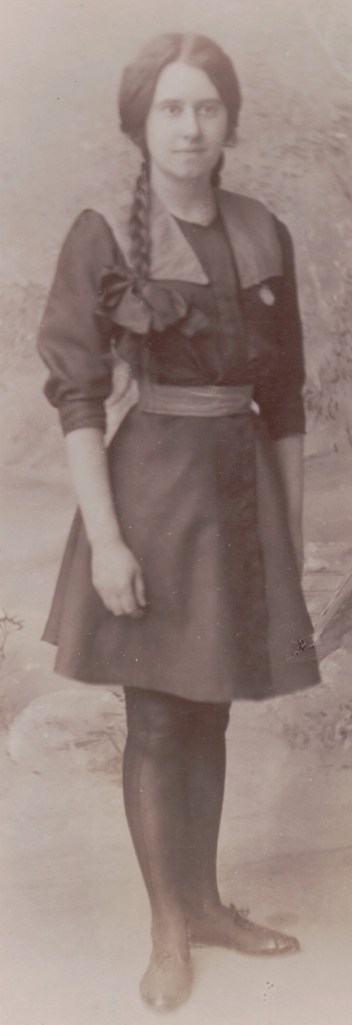
Finally, I’d welcome comments on May’s attire in this photograph. She was born in 1889, surely this is shockingly short. Could it be some kind of theatrical costume? The never-ending hunt continues.