Cornish Adventure Aventur Kernewek (possibly) part 5 (nothing to do with travel but partly to do with family history)

It has been a while since I regaled you with news of my attempts to learn Cornish, mainly because ‘I’ve mastered a few more words’ isn’t exactly newsworthy. Questions are being asked, so here is an update. My second term of lessons has now drawn to a close, so I thought I should just put it out there that I am still on this adventure. I certainly would never have believed at the outset that I could amass a vocabulary of about 1000 words in twenty hours worth of lessons, especially as it took me about a month to get beyond the first couple of dozen. I’ll admit I am sometimes a bit hazy about plurals and whether things are male or female but I am getting there. I should elaborate, I am pretty clear about what makes actual things male or female, it is the gender of inanimate objects that is trickier.

The real struggle is stringing these words together into anything approaching a grammatical sentence. Then there are the mutations. If something begins with a g, why the need to suddenly make it begin with a k – or should that be the other way round? I have purchased an as yet unopened daunting book of verb tables but I’m not sure that that marks progress.

Why am I doing this? Well it is a bucket list kind of a thing, a later life crisis – I’d love to say mid-life crisis but who am I kidding? It is also a mental challenge. Some people climb mountains because they are there, I guess I do this to prove I can, despite my total ineptitude for languages other than my own. Mainly I am attracted to the idea of connecting with my Cornish roots. Cornwall features in my ancestry more than any other county. Admittedly this is eastern Cornwall, not the mystical far south-west but definitely Cornwall. Some of these lines can be traced back to the seventeenth century. I am looking at you Sambells, Rooses, Spears, Oughs and many more. Did you speak Cornish? Dydh Da dhywgh hwi.

Great encouragement, next term’s course is for ‘post beginners’, so I’m officially no longer a beginner. I am going to have to do a awful lot of consolidating over the Easter break to live up to this status.

New Book, New Ventures and a Random Shopping Order

Firstly, I am now allowed to tell the world the exciting news that my next book is at the publishers. This is a non-fiction volume, commissioned by Pen and Sword, about tracing Marginalised Ancestors. So, my usual fare of tragedy and trauma, with chapters on Poverty, Criminality, Illegitimacy, Mental Health, Sickness, Prostitution, Witchcraft and more. Each chapter includes a case study and they were such fun to research. I can’t wait to introduce you to Sarah and Joseph and Charity and Harriet and Frederick and co.. Don’t hold your breath though. I am hoping that this may be out by the end of the year, so in your Christmas stockings but it could be 2024. This isn’t exactly a cover reveal as it is still provisional but I have been given the green light to share.

Then two new ventures that will also involve writing. I am to join The History Girls as a reserve blogger. This blog contains a fascinating range of posts on all things historical and is billed as ‘A blog from great writers of historical fiction’. I am having a serious bout of imposter syndrome but it should be fun. As I clearly don’t have enough to do, I applied for and have been accepted as a contributor to the Mass Observation Project. This is particularly exciting as my mother was a contributor in the early 1960s. The website does say that the original project ran from 1937 to the early 1950s but does also mention some material from the 1960s and I distinctly remember my mother having to write down what was on her shopping list. They have asked for a biography ‘it can be as long or as short as you like’. Do they realise that I have an 80,000 word, as yet unfinished, auto-biography stashed away? I am assuming they don’t want all of that. On the other hand ……….

Last week, I encountered that thing when you accidentally click on the wrong day for your T****s order without realising (meant to be next week) and just bung all the favourites in the basket regardless to hold the order, thinking you’ll sort it out and delete stuff a couple of days before. Then you get an email confirming that goods to the value of twice your normal shop are on their way and you have no space in the freezer, because obviously the order is the following week and you daren’t even look at what you’ve ordered, as probably it includes stuff that your daughter, who eats funny modern stuff, ordered when she was here and a load of random things you don’t want. I never did look at the order, so Mr T****’s delivery man turned up with quite a lot of trays of stuff. Well, it could have been worse. Not too much frozen stuff, no weird modern stuff but I have all the ingredients ready for next year’s Christmas cake and puddings!

RootsTech Roundup Day 3 #NotAtRootsTech

On the third day of  RootsTech I had been really looking forward to Wanda Wyporska’s session (from late UK time on day 2) about researching women and was sad to see that it was not able to be recorded. As the custodian of ancestral christening gowns, wedding dresses and quilts Preserving your Ancestors’ Textiles and Handmade Treasures by Melissa Barker was another that was high on my ‘must watch’ list. Again, if you watch, you can skip the first 3 minutes 19 seconds of setting up chat. Sadly my house is too small to follow all of her advice. Interesting to learn that folded textiles should be refolded in a different way every few months to avoid deterioration along the creases.

Next, another talk from Diahan Southard, My Messy, Complicated Birth Roots Story. This was a fascinating and well-presented session, highlighting the problems of trying to identify DNA matches, particularly if you are related to someone through two different family lines. Highly recommended.

30 Fun and Meaningful Activities for Kids and Grandkids to Celebrate their Ancestors Sharlene Habermeyer was also on my watch list. Two minutes in before this one starts. I do appreciate and welcome the fact that these videos have been made available so quickly but wonder if a little editing out of the set up might have been useful. The presentation does what it says in the tin and Sharlene’s website has free downloadable resources http://www.growinglittleleaves.com/printables.html. A few are US orientated but there are others that are applicable to all. I did cringe however at her suggestion of cleaning graves and making rubbings of them. This is common practice elsewhere but is definitely not advised, or indeed legal, in Britain, where the lichens that grow on gravestones are protected. I did love the idea of sharing memorabilia; I just wish my grandchildren visited often enough to do this. Trying on ancestral wedding dresses or uniforms was another great idea, although I don’t see why this should be a gendered activity. Plenty of really good suggestions for using ancestral photos. I shall be reading the full details of the activities mentioned by Sharlene on her website and trying some of the ideas; first I think will be the talents and hobbies activity and the timeline. On a similar topic, I listed to Sarah Day’s short GenZ Genealogy presentation from 2022, outlining how we can support 10-24 year olds on the genealogical journeys. She also suggests what GenZ themselves can do. Pleased to hear that this included joining societies. Another catch up from last year was Write your Family Stories (in 30 minutes or less) by Brenda Hudson. Useful suggestions here for those who struggle with starting to write stories.

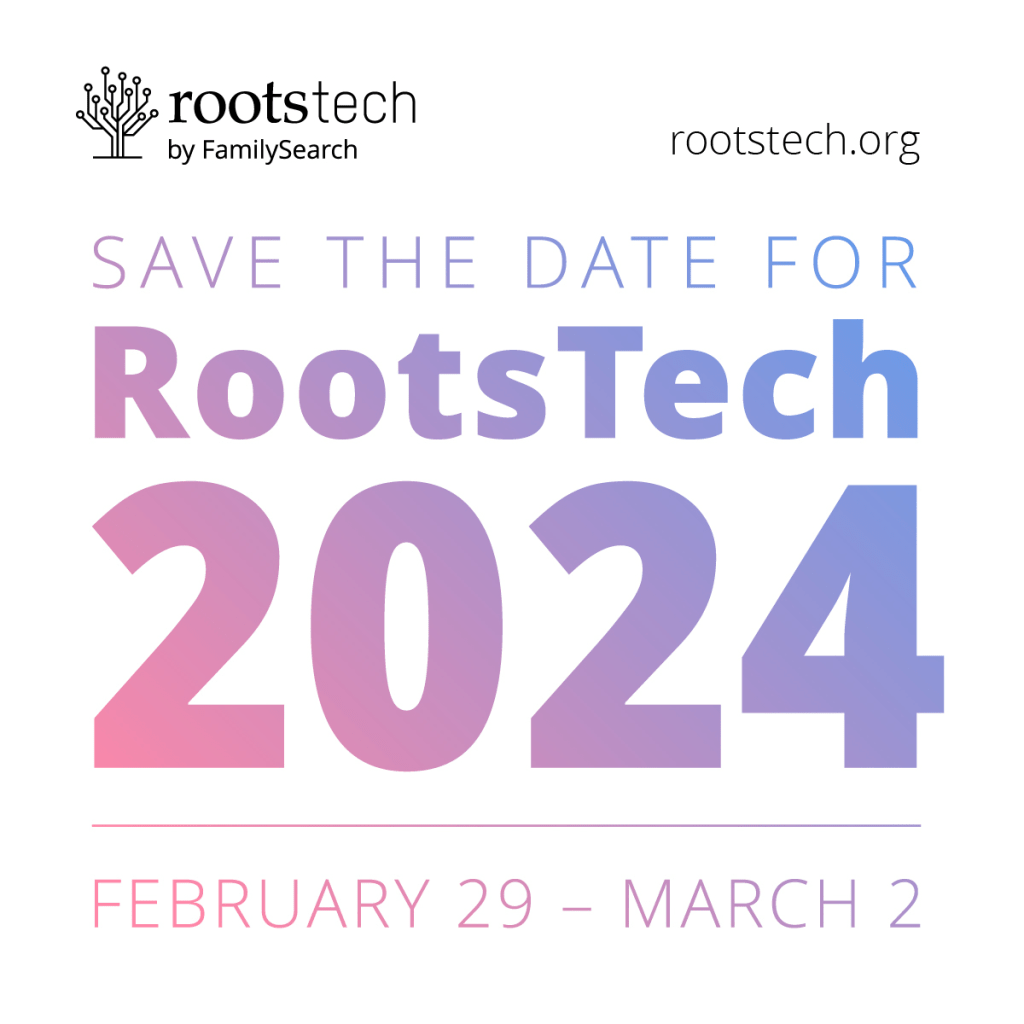
So that’s a wrap. I do still have a couple left on this year’s play list and few few lingering from previous years. I will no doubt add more when others share their recommendations. I will try not to leave it until next year to watch these. The dates for next year are announced – so make a note in your diaries.

RootsTech Roundup Day 2 #NotAtRootsTech

The second day of RootsTech began, which meant an opportunity to catch the sessions that had screened late in the US day on day one, if that makes sense. I decided to take a look at the virtual expo hall. Unlike what you might be used to at UK genealogy shows, the vast majority of the stands that are available virtually are commercial, with only a tiny handful of society stands. A couple of the stands did catch my eye. Artifcts, if you can get past the spelling contraction, is a great concept, encouraging us to tell the stories of heirlooms. This is a lovely idea but I need convincing that you need to do this via a commercial site; just tell the stories for yourself in what ever format suits. This is something I have been working towards for a few months but other projects, such as A Few Forgotten Women’s free online sessions for International Women’s Day on 8 March, have rather taken over. The RootsTech expo hall also led me to a really good offer price, for in-person and virtual attendees, from Family Tree Magazine for membership of their Family Tree Plus Club.

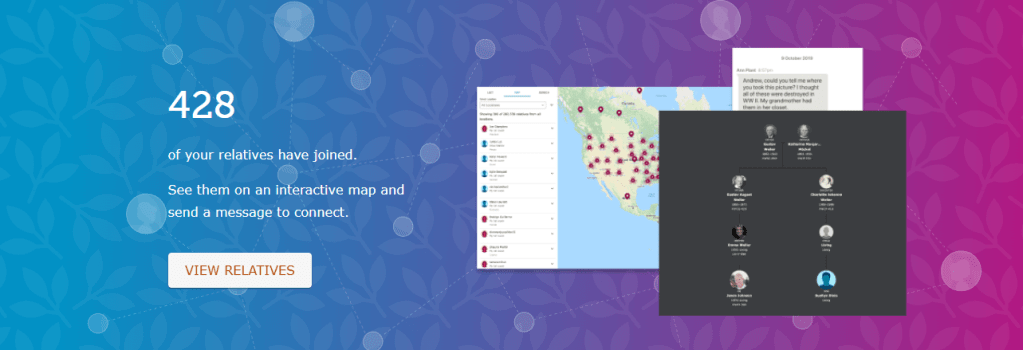
I also had a look at my Relatives at Rootstech, which is a bit of fun for those who have linked themselves to the composite tree at Family Search. This is available until the end of March and you can connect with other RootsTech attendees whose ancestry you allegedly share. I have to say that most of my contacts are 7th-9th cousins and some of the family trees delve into realms where I would not dare to tread but I am hopeful that my third cousin will respond to my message at some point.

In preparation for our Forgotten Women Friday on 24th March, when some of the women needing research are of Irish origin (volunteers welcome for tracing these and those from England), I began by listening to Brian Donavan’s Irish Family History is Easy. Seriously!. He focussed on using FindmyPast and Irish Genealogy. Definitely a great introduction to Irish research and I hadn’t realised so much was on FindmyPast. Next, I chose Hidden Stories Discovered in just Three Documents by Patti Gillespie, which sounded intriguing. Be warned on this one, the talk doesn’t start until four minutes twenty seconds in, so don’t be put off by the long silence. I liked her phrase ‘compassionate context’; our ancestors’ lives and life decisions should viewed in this way. Patti also emphasises the importance of citations. She regards any system of citation that will allow another person to recreate the research path as being adequate; a woman after my own heart.

I then watched Meet Storied; the next chapter in family history with Brandon Camp and Finn Larson. Storied is one of the sponsors of RootsTech. Their product is a way of encouraging and preserving stories and there’s a good deal on if you sign up during the RootsTech period. Whilst I am one hundred percent behind the principal, I can’t help feeling that, a bit like Artifcts, you could just write it down for yourself. The software also has a feature whereby artificial intelligence can assist you with your story. This is impressive but I do have some reservations about this. I suppose it might be useful for those who have concerns about their writing skills. There are some real plus points to the software though. I did particularly like their emphasis on including information about those with whom we have non-familial relationships, such as friends, neighbours and co-workers. In addition, there is the opportunity to capture relationships to communities, be that a village, a workplace, a church or other institution. The software even supports the inclusion of pets. There is a free account option, which seems to include quite a few features. The paid version include access to records but these are all US based.

That was all I had time for yesterday but there is no rush as the presentations remain available for you to watch at your leisure, I am still catching up on 2021 and 2022! If you didn’t think to register in advance for the free virtual event there is still time.

RootsTech Roundup Day 1 #NotAtRootsTech

Yesterday saw the beginning of the genealogical extravaganza that is RootsTech. I am attending virtually, which is free and there is an unbelievable variety of presentations to choose from, with over 1300 speakers from across the globe. My playlist is best described as ‘eclectic’ and it reflects my particular interests, so I thought I’d share those I have watched so far, in case there’s something that appeals to you too. As I am in the UK, some the talks I am hoping to hear from day one are a bit late in the day for me but I will catch up on those today and there were plenty to choose from in the ‘On Demand’ section that I could watch yesterday. I could also catch up on a few from 2021 and 2022 that I didn’t manage to listed to then. I decided not to offer any sessions myself this time but two of my sessions from 2022 are still available, How to Handle Sensitive Topics in Family History and Family Photographs and a Sense of Belonging.

I began with Davina Wilson’s, Considering Age When Researching Your Ancestors, stressing the importance of age and giving a summary of key dates in English and Welsh research. This is an interesting and important topic and something we should all be aware of. I followed this with Help! My Ancestors were related to each Other! by Diahan Southard, as my Smith and Seear ancestors have first cousin marriages in two successive generations, which probably accounts for a great deal. Diahan gave a clear explanation of the difference between multiple relationship, pedigree collapse and endogamy and the impact that these have on our DNA. The advice to focus on our  ‘best’ DNA matches, those with the largest longest segment, particularly was useful.

Something a little different next, with Judy Nimer Muhn’s introduction to The Argyll Papers at Inverary Castle: the family and estate archive of the Duke of Argyll and Tackling Photo Albums: identify, preserve and share with Maureen Taylor

While I was waiting for the time difference to catch up, I looked back at some 2022 presentations and found Penny Walter’s Damnatio memoriae: condemnation of a person’s memory to be a thought provoking presentation about iconoclasm, selectivity and the considerations for family historians when dealing with difficult ancestral connections; definitely worth a listen for us all. Another presentation from 2022 was P J Elias’s How can FANs give context to your Ancestors’ Lives? Using his Polish-American family as examples. It is so refreshing to listen to presentations from young genealogists.

As well as taking the opportunity to listen to presenters who are now to me, it is always a pleasure to catch up with talks from my world-wide genealogy friends. I couldn’t resist another listen to Michelle Patient’s heart-warming Finding Frank story from last year. I love case study stories and this is a great one.

Better still, we do it all again tomorrow.