I’m finally getting round to finishing the story of our trip to northern climes. There were lovely views as we crossed the county boundary to visit the RSPB reserve at Coombes Valley, near Leek in Staffordshire. We had a pleasant woodland walk but apart from a couple of buzzards, wildlife did its typical disappearing trick yet again. The most birds we saw were those spotted whilst in the car park.
The next day was the Family History conference at Buxton. It felt strange but it was fun to be back at a larger in-person event, maybe I had missed these occasions more than I thought. The conference was held in the Palace Hotel, obviously once very grand but now a faded old lady, somewhat fraying at the edges. I’ve organised enough conferences to know that it is the things that are out of your control that go wrong and I really felt for the organisers. In theory there was parking reserved for speakers and exhibitors. This had been absorbed by other hotel guests long before 8.20am when I arrived. I and my books were unceremoniously deposited on the doorstep whilst my companion circulated the car park many times, hoping to pounce as someone left. Then there was the heating, or rather there wasn’t the heating. Despite several requests, the management left the settings at arctic. This meant that I had several cups of coffee to keep warm. Decaffinated coffee didn’t seem an option so it was full strength or nothing. This was not a good idea. Lunch was a little lukewarm but the tiramisu was to die for. The previous couple of sentences contain the origins of my downfall.
The conference itself was excellent, with talks from Debbie Kennet on surnames, Nick Barratt on house history and Helen Tovey looking at four decades of Family Tree Magazine. My own presentation was about one-place studies. It was lovely to chat to people, including meeting two more of my family history coven in person for the first time. I also realised how many more books you sell when you are speaking in person and left with near empty boxes.
By the end of the day I was feeling very shaky and I began by blaming the caffeinated coffee. By the evening I was very unpleasantly unwell, not great at any time but especially not in a caravan. In retrospect, I think it was possibly the tiramisu and I heard that I wasn’t the only one to be struck down; maybe I shouldn’t have said ‘to die for’.
The next day we’d arranged to meet up with friends. I was still decidedly fragile so we decided not to go for our planned walk and chatted instead. There was more meeting up the following day, family this time and we were able to watch the Queen’s funeral and walk to the nearby Chatsworth Estate.
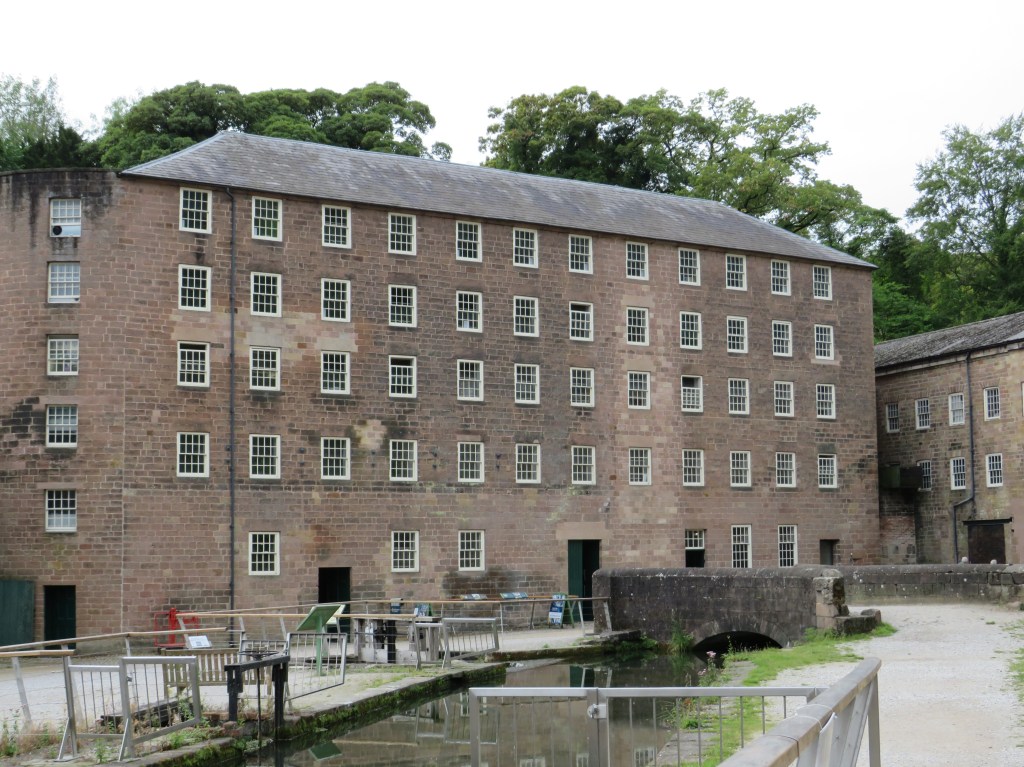
Our final day saw us return to Cromford Mill, which, fortuitously, was open this time. No plays on offer but a chance to view the industrial heritage of the area. We arrived just in time to join tour guide, David, who showed a small group of us round.
Cromford Mills forms part of the World Heritage Site that stretches for fifteen miles along the Derwent Valley. Today’s trip brought to mind long ago schooldays learning about the industrial revolution. In 1768, Richard Arkwright, a barber and wig-maker, patented his water-powered spinning frame, invented in conjunction with John Kay. Arkwright was described as ‘a man of copious free digestion’; that sounds like a phrase worth dropping into a conversation at an appropriate moment. Working with the Nottinghamshire hosiery Industry, Arkwright looked for a suitable site to set up his mill in order to produce cotton thread. Cromford had the necessary water supply from the Bonsall Brook and Cromford Sough was diverted to increase the flow. The site was on a turnpike route, vital for transporting raw cotton and the spun thread. Raw cotton arrived in Liverpool from the Caribbean and would be taken by pack horse to the mill. Arkwright used builders from the local lead mines to construct his mill. The building was tall and thin to optimise the light and this became the blueprint for other mills in the area. Initially, the water wheel was constructed using wooden peg gears. The idea was to be ready for production as swiftly as possible.
The frame was designed to be simple to operate, so unskilled workers could be used. Cheap labour was obviously an attraction, so Arkwright largely employed the wives and children of local lead miners. At its peak, over 1000 workers were employed in two shifts. The employees were better paid than farm workers and lead miners. Arkwright supplied toilets in the factory for his workers and there was barrack-like accommodation on site for the male apprentices. He also had workers’ cottages constructed in the village. A second mill was built at Cromford, as well as others in the surrounding area.
Concerns about possible attacks by machine wreckers led to keeping pikes and small arms on site, which the workers were expected to use against saboteurs if the occasion arose. In fact, there were few problems. Until 1775, carding was done manually, which proved inadequate to meet the demand. A carding engine was invented in 1775. The invention of Cartwright’s mechanised loom in the 1780s, increased the demand for spun cotton. Arkwright is regarded as the father of the factory system and it was interesting to explore the site. I was still not feeling up to too much standing or walking but we finished off our visit with a walk along the canal.
Then it was time to head for home. We left early on a beautiful misty morning. I think this may not be our last visit to the area.


 The History Interpreter - Janet Few
The title invited me in and I was hooked by your personal reflections on a journey.
I learnt a lot more about Arkwright’s inventions than I did at school! Lovely misty photo too.