Well, here we are, nearly three weeks and two lessons in. It took me about ten days to master seven words/phrases. Then there was a bit of an epiphany and suddenly more words began to stick. I do find it easier to remember nouns, rather than abstract concepts and phrases. I’ve got basic colours sorted. It is interesting that, despite Cornish being an ancient language, there are words for things like car, or hyperlink, that didn’t exist when Cornish was last spoken as a first language. Disclaimer – I have no idea what the Cornish for hyperlink is but it is in the dictionary. The Cornish for place names is also fascinating. For example, Falmouth becomes Aberfal, aber being ‘mouth’, as in Aberystwyth or Aberdeen.
Writing and reading, rather than listening seems to be the way to go. I am up to about sixty flash cards now and can cope with English to Cornish and Cornish to English. Simple sentences are harder. I can just about manage ‘the house is red’ (except you say ‘red is the house’), ‘the sea is blue’ and so on. All cool phrases but probably not hugely useful in the great scheme of things.
I am trying to crack the spelling by writing things out. Cornish is pretty consonant heavy and I have to remember that th is spelt dh and ch gh. I have been slightly confused by my recent few days being exposed to Welsh signage, to the extent that I started to think I was learning Welsh instead. There was however a proud moment when chatting to a National Trust guide about Welsh and Cornish, when he used a Welsh word for ‘splendid’ and I recognised it!
So, onwards and upwards. Next week is weather. Oh and I can now say duw genowgh.
After an uneventful journey, we arrived at the caravan site in Newport in beautiful autumn sunshine. We were just in time to explore neighbouring Tredegar House. I had even remembered my National Trust passport. Unfortunately, I had forgotten my membership card. By the magic of technology, I was located on the data base and we gained entry. There was only time for a quick look round this substantial seventeenth century house, home to the Morgan family. It was built on the site of a previous house by William Morgan, with the dowry received for his first wife and cousin Blanche. William’s second wife trued to murder him. The Morgans were substantial land owners
The estate’s downfall came in the 1920s when the then owner lived an extravagant lifestyle as a ‘Bright Young Thing’. He was also involved in the occult. During the Second World War he worked for M18 using carrier pigeons to bring information from Europe. Evan was court martialled for divulging the information to some Girl Guides. The house was sold as as school in 1951 and was acquire dby the council in 1974. It has been run by the National Trust since 2012
On a beautiful autumn day, we set off for St. Fagans. There was a slight issue paying to park as the instructions were in Welsh but English instructions were accessed and entrance to St. Fagans was free. We had been before but there have been many changes since. We began to explore the reconstructed houses, everything from an iron age round house to a pre-fab. The round house was particularly superior, consisting of two circular structures. Unfortunately, the guide was outside enjoying the sun so I could only photograph half of it. The circular pig sty was interesting, circular as pigs are more likely to escape from rectangular structures. There was a urinal, reminding patrons to adjust their clothing before leaving, several farmhouses, Pen-rhiw Unitarian Chapel and St Teilo’s Church with impressive reconstructed wall paintings. There was also a terrace of houses, each one decorated in a different period style. The civil war battle of St Fagans was the largest on Welsh soil and ended in a decisive victory for the Parliamentarians.
Before leaving Wales we popped back to Tredegar Gardens whose points of interest include a forty two foot long shovelboard in the orangery; allegedly the longest oak plank table in Britain.
I should never have mentioned learning Cornish. Quick as something quicker than a flash, Martha had found an online course through Exeter University, with the added bonus that as an alumni I got a discount. In a decidedly rash moment I enrolled.
Some background here. I am not daft. I will put it out there, because I need encouragement, that I managed to get a first class honours in the recently completed Experimental Archaeology post-grad certificate. So, despite advancing years, I can still learn something new. I’ve had books published, so I guess that make me reasonably literate. I enjoyed school and did fairly well, apart from PE. The only thing related to PE that I was any good at was ‘losing’ my PE kit. Oh, and languages; I was rubbish at languages. Latin gave me up after two years. I do have a French O level. It took me six years and two attempts to achieve this. I ended up with a middle level pass, mainly because grades were calculated on a curve of natural distribution and I resat with everyone else who had failed the first time. So basically I was slightly better than some other people who are no good at French. There’s no way that I would claim to be able to speak French. I can still remember some vocabulary. There was that incident while I was in French-speaking Canada when I correctly translated a road sign that said ‘Danger of…’. The trouble was I had no idea what the second part of the phrase meant (turned out it was deer). Basically, if there’s a word to describe an inability to learn languages other than one’s own, the equivalent of dyslexia or dyscalculia, that’s me. If there isn’t a word maybe there should be.
We have had one Cornish lesson so far. I am definitely the oldest in the group; most are twenty-somethings. ‘Let’s introduce ourselves and say why we want to learn Cornish’, says the tutor. The other introductions were along the lines of, ‘I am a professional translator’ and ‘I already speak (insert several other languages here)’. By this time, I am wondering if I do actually want to learn Cornish at all.
Anyway, we went through a few of the standard phrases you cover when you first start learning a language. ‘Hello, how are you, my name is ……’. Does anyone actually ever say ‘my name is’? Surely you just say ‘I’m’. So after an hour everyone is prattling away and I’m still on ‘Dydh da, fatala genes’ (and I’ve just had to check the spelling for that). I’ve not mastered ‘my name is’.
I’ve tried all the revision techniques I passed on to pupils when I was teaching. I’ve made some flash cards. I think I am up to seven phrases now. I can go from Cornish to English much more easily than the other way round. At the rate of one phrase/word a day I may be some time. I’ve listened to a recommended online course that relies purely on listening and repeating. There are strict instructions not to write anything down. After ten minutes of that I have confirmed that I do not learn by listening. I need to see things. It wasn’t helped because they didn’t start with the whole ‘Hello, my name is…’ thing but a load of different phrases none of which have stuck, despite the constant repetition. Arggh. It CANNOT be this hard. I know it is good for me to be challenged and probably good for me to find something that isn’t relatively easy but there are challenges and there is the impossible. I will persevere but don’t expect too much of me. I am supposed to know what goodbye is. I can manage nos da (goodnight). That’s going to be right for some of my international audience right?
I’m finally getting round to finishing the story of our trip to northern climes. There were lovely views as we crossed the county boundary to visit the RSPB reserve at Coombes Valley, near Leek in Staffordshire. We had a pleasant woodland walk but apart from a couple of buzzards, wildlife did its typical disappearing trick yet again. The most birds we saw were those spotted whilst in the car park.
The next day was the Family History conference at Buxton. It felt strange but it was fun to be back at a larger in-person event, maybe I had missed these occasions more than I thought. The conference was held in the Palace Hotel, obviously once very grand but now a faded old lady, somewhat fraying at the edges. I’ve organised enough conferences to know that it is the things that are out of your control that go wrong and I really felt for the organisers. In theory there was parking reserved for speakers and exhibitors. This had been absorbed by other hotel guests long before 8.20am when I arrived. I and my books were unceremoniously deposited on the doorstep whilst my companion circulated the car park many times, hoping to pounce as someone left. Then there was the heating, or rather there wasn’t the heating. Despite several requests, the management left the settings at arctic. This meant that I had several cups of coffee to keep warm. Decaffinated coffee didn’t seem an option so it was full strength or nothing. This was not a good idea. Lunch was a little lukewarm but the tiramisu was to die for. The previous couple of sentences contain the origins of my downfall.
The conference itself was excellent, with talks from Debbie Kennet on surnames, Nick Barratt on house history and Helen Tovey looking at four decades of Family Tree Magazine. My own presentation was about one-place studies. It was lovely to chat to people, including meeting two more of my family history coven in person for the first time. I also realised how many more books you sell when you are speaking in person and left with near empty boxes.
By the end of the day I was feeling very shaky and I began by blaming the caffeinated coffee. By the evening I was very unpleasantly unwell, not great at any time but especially not in a caravan. In retrospect, I think it was possibly the tiramisu and I heard that I wasn’t the only one to be struck down; maybe I shouldn’t have said ‘to die for’.
The next day we’d arranged to meet up with friends. I was still decidedly fragile so we decided not to go for our planned walk and chatted instead. There was more meeting up the following day, family this time and we were able to watch the Queen’s funeral and walk to the nearby Chatsworth Estate.
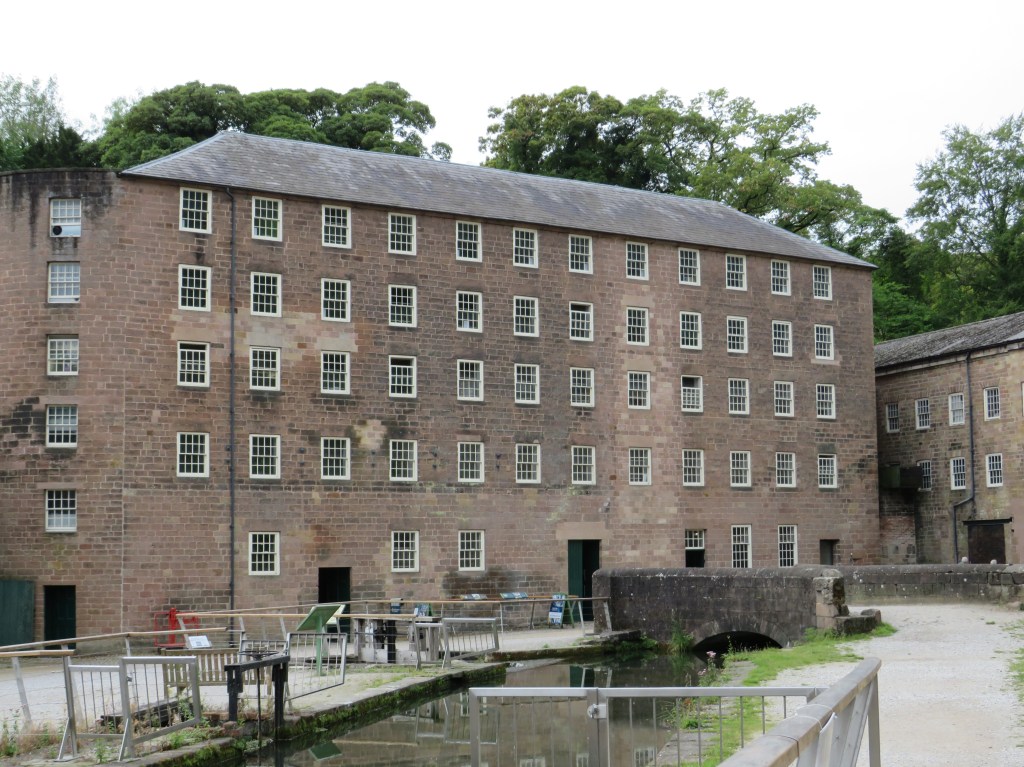
Our final day saw us return to Cromford Mill, which, fortuitously, was open this time. No plays on offer but a chance to view the industrial heritage of the area. We arrived just in time to join tour guide, David, who showed a small group of us round.
Cromford Mills forms part of the World Heritage Site that stretches for fifteen miles along the Derwent Valley. Today’s trip brought to mind long ago schooldays learning about the industrial revolution. In 1768, Richard Arkwright, a barber and wig-maker, patented his water-powered spinning frame, invented in conjunction with John Kay. Arkwright was described as ‘a man of copious free digestion’; that sounds like a phrase worth dropping into a conversation at an appropriate moment. Working with the Nottinghamshire hosiery Industry, Arkwright looked for a suitable site to set up his mill in order to produce cotton thread. Cromford had the necessary water supply from the Bonsall Brook and Cromford Sough was diverted to increase the flow. The site was on a turnpike route, vital for transporting raw cotton and the spun thread. Raw cotton arrived in Liverpool from the Caribbean and would be taken by pack horse to the mill. Arkwright used builders from the local lead mines to construct his mill. The building was tall and thin to optimise the light and this became the blueprint for other mills in the area. Initially, the water wheel was constructed using wooden peg gears. The idea was to be ready for production as swiftly as possible.
The frame was designed to be simple to operate, so unskilled workers could be used. Cheap labour was obviously an attraction, so Arkwright largely employed the wives and children of local lead miners. At its peak, over 1000 workers were employed in two shifts. The employees were better paid than farm workers and lead miners. Arkwright supplied toilets in the factory for his workers and there was barrack-like accommodation on site for the male apprentices. He also had workers’ cottages constructed in the village. A second mill was built at Cromford, as well as others in the surrounding area.
Concerns about possible attacks by machine wreckers led to keeping pikes and small arms on site, which the workers were expected to use against saboteurs if the occasion arose. In fact, there were few problems. Until 1775, carding was done manually, which proved inadequate to meet the demand. A carding engine was invented in 1775. The invention of Cartwright’s mechanised loom in the 1780s, increased the demand for spun cotton. Arkwright is regarded as the father of the factory system and it was interesting to explore the site. I was still not feeling up to too much standing or walking but we finished off our visit with a walk along the canal.
Then it was time to head for home. We left early on a beautiful misty morning. I think this may not be our last visit to the area.





 The History Interpreter - Janet Few