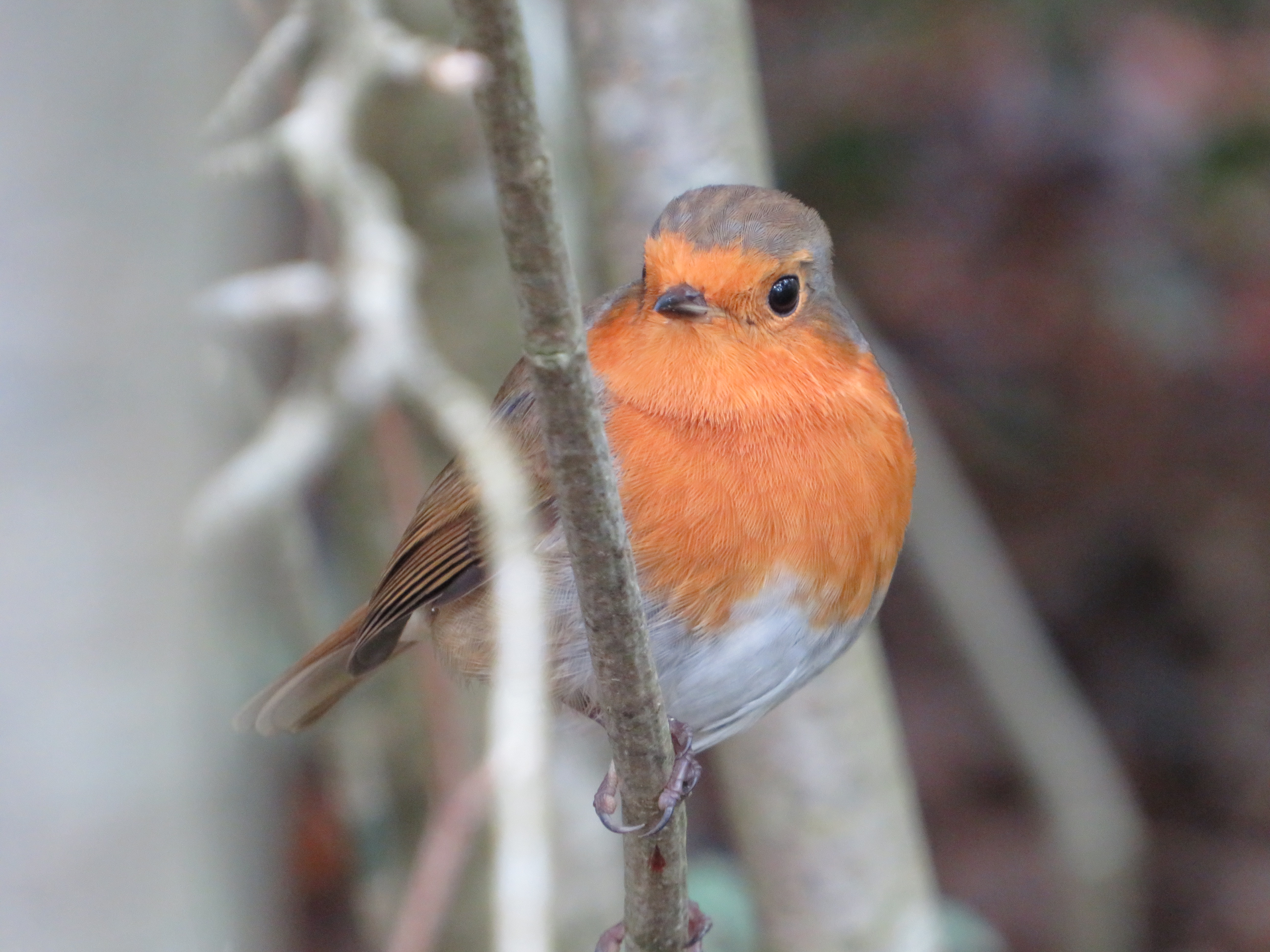
Preparing to leave our caravan site in the Lakes, the robin called to bid us farewell, bringing some of his friends, including a nuthatch. We had an uneventful drive south-eastward to Buxton. The landscape is notably different on the Peak District, with hills, open fields and mellow stone.
The Derbyshire site was adjacent to a country park so, once settled, we walked up to Solomon’s Temple, so named for local landowner Solomon Mycock and built in 1894 to replace a former building that was thought to have been commissioned by the Duke of Devonshire, to provide employment for unemployed lime workers in the 1820s. Archaeological finds suggest that this was the site of a Bronze Age burial mound, as artefacts dating from c. 3500 BCE have been found.
We had an early evening meal and left for Cromford where we had booked to see an open-air play. In fact we’d altered our holiday to arrive earlier in Buxton so we could do this. On arrival everything seemed shut and we could see no sign of an imminent performance. Having wandered around for half an hour and asked several people, I manage to find some mobile signal, rare since leaving home and checked the website to discover that the performance had been cancelled. As the play was about the gunpowder plot, I could understand that, in the aftermath of the Queen’s death, it might not be the most tactful time for a performance about trying to blow up a monarch but apparently the decision to cancel was only taken six days later. I was decidedly annoyed that no one seemed to think that it was a good idea to email those who had booked, to save them a round trip of forty miles, or indeed to put a notice of the cancellation on the firmly locked doors but hey ho. After five emails our not inconsequential entrance money was refunded.
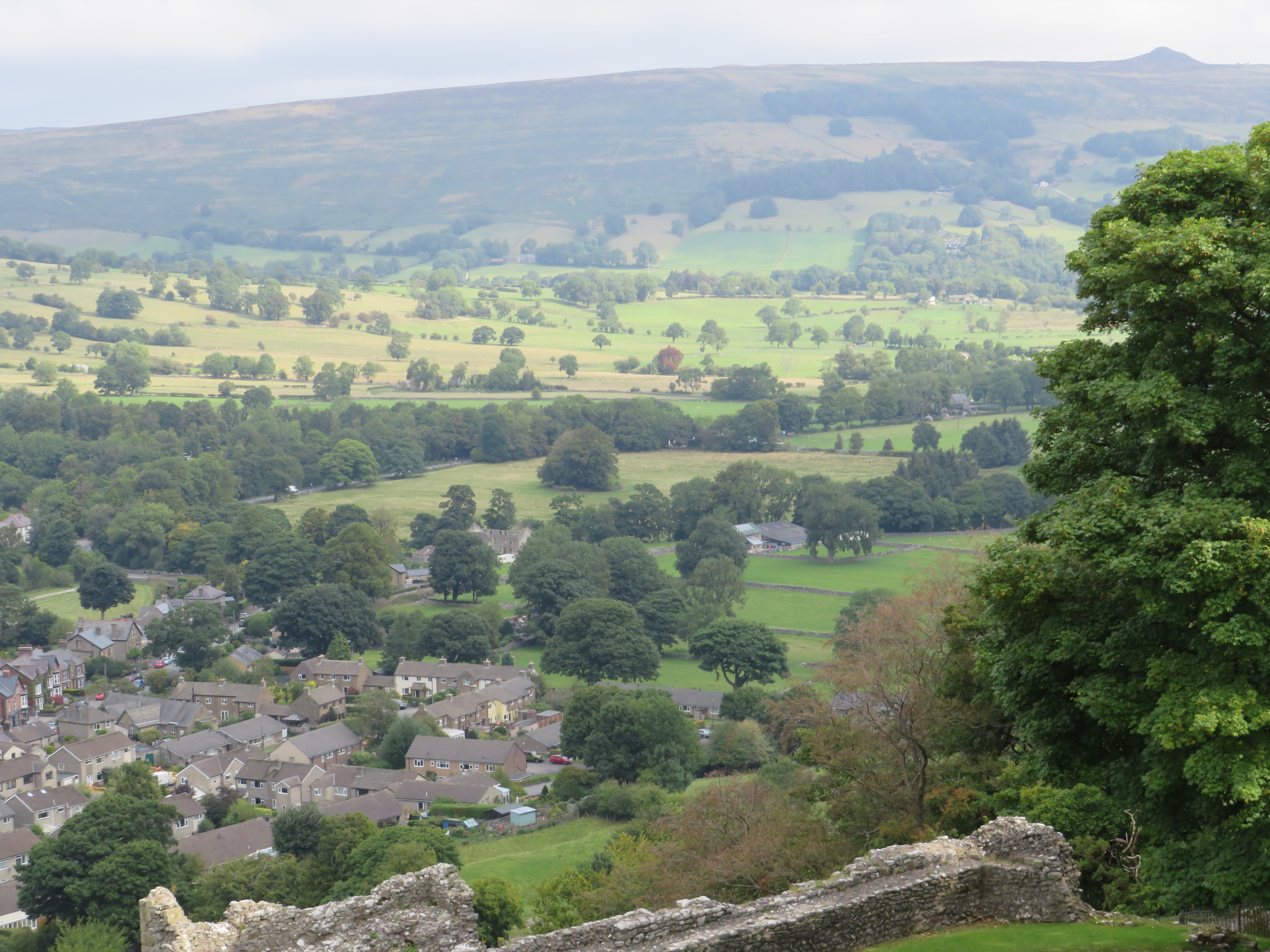
The next day we drove to Hope Valley and along Winnats Pass, with its impressive views across to Mam Tor, the site of a Hill Fort. The Hope Valley is the boundary between the millstone grit of the ‘Dark Peak’ and the differing geology of the ‘White Peak’, an area of carboniferous limestone, with its elaborate cave system. Our destination was Castleton and Peveril Castle, one of many castles established after the conquest in the Forest of the Peak to establish Norman control. Originally called the Castle of the High Peak, the castle was later named for William Peveril, an early keeper of the royal forest. The castle’s purpose was more administrative than defensive, being a base for the Keepers of the Forest of the Peak from the eleventh to sixteenth centuries. Their role was to ensure that the punitive Forest Laws were adhered to; fines were paid and rents were collected. The value of the area to the crown lay in its use as a royal hunting ground and also the local lead and silver mines. Castleton grew up in the late twelfth century, its houses and mills providing an income for the castle’s estate. It was a stop on the packhorse route.
Although the castle was owned by the monarch or a member of the royal family, they rarely visited. Henry III, who was almost certainly responsible for constructing the New Hall at Peveril, only stayed once. Even after the building fell into disrepair, the castle continued to be used as a courthouse, prison and the local pound until the sixteenth century, after which much of the castle was demolished and the dressed building stone was plundered.
We looked at various gift shops selling the local Blue John or Fluorspar and read about John Tym’s Blue John workshop. We had excellent cakes and drinks in Dolly’s tea room, really good value too and highly recommended. Allegedly this premises, in a former incarnation, was billed the worst café in the country; definitely not the case now. A Buxton shopping trip yielded not only food but the adaptor required to download my photographs.
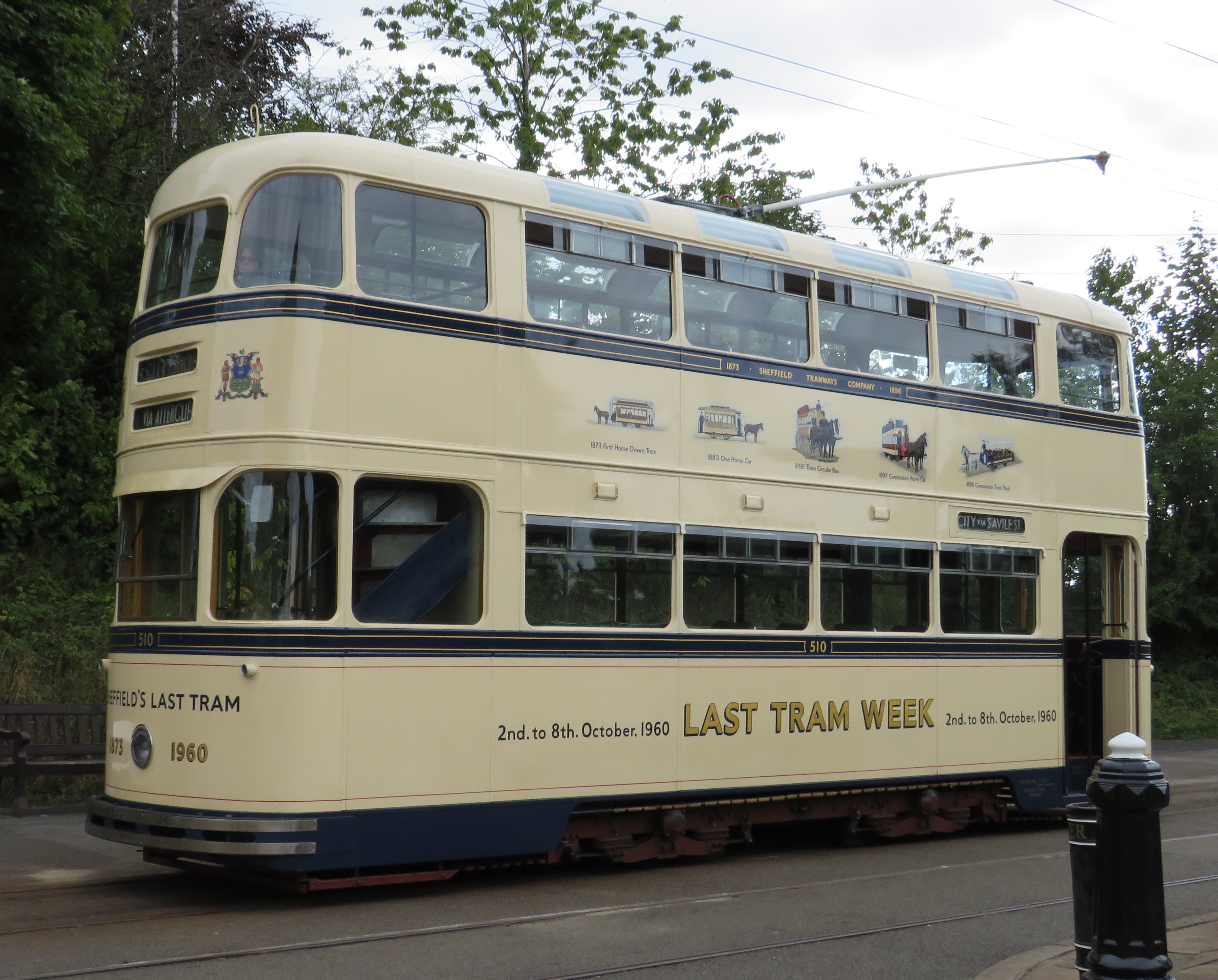
On Martha’s recommendation, we headed off to Crich Tramway Village without too much trouble despite a road closure. This haven for preserved trams was opened in 1959 after the former limestone quarry closed. This attraction is well presented and a credit to the largely volunteer workforce. The enthusiastic Ken showed us round. A random collection of items of architectural heritage have found their way on site but blend together. These include what remained of the Derby Assembly Rooms, which was built in 1765 and caught fire in 1963. Its brick by brick demolition and re-erection took three years. There are two 1897 gas lamps, from Ashton-under-Lyne, originally cast to commemorate Queen Victoria’s diamond jubilee. The gates came from Marylebone station, there’s a tramway shelter from Matlock and a Hendon police phone box. The Red Lion pub from Stoke on Trent was particularly notable, as was one of the last twenty ‘Penfold’ hexagonal Victorian post boxes in the country. One of the more bizarre artefacts was the ventilation pipe from an underground Birmingham toilet.
We road on two trams, one a 1928 from Porto, Portugal. There were many more trams to view and a huge exhibition area. We took our second tram on a one way journey so we could walk back through the woods and view the wooden sculpture trail. We could see the Sherwood Foresters’ War Memorial, which marks the highest point in Derbyshire. There is a view of eight counties from here but access is restricted at the moment so we couldn’t walk up to it. The road closure was a little more impactful on our return journey but we made it back without too much of a detour.
We made a return visit to Stott Park Bobbin Mill, a fascinating insight into the industrial heritage of the area. The factory was built in 1835 to provide bobbins for the Lancashire cotton industry and was ideally situated for water power and the necessary supply of birch, sycamore and ash. We arrived just in time for a guided tour by Ann. The mill produced bobbins in 260 different styles. Many of the workforce were young boys for the Ulverston workhouse. There was little regard for health and safety. Apart from the dust from the sawdust and shavings, the unguarded machinery would have been a hazard for any workers whose concentration lapsed; circular saws were driven at 3000 rpm. The workshops were well ventilated to reduce fire risks but this made them very cold. Shavings might be waist high to help keep the workers warm but this was of course a fire hazard. Nineteenth century workers were on piecework and were paid by the gross. The tally man would mark their sticks when each gross was completed.
Many workers were laid off when the supply of cotton was disrupted during the American Civil War in the 1860s and the ensuing ‘Lancashire Cotton Famine’ led to a drop in the demand for bobbins. About 1870, W A Fell introduced a semi-automatic boring machine, which simplified the task of boring holes in the bobbins, reducing it to loading new blocks and removing bored bobbins. In 1880, a steam engine replaced the water mill as a source of power. Once plastic began to replace wood the mill went into decline and it finally closed in 1971.
Rain stopped play as regards walking but we did stop off at the Esthwaite Water Café for some very acceptable cake and decent sized mugs of tea and coffee, which we consumed overlooking the lake.
We came home to the news of the Queen’s death.
The weather forecast was uncertain, so we decided on an early walk, whilst it was dry and headed anti-clockwise around the lake for a mile or so and then returned in order to head off to Acorn Bank, an interesting National Trust property. Acorn Bank is situated at Temple Sowerby, which takes its name from its association with the Knights Templar, who were gifted the manor by Henry II in 1185. The next owners, in the mid-fourteenth century, were the Knights of the Hospital of St. John. After the dissolution of the monasteries, Acorn Bank was in the hands Thomas Dalston and his descendants for almost four hundred years. The writer Dorothy Una Ratcliffe purchased Acorn Bank in 1934 and was it given to the National Trust in 1950. The house was tenanted until the 1990s and spent time as a nursing home.
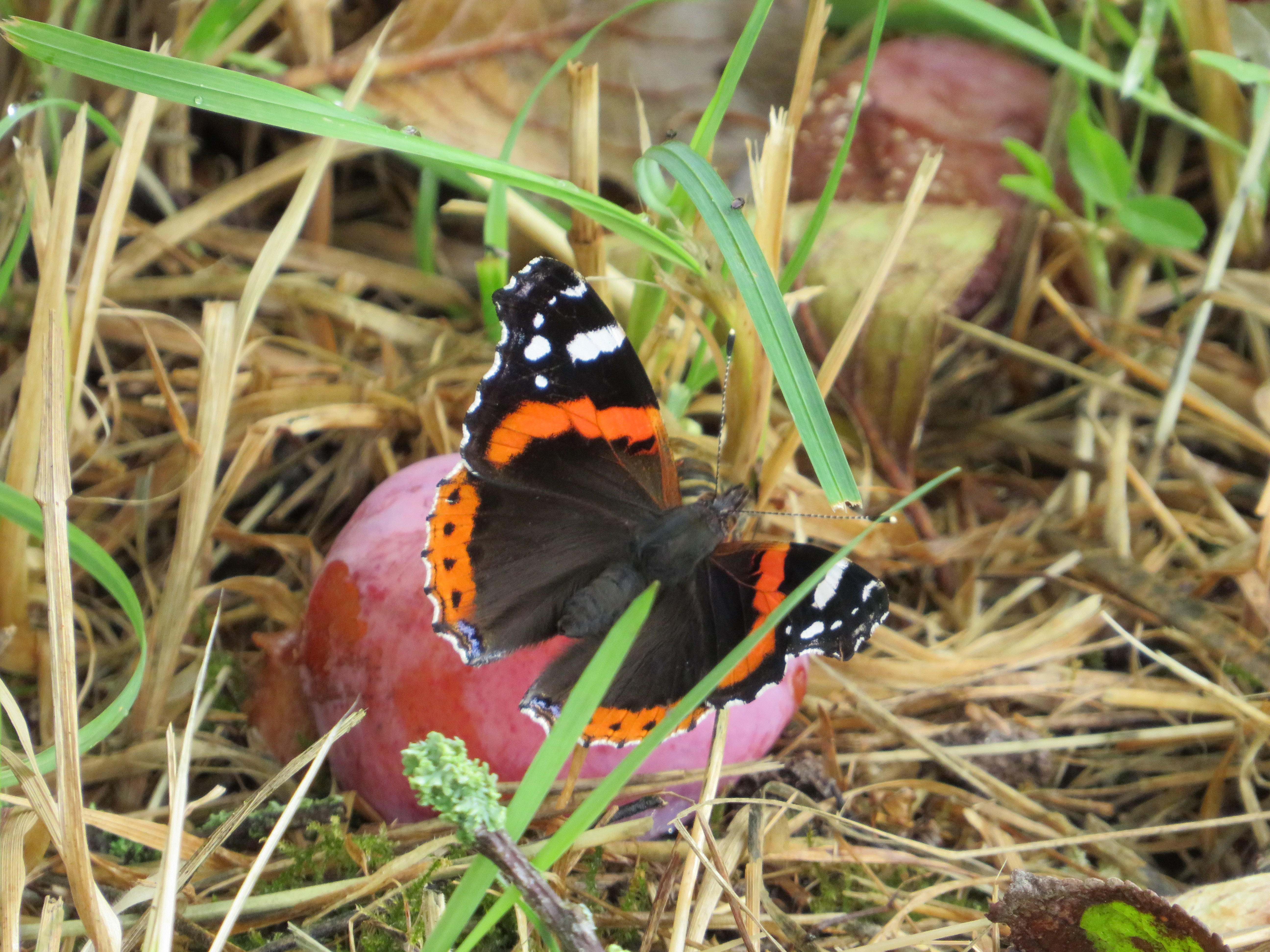
Parts of the current house are sixteenth century but there were later alterations and the façade is eighteenth century. It is the gardens and orchards that are notable at Acorn Bank. The orchards are home to over a hundred varieties of apple, some of which were grown in cordons, in other words, trained diagonally to save space. This year’s crop looked to be prolific. Here also is the largest herb garden in National Trust ownership. There were bee hives to aid pollination and we spotted a large number of red admiral butterflies feasting on fallen plums. Although the surrounding woodland, with its streams and ponds, are a haven for wildlife, the fauna was, as so often on our holidays, conspicuous by its absence. Within the woods are the remains of gypsum mines. This was produced on the estate from 1880-1938 and sold as fertiliser or for plaster. We also walked down to the watermill.
To make up for the lack of wildlife at Acorn Bank, the red squirrels came out to play once back on the site but hasty scampering made them difficult to photograph. They seem to make a habit of opening the top of one of the bird boxes to investigate the contents. The late afternoon was spent watching the accession speech of Charles III.
We set off early to go to Hill Top, a seventeenth century cottage owned by Beatrix Potter from 1905 but used as a writing retreat, rather than her home. She was responsible for extending the property but no mains water or sanitation system was installed until 1928, when her nephew came to live at Hill Top. It was fascinating to see some of Beatrix Potter’s books lying open to show illustrations that mirrored the part of the house or garden that we were in. A bed was covered by a reproduction of the wedding quilt made for her parents in 1863; the original quilt is in the V & A. The main living room had a rather strange wallpapered ceiling . Some knowledgeable guides told us the story of the house and Beatrix’s life. She was constrained by the mores of her time and regretted being known for ‘bunny books’ rather than her other accomplishments, such as botanical drawings. The first book she wrote after her marriage is now seen as a treatise in support of women’s suffrage and was turned down by Warne’s, her publishers. Her published works after this date tended to be re-presentations of earlier works. The cottage garden was beautiful and you expected to spot Peter Rabbit and friends hiding in the foliage.
On the way home, we stopped off to view the standing stones at Castlerigg, visited by William and Dorothy Wordsworth in 1799. We also called in at Keswick for some food. Finally, a short walk to the lake in the afternoon.
We drove out to St. Bees, which was an opportunity to see the sea but on the whole not very inspiring. We climbed the cliffs and rewarded ourselves with an ice cream. We returned via Threlkeld Mining Museum. The quarry opened in the 1870s to provide ballast for the newly opened Penrith-Keswick line and closed in 1982. There were plenty of construction vehicles in varying states of decay, some of which are being restored. We had mistimed our arrival to miss the 1pm train ride, so waited for the 3pm trip before heading home as the rain began. This is an interesting museum, which is clearly a hobby for construction vehicle enthusiasts. Don’t expect professional presentation of exhibits but worth a visit.
It was rainy on our last day in the Lakes, so we went for a drive towards Bassenthwaite. We had planned to go to the post office in Keswick but missed the turning and couldn’t find the free parking. When we finally found it there was no space, so we returned to the van and tried again later with more success. It finally stopped raining in the late afternoon so we could walk by the lake without getting soaked.
Amidst all this touristy activity working/volunteering life went on. Conducting a Zoom meeting was not without difficulty. Great signal in the hotspot but I couldn’t face standing up and waving my arms about for two hours to keep the light on in the hut. Plan B was driving the car to beside the hut and sitting in the car. Thankfully it was a new laptop so had plenty of battery. Of course nights are drawing in so by the middle of the meeting, not wanting to drain the car battery by using the courtesy light, I was in the dark in any case!
We’ve been back from our latest excursion for several days but the ‘interesting’ connectivity issues whilst away meant that I am posting news of these adventures retrospectively. So cast your mind back a few weeks, we are now in early September )although in my head we have surely only just got to June). Day one, other commitments meant that we left home at lunchtime and had an uneventful run to our ‘breaking the journey’ stop in Tewkesbury. Van pitched, we took a short walk into town to acquire some very tasty fish and chips. Tewkesbury makes the most of its heritage. There are several historic buildings and plaques explaining their significance. Heraldic banners along the main street also give a unique flavour.
As it was raining the next day, we forewent another walk round Tewkesbury and drove straight to Keswick amidst delays on the M6, due to an overturned lorry. The satnav was counter-intuitive but we didn’t get lost. The campsite at Borrowdale is in a beautiful wooded setting near Cat Bells and a short walk from Lake Derwentwater, where Swallows and Amazons and Star Wars were filmed. Access to the site is a little challenging but nothing that fifty years’ experience of towing caravans couldn’t handle. A friendly robin greeted us and even popped in the van to say hello. As a bonus, the sun came out, allowing us to walk round the lake. We passed a shed that is home to ‘Teddy in the Window’, who collects money for charity. The outside of the shed is decorated with letters and postcards to Teddy from all over the world. The downside of the site is that wifi access is limited. To be fair, the hot spot includes the information shed, which is one up on huddling under a tree. It does however necessitate standing up and moving continually, as the light in the hut works on a sensor. With two evening meetings due this week, at least for as long as my battery lasts, I anticipated an interesting time.
On our first full day in the Lakes, we set off for Allen Bank in Grasmere. I had neglected to note the postcode and had no phone signal but the helpful site warden found it for me, saving me repairing to the shed hotspot. There is blue badge parking only at Allen Bank, so we parked in Grasmere Village and walked up to the house. It was built in 1805, an era when many industrialists from Manchester and Liverpool were settling in the Lake District. This house was rented to Wordsworth for three years. There is a definite twist to this National Trust property, which suffered from fire damage. It is set up for interaction, with opportunities to sit and read, borrow an art pack and draw, play board games, or just admire the impressive views. An added touch is the provision of explorer rucksacks that children can borrow as they explore the grounds. Some of the fire damaged walls have been painted with interesting murals by a local artist. A nearby, detached billiard room, which resembles a chapel, complete with stained glass, is being renovated and is due to open on Friday. It doesn’t take long to view the house but it is definitely worth investigating the surrounding gardens and woodland. The gardens have been designed with biodiversity in mind and Herdwick Fleeces are used as mulch. There is an uphill walk through the woods to a viewpoint. This did involve climbing wet granite steps, made additionally slippery by fallen leaves but we survived. This despite my not having my non-varifocal glasses with me, making clambering more difficult, as I am unable to see my feet clearly.
Next, a look round Grasmere and a stop to consume cake and a drink. I was tempted by the many sales in the outdoor clothing outlets and acquired what is allegedly a waterproof jacket with a 70% discount. Just as well as I would never spend £90 on a jacket. It will be interesting to see if the claims of breathability and waterproofing are valid.
We stopped off in Keswick on the way home. This was partly to try to purchase an SD card to USB convertor to download my photographs as the new laptop is lacking an SD card slot. In both Grasmere and Keswick there are plenty of cafes, upmarket tourist shops and outdoor clothing outlets but a distinct lack of a camera or computer shop. We managed to secure roadside parking in Keswick and having drawn a blank amongst the shops, went down to the lake. There were people feeding the geese and ducks, providing photographing opportunities. Apparently the views of the lake were revealed in 1747 when the Crow Bank oak plantation was felled. From then on Keswick became a magnet for artists, writers and travellers.
I have had a particular affinity with my great, great grandmother, Ann Stratford, ever since I discovered that her childhood home was in the road I myself lived in for three years. Ann was the third of the five children of Richard and Grace Stratford née Kingham.[i] She was baptised on the 13th of May 1834 at St. Michael and All Angels, Aston Clinton, Buckinghamshire[ii] and it seems that she spent the first twenty-one years of her life living there.[iii] Aston Clinton is a village situated on the main road between the towns of Tring, in Hertfordshire and Aylesbury in Buckinghamshire. Once married, Ann moved six miles away to Little Kimble,[iv] another Buckinghamshire village whose economy was dependent on agriculture. In company with many rural areas, Buckinghamshire was a flourishing centre for home industry, in particular lace-making and straw-plaiting. Many members of the Stratford family were involved in the plaiting and distribution of straw for the hat trade, which centred on Luton. Born on the eve of the Victorian era, in 1834 and dying a month before Edward VII, in 1911, Ann Stratford’s life-story spans not just the Victorian age but also the rise and demise of the domestic straw-plait trade.
St. Michael and All Angels, Aston Clinton
At the time of Ann’s birth, Buckinghamshire was still suffering from the aftermath of the Swing Riots. In 1830, following an agricultural depression and a series of bad harvests, the plight of agricultural labourers led to protests, during which threshing machines across the south of the country were destroyed under the auspices of the mythical Captain Swing. Conditions and wages were poor, with workers increasingly being hired on short term contracts and having to find their own accommodation, leaving them destitute when work was scarce. Prior to the Poor Law Amendment Act of 1834, poor relief was inadequate and the obligation of church tithes was punitive. The riots spread across the south of England and were prevalent in Buckinghamshire and the surrounding counties.
The Swing rioters targeted those they perceived as wealthy and overseers of the poor were sent threatening letters, ostensibly from Captain Swing. The rioters demanded increased wages, better conditions, reductions in rents and tithe payments, as well as the destruction of threshing machines. Groups of rioters roamed the countryside damaging threshing machines, burning ricks and attacking property. As labourers in an agricultural community, even if they were not actively involved, the Stratfords must have been affected by causes and consequences of these troubles.
Before Ann’s birth, in 1829, her father Richard, had twice been in court for petty theft.[v] This may have been as a result of the actions of a headstrong young man but the stealing of firewood and turnips suggests perhaps that the family were in dire straits. As poverty tightened its grip, families, such as the Stratfords, were increasingly dependent on income from home industries, in their case straw-plaiting. In 1839, Ann’s short-lived younger brother was born.[vi] In the January of 1840, her two and a half year old sister, Mary, died of convulsions.[vii] Just a month later, Ann’s mother, Grace, mother died of tuberculosis.[viii] This left Ann’s father, a straw dealer, with three young children, Ann and her two older brothers, to care for. Just over three months after the death of his first wife, Richard Stratford married again, to nineteen year old Hannah Young;[ix] Ann was just six years old.
The plait trade flourished in the years known as the ‘hungry forties’. The Stratford’s local market would have been five miles to the east, in Tring. By 1846, a new market opened up to the west in Aylesbury, four miles away from Aston Clinton. The first Aylesbury market was held on the 3rd of October and twenty children under the age of twelve, from surrounding villages, were give monetary prizes for their plait; one of the winners was eleven-year-old Ann Stratford.[x] Ann was recorded as a plaiter in the 1851 census. She was living with her family in Green End Street, Aston Clinton, where I was to live in the 1980s.[xi] It was in 1851 that Anthony Nathan de Rothschild purchased the Aston Clinton estate from The Duke of Buckingham.[xii] The Rothschilds were to set up a model farm in the parish.
Green End Street, Aston Clinton
According to Gróf, 4% of the female population of Buckinghamshire in 1851 were involved in the plait trade, yet in some parishes, such as Edlesborough, the figure was as high as 58%.[xiii] Conditions were notoriously hard for straw-plaiters, who would be brought weekly supplies of straw by the plaitman and paid by the score (twenty yards) for what they produced; the more complex patterns commanding the highest rates. From a very young age, children would be expected to contribute to the family income in this way, some in plait schools that gained a reputation for ‘places of child exploitation amid exceptional squalor, and even cruelty’.[xiv]
In 1851, Ann was one of one hundred and eighteen females aged between five and twenty five in Aston Clinton, 59% of whom were involved in the plait trade. In all, 60% of Aston Clinton females, including children, were recorded with some form of occupation; two thirds of them were plaiters.[xv] Ann Stratford’s father Richard was a straw dealer,[xvi] as was her older brother Peter;[xvii] another brother, Henry, was a straw drawer, preparing the straw for plaiting.[xviii] The graph below shows the age and gender distribution of the two hundred and thirty nine plait workers in Aston Clinton in 1851; they made up 41% of the workforce in the parish.
Inhabitants of Aston Clinton in 1851 who were involved in the Plait Trade[xix]
Children as young as three would begin to learn to plait. Plaiting expert, Veronica Main, has found a record of a child of eighteen months involved.[xx] The children would be crowded into plait schools, held in small cottage rooms= that had poor lighting and were full of fumes from the ‘chaddy pot’ charcoal heaters that they put under their skirts for warmth. Those running the schools were accused of exploiting their labour-force. School is a misleading appellation, the education provided related solely to plaiting. Ann was illiterate, signing her marriage certificate and registering her daughters’ birth with a cross.[xxi] A child’s early attempts at plait would not be saleable and were termed ‘widdle waddle’ but by the age of ten, a child could earn two-thirds of an adult’s income.
The plaiters would work twelve or fourteen hour days but the rewards were significant; the most proficient, who produced the more complicated patterns, might earn more than their agricultural labouring husbands. Plain plait was worth seven pence a score. In 1813, Priest wrote, ‘women and children here make great earnings by making lace and platting [sic] straw, unfortunately to the disadvantage of agriculture; for whilst they can earn by such work from 7s. to 30s. per week ……, it can scarce be expected they would undertake work in the field’.[xxii] Lucy Luck referred to the straw season, as being from January to June, saying that there was less work during the remainder of the year[xxiii] but there was a good living to be made from plaiting.
There were several roles involved in the plait trade, including drawers, strippers, cutters, splitters, sorters, bleachers, dyers and the plaiters themselves. One splitter could provide enough straw for fifty plaiters. Although it was possible to fulfil more than one of these roles, increasingly, individuals specialised in one or the other. At the top of the hierarchy were the straw dealers, some having large-scale, highly profitable businesses. At the first Aylesbury plait market, held in 1846, Mr Thorn of Aston Clinton brought 500 score of plait to sell; the most productive dealer bringing 1300 score and nearly £1000 of plait changed hands.[xxiv]
There were health hazards associated with plaiting. Plaiters developed cracks at the corners of their mouths, from dampening the straw. If dyed straws were used, the dye transferred to the plaiter’s mouth. The posture required also led to hunched left shoulders.
Throughout the nineteenth century, middle-class men passed judgements on the lifestyle of the straw-plaiters. Straw-plaiting was regarded as leading to immorality and ignorance, with plaiters deemed to be more likely to have illegitimate children and lack proficiency in essential domestic tasks. The plaiters’ husbands were accused of being lazy and living on their wives’ incomes. In 1882, it was reported that plaiters
“are a sadly untidy and unthrifty set of people, scarcely knowing how to do a stitch of needlework, or cook a potato; addicted to making a cup of tea and eating dry bread and butter if they can afford it.”[xxv]
Goose writes that,
“The Clergy Visitation Returns for Buckinghamshire in 1854 and 1866 blamed high levels of illegitimacy squarely on the industry. At Stewkley and Linsdale the ‘evils’ of the trade were castigated, while at Aston Clinton the local clergyman complained that plaiters became independent of their parents too soon, leading to early marriages and unspecified ‘immorality’ which, it was claimed, frequently took place on Buckland Common.”[xxvi]
Goose goes on to point out that, in 1864, the Royal Commission on Children’s Employment reported that children could earn 6d a week from straw-plaiting, therefore there was a significant incentive for parents to put them to work, thus, “it is not surprising… that ignorance and vice abound among a population so reared.”[xxvii] As early as 1804, Arthur Young wrote in General View of Agriculture of the County of Hertfordshire that, “the farmers complain of it, as doing mischief, for it makes the poor saucy, and no servants can be procured, where this manufacture establishes itself.”[xxviii] George Culley’s report to the Royal Commission on the Employment of Children, Young Persons and Women in Agriculture of 1867/8, commented on the “great want of chastity amongst the plait girls,” blaming the early independence from their parents, that earnings from plait allowed and the fact that, “male and female plaiters go about the lanes together in summer engaged in work which has not even the wholesome corrective of more or less physical exhaustion”.[xxix]
Despite these contemporary claims, Gróf’s study of Edesleborough in Buckinghamshire[xxx] concluded that the assertions of higher illegitimacy rates amongst plait workers were unfounded. Goose’s wider study of Hertfordshire suggests that despite indications of enhanced rates of illegitimacy in some plaiting areas, this was not necessarily attributable to plaiting, other factors being at work.[xxxi]
Plait-School
Image George Washington Brownlow in the public domain
Studying the Stratford family shows that Aston Clinton was similar to Edlesborough, in that their women played a vital role in the family economy. These villages had far more women with recorded occupations than the county average of 4%. Two of the factors that Pennington and Westover cite as being likely to result in the emergence of home industry, such as plaiting, were low wages for men and the prevalence of casual labour; both factors which also stimulated the Swing Riots.[xxxii] It can be seen that Ann was part of a much wider pattern of female employment.
On the 13th of March 1855, Ann gave birth to an illegitimate daughter, Mary Ann Howe Stratford in Aston Clinton.[xxxiii] There is no DNA evidence to confirm or refute the identity of Mary Ann’s father but it seems almost certain that he was William Howe. Ann was to marry William three months later in his home village of Great Kimble, where the couple set up home. What then of the allegation of immorality amongst plait workers? Ann’s eldest brother had been born three months before her parents’ marriage. Ann’s own first child was also born out of wedlock. Would Ann, or her mother Grace, have been subjected to the ‘rough music’ that traditionally accompanied illegitimate births? This involved banging saucepan-lids or tins cans together to cause a commotion outside the mother’s home. At her baptism, which took place in Great Kimble after the marriage of William and Ann, Mary Ann’s parents were listed as Robert and Charlotte Howe, who were in fact William’s parents.[xxxiv] As Charlotte would have been fifty at the time this seems unlikely, also Mary appears in the 1861 census as William’s daughter.[xxxv] Mary Ann’s birth was registered as Mary Ann Howe Stratford,[xxxvi] underlining the probability that she was the child of William and Ann and illustrating that the baptism record is misleading.
St. Nicholas’, Great Kimble
From this single instance it is difficult to draw any conclusions about pre-marital pregnancy however, in this respect Ann was adding weight to those who reviled the straw-plaiting women as being promiscuous. Gróf mentions an unreferenced Parliamentary Report of 1842 which stated that, “the moral condition of the lace-makers seems nearly as low as that of the plaiters… chastity is at a sad discount … prostitution is at a high premium.”[xxxvii]
Ann’s husband, William, was an agricultural labourer. Despite the Swing Riots and increased demand for labourers following waves of emigration, agricultural wages were still low in Buckinghamshire in the 1850s. Perhaps attracted by the promise of up to £6 bounty, in 1852, whilst still a single man, William Howehad responded to a recruiting poster and enlisted in the Royal Bucks King’s Own regiment of militia.[xxxviii] The militia were groups of amateur soldiers, mustered in times of strife or perceived threat. The Militia Act of 1852 was a response to the fear of French invasion and 80,000 men were sought. It was hoped to recruit sufficient volunteers but the Act did provide for a ballot to force men to enrol should they not come forward. Private 492 William How [sic] was recruited on the 28th of October 1852 at the age of twenty years and eight months[xxxix]. His height was 5’ 6¼”, his occupation was listed as labourer and he received an initial bounty of sixteen shillings. Over the next two years William undertook several periods of service throughout the county, receiving regular bounty payments of up to £3 13/- a quarter.[xl] This illustrates how wider reaching foreign affairs affected the life of a simple agricultural family in the provinces.[xli]
When Ann married William Howe at St. Nicholas’, Great Kimble on the 26th of June 1855; she was described as a servant of Great Kimble and William was recorded as being a militiaman.[xliii] It appears that William and Ann spent thirty years in the same cottage.[xliv] It is likely that they moved there on marriage in 1855 and were still there in 1886 when their daughter, Caroline, returned from Battersea in south London, in order to give birth to her daughter, my grandmother, Elizabeth Ann Hogg.[xlv] The census returns of 1861 and 1871[xlvi] suggest that this cottage was close to a chapel and the Crown Inn, with just one cottage between the Howe’s and the Inn. In Little Kimble, when I visited in the 1990s, Old Chapel Close indicated the site of the Chapel and an Indian Restaurant inhabited what appears to be the former Crown Inn. Next door was one cottage, then named ‘*** ******’, clearly old enough to have been built by the 1850s. Further on again, was Brookside House, where William and Ann’s daughter Jane was working in 1881.[xlvii] So where could William and Ann have lived? Had it been demolished? Looking more carefully at ‘*** ******’ it became obvious that this was once two cottages; the brickwork round a second front door was clearly visible to the left of the existing door. So, the right-hand half of ‘*** ******’ was home to William, Ann and their nine children. In 1861, the family, by then with four children, even found room for a lodger, George Fleet; almost certainly an economic necessity. According to the 1861 census, Ann was still plaiting.[xlviii]
The Probable Former Home of William and Ann Howe
William and Ann went on to have five more daughters and three sons. They all survived to adulthood and married, which seems unusual in times of poverty and poor public health. It is possible that there were miscarriages but the children are very evenly spaced.[xlix]
Although no occupation is listed for Ann in the censuses from 1871 to 1891,[l] it is almost certain that she would have continued to plait; women’s occupations are notoriously under-represented in the census returns. Toward the end of their lives William and Ann went to live in Weston Road, in Ann’s home parish of Aston Clinton, next to their son Joseph, for a time. They were there in 1891, when, at the age of sixty, William was working as a roadman and by this time, Ann had lost her hearing.[li] Ten years later, they had returned to Great Kimble and were living in Smokey Row. William was working as a horseman on a farm. Ann was then recorded as plaiting straw.[lii] William, described as a farm labourer, died in Great Kimble of exhaustion and acute bronchitis on the 14th of December 1904. His death was registered by his daughter-in-law Louisa, who had come down from Fulham and had been in attendance at the time of William’s death.[liii]
Ann’s generation was the last to depend on straw. The market had collapsed in the face of cheap imports and former plaiters were forced to turn to sewing the foreign plait into bonnets, or to seek other means of contributing to the domestic economy. Of Ann’s daughters, only the eldest, Mary Ann, took up plaiting, something she did into adulthood, although by the time she was widowed, in 1911, she was engaged in laundry work, there being no longer any demand for plaiting.[liv] The remaining daughters went into domestic service, or worked as dressmakers.[lv]
On the 1st of April 1911, Ann died in Saunderton Workhouse infirmary of old age and exhaustion. Her death was registered as Hannah How.[lvi] Ann was buried with her husband at Great Kimble.[lvii]
Clarke, E. ‘Plait and Plaiters’ in Cassell’s Family Magazine (1882) Vol. 8 pp. 76-79.
Davis, Jean Straw Plait Shire Publications Ltd. (1981).
Few, Martha unpublished, untitled essay for The Open University course A173 (2008).
Goose, Nigel ‘How saucy did it make the poor?: Illegitimacy fertility and the family in nineteenth century Hertfordshire’ in History Vol. 91.4 304 (2006) pp. 530-556.
Gróf, Lázló L., Children of Straw, Baron, Buckingham (2002).
Luck, Lucy ‘Lucy Luck Straw-plait Worker’ in Burnett, John Useful Toil: autobiographies of working people from the 1820s to the 1920s Routledge (1974) pp. 53-62.
Pennington, S and Westover, B., A Hidden Workforce, homeworkers in England 1850-1985, Macmillan Education, Basingstoke (1989).
Page, William [ed.] ‘The parishes of Aylesbury hundred: Aston Clinton’, in A History of the County of Buckingham: Volume 2,Victoria County Histories (1908), pp. 312-319. Accessed via British History Onlinehttp://www.british-history.ac.uk/vch/bucks/vol2/pp312-319 accessed 23 September 2022.
Priest, St. John General View of Agriculture of the County of Buckinghamshire (1813).
Tremenheere, Hugh S. Commission on Employment of Children, Young Persons and Women in Agriculture H. M. Stationery Office (1867)
Young, Arthur General View of Agriculture of the County of Hertfordshire (1804).
Acknowledgements
Thanks to Martha Barnard, Lorna Brooks, Stephen Daglish, Vicki Morphew.
[i] Aston Clinton entries from Buckinghamshire Baptisms Index via www.findmypast.so.uk original document reference PR8/1/4. 1851 census for Green End Street, Aston Clinton, Buckinghamshire HO107 1721 folio 485.
[ii] Aston Clinton entries from Buckinghamshire Baptisms Index via www.findmypast.so.uk original document reference PR8/1/4.
[iii] Aston Clinton entries from Buckinghamshire Baptisms Index via www.findmypast.co.uk original document reference PR8/1/4. 1851 census for Green End Street, Aston Clinton, Buckinghamshire HO107 1721 folio 485.
[iv] 1861 census for Great Kimble, Buckinghamshire, RG9 861 folio 91.
[v]Bucks Gazette 16 May 1829 p. 4 col. d. Bucks Gazette 28 November 1829 p. 4 col. c.
[vi] Birth certificate of male Stratford 1839 digital image from the General Register Office.
[vii] Death certificate of Mary Stratford 1840 digital image from the General Register Office.
[viii] Death certificate of Grace Stratford née Kingham 1840 pdf from the General Register Office.
[x]Bucks Advertiser & Aylesbury News 10 October 1846 p. 4 col. d.
[xi] 1851 census for Green End Street, Aston Clinton, Buckinghamshire HO107 1721 folio 485.
[xii] Page, William [ed.] ‘The parishes of Aylesbury hundred: Aston Clinton’, in A History of the County of Buckingham: Volume 2,Victoria County Histories (1908), pp. 312-319. Accessed via British History Onlinehttp://www.british-history.ac.uk/vch/bucks/vol2/pp312-319 accessed 23 September 2022.
[xiii] Gróf, Lázló L., Children of Straw, Baron, Buckingham (2002).
[xiv] Gróf, Lázló L., Children of Straw, Baron, Buckingham (2002) p. 65.
[xv] 1851 Census Index CD, Buckinghamshire Family History Society.
[xvi] 1851 census for Green End Street, Aston Clinton, Buckinghamshire HO107 1721 folio 485.
[xvii] 1861 census for Plumbers Arms, Weston Road, Aston Clinton, Buckinghamshire RG9 867 folio 8.
[xviii] 1841 census for College Farm Road, Aston Clinton, Buckinghamshire HO107 40/1 folio 10.
[xix] Few, Martha unpublished, untitled essay for The Open University course A173 (2008).
[xx] BBC2 Made in Britain: hats first screened 2018.
[xxi] Marriage certificate of William Howe and Ann Stratford 1855 from the Local Registrar. Birth certificate of Mary Ann Howe Stratford digital image from the General Register Office.
[xxii] Priest, St. John General View of Agriculture of the County of Buckinghamshire (1813) p .346.
[xxiii] Luck, Lucy ‘Lucy Luck Straw-plait Worker’ in Burnett, John Useful Toil: autobiographies of working people from the 1820s to the 1920s Routledge (1974) p. 63.
[xxiv]Bucks Advertiser & Aylesbury News 10 October 1846 p. 4 col. d.
[xxv] Clarke, E. ‘Plait and Plaiters’ in Cassell’s Family Magazine (1882) Vol. 8 p. 76.
[xxvi] Goose, Nigel ‘How saucy did it make the poor?: Illegitimacy fertility and the family in nineteenth century Hertfordshire’ in History Vol. 91.4 304 (2006) p. 534.
[xxvii] Goose, Nigel ‘How saucy did it make the poor?: Illegitimacy fertility and the family in nineteenth century Hertfordshire’ in History Vol. 91.4 304 (2006) p. 535.
[xxviii] Young, Arthur General View of Agriculture of the County of Hertfordshire (1804) p. 222.
[xxix] Tremenheere, Hugh S. Commission on Employment of Children, Young Persons and Women in Agriculture H. M. Stationery Office (1867) p. 135 mentioned in Goose, Nigel ‘How saucy did it make the poor?: Illegitimacy fertility and the family in nineteenth century Hertfordshire’ in History Vol.91.4 304 (2006) p. 535.
[xxx] Gróf, László Children of Straw: the story of straw plait, a vanished craft and industry Baron (2002).
[xxxi] Goose, Nigel ‘How saucy did it make the poor?: Illegitimacy fertility and the family in nineteenth century Hertfordshire’ in History Vol. 91.4 304 (2006) pp. 530-556.
[xxxii] Pennington, S and Westover, B., A Hidden Workforce, homeworkers in England 1850-1985, Macmillan Education, Basingstoke (1989).
[xxxiii] Birth certificate of Mary Ann Howe Stratford digital image from the General Register Office.
[xxxiv] Aston Clinton entries from Buckinghamshire Baptisms Index via www.findmypast.co.uk original document reference PR8/1/4.
[xxxv] 1861 census for Great Kimble, Buckinghamshire RG9 861 folio 91.
[xxxvi] Birth certificate of Mary Ann Howe Stratford digital image from the General Register Office.
[xxxvii] Gróf, Lázló L., Children of Straw, Baron, Buckingham (2002) p.80. He is presumably refering to the second report of the Children’s Employment Commission.
[xxxviii] WO13 199 Muster Books and Pay Lists Royal Bucks King’s Own Regiment of Militia Enrolment Account 1852.
[xxxix] He was in fact twenty one years and eight months old.
[xl] WO13 199 Muster Books and Pay Lists Royal Bucks King’s Own Regiment of Militia Enrolment Account 1852.
[xli] Some of the information in this paragraph is based on Few, Martha unpublished, untitled essay for The Open University course A173 (2008); used with permission.
[xlii] Recruiting Poster reproduced in Beckett, Ian Call to Arms: Buckinghamshire’s Citizen Soldiers Barracuda Books (1985) p. 49.
[xliii] Marriage certificate of William Howe and Ann Stratford 1855 from the local registrar.
[xliv] 1861 census for Great Kimble, Buckinghamshire RG9 861 folio 91; 1871 census for Aylesbury Road, Little Kimble, Buckinghamshire RG10 1408 folio 109; 1881 census for Aylesbury Road, Little Kimble, Buckinghamshire RG11 1469 folio 95.
[xlv] Birth certificate of Elizabeth Ann Hogg 1886, short certificate in family possession, full certificate from the General Register Office.
[xlvi] 1861 census for Great Kimble, Buckinghamshire RG9 861 folio 91; 1871 census for Aylesbury Road, Little Kimble, Buckinghamshire RG10 1408 folio 109.
[xlvii] 1881 census index for Brookside, Little Kimble, Buckinghamshire RG11 1469 folio 97.
[xlviii] 1861 census for Great Kimble, Buckinghamshire RG9 861 folio 91.
[xlix] 1861 census for Great Kimble, Buckinghamshire RG9 861 folio 91; 1871 census for Aylesbury Road, Little Kimble, Buckinghamshire RG10 1408 folio 109; 1881 census for Aylesbury Road, Little Kimble, Buckinghamshire RG11 1469 folio 95. Birth indexes of the General Registrar.
[l] 1871 census for Aylesbury Road, Little Kimble, Buckinghamshire RG10 1408 folio 109; 1881 census for Aylesbury Road, Little Kimble, Buckinghamshire RG11 1469 folio 95. 1891 census for Weston Road, Aston Clinton, Buckinghamshire RG12 1146 folio 37.
[li] 1891 census for Weston Road, Aston Clinton, Buckinghamshire RG12 1146 folio 37.
[lii] 1901 census for Smokey Row, Great Kimble, Buckinghamshire RG13 1352 folio 83.
[liii] Death certificate of William Howe 1904 from the Local Registrar.
[liv] 1911 census for Great Kimble, Buckinghamshire RG14 7901 sn 7.
[lv] 1881 census for 10 Church Street, Aylesbury, Buckinghamshire RG11 1472 folio 32. 1891 census for Church Cottages, Great Kimble, Buckinghamshire RG12 1142 folio 79. 1891 census for 37 Park Lane, St, George’s Hanover Square, London RG12 67 folio 87. 1881 census for Brookside, Little Kimble, Buckinghamshire RG11 1469 folio 97. 1891 census for 100 Fetter Lane, London RG12 238 folio 34. 1881 census for 14 Rickford’s Hill, Aylesbury, Buckinghamshire RG11 1472 folio 24.
[lvi] Death certificate (pdf) Hannah How 1911 from the General Register Office.
[lvii] Gravestone at St. Nicholas’ Great Kimble, Buckinghamshire.
It has been a long time since I wrote about my experimental archaeology adventures, partly because I have been having fun completing the final assignment but also because anything involving technology has been hampered by the long and sorry lack of a laptop saga. I won’t bore you further with that but in summary, after nearly seven weeks of inadequate computing, making everything take twice as long as it should, the issue was finally resolved. This involved buying a replacement machine, which I could have done in the first place, hindsight and all that.
Back to the experimental archaeology. The final trimester of my course was entitled Crafts, Making and Storytelling, which, as the name suggests, involved actually making something. Having received very pleasing and unexpected grades for my second trimester assignments, I began the new module full of enthusiasm. In April, I began to consider what I could make for the assignment. Initially, I had contemplated something fishing related, which would be appropriate for my coastal connections and build on my assignment for module one. Having dismissed the idea of a coracle as being too impractical, I wondered whether a traditional withy lobster-pot might be an alternative. A willow-weaving workshop made me flirt with the idea of basketry.
As a family historian, I wanted to experience an activity that would have been familiar to my ancestors, which led me to straw-plaiting. My great great grandmother, Ann Stratford and many of her immediate family were straw-plaiters. I already had an affinity with this lady, as I spent three years living in her home county of Buckinghamshire in the 1980s, before I knew I had ancestral connections to the area. It was only after I left that I discovered I had been living not just in the county or village of her birth but in the road in which Ann had been born.
I began to research the history and craft of straw-plaiting, discovering that it is on the red list of endangered heritage crafts, with fewer than twenty crafts-persons plaiting on a professional or amateur basis. I wasn’t anticipating becoming an accomplished practitioner but the prospect of trying something unusual appealed. My decision was made.
That was the easy part. Then craftsperson’s block set in. Whilst my colleagues were off casting bronze, building cloam ovens and shooting beavers to make robes (this last in the US I should add), I retreated into my comfort zone and spent ages on the storytelling element, revisiting my research into the life of great great granny and the craft of straw-plaiting, There were a variety of plaiting techniques of differing complexity. I learned about plain, pearl and brilliant designs and read of the possibilities of enhancing the plait with coloured straws, or using two straws together to improve the plait. I found illustrations of satin box, middle, wagon wheel and feather edge plaits. Finally, after a reinvigorating Zoom chat with fellow students, I realised that this was a making project and something needed to be produced. I sourced and ordered some straw, which then sat on my kitchen table for two weeks before I could bring myself to open the package. I moved on to researching straw-plaiting but I still wasn’t making anything. I am not by nature a quitter so eventually I made a start.
I decided to keep it simple and use a basic seven-strand plait. I had done this before as a child but had no recollection of how it was achieved. Online illustrations revealed that the plaiters’ rhyme, ‘under one, over two, pull it tight and that will do’, told you all that you needed to know. Unwilling to waste straws, I began by practicing with string. It didn’t take long to get into the rhythm but I only managed to avoid confusing the strands by lying them on a flat surface and securing the knotted end at the bottom with Sellotape. If I stopped and walked away, despite carefully laying out the strands, it was difficult to pick up where I left off. It was also very slow. I manage to produce something passable, if short and a little uneven. Even though straw has very different qualities to string it was difficult to imagine how plaiting could be done by holding seven straws in the air, let alone using thumbs and middle fingers, which was the approved technique.
As straw-plaiting was a family activity, with ten-year-olds allegedly being as proficient as adults, I practiced string plaiting with some of my descendants. They all mastered the technique quickly. My adult daughter produced a neat plait. The eight-year-old had trouble pulling it taught but realised her deficiency and declared hers to be widdle-waddle (the plaiters’ term for a child’s unsaleable plait). I don’t think either of the children thought it would be much fun as a long-term activity.
It was time to try using straw. I cut the ends off with a knife and tried splitting the straw but either my straw was thinner than nineteenth century straw or I lacked a sufficiently steady hand, as all I produced were small slivers of straw. I had read that ‘early home-made hats were crude and bulky’ and would have used un-split straw. This sounded like a description of something that I might produce, so I decided that I would use whole straws. I was not going to attempt the bleaching or dying parts of the process, which, in any case, would not have been universal. I ‘milled’ the full length of the straw with my rolling pin. Next came the soaking. The fifteen inch lengths fitted in my sink but straw floats, so I weighted it down with a knife.
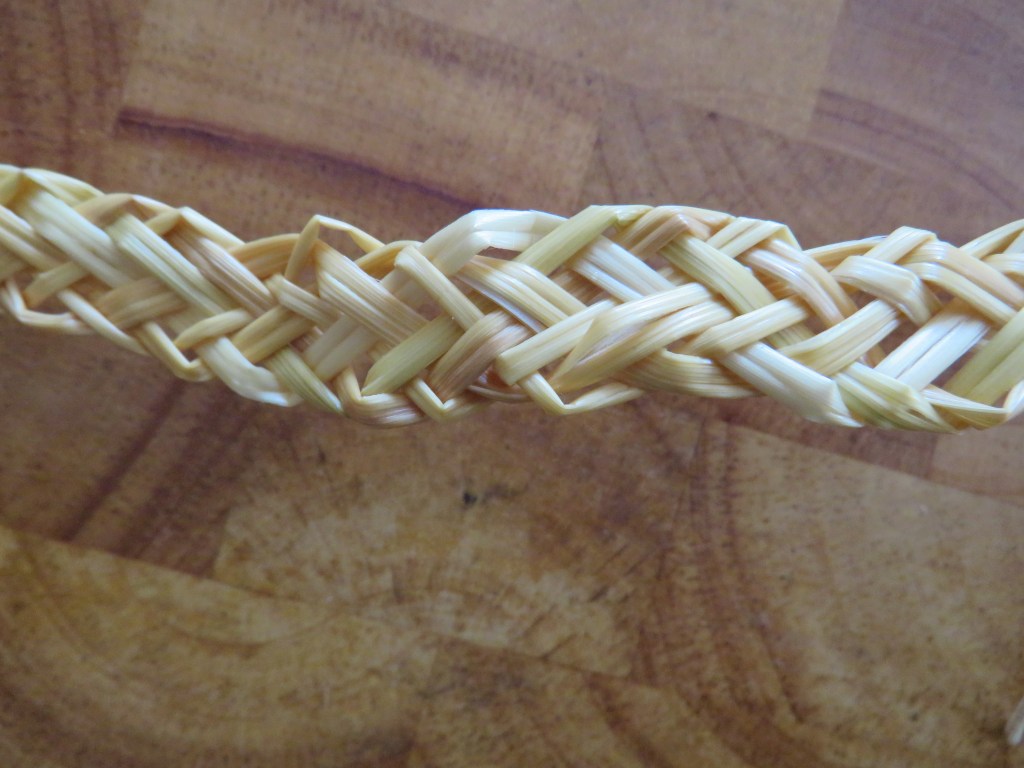
I chose seven straws, tied the ends together with yarn and began to plait. The approved method of using my thumbs and middle fingers to plait and my forefingers to turn splits, or in my case, straws, sounded rather like patting one’s head and rubbing ones stomach but I started slowly. I began by laying the straw on a flat surface, as I had with the string. This went well until I reached the end of the straws; all seven ran out at the same time. I made a terrible mess of trying to join in new straws. With hindsight maybe I should have started with straws of different lengths. As I progressed joining new straws became a little easier, as only one or two needed replacing at the same time. I gradually progress from the table to holding the straws in my hands but had to recite the ‘over one under two’ rhyme to keep me in rhythm. After an hour of plaiting, I had produced thirty inches of plait. The literature is contradictory about likely output but opinions ranged from ten to twenty-seven yards per day; I clearly had a long way to go.
My next plaiting session, I tried a different method of joining on new straws, slotting the hollow end of the new straw over the narrow end of the previous one. This wasn’t always successful as sometimes the end of the new straw split but it was an improvement. I was finding the straw more difficult to manage and realised I had forgotten the milling stage. This resulted in a much less neat plait but did mean I had preserved the hollow ends, thus enabling me to join straws using these. I resolved in future to mill but not to continue this to the very end, so that I could still slide one straw over another and avoid so many loose ends. Still chanting the rhyme, I achieved a similar output to the previous session.
By the third attempt, I was getting quicker but certainly not neater. After an hour and a half I had another ninety inches of plait. I had expected to find working the straw rough to the touch but this wasn’t the case. Keeping the straw wet meant that my fingers were continually damp and having plaited for longer, my right arm and shoulder were aching. By now, visions of plaiting were appearing before my eyes when I closed them.
Fortuitously, at this point, BBC2 re-screened a programme about the Luton hat trade. This revealed several useful pieces of information. Firstly, I had been using my straw splitter incorrectly. I was trying to score the straw with the point but it seems that the point needed to be inserted in the end of a straw and pulled down. I tried this technique but the results were little better than those achieved using my method. Alarmingly, I learned that 4000 straws were required to make a hat. I am glad I didn’t know this beforehand as I would not have contemplated investing £240 on straw. More encouragingly, the narrator went on to say that nine yards of plait could make a hat. I already had nearly five yards having used about fifty straws so something wasn’t computing here.
By day four I was getting both fast and neater, achieving 1·5 yards in twenty minutes. Joining in new straws was still not very tidy but in general, the finished plait looked less messy than my first attempts, partly because I wasn’t plaiting to the thinnest end of the straws. I still wasn’t able to use my fingers in the approved manner. The discomfort in my right arm and shoulder continued and I still needed to recite the rhyme as I plaited but it was definitely becoming more instinctive. I did try putting the straws in my mouth, as Victorian plaiters would have done but I failed to see how the whole straw could be kept damp in this way.
At this point, I was excited to discover that great great granny, at the age of twelve, had won a prize for her plaiting. I am not sure those particular skills have passed to me. I began writing the final assignment, concentrating on describing the craft and telling the story.
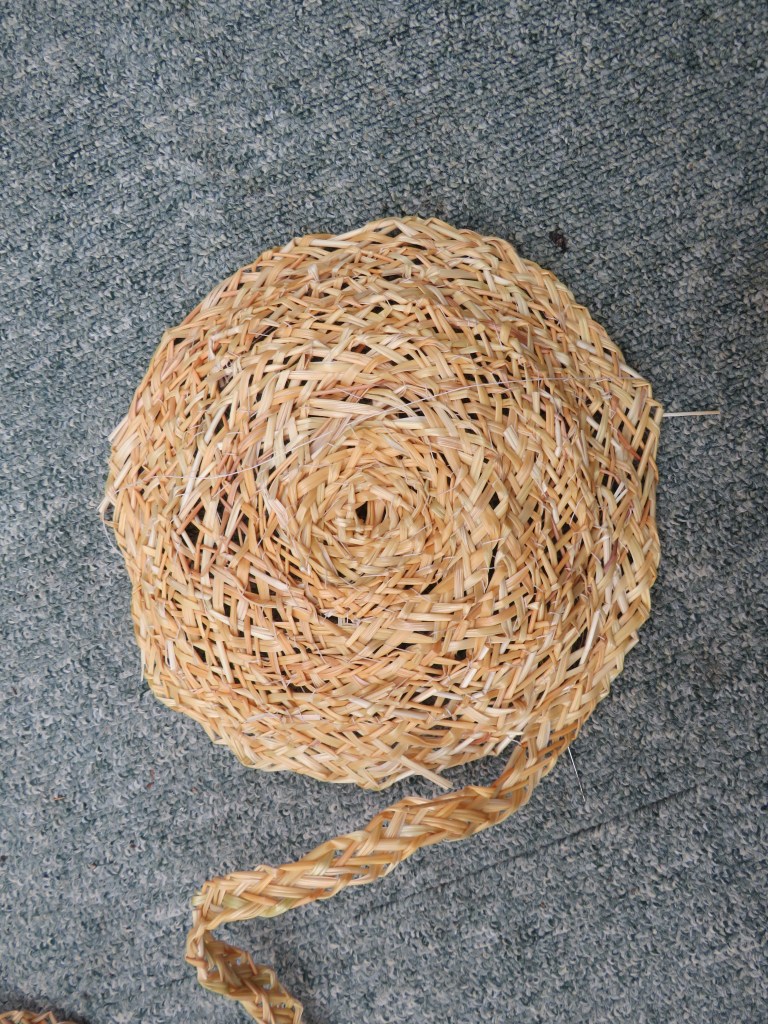
Three more plaiting sessions and I thought I might have enough to make a hat. I started in the centre and began to pull the braid into a spiral, working in an anti-clockwise direction; this may be because I am naturally left-handed. This was a more uncomfortable process, with the rough straw scraping at the skin on the backs of my fingers. It was also difficult to keep the plait damp. I decided not to overlap the braid in the English fashion as that would require more plait. I didn’t really have much idea how to create a hat shape and wondered if I would end up with a flat circle. Professional hat-makers would have used a head-shaped block and steamed the straw into shape. I didn’t have the wherewithal to do this. In the end the shape evolved of its own accord as I continued to sew. I was concerned that it might be difficult to finish off the ends but this was relatively simple as the ends of unplaited straw could be tucked into the weave.
The finished object resembled a pudding basin or lampshade, rather than a hat and certainly wasn’t neat and stylish. The underside of the straw is very scratchy, making it uncomfortable to wear. I did try tying it on as an alternative way to wear it.
Whilst I was pleased to have created a finished product, I was a little disappointed not to have made something that I could actually wear in public, even if only when I am living in the seventeenth century. I am not a natural crafts-person and I am also a perfectionist. What I produced was far from perfect but I enjoyed the process. The repetitive action of the plaiting was therapeutic but I certainly wouldn’t want to spend my working life as a plaiter of straw. I particularly valued the chance to step into my ancestor’s shoes and feel an even closer connection to Ann as a result of this project. Highly recommended for all family historians. Would I try this again? My heart says yes but my head knows that there isn’t room in my life to pursue craft activities with much rigor. I can see myself demonstrating the plaiting technique if the occasion arises. I have revisited my research into Ann’s family, with particular emphasis on the social context and the role that straw-plaiting played in the community and her life; I feel that I can now do so with greater insight. Watch this space for a post about Ann.
The course has been a great experience. I have learned a great deal about experimental archaeology and still more about material culture. I have climbed some technological hills and crafting mountains. I have met some hugely talented, diverse fellow students and we plan to keep in touch. So what next? There are plans. It may be that there will be an online MA on offer, which is tempting, further study does appeal. I am however mindful of how many things I still want to achieve and maybe I need to start prioritising as tempus is fugitting away like mad (it is still May isn’t it?). There is an exciting potential project in the offing with my coven lovely group of ladies. I have a non-fiction book to finish writing. I really want to focus on telling more stories from my own family history and as a result of this course, focussing on some of the family heirlooms and telling their stories before they are lost. I do still hanker after learning Cornish, remember I got as far as buying the books in lockdown?








 The History Interpreter - Janet Few