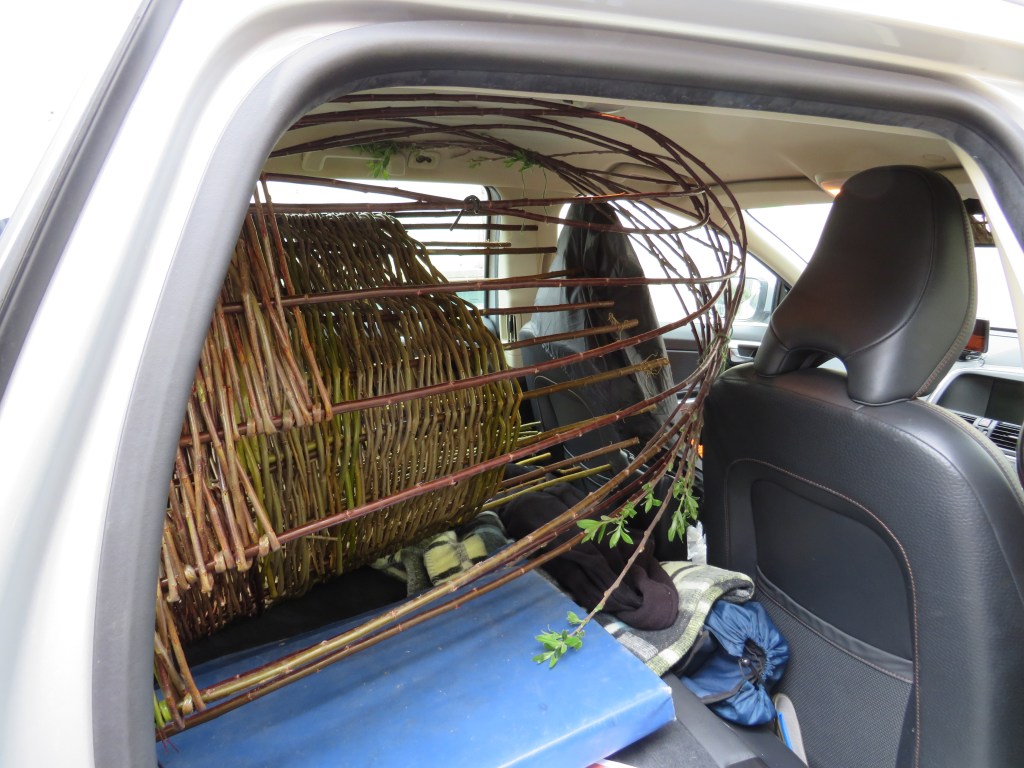
Stripping the Willow – or How Much can you Fit in the Boot of a Volvo?

I am not sure if this should have been one of my experimental archaeology posts. It certainly qualified as an experiment! We headed round the many roundabouts to the Weald and Downland Museum (home of the Repair Shop) for a living willow chair making workshop. There was some confusion over the start time, with the tickets saying 9.30am and the email sent earlier in the week saying 10am ‘but please arrive fifteen minutes early’. We went for arriving at 9.25am – late by my standards. It turned out that it was supposed to be 9.30am but we were the only ones who didn’t think it was 10am, so there was a bit of a delay. We helped with the setting up and I got the initiative test that was assembling the stand to be used as a base to assemble the chair. That achieved, we waited for the others to arrive. A word about the toilet, which randomly had a floor length window. Ok, so it was frosted glass but still a bit disconcerting.

Lead by Ganesh Kings of Creative Willow, eight of us began our weaving. This was physically a little less demanding than the boat riveting of last December but still quite hard on the thumbs and arms. Apparently, there are a whopping 328 species of willow grown in Britain and we had several to choose from of different thicknesses and colours. There is a folkloric aspect to how some of the varieties acquired their names, such as Dicky Meadows Green and. We wove away. I instinctively worked lefthandedly. It seems not all my natural left-handedness has been eroded by a combination of an infants’ school who thought it was a sign of moral weakness and a badly broken left wrist in my teens. My brain still thinks I am lefthanded.

My chair wasn’t the neatest in the world but I was proud of it. I was concerned that spending all day inside would make it difficult to keep up my step count but no. I clocked up six miles walking round and round my chair, weaving as I went. Next came the challenge of getting not one but two completed chairs in the car. It is a Volvo XC60. If like me, your knowledge of makes of car is limited to ‘it has four wheels’, that’s a pretty big car. Back seats down, a bit of pushing and shoving and by agreeing to sit with our knees under our chins, the chairs were in. Sort of. We chopped a bit off a few legs (the chairs’ legs, not our own). In many cars this would have been sufficient. You’d slam the boot lid and the contents would have squished up satisfactorily. Unfortunately, the fisherman of my acquaintance has a relatively posh car with a self-close boot that you can’t override. The boot lid descends automatically. It senses a minute particle in the way and it rises again. Mission eventually accomplished, we realised that it would not be practical to drive round sightseeing with a car full of chairs the following day, so we decided to return home a day early.

The ordeal was not yet over. The chairs had to be planted. Each one has nineteen ‘legs’, fourteen of which will hopefully grow. Not a lot of choice of planting position in my teeny tiny garden and the soil is rock hard. The emphasis is on rock, as much of the garden is a spoil tip from when the chapel next door was rebuilt. Add to that substantial cherry tree roots and creating the required ‘donut’ shapes for two sets of chair legs was a challenge. We had to cut more off the legs than was probably wise but the chairs were finally in situ. Let’s just say, no murderers could dispose of a dead body in my garden without considerable effort.

There was a bit of an elephant in the room as we wove our chairs. Chairs, by definition, are for sitting on. These chairs are hollow structure and have no seats. It seems that the solution is to fill the space with earth and grow a grassy seat. This requires more spare earth than I have, so no sitting on the chairs yet but they look impressive. I also have to decide how I want to arrange the living trees, which can be tied to form a bower if I wish. It will be interesting to see how they grow.

The downside of the workshop was that I was only able to catch up with a few of the amazing History for Ukraine talks, contributed by many of my friends and colleagues over the weekend. What an incredible event organised by Natalie and her team; congratulations to all involved and to all those who helped to raise such a stupendous total. I really hope I get the chance to participate in some satellite events in the future.

Sunny Sussex

I am spending a few days in Sussex, which is indeed sunny. Yesterday, we arrived in time to take a look at the RSPB reserve at Pagham Harbour. This was a pleasant walk with views out towards the sea. The website warned us that the visitors’ centre and toilets would be closed due to staff sickness. Fortunately, only half of this was true.

Today, we headed off to the seventeenth century National Trust property Uppark, the home of the Meade-Featherstonehaugh family. This part of Sussex seems to be overburdened with roundabouts and Sally the Sat-nav was feeling sluggish today, which made exiting said roundabouts in the correct place somewhat tricky but we arrived without too much of a diversion. More Covid related staff shortages meant that only the ground floor of the house was open but there was plenty to see including some incredibly finely worked tapestries, with the tiniest stitches imaginable. Uppark suffered a serious fire in 1989 and had to be extensively restored but there still seemed to be original furniture on view.. We wandered round the grounds and were in time to enjoy the daffodils. Historic plans are being used to restore the garden’s pathways to the original designs by Humphry Repton.

In the afternoon, we explored Bersted Brook Nature Reserve, next to the caravan site. It was a tad underwhelming but it was an opportunity to walk away from the road and the blackthorn blossom was spectacular. We even managed to acquire something for tea from a nearby supermarket, which save us from the decidedly dubious ‘pleasure’ of resorting to one of the numerous local take-away chains.

Family History in Springtime and a Decorating Debacle

It is Women’s History month. I really should be getting on with granny’s biography but that seems to have slipped to the bottom of the very long to do list. I was chuffed to see that The National Archives were recommending my book Remember Then for Women’s History week. There are still copies hiding under the spare bed of a fisherman of my acquaintance, if you’d like you cross my palm with silver. I have no idea why it is on sale on Amazon for £19.90. You can get it from me for the proper price of £12.95, just get in touch. In anticipation of a visit to the area where they originated, I have taken a look at granny’s deeper ancestry. I even managed to find a couple of new 5th and 6th x great grandparents but the mystery of which of two Johns is my 4x great grandfather remains. Fortunately, the Johns are first cousins, so, after what I call a wiring diagram, indicating the either/or, the line can be continued back to the sixteenth century.

Having decided, reluctantly, not to go to Ireland this month, in theory my diary should have been clear. Explain to me then how I have had something on, on thirteen evenings out of the last fifteen. It would have been fourteen but one was cancelled. On the strength of a nominally ‘free’ month. I decided it was time to decorate the hall and landing. The above-mentioned fisherman offered to do the death-defying balancing ladders on the stairs stuff. I was a bit reluctant to agree to this but was persuaded. Fortunately, that part was accomplished without incident. I couldn’t watch. The idea was that I would do most of the rest but in the end my role was limited to affixing miles of masking tape round door frames. This wasn’t as easy as it sounds as the reel of tape had been lying around for a while and peeled off the roll in three inch lengths. After a couple of hours I had completed the task. Halls and landing have so many doors. I sat down to some computer work, smugly content that the job was done. Leaving the room shortly afterwards, I was dismayed to see streamers of masking tape dangling from every point. A new reel of tape was purchased and I did it all again. I should say that my hall and landing could not be smaller. The hall is three foot square and the landing is a narrow corridor. There is nothing in the space. How then, has this decorating endeavour meant that there is evidence of its undertaking in every other room?

I still have a mile long playlist of Rootstech sessions to watch. In the meantime, on the horizon, there are three other key events to highlight. In chronological order:- Do check out the Historians for Ukraine event on 26 and 27 March.  I had hoped to be involved in this but I will be in a field and I don’t know how reliable my internet will be, so I will be cheering from the sidelines and hope to take part in a spin off event. An event that I am actively involved in is a Free 24 Hour Genealogy Marathon, run by Legacy on 7 and 8 April. You can register for that here.

Then on 7 May is the Youth Genealogy Conference. I get a sneak peak at the speakers’ submissions and I’ve been excited by the response. This is going to be a great day, with some thought provoking and interesting talks from some knowledgeable younger presenters. Don’t worry, I will make sure everyone knows how to attend. There is no age limit on the audience!

The website creation for the Braund family continues. I was advised that there were accessibility issues. For example, not all of the many images had alternative text, which is necessary to enable those with a screen reader to know what is in them. A bit of poking about in the bowels of Wix and I discovered a button to press to identify accessibility problems on the site. Button duly pressed, the whole site ground to a halt. After this had happened several times, I started going through the images individually and checking that they had alternate text. I tried the button again and 99 issues remained. It seems that we had had so many issues that we’d broken the system. All sorted now on the accessibility front, so it is back to the exciting job of continuing to add content.

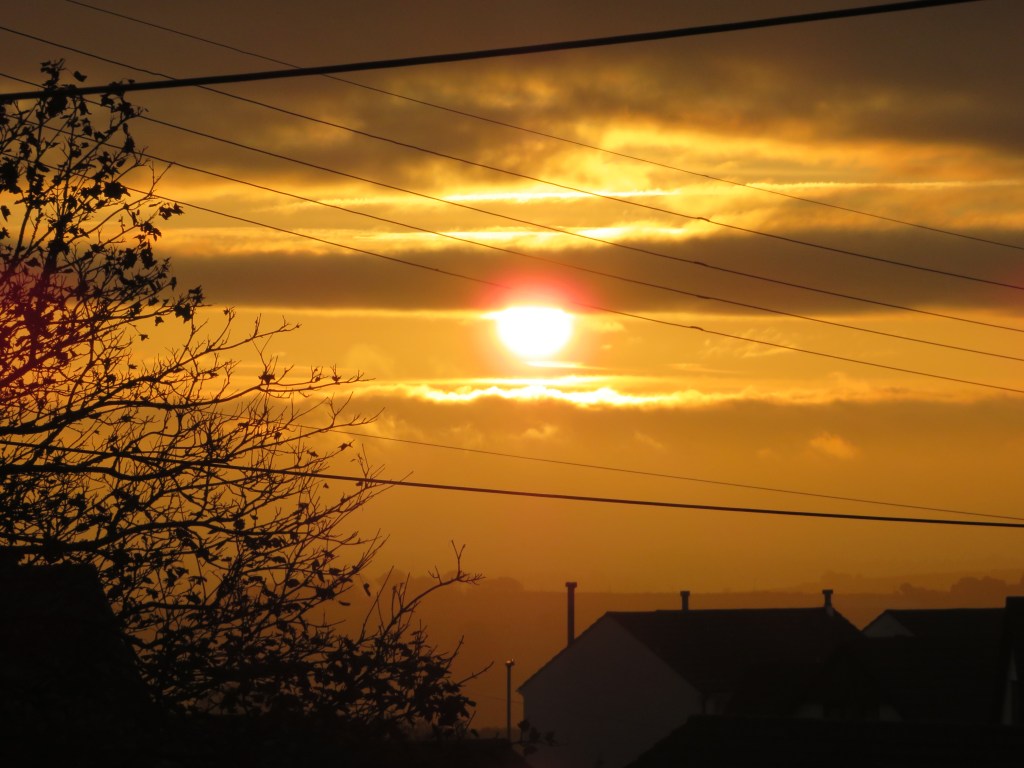
To accentuate the positive, in my hemisphere there are wonderful signs of spring in the air. I am writing this at 5.30 am, watching the sky lighten and it is warm enough to open the window and listen to the symphony that is the birds’ wake up call.

Sunrise

Rootstech Roundup

Well, one week on and I really thought it was time for a RootsTech round up. I have to say that I haven’t yet had time to sample many sessions. That’s the advantage of knowing that these will still be there for me to watch gradually over the coming months. It does also mean that I have been a little lazy about working my way through my playlist. I must admit that, with 1222 presenters, many offering multiple sessions, navigating my way to what might interest or intrigue me is a bit of a challenge. I tend to rely on the recommendations of others and looking for speakers that I know, first of all. Next, I look at topics of interest and I did find it a little difficult to locate these. Finally, I always try to add something that is out of my comfort zone and/or by speakers I don’t know. I’ll be honest I usually avoid the keynote sessions, although I know others enjoy these. This year there was an international line-up but in the absence of anyone I’d heard of, I have given these a miss so far.

I started off very early on the Friday morning, joining in with Michelle Patient and Fiona Brooker of Talking Family History, who were solving brick walls. This was really enjoyable and Fiona and Michelle coped admirably with some technological challenges and the absence of their third panellist due to illness.

I had one other live session high on my list of must watches and that was the discussion led by Lynn Broderick and Jill Ball on ‘Dealing with Ethical Dilemmas in an Online World’. This should be essential watching for all family historians who engage online. Sadly, a prior commitment meant that I couldn’t listen live and it took a few days for it to become available. I was particularly pleased to hear Jill’s opening tribute to the indigenous settlers of their lands and their contribution to the history of the past. Lynn and Jill had assembled an all-star panel to tackle some crucial issues, each of which really deserved a whole session on its own. It was great to have Daniel of The Hidden Branch as part of the team. Again, there were some minor technical gremlins as the presenters tried to share their polls but these did not distract from the discussion. As a viewer of the recording, we couldn’t see the questions, maybe something that presenters should be warned of in advance so they can include a slide with the questions. A shame too that there was no access to the chat after time.

Judy Russell’s contribution to this panel on copyright is also something that many people in the genealogy community need to hear. It is alarming but sadly unsurprising, how many people aren’t adhering to the ethical or even the legal issues in this regard. Just because we can, does not mean we should. Equally unsurprising and worrying was the level of ignorance about which DNA companies use their database for law-enforcement purposes.

For some light relief, I listened to Caroline Gurney on the folk traditions of Maypole and Morris dancing. Next up was ‘Around the World with the 1921 Census’ with Jen Baldwin; great to hear one-place studies getting a mention. An excellent case-study session was Michelle Patient’s ‘Finding Frank’. I have so many more sessions to work through; I’ll comment on these when I get to them. Oh, and I am having great fun with Relatives at Rootstech – of which more another time.

It has also been great to to get positive feedback on my own sessions, which you can find here.