All Things Mayflower

Saturday was the all-day Mayflower 400 International conference. The eagle-eyed mathematicians amongst you will note that it is in fact 401 years since the Mayflower sailed in 1620. The conference was originally scheduled for last year and was to be a live event. It was delayed by a year and finally converted to an online format. This meant that there were attendees from across the globe, many of them watching at hours when most self-respecting folk were asleep.

After a very interesting and relevant introduction from Charlie Courtenay, Earl of Devon, Master Christopher and Mistress Agnes chatted about their lives in Devon in the fifty years since the Mayflower sailed. For various logistical reasons we had pre-recorded this, amidst a certain amount of issues, such as very loud, large tractors driving past, or the phone ringing at inopportune moments. Cue take 3, or 4, or 10.

After us, Cor de Graaf gave the Leiden perspective. I am so in awe of people who can present in a second language. After some friendly lunchtime chat, that is characteristic of Devon Family History Society meetings, Phil Revell told the story of the More children from Shropshire, who were dispatched across the Atlantic on the Mayflower, having been taken from their mother.

This was followed by Debbie Kennett, explaining the uses of genetic genealogy. Then a thought-provoking session from UK based, American TV journalist, Jim Boulden. He was analysing why lineage societies, such as that for Mayflower descendants, are so popular in the US.

Jo Loosemore told us about the problems of curating the Mayflower Exhibition at The Box in Plymouth, during a pandemic. Hearing about the ethos behind the exhibition, which incorporated heavy involvement from the Wampanoag, was fascinating. Unfortunately, now the day was virtual and therefore extended into the evening, I didn’t get to stay for Nick Barrett’s closing session, a real shame as Nick is always an excellent speaker.

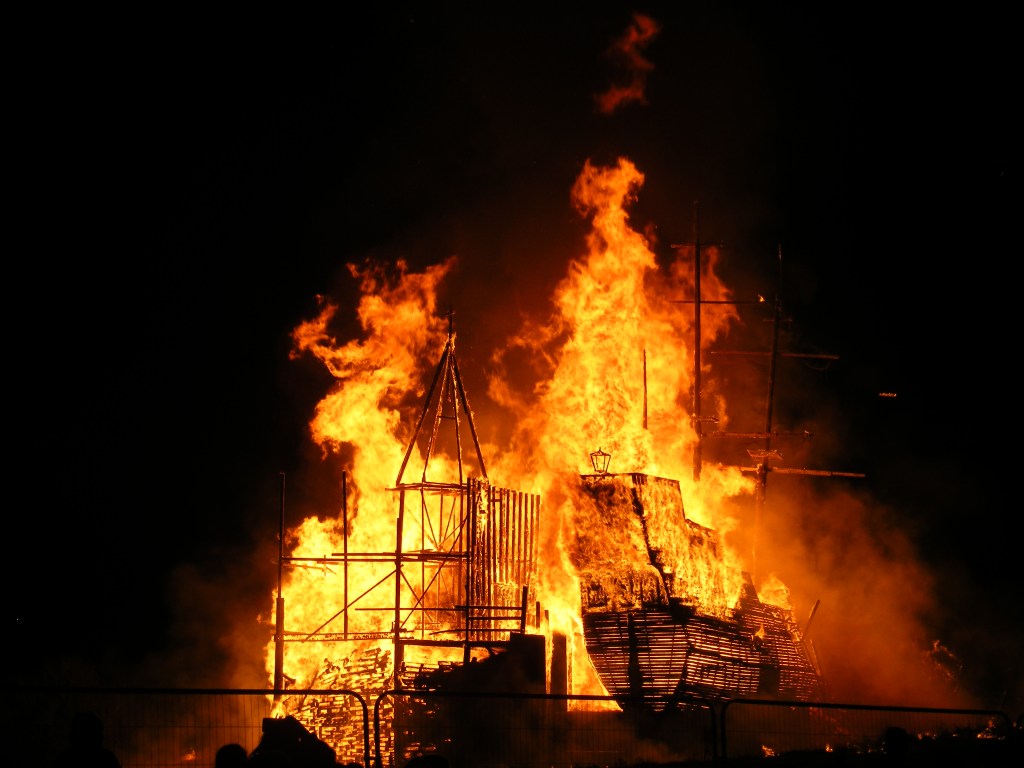
Two years ago, I purchased tickets for the Torrington Bonfire. If you are thinking, pile of sticks, add a match, you couldn’t be further from the truth. I have been to three previous bonfires and these are truly spectacular events. They are organised by Torrington Cavaliers who spend two or three years building elaborate constructions, which are then burned, raising thousands of pounds for charity. Previous models have included the Victory, a Medieval castle, Trumpton and London’s Pudding Lane. So convincing was this last construction that a local estate agent was approached by someone trying to purchase one of the new houses that were being built on the common. This time, in another delayed event, it was the Mayflower that was to be consigned to the flames. The first thing of note was that this was a full-scale model and it really brought home just how small the Mayflower was and how hazardous that transatlantic journey would have been.

I am now going to get a bit ranty, so you may want to stop reading here. First, some context. In the past week Devon and Cornwall have been declared an area requiring enhanced response measures, due to levels of COVID that are twice the national average. In my immediate area, nearly half of all recorded COVID cases have been in the past month. Our major hospitals are on red alert. Although nothing is mandatory, extra caution, including continued mask-wearing, reducing social contact and regular self-testing is being advised. I have been doing all this as a matter of course anyway.

We debated whether it was sensible to attend a large scale event (the actual attendance was 9000). This would be the first time in eighteen months that I had intentionally put myself in a situation where there would be more than half a dozen people together. We reasoned that it was outside and we could remain on the outskirts, or even come home if we wanted to. We also decided to miss much of the preliminary activity and go later than we otherwise might have. Stupidly, we also thought that the recently announced need for particular caution might mean that people would be more considerate. Naturally, we resolved to wear masks.

We did indeed station ourselves on the periphery, in a place where we could see many of the other 9000 or so attendees passing by. We were several metres from anyone else until the very end when a raucous, large family pushed in front of us, despite there being plenty of space elsewhere. I passed the time waiting for the fireworks people watching and then with incredulity, counting the mask wearers. You might expect older people at least to be more cautious (nope – not one person who appeared to be over fifty, apart from us, with a mask). The first aiders then, they’d need to wear masks, wouldn’t they? No again, one out of the four that I saw. Out of 9000 people, of whom I estimate I saw well over 2000, sixteen, just sixteen were wearing masks, most of them children. I know we were outside but closer to the centre of activity, people were crammed in. Then, in what I thought was the height of irresponsibility, one of the live bands encouraged the audience to sing along. Bear in mind that most of the non mask-wearing audience were shoulder to shoulder with strangers.

I know I am over cautious, I know people are desperate for things to be ‘normal’ but I was shocked at the total lack of awareness and concern. I also know that mask wearing isn’t pleasant. It was the first time I had worn mine outside for several hours and as the night grew colder, I was either viewing the spectacular fireworks through a fog or wiping my glasses every ten seconds. No it wasn’t pleasant, yes it was a pain but I did it and willingly. Not only because I want to reduce my risk of being seriously ill, requiring hospitalisation or dying but I also want to reduce risks for others. I too want to go back to ‘normal’. I want going out to be safer for those with vulnerable, as yet unvaccinated, children and my immune-compromised friends for whom vaccines are unlikely to be effective and for whom COVID would be extremely damaging or fatal. I guess others who feel like me chose to stay away from Saturday’s event and attending was certainly out of character with my behaviour over the past eighteen months. I am still not sure if I regret going. I felt that for the most part, we minimised risk but it shouldn’t just have been up to us. This is a community issue and everyone should be playing their part. Vaccination helps but is not immunity. Outside helps but is no guarantee that infection won’t spread. Take care of yourselves people, take care of each other. So, a great event; the fireworks were particularly impressive, shame about the audience. I am sure if each one of those people was asked what they would do to save the lives of their children, grandparents, loved-ones, they’d say ‘anything’. We are not being asked to donate our kidneys, to do ‘anything’, we are being asked to be careful, considerate, human. I am not ‘living in fear’ or being dictated to, I am making informed personal choices and taking reasonable precautions to keep myself safe, in the same way that I wear a seatbelt, or exercise and eat reasonably sensibly. I can’t understand the thinking behind the behaviour I witnessed on Saturday night. I can only assume they think the risk is minimal that the odds are ‘it won’t happen to me’. I hope for their sakes their gamble with those odds pays off.

The Experimental Archaeology Adventure Part 1: the adventure begins

I am not sure which is more experimental, the archaeology or the adventure. Before I wrote Barefoot on the Cobbles it was a toss up between writing a novel and doing an experimental archaeology course and back in 2016, I opted for the former, which was at least cheaper! Two novels on and I was all set to begin novel number three. I had an idea (I still do) but it just wasn’t working. Time, thinks I, to put it to one side and return to the experimental archaeology course idea. This may well ensure that the creative novel three juices begin to reflow any time about now. Of course, in the intervening five years the world has changed. Despite all the awfulness, I now had more scope because there were courses that I could attend virtually. I looked for possibilities and came up with what seemed to be just what I wanted, at University College, Dublin. To be honest the course details were sketchy in the extreme but it specifically mentioned that it was suitable for historical interpreters, so I decided to take the plunge.

The first hurdle was circumnavigating the online applications process. Not hugely difficult but I needed an academic reference at a time when all universities were effectively closed. I also needed it quickly as it seemed that it was pretty much a ‘first come first served’ for suitable applicants. Not only was it the Easter vacation but everyone was working from home. It was also more than ten years on from my PhD, would anyone remember who I was? After a few phone calls and emails, I finally secured a reference that implied that I might be capable of Postgraduate level study.

Shortly after, I was given a place and began to wonder quite what I had let myself in for; it was still all a bit of a mystery. There were a couple of introductory Zooms over the summer. I ‘met’ the professor responsible for the course and he seemed to be my sort of person. I lurched between excitement, sheer terror and putting it to the back of my mind.

Then, this week, it all began to take off. I had several generic emails telling me how to stay safe on campus and explaining about all the great activities that I could take part in, or of course, not, in my case. It was time to formally register. This was mostly straightforward but I needed the dreaded passport photo. This came with all the usual, plain background, don’t wear a hat, don’t look sideways, don’t have your hair in front of your face and worst of all, don’t have a reflection in your glasses, instructions. I didn’t have anything remotely suitable but fortunately Martha was on hand to produce something that, for a passport type photo of someone who is 100% not photogenic, actually looked half decent. I tried to upload it. Error message. ‘Your photo must be less than 50KB. Hmmm that is really pretty small. I tried taking a screen shot of the 2.5MB photo. Ah, that was considerably smaller but still 62KB. The registration paged offered the option of an online photo size reducing thingy. Now I looked like something out of a hall of mirrors. A few more attempts and success. Now I am waiting to see if it meets with approval; it had better, as this is as good as it gets. Next, I have to decide if I want to give my parents access to my academic record. I am tempted to say yes but decide that might be tricky as they’ve been dead for 56 and 10 years.

Finally, I get a summary of the three modules that make up the course. Now I am really excited. Fortunately, they look brilliant, especially ‘Crafts, Making and Storytelling’, which comes in the summer trimester (or term as we English say – trimester sounds like I am pregnant). I also have a shiny new academic email address to add to the many that I already have. I wonder if we get to keep it post course. I have now had academic email addresses in two different countries, which is weirdly thrilling.

No book list yet, which will be the next excitement. In anticipation of needing extra shelf space and cash to purchase the new books, Martha has been helping me with a book cull. If anyone wants some heraldry books at bargain prices please get in touch.#

I may be a bit stuck for pictures for this series of posts but here I am being vaguely experimental. No, no idea why it looks like I am praying.

About Family and Family History

I know, I know, I’ve been worryingly silent lately. I think this is my longest ever gap between blogs. You only have to read my previous post to know that I haven’t been sitting around doing nothing. Firstly the family have been visiting. This involves excavating the house from under its protective layer of dust, although I suspect the visitors think I could have done a better job. It also means that I’ve been cautiously out and about digging sandcastles, blowing bubbles, reading stories and other fun things.

The family history continues of course. This month, I have managed to have items in both leading UK family history magazines. My discussion on why our ancestors might have been embarrassing is in the latest issue of Family Tree Magazine and there is a short item about agricultural labourers as part of a feature about genealogy education in Who Do You Think You Are?.

One Pharos course (In Sickness and in Death: researching the ill-health and death of your ancestors) draws to a close and another, First Steps to a One-place Study, begins. I am also checking through Are you Sitting Comfortably: writing and telling your family history ready for October and working on a beginners’ course for Devon Family HIstory Society. There are talks to three countries on the horizon, I’ve done some more brick wall demolition and chatted all thing one-place for an upcoming Family History Federation podcast.

I am still working with my lovely memories group, which is really just chatting with friends. I have got to the end of 1973 in my hugely embarrassing diary read. Another ten years and it might start to get better!

If you’ve been following my ramblings for a while you will know that I am passionate about involving young people in their history and heritage. It is something that I have written about and give talks on. Finally, in no small part due to the wonderful folk at Hidden Branch, there is a real enthusiasm for moving forward in this area. Family history societies need to embrace this if they are to have a future. Down here in Devon we are looking for someone (or several someones) with Devon heritage, or a Devon address, in the 18-25 age range to help us to take our society forward in this respect. If that’s you, or if you know someone, please get in touch. It is no good a load of old people trying to decide what they think younger people want.

Following on from the great loft sort out, I’ve embarked on a bit of a book cull. This may sound like sacrilege but when you have a house as small as mine, it is hard to justify keeping books that you haven’t opened since the 1970s. This week on Twitter someone pointed out that 1980 (which as we all know must be about ten years ago surely) is the same distance from 1939 as it is from 2021 – noooooooo.

We are off on another mini jaunt soon, this time heading east to Norfolk. Time of course to revisit the Norfolk ancestry so I can plan the obligatory churchyard tour. There are images of parish registers online now, which weren’t available last time I worked on this branch and ooh look there are a few new ancestors to be discovered. Currently, I am wrestling with some Norwich woolcombers and Great Yarmouth shopkeepers and trying to negotiate my way past an ancestor who was not baptised and came from a non-will writing family who never appear in the newspapers. The use of more unusual forenames means that I am pretty sure who his parents are but evidence, there’s another thing.

The excitement is building prior to the start of my postgraduate certificate course but I have decided to chart my progress through that in a series of separate posts, so watch this space.