Young Genealogists: what can YOU do to nurture the next generation of family historians?

Well, this isn’t the blog post that I was going to write. I was going to tell you about my second day at THE Genealogy Show and in part I still will but this needs saying and it needs saying now. At the show, I listened to Daniel’s presentation Genealogy from a Young Genealogist’s Perspective. In the second half, he challenges older family historians to make life easier for young genealogists, who have a number of barriers to participation. Not least of these is the attitude of some of those of more mature years in the genealogy community. Engaging younger family historians is something I have been advocating since I was just a few years older than Daniel and that’s quite a long time!

Family History and Local History is perceived as a hobby for the older generation. When I attended my first meeting in 1982, I was the youngest person there, probably by about thirty years. Sadly, here we are, forty years later and I am STILL in the younger 25% of attendees. There are certainly younger genealogists out there but family history societies have singularly failed to engage the under 40s, let alone the under 20s. Family historians are constantly bemoaning the fact that their children/grandchildren are not interested in their family history. Here is a revelation. In most cases, what family history societies and individuals have been doing to encourage younger people hasn’t worked up to now. If we carry on doing the same thing, guess what, it isn’t magically going to become engaging and relevant to younger people. Nothing is going to happen except that older family historians will die off, no one will be interested in taking over their research and it will become increasingly difficult to recruit members and officers to societies.

If we value our hobby and our own research, we have to be pro-active in order to broaden its appeal down the age range. We need to be inclusive and work to break down some of those barriers. It is our job to reach out, not the young genealogists’ task to scale those obstacles. Younger genealogists need a safe, affordable place to interact and to pursue OUR hobby, with acceptance and nurturing from more experienced genealogists. We need to understand that the GenZ genealogists (aged c.13-25) have a valuable contribution to make. They have knowledge and a thirst for more, they have energy, they have ideas. Family History Societies need to take advantage of this in a mutually beneficial relationship.

So what can you do, or what can you ask your society to do? How affordable is membership, could it be free for under 18s? The response, ‘We’ve never been asked for under 18s membership’, may be true but is not satisfactory. Free under 18 or student membership needs to be publicised loud and clear in a prominent place on the society website, perhaps with posters on display in places where young people are, or mentions in school and college newsletters. It is no good doing this until the society has something attractive to offer those young genealogists. Can you provide activities that would engage school and college goers? Could you stage events (virtual or in person), where entrance is dependent on bringing along someone under 25? Some societies have premises with access to the major data providers, can we welcome young people to take advantage of this? Not in a passive, ‘well we wouldn’t turn them away’ manner but by doing things to actively promote this in a safeguarding compliant way, at young person’s open day perhaps. Could each society seek out a young person’s advocate to join their committee, if only on an ad hoc/advisory basis? Needless to say that advocate has to be a young person.

So you have read this far and thought a) She is ranting again and b) I’m not on a committee what can I do? If you are a society member, you can make suggestions to your committee. If you are not associated with a society, you can still ensure that you make our hobby engaging and accessible to the young people around you, be that your family, youth groups, schools, or young people in your neighbourhood.

I have been saying this for so long. Young people are interested in family history, they are just not interested in doing it OUR WAY. It is up to US as individuals/societies/whatever to adapt and take our hobby to them where they are, not just carry on in the same old way and lament the absence of those young genealogist in our own milieu.

If you have the opportunity to listen to Daniel’s presentation, please do. It is worth the now reduced entrance fee to THE Genealogy Show on its own. Do something, or before long, your research, your society, our hobby, will be dust.

I had the pleasure of being interviewed by Daniel for his podcast last night but more of that another time. Do take a look at the activities of him and his Hidden Branch colleagues and let us ensure that the younger genealogists are no longer hidden.

429 1 Nov 2019
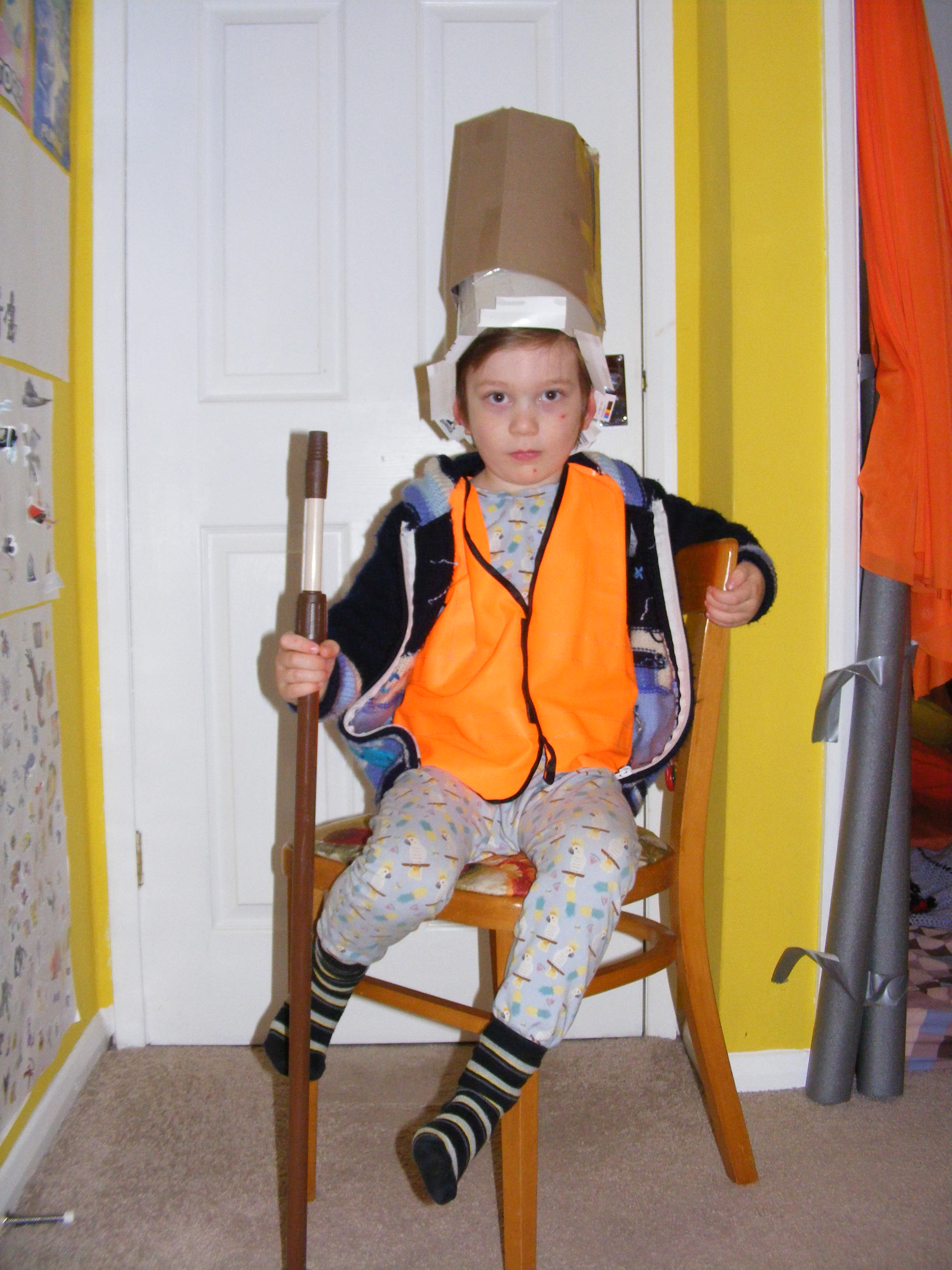
Posing as his 6 x great grandfather

This young man, now aged seven, is interested in his family history and is currently compiling a family history scrap book.

Family History Busyness – THE Genealogy Show Day 1 and other excitements

I’ve been bracing myself for a ridiculously busy couple of days. After virtually presenting in Kent and Norfolk yesterday, today was the first of two THE Genealogy Show days. Talks are being live streamed over 48 hours and my first went live at 4am my time. I was invited to listen to myself (always cringe making) and be on hand to answer questions, I decided to pass on that one. I only just missed the opportunity, so spent the early hours exploring the Show’s website and even manged to sneak in the chance to listen to three exciting young genealogists in a panel discussion about young people and genealogy. It is several decades since I was that young person and it is great to watch the baton passing on.

This was followed by my fortnightly chat with the lovely folk of Talking Family History. They are starting a new series in July, so now would be a good time to join in the fun. Then it was my turn to person the Society for One-Place Studies booth for THE Genealogy Show. Over lunch, I tuned in to Dr Sophie Kay’s Negative Spaces presentation; definitely worth a listen. Later, I had the chance to watch Andy Browning’s fascinating story Following in Family Footsteps.

Other recent feelgood family history moments. A photograph of my, now demolished, first teeny tiny infants’ school being posted on a Facebook Group, together with a picture of the headteacher, albeit about twenty years before my time. A few weeks ago, I was very excited to be offered the chance to acquire a one-name related long case clock. Even better, my nearest and dearest agreed that it could be a belated birthday present. The maker was from a different branch of the family to my own but it is still very special to have it safely ticking away in my living room. Finally, our local history group held its first hybrid meeting, with the speaker and five others in the meeting room and others Zooming in from as far afield as New Zealand and Canada. We still need to work to improve the sound quality but we are proud that a small society such as ours has been able to take a first step towards making our meetings accessible to those who are not comfortable with technology as well as our friends who are too far away to attend in person.

Tomorrow more busyness, more family history talks to give and listen to and an interview with Daniel’s Genealogy in the evening.

Operation Toy Excavation

What else do you do on a summer Saturday but excavate the historic doll/stuffed toy collection from under the dust of ages and I do mean ages. I am not sure that the stuffed toys have had the dust bashed out of them for decades.

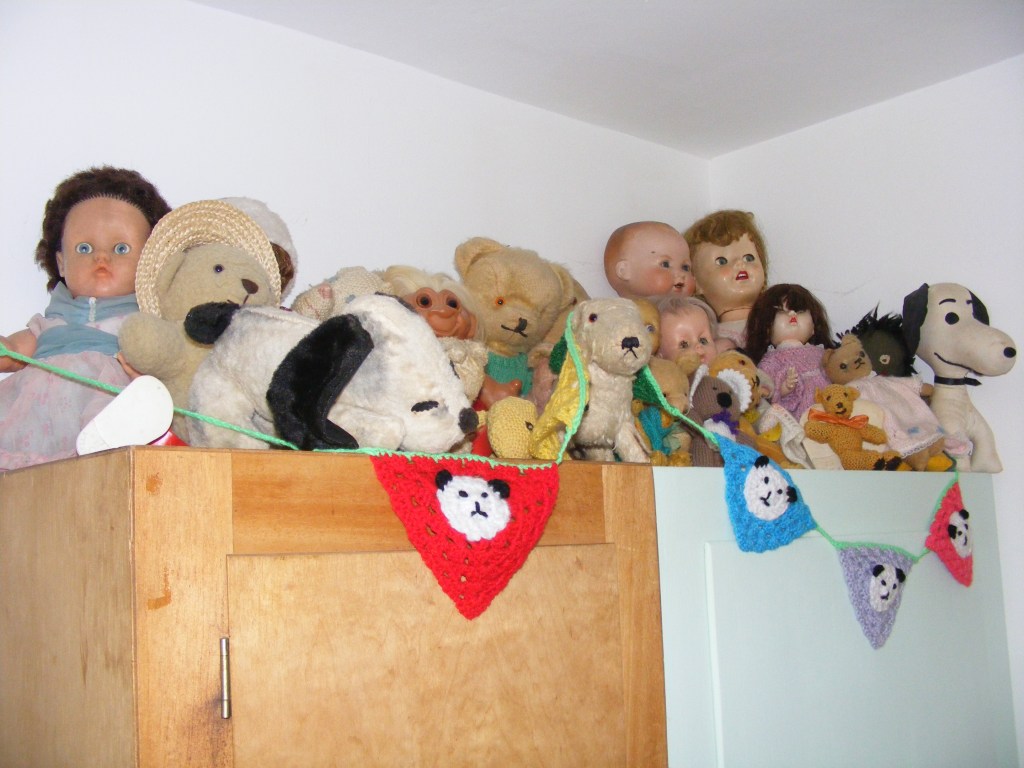
Meet the motley crew, some of who are almost centenarians.

They were removed from their cupboard-top home, stripped naked, apart from the two that my mother appeared to have sewn into their clothes and readied for the major operation.

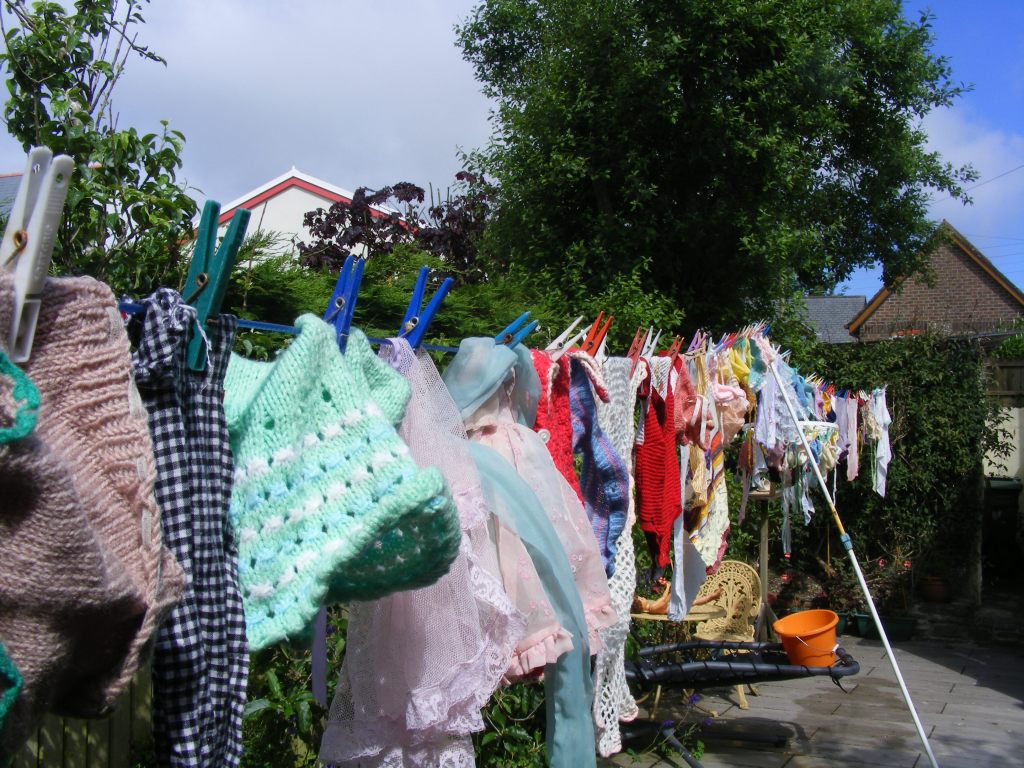
Next, to wash the clothes, some of which needed hand washing. It might be a while since they were last washed but I know from bitter experience these are old fabrics that are far from colour fast. Sadly, since they were last laundered, it seemed that the moth had made a meal of some of the woollen items, lovingly knitted by three generations.

The shoes were scrubbed and left to drain.

Then bath time. I don’t have a real bath (I have what is officially the smallest bathroom in the world – seventeenth century cottages not being too hot on bathrooms, so I replaced the bath with a shower). No bath means no bubble bath, so I substituted washing up liquid. It turned out that I also had to use a rather rough washing up sponge to scrap the dust from grubby limbs and faces – sorry dollies.

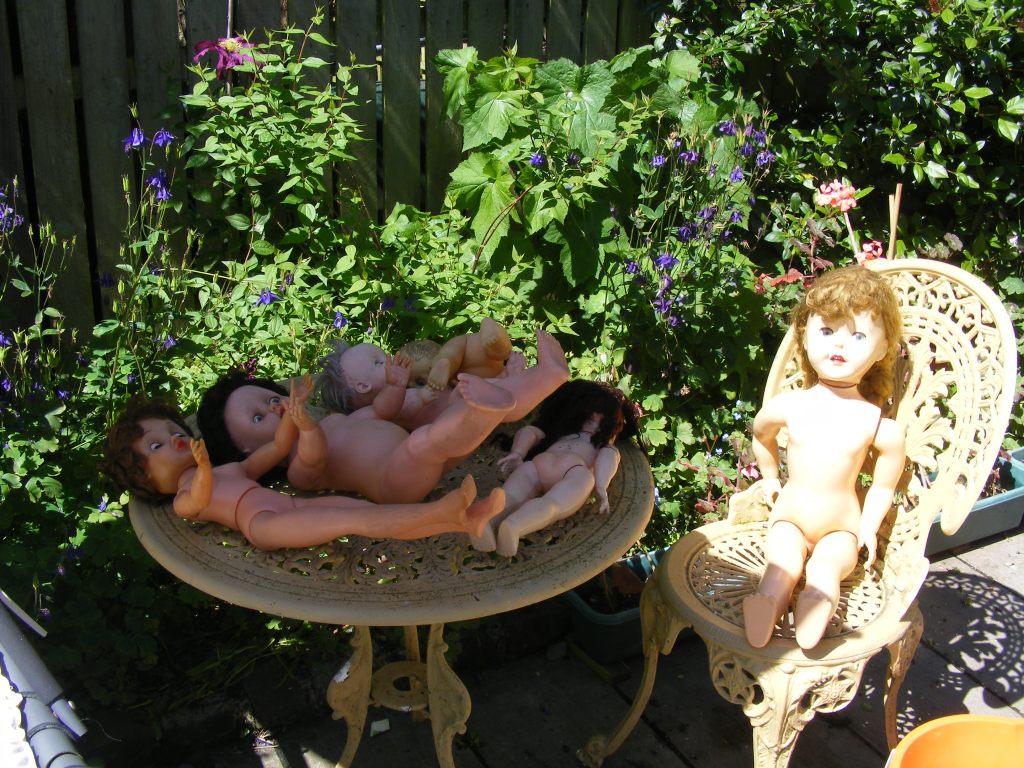
From the left: Christine, Jilly, Mary, Jane, Betty, Sally, Big Peter – you can pin point my generation just from the names.

As you will see, the baby bath has stood the test of time. I am wondering if this will be marked up as an inappropriate image.

Mary and Jilly

You have no idea how long it takes to peg umpteen small items on the washing line. Take it from me – a long time and it used up every inch of line and every peg I could find.

The dolls were left in the sun to dry. I did have to temporarily amputate a few limbs and even one head, in order to let the water drain out.

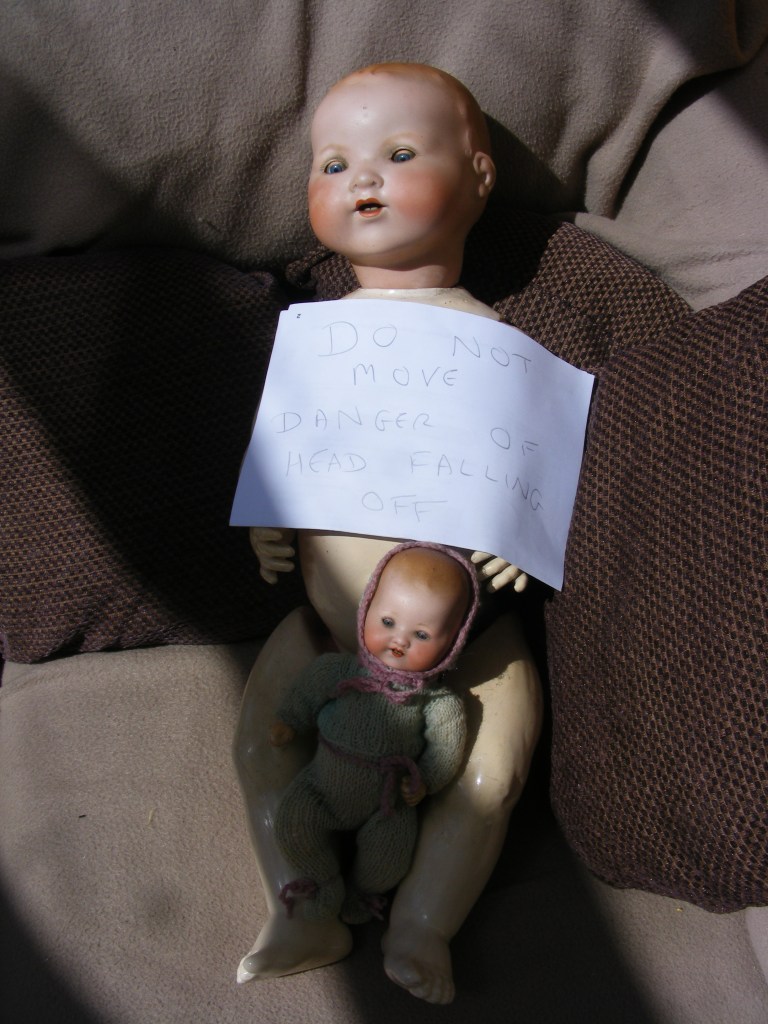
Big Peter and baby Peter (not a lot of imaginative naming on the part of my mother there), now in their late nineties, were spared total immersion, not least because baby Peter’s clothes don’t come off. In fact I fear for the stability of the wires attaching Big Peter’s limbs and heads, hence the warning notice.

Then it was time to bash the soft toys together and stand well back as the dust flew.

A quick bake in the sun followed. Today they will be redressed and replaced on top of the cupboard. It is a sobering thought that if they wait as long for their next washing as they did for this one, I may not be around to do it.

My lovely memories group ladies are writing about the toys and games of their childhood at the moment. I am fortunate to have many of mine still in my possession. The great loft sort has revealed a feast of goodies. They may just become the subject of a talk. In the meantime, whether you still have the contents of your toybox or not, I would encourage you to record the memories of your own particular treasures.

NB no dolls were permanently harmed in the creation of this blog – well, I am not sure I should have washed Jane’s hair (already her second lot of hair) but she will get over it.

Being Presidential and New Horizons

Here I am, three decades after serving on the executive committee of the Family History Federation, having the honour of being voted in as its President. I am following some seriously big names in the genealogical community. To be considered some kind of elder stateswoman, is not only a humbling experience, it also makes me feel incredibly ancient. Perhaps I should point out that during my time on the executive I was the youngest ever serving member; though I think that record has since been passed to someone else. Family history societies are at a cross-roads. Many have seen slowly declining memberships and have struggled to fill committee and volunteer roles in recent years. Now is the time to reinvent ourselves and our function, or to fade into oblivion. We cannot keep repeating the pattern that has not been working well and expect it to suddenly become relevant and appealing. The pandemic has forced us to rethink the way in which we do many things. Societies can either put change in the ‘too hard’ basket or embrace it and perhaps use it as the first step to a resurgence. Societies can still be relevant in today’s genealogical landscape but it takes work and insight to make them so. For many years, I have come into contact with societies across the world as a member, a volunteer and a speaker. In the past year, my ‘catchment area’ has expanded exponentially and I am looking forward to ‘meeting’ many more family historians in the coming months. I am very mindful of the honour that has been entrusted to me in these challenging times.

On the family history front, I have been getting out my sledge hammer and attempting to crash through some family history brick walls for Devon researchers. Despite much of the sleuthing being done by my colleague, I ended up presenting the findings in a FindmyPast podcast, which you can view here. These may not be your personal brick walls but the techniques we used could be effective on your own problem ancestors.

I have also had what is probably classed as an old-age crisis. Before I wrote Barefoot on the Cobbles, I debated whether to write a novel or take a post-graduate course. On that occasion, the novel writing won. I am still playing with ideas for a possible third novel but nothing yet seems quite right, so I have returned to the post-graduate idea. I am excited to have been accepted by University College Dublin as a remote student on their certificate course in experimental archaeology and material culture. I am not quite sure what I have let myself in for but I am not going to be bored.

My ‘Discovering more about your Agricultural Labouring Ancestors’ online course is coming to an end and the students are now compiling case studies about their chosen farming ancestors. I have a few more submissions to read from my ‘Writing and Telling your Family History’ students, then thoughts will turn to next month’s course, ‘In Sickness and in Death – researching the ill-health and death of your ancestors’. As I said, no time to be bored.

For those of you waiting to hear about the end of our short trip to South Devon, watch this space.

Days 3 and 4 What Happened Next

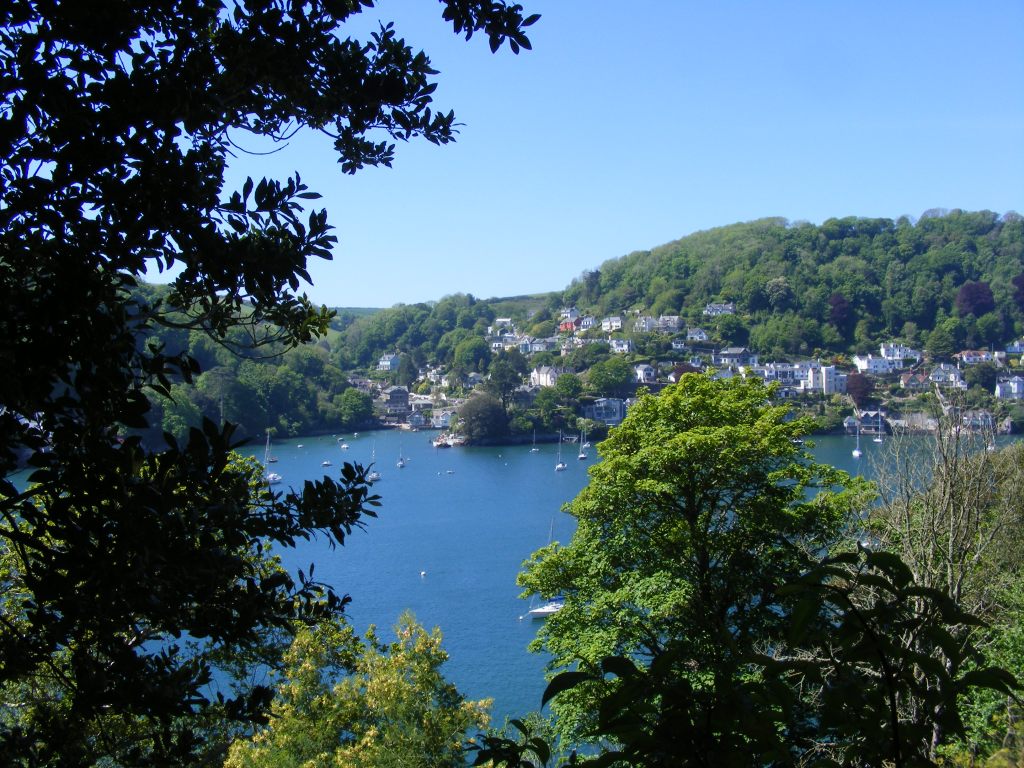
Undaunted, well fairly undaunted, we drove to Kingswear to try to tackle the coastal footpath in the right order from that end. It would be a mere two miles from where we finished the previous day (and then another two miles back to the car). We would then decide if we wanted to repeat the bit we’d done in the wrong order to ‘do it properly’. Kingwear has a very attractive harbour, even though it is sad to see the fishing fleet of the past has been replaced with pleasure yachts. The first part of the walk from Kingswear in the Brixham direction is on pavements out of the town. The gradient is, shall we say, challenging, even if it is smooth underfoot. I just about managed this and then the route took us through a wooded section. I was very thankful for the shade as it was another very hot day.  After half an hour, there was an encouraging sign that told us it was only 1¼ miles to where we had abandoned the walk the previous day. Yay! 1¼ miles is but nothing. Except that it was.

We descended into the valley via a flight of steps and a rough path to Mill Bay Cove. I am used to reading Ordnance Survey maps. Perhaps I should have taken better note of quite how close together the contour lines were – that would be practically on top of each other. I started to climb the steps cut into the path as we left the cove. I stopped for a rest. I climbed some more. I rested some more. I climbed a little further. My body really wasn’t playing ball. Reluctantly, I decided that a walk was a walk and I ought to be proud of how far we have come since Minehead, rather than how much we didn’t complete. Even though my future walks will need to be on flatter terrain, I guess I should be grateful that I am still able to go for a walk, albeit a flattish one.

We returned to the safety of the car; its thermometer told us that the outside air temperature was thirty degrees. That seemed to escape the weather station statistics. An afternoon of rest, if not full recouperation, followed.

Taking it easyish seemed to be the best plan for the next few days. Day four was showery and cooler but humid. In search of places that wouldn’t be too peopley, we drove out beyond Buckfastleigh, on the edge of Dartmoor. Venturing down some byways that were, at least in theory, roads, we reached Hembury Woods. Lacking a map, we were keen not to get lost on our woodland wander. Our first attempt was unadventurous and based on keeping left but we ended up back at the car after about three hundred yards. We would need to be more daring and try to remember lefts and rights. One woodland path does look very much like another. We tried leaving field signs – once a Girl Guide …….. – although I was concerned that a passer by might move our carefully laid twig arrows. In the end, it seemed we were following a pre-laid trail, as small piles of sawdust were laid at intervals along our way. The woodland was strewn with a wildflower, later identified courtesy of the flowers book as Small Cow-wheat. Not heard of it? No, me neither.

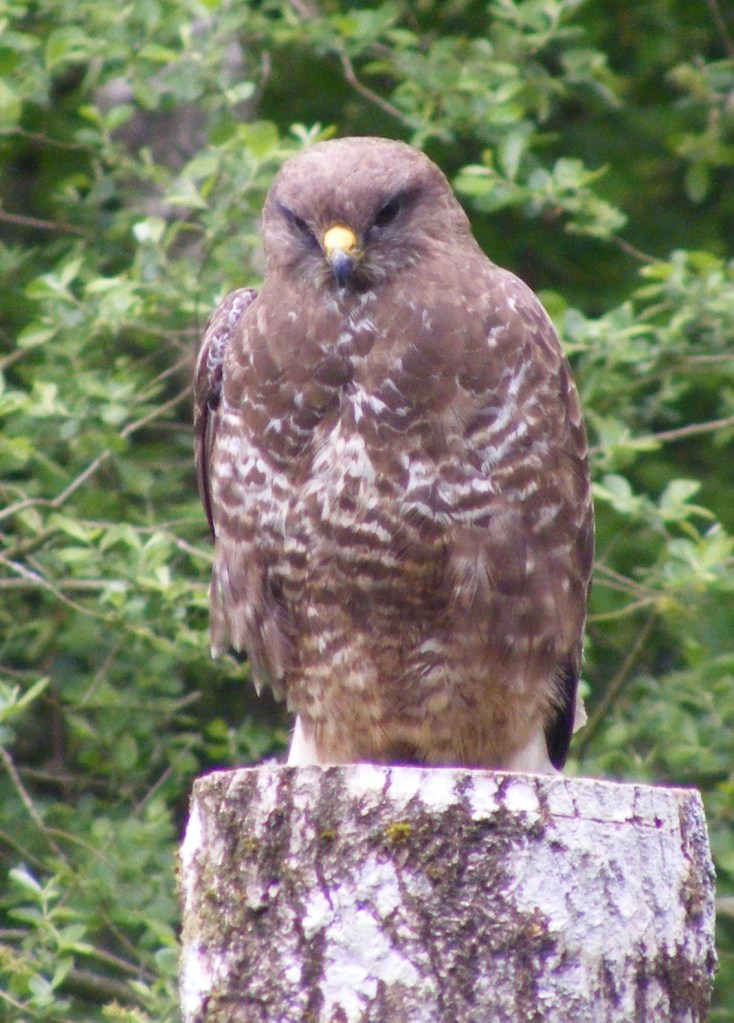
Having reached what I felt was a suitable half way point if we were to have a not too strenuous walk, I was keen to retrace our steps but my companion was confident we could make a circular route. I was less convinced but we soldiered on. Behold and lo! There was the car. In order to keep the step count up, we also returned to the country park next to the site and were rewarded by the site of a roosting buzzard. Small birds and squirrels were feeding heedlessly nearby but perhaps the buzzard had had its lunch.