Mills, Castles and Elusive Gravestones

Having arrived in COVID central, on another lovely sunny day, we set off in search of the many local mills once worked by the Eadington family. We wander round Lesbury and then on to Alnmouth, which is very pleasant. We have reasonable success in locating the sites on our list and most are away from the crowds anxious to enjoy the last day of summer. We get stuck behind a flock of sheep, some of which have gone rogue and broken away in the opposite direction. One man and his dog, or in this case quad-bike, it is not. ‘Hunt the mill’ does take us to places other itineraries do not reach.

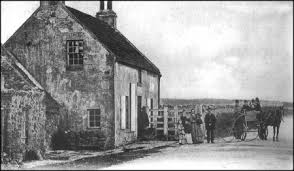
The next day and the temperature has dropped by ten degrees. Undaunted we venture north in the footsteps of my great great grandparents who travelled across the border to Lamberton Toll for a Scottish irregular marriage. I am pretty sure they would have taken the coach that ran up what is now the A1, from close to their home right to the Toll. I know that the toll house no longer exists but allegedly there is a plaque marking the spot. Fail on that one. It must be a very well-hidden plaque. Heading westwards, we call in at Norham Castle, built in the C12th for the Bishops of Durham as an entertaining space. It was here, in 1291, that Edward I and his advisors chose John Baliol, from thirteen contenders, to be the Scottish king. There was significant re-building following damage in the 1510s when the Scots got a bit troublesome. It had been subject to many sieges over the centuries. My ancestors lived close to this castle and would have known it when it was a little less ruined than it is now. Until it came under state ownership in 1929, it had not been maintained since the Union of the Crowns reduced the threat from the North.

Then it is off to Norham church to search for some gravestones. This will be fine, we have plot numbers and a plan. We know where row one is, what we don’t know is which end of the row is number one, nor is it quite clear what constitutes a row amongst the randomly scattered stones. More by luck than plan, we locate two of the four. What I have neglected to do, is note the names on stones surrounding the ones I am interested in, which might be more legible. We have phones, in theory we should be able to find the website and look at the transcription. In practice, neither of us has mastered using the phone for internet searches so that is not an option. In any case the stones I am missing are 1720s and the transcription was probably done in the 1980s so it is likely that they are no longer standing or legible.

Home via a couple of Scottish churches which involves a gate-related incident. Mindful that we are in a COVID hotspot, I attempt to hook the gate open with my foot. I achieve this and my companion exits the church yard. As he does so, he pushes the gate open further. Sadly, my foot is still wedged in it at the time. As I am wearing wellies in order to scour wet churchyards, I fail to hop backwards sufficiently swiftly and end up sinking to the ground grabbing the gate that I had been at pains not to touch in the process. It really is easier to stay at home. Fortunately, we have plenty of hand sanitiser. The car is making a bit of a weird noise. It is going and there are no warning messages but it looks like tomorrow will involve a trip to a garage. We do have form for getting stranded miles from home.

The Great Escape Begins

So, in the run up to departing for the wilds of Northumberland, I indulge in what was apparently some over-zealous gardening and am rendered almost immobile by a pulled muscle in my back. This means that many of the ‘must do before I go’ jobs take twice as long as usual, or don’t get done at all. Let’s be honest, it’s taking half an hour to get out of bed. The days have been punctuated by numerous Zooms, including C17th presentations for The Institute of Heraldic and Genealogical Studies and a panel chat for Family Tree Magazine – you can watch it here. By the time I got to the panel I’d already been presenting for two hours, hence the regular swigs of gin water.

Having been out of the house a mere handful of times since March it does seem rather out of character that we decide to head to Northumberland just as it hits special COVID measures. The plan is to be in the middle of nowhere in the north of the county and restrict ourselves to driving/walking in isolated areas. Definitely no tourist attractions/pubs/restaurants and with luck, just one shop visit – it will be my first for six months.  We are also on stand-by to bale out at any point. In the interests of avoiding public toilets, which are in any case non-existent in the wilds of Northumberland, we have purchased what is basically a bucket with a seat attached. I am still not quite sure how using this in the boot of the car will go, even though it is quite a big boot. Not being able to bend will make it even more ‘interesting’ than it might otherwise have been. Said purchase did mean that Amazon, bless them, sent the usual ‘Would you like to share your experience of …..?’ email. Ermmm, are you quite sure Amazon? Anyway, it is, as yet, untried; I’ll let you know how it goes.

I also have a new phone, this is a proper phone, one that, in theory, does things apart from make phone calls. The operator is still playing catch-up but I am gradually increasing my ability to make it do things. I even occasionally remember to charge it and turn it on.

On the way north, we call on some descendants and meet at a National Trust property. This counts as very adventurous for me and we have duly pre-booked. On arrival at the entrance the man fails to find my name on his list. I have helpfully printed out the tickets and I rummage in my bag for these, only to find that I have inadvertently booked for a different day! By this time, the other half of the party are already inside. I ask if I can inform them of the problem. Whilst I am confessing to my blunder, the fisherman of my acquaintance somehow blags our way in, partly due to his powers of persuasion but helped by my life membership and his status as a National Trust volunteer. Phew. A lovely sunny day and some glorious flowers, although I prefer the wildflowers to the dahlias. It was lovely to spend socially-distanced time with the family. Onwards and upwards.

Family History Excitements and Jumping on the Scottish Bandwagon

My book launch two weeks ago seems to belong in the dim and distant past now. It went very well thank you, with 120 Zooming in. Thanks go to Devon Family History Society for hosting. The book is selling steadily and I am starting to get some lovely feedback. If anyone could face popping a teeny review on the dreaded Amazon I’d be grateful, as this open doors to other reviews. You don’t have to have bought the book from Amazon, you just have to have bought something from them. Reviews elsewhere are also welcome of course. In case you’ve missed all this book news and if so where have you been? details are here.

Plenty of news in the Family History world. 2021 is going to be exciting. Rootstech, for which I am an Ambassador once again, is to be virtual and free. This really is a chance to embrace the Rootstech experience without going to Salt Lake City. 25-27 February are the dates to save and you can register now. I am also proud to be joining my down under friends as a speaker for the Family History Down Under conference in March. This too is a virtual event, with a great international line-up.

Then those of us who have done Ancestry DNA tests had our ethnicity estimates updated. These are of course just that – estimates but it seems that the whole world is now Scottish, not just me. My own estimate changed very little, 5% moved from England to Scotland but there are many reports of increased Scottishness appearing in people’s estimates. See here for my take on ethnicity estimates.

On the subject of Scotland, I still haven’t added any ‘born in Scotland’ ancestors to my tree. It looks likely but I am waiting for more supporting evidence. Really exciting news though. After more than forty years of searching, I have found that my great great grandparents did get married after all – sort of. In preparation for heading north, I reviewed my Northumbrian ancestry for the nth time. This branch is the one that gets stuck first. I am pretty sure who my 3x great grandparents are, I just need more evidence (a bit of a theme you’ll notice). For those who’d like all the details of this sorry search, I’ve written about it before. My great great grandparents, John Hogg and Elizabeth Pearson, were not married in the 1851 census and apparently married by the time their daughter was born in March 1854. Despite four decades of not finding the marriage, I am always optimistic so I tried again. This time though a glimmer of hope. Family Search led me to a notice in the Newcastle Chronicle recording a marriage of Mr John Hogg and Miss Elizabeth Pearson on the 13th April 1853. The names and date were right but was this my great great grandparents? They were not of the class to put a notice in the newspaper and they were in the Morpeth area not Newcastle. Finding the actual article was a challenge. It didn’t show up in a newspaper search on FindmyPast; I had to look for the individual newspaper and then find the page. The column was one of those in a margin, so distortion meant that it was not picked up by OCR. The snippet made it clear that this was the right couple as both were ‘of Espley’, a small Northumbrian hamlet where I knew they were living in 1854. Helpfully, it gave the place of marriage ‘Lamberton’. A quick google revealed that this was not the breakthrough I had been hoping for. Lamberton Toll was the location for Scottish irregular marriages; a less well-known Gretna Green. I suspect they travelled there because he was 23 years her senior, with children as old as his new wife and she had already had two illegitimate children. Perhaps that was why they put the notice in the paper,because they didn’t have an official certificate. It was an odd paper to choose though, why not pick a Morpeth paper, which was their nearest town? Some records of Lamberton Toll marriages do survive, sadly not for 1853 though, all that there is is an index. So there is my hope of confirming John’s father’s name gone (I was so hoping that it was Robert). The only faint chink in the brick wall is that John’s first marriage is also missing, was that another irregular marriage?

The moral of the story is don’t give up. At least I have a date and a place for the marriage if not the vital father’s name. The next post may come from the wilds of ancestral Northumberland, might just sneak in a quick trip to Lamberton!

Lamberton Toll

The Tale of Peter Pig-owner and should I buy a kilt?

There’s so much going on at the moment, of which more another time but for today a tale that shows you can still find something new, even after over forty years of family history research.

Yesterday I should have been giving my presentation ‘Madness and Melancholia: the mental health of our ancestors’ a final run through (incidentally still time to come along to this one if you cross my palm with £2.50) but my early morning email trawl dictated otherwise.

An email from My Heritage ‘You’ve got Record Matches’. Sorry My Heritage John Parr of Devon and Johann Jakob Parr are not the same person. Nor is Richard William Braund of Cornwall the one in Melbourne. Their third offering did catch my eye. An extract from a history of Alnwick, Northumberland, published in 1866, referring to Peter Eadington a miller. Now, lurking on my tree is 4 x great grandfather Peter Eadington, miller, not of Alnwick but of Norham, some thirty miles north on the Scottish border. I knew that Peter’s daughter lived in Alnwick after she was married but it hadn’t occurred to me that there might be an earlier family connection.

Although my DNA and tree have been uploaded to My Heritage, I don’t have a subscription so couldn’t look at the record but I found a free copy of the book online and could see that this was too late for my Peter Eadington. Nonetheless it set me thinking. about family connections with Alnwick. Firstly, my Peter Eadington was a bit of a lad. He was a miller in Norham between about 1788 and 1805, during which time he had six children by three different women. One, Alice, he appears to have been married to, although no marriage record has been found. His two eldest daughters were probably born within weeks of each other. His story, as was, is available here but now of course it needs updating.

So, the whole of yesterday was spent following this Bright Shiny Object, with some success. During the course of twelve hours’ research I found, amongst other things, that Peter, whose baptism and marriage still elude me, was sometimes called Patrick, as was his first cousin Peter/Patrick, who was also his brother in law. Ancestry tree owners have these two beautifully muddled and today’s task is to decide which of the two married Sarah Dodds. I am almost certain it is my Peter, in which case he lied about his age on his marriage bond, probably because he was nearly twenty years older than Sarah. Personally, I would have been a bit more worried about his chequered past but hey. Unfortunately, this makes him the right age for cousin Peter/Patrick. The will of his father, David, freely available on the North East Inheritance database, was key to all this but because it is not on Ancestry, it has been ignored and therefore the Peter/Patrick name change has not been picked up. Also key is a family gravestone in Alnwick cemetery. The great piece of luck is that all this came to light BEFORE I am due to stay just outside Alnwick. With the luck of 2020 it would have been after, although there is still time for a regional lockdown to sabotage the trip. The bad news is that there are nearly 600 gravestones in Alnwick cemetery – ah well at least we will be socially distanced.

I now know that he, or possibly cousin Peter (I need to check who was at which mill and what time) owned a boar that, when killed, weighed 52 stone. Thanks British Newspaper Library. The ubiquitous Ancestry trees claim Scottish ancestry for both of Peter’s parents. I still have to satisfy myself that this is correct. If it is, they will be my first direct ancestors born outside England, which is very exciting.

Beside this, last week’s discovery that my grandfather’s first cousin was an actor with the fingers of his right hand missing, who performed with Cary Grant, pales into insignificance. William Smith is, after all, a bit harder to trace. So don’t tell me your family history is ‘finished’ there is always more to uncover.

Now back to who married Sarah Dodds?

St. Michael's, Alnwick

St. Michael’s, Alnwick