I belong to many family history forums and most days I receive several emails with family/local history enquiries. I am afraid this isn’t an invitation for you to send me your queries – I am already at capacity! Nor is it meant to be a complaint about those who do ask questions. There are no silly questions and we should all be trying to increase our knowledge. This is meant to help people to frame those questions in a way that is more likely to get a satisfactory response.
It is highly likely that you can answer many questions yourself and if you can’t, there are steps you can take before you ask your question. Often, I am asked ‘where can I find such and such a record?’ or ‘are there any records for …..?’ type questions. Sometimes I know the answer straight away. If I don’t, I type the question into my search engine of choice and guess what, there, in a matter of moments is the answer. The questioner could have done the same.
Show me a family historian and I will show you someone who has a brick wall ancestor, those folk who appear to have been beamed down from outer space, or who disappear without trace. I often offer to help with a bit of demolition. Frequently, the enquirer hasn’t exhausted all the possibilities themselves, or there is a more productive way that they could set out their question. By reassessing the problem, they might be able to move that brick wall back a generation without any suggestions from me.
So, before you ask for help with your brick wall, here are some simple steps to follow.
- Decide exactly what the problem (the research question) is. Just pick one specific thing, not ‘more about John Brown’. For example, ‘I want to find John Brown’s parents’ names’, or ‘I want to know where and when John Brown died’, or ‘I want to find John Brown in the 1881 census.’
- Next, reassess everything that you already know about John Brown. There may be a clue in some aspect of the documentation that you already have. Create a timeline of John Brown’s life using all this information. Include the sources for that information, as some sources will be more reliable than others. Please note that ‘Ancestry’ is not a source, although ‘family tree compiled by x on Ancestry’ can be. Ancestry (or FindmyPast or Family Search etc.) may be the way that you accessed the source but the source will be an original document, a transcription or an index.
- See if you can fill in any gaps. Do you have John Brown’s birth AND his baptism, do you have him recorded in every census? Have you looked recently to see if there is new information available online that was not there when you last searched for John Brown?
- Make a note of any possible further research that might be helpful but which you cannot do at the moment, perhaps because the records are not online, or you can’t visit that repository, or afford to buy copies.
- Make a list of where you have already looked and what you have searched for.
- Finally, make sure you include a place and a time frame. Those who post on international genealogy forums seems to be particularly poor at this. There seems to be an assumption that, if no place is mentioned, it must be the US. There are genealogists elsewhere! Please avoid using abbreviations; these might be meaningful to you but ambiguous to others. Is WA Washington state or Western Australia?
To give you an idea of what I mean, I have given an example below. This is a genuine example, apart from the ‘searches completed so far section’.
When and only when, you have reached the end of step 6, share your problem. Family historians love a good mystery and a fresh pair of eyes can often help. If they can’t, then at least it might be comforting to know that you have done all the right things.
An Example
Brick wall ancestor – Mary Cardell 2 x great grandmother
Research Question
I would like to find the full names of Mary’s parents.
Summary
Mary Woolgar née Cardell is my 2x great grandmother. On her marriage certificate and the birth certificates/registrations for her four children, her surname is consistently spelt CARDELL. The marriage certificate suggests that she signed her own name. Earlier generations may not have been literate, so the name might be rendered differently and my searches have included all phonetically likely variants of the name, of which there are many! It is even possible that it is a corruption of McArdle.
The evidence suggests that Mary, or at least whoever provided the information to the census enumerators, was convinced that she was born in Highgate, Middlesex. Ignoring the 1841 census evidence, when ages were rounded down in any case, the suggested dates of birth from the other sources are consistent. If all ages are correct, then Mary was born on 4 or 5 April 1817. It seems fairly certain that she was born between 1816 and 1818.
Other clues are provided by her marriage certificate to Philip Woolgar, which I obtained from the General Registrar. As it was a handwritten copy, I also consulted an image of the original parish marriage register, to ensure there were no copying errors at any stage between the church and the certificate that I received. The information was the same and assuming it is accurate, Mary’s father was James Cardell, a gardener. There is no indication that either of the fathers were deceased at the time of the marriage. Searching surrounding entries, suggests that whoever filled in the register did not make a habit of noting if the fathers were deceased, so we cannot be sure James was still alive. The witnesses were William Groves and Catharine Cardell who has been shown to be Mary’s sister.
Timeline (working backwards)
Sources are in red, possible further research is in blue. I have omitted the full document references here to simplify matters.
- 18 January 1892 buried Islington. Deceased online. I need to check the original burial registers and possibly locate a gravestone, if one survives. It seems odd that she was buried the other side of the river, albeit only seven miles away. Islington is however nearer to Highgate.
- 13 January 1892 died 153 Rialton Road, Lambeth (the home of her daughter Caroline) death certificate age 74 – born 14 January 1817- 13 January 1818
- 1891 census age 74 born Highgate, Middlesex – born 6 April 1816-5 April 1817
- 1881 census age 63 born Middlesex – born 4 April 1817- 3 April 1818
- 1871 census age 53 born Highgate, Middlesex – born 3 April 1817- 2 April 1818
- 1861 census living Rosendale Road, Lambeth age 44 born Highgate, Middlesex – born 8 April 1816-7 April 1817
- 7 Sept 1855 son Philip James born Figs Marsh, Mitcham son’s birth certificate
- 1851 census not located
- 5 Mar 1848 daughter Fanny Amelia baptised Highgate, ‘of Highgate’ baptism register
- 5 Feb 1848 daughter Fanny Amelia born, the exact address is unclear but appears to read ‘Cookers Haven’, Finchley daughter’s birth certificate
- 1 Feb 1846 daughter Mary Ann baptised Highgate, ‘of Highgate’ baptism register
- D Q 1845 daughter Mary Ann born registered Barnet RD (as Wodgar) born Finchley GRO indexes, census returns for daughter. I could purchase this birth certificate.
- 27 Nov 1842 d Caroline baptised in Highgate, ‘of Highgate’ baptism register
- J Q 1842 daughter Caroline born registered St Luke’s district (Caroline’s census entries say born St. Lukes (1861/1871/1901) Clerkenwell (1881 NB husband b Clerkenwell) London (1911)) GRO indexes I could purchase this birth certificate.
- 1841 census living Turnpike road, Finchley age 25 born Middlesex – born 7 June 1811-6 June 1816
- 1 May 1841 marriage certificate ‘of full age’ – born before May 1820. Father, James Cardell, gardener. I have also checked the parish register entry for the marriage and the details are identical to the marriage register
Searches completed so far (not a genuine example)
I have searched the indexes at Ancestry, Family Search and FindmyPast for James Cardell (and variants) between 1750-1805 in London and Middlesex.
If you want to know more about my actual long and inconclusive search for Mary’s parents, there have been several posts about it on this website, including the sorry tale how I nearly adopted a very exciting (but sadly wrong) set of ancestors for Mary. Of course, if you can find Mary’s parents for me, even better.
https://thehistoryinterpreter.wordpress.com/2019/03/08/my-problem-female-ancestor-internationalwomensday/
https://thehistoryinterpreter.wordpress.com/2019/03/22/clock-makers-vicars-huguenots-and-pirates-some-family-history-excitements/
https://thehistoryinterpreter.wordpress.com/2019/04/19/nearly-my-ancestors-or-how-i-almost-climbed-the-wrong-very-exciting-family-tree/
https://thehistoryinterpreter.wordpress.com/2020/01/19/how-do-you-solve-a-problem-like-maria-a-family-history-conundrum/
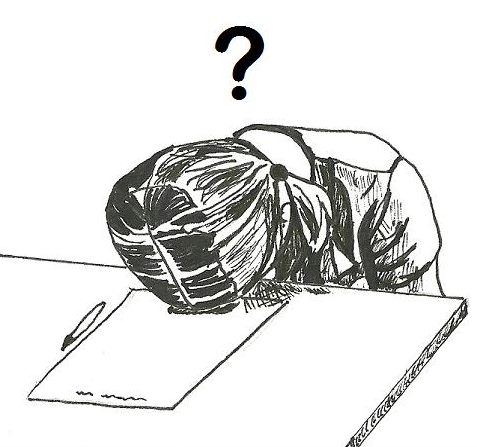
Drawing by ‘Artie Race’

 The History Interpreter - Janet Few