As regular readers will know, I am comparatively new to the convoluted ‘excitements’ of Ancestry DNA matches. I’ve been having a little play. If you have nothing better to do, you might see how your matches compare. You probably won’t all read to the end so I will put today’s new novel hint at the beginning – #5 It contains a modern strand. The novel also has the beginnings of its own webpage now. This post is probably for those who like fiddling with numbers and charts. If that’s not you, please go and use your time more wisely and stop reading now.
So, back to the DNA. I have, according to Ancestry, two 3-4th cousin matches, 316 4th-6th cousin matches and as of this minute, 35,218 5th-8th cousin matches. I have looked at all those with common ancestors (allegedly 86 people although a couple have some incorrect trees). I have also checked all those that match at 16cM or more and all the shared matches of these people, plus a random selection of others. That’s over 2000 matches in all. So far, I have identified precisely how I am related to 78 people. The DNA that I share with some of these individuals is a little as 6cm. I am also more closely related to some than ancestry believes. Thanks to shared matching, I have an additional 237 matches, where I can tell which branch of the family is likely to be responsible for the link, although not the precise details of how we are connected.
I am very far from being a DNA expert, so please do tell me if all this is total nonsense. Anyway, I thought it might be fun to consider how my matches are distributed amongst different branches of my family and to speculate on why not all my great great grandparents are equally represented.
My paternal grandfather’s paternal grandfather
The Braund family from Devon and Cornwall can be traced back to the 1680s. 28 of my identified matches relate to this branch of the family and I know precisely how 20 of them relate to me. The closest relations are two 3rd cousins once removed, with whom I share 35 and 20cM. Most are 6th cousins but I do have a 7th cousin (who matches at 11cM) and a 7th cousin once removed (with 15 shared cM). I have not ruled out being related twice over with some of these individuals. In fact, in one case, I know I am.
My paternal grandfather’s paternal grandmother
The Nicholls family, also from Cornwall, can be traced back the 1630s. They yield just six matches, only one of which I can precisely identify. This is a 4th cousin once removed (a 20cM match).
My paternal grandfather’s maternal grandfather
The Bishops, another west country family, are responsible for a whopping 104 matches, most of whom have no trees or private trees. The 12 for whom I have precise details of how we are related, vary from a 3rd cousin once removed, who only shares 12cM of DNA, to several 6th cousins, one of whom shares 14cM.
My paternal grandfather’s maternal grandmother
The Buckinghams and their forebears come from Cornwall. I have 39 matches that I have identified as relating to this branch, three of whom have a known place on the family tree. These range from a 5th cousin (21cm) to a 6th cousin (11cm). The closest relative shares 43cM of DNA (precise relationship unknown).
This quarter of my family is responsible for nearly 60% of my identified matches. There are obviously a number of factors at work here. Firstly, as I have not inherited an equal amount of DNA from each grandparent, I am less likely to have matches with those whose DNA is more diluted in my make-up. Perhaps I have a higher proportion of west-country DNA (although Living DNA’s ethnicity estimate suggests not). In addition and probably more significantly, the south-west branches are likely to be linked to a higher proportion of emigrants, therefore there will be more residents of the USA amongst the wider family. Given the much higher number of US citizens who have tested, this is bound to have an impact. Also, by using shared matches to identify likely group members, there is a snowball effect.
My paternal grandmother’s paternal grandparents
What about the other three quarters of my ancestry? My paternal grandmother’s quarter is the poorest yield for DNA matches, with none for her father, the Hoggs from Northumberland and just two 4th cousins (19cM shared) for her paternal grandmother. I believe that this is largely because these lines are more difficult to trace, not just for me but for other researchers too. The Hogg line hits a brick wall in 1804. Therefore matches on these lines are probably hidden within the many hundreds of matches for whom I cannot identify a common ancestor. Of course, I cannot ignore the possibility that Mr Hogg may not actually be my genetic great great grandparent.
My paternal grandmother’s maternal grandparents
The Howe and Stratford lines from Buckinghamshire (with 7 matches, 4 of which are identified), give me one of my closest matches, a third cousin, yet we share just 27cM. It looks as if this grandparent is under-represented in my DNA, another possible reason for fewer matches. So, fewer than 3% of my matches come from my paternal grandmother.
My maternal grandfather’s ancestors
On my mother’s father’s side we hit the problem of endogamy; with the Smiths and the Seears intermarrying in three successive generations. This means that I am related to most of my matches in more than one way, making meaningful analysis difficult. I do have 46 matches in this line, five of whom can be located on my family tree. I have one matche to my Norfolk great great grandparent, Anne Bulley, a 4th cousin sharing 18cM of DNA). This again is a difficult-to-trace branch. Despite this, 15% of my matches relate to my maternal grandfather.
My maternal grandmother’s ancestors
Finally, to my maternal grandmother’s line. The Sussex Woolgars are well documented and can be traced back to the C15th, so perhaps it is not surprising that there are 23 relatives on this branch, ranging from a 4th cousin (with only 6cM shared) to a 6th cousin sharing 17cM. Six of these can be precisely identified.
On the virtually impossible to trace Cardell line I have two matches. These support my speculation as to the ancestry of my brick wall ancestor but more is needed.
The Essex Dawsons and Bowyers can be traced back to the 1650s, again giving potential for plenty of matches and there are 47 of them, of which I can pinpoint the exact relationship for 16, all of whom are 4th– 6th cousins. Thus, this grandparent gives me 23% of my matches, not far from her fair share.
In summary then, this is the percentage of matches that each grandparents is responsible for:-
Paternal grandfather 60%, paternal grandmother 3%, maternal grandfather 15%, maternal grandmother 23% – sorry, I know that adds up to 101% – blame rounding up/down.
Ancestry have just announced their Mother’s Day sale. Shall take the plunge and get a daughter to test, so I can do all this for her paternal ancestry as well?
* My only connection with any DNA testing company, is as a customer. I have received no concessions, free gifts or financial inducements from any of them.
And just because I can, one of my favourite family photos, colourised by MyHeritage and then enhanced by me.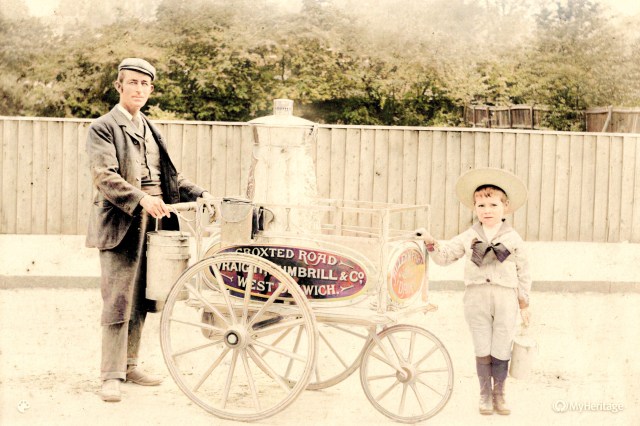




 I am eternally grateful for ‘online’. I’ve helped Edward lay out a family tree. I managed to access Zoom for the first time to chat with other genealogy types and used Skype to meet with my authors’ group. I think Martha, Lucy and I are planning a family music recital later in the week. On the downside, I have a totally unintelligible communication from the US tax people, or possibly from Amazon, relating to my meagre Amazon sales to the US. I fill in my own UK self-assessment forms with ease. This is unintelligible, as is the website it directs you to. It seems I am a ‘non-resident alien’ (that may explain a lot) and I may need to visit my US Embassy for a tax form – like that’s going to happen. Or I can write to Illinois, ditto at present – not going to make a non-essential Post Office visit. So now I am worrying about being hauled off to some federal prison for non-payment of taxes.


 The History Interpreter - Janet Few