As one year comes to an end and another looms on the horizon we often have wonderful intentions about where the next year will take us. Sometimes we make commitments that relate to our health or long overdue tasks. As genealogists, we might make research plans for the forthcoming twelve months. Meeting with relatives over the holiday season might have reawakened enthusiasm for investigating a particular branch of the family. One thing that all too many of us continually put off is the task that we label ‘writing it up’. One day we will put all this in some sort of coherent order for our nearest and dearest. We just want to kill off auntie Annie/get back one more generation/prove that family rumour first. In short, we want to ‘finish’ our research but as all but the most naïve genealogists know, the day that we finish our research never comes.
Why then are we putting off the dreaded ‘writing it up’? Some feel that their online tree, plus rigorous source citations, is a finished product in itself. Ask yourself though how appealing this is to non-genealogist family members. You are much more likely to spark their interest with stories, with context. To make your family into three dimensional characters, you need to think about the local and social historical background to their lives.
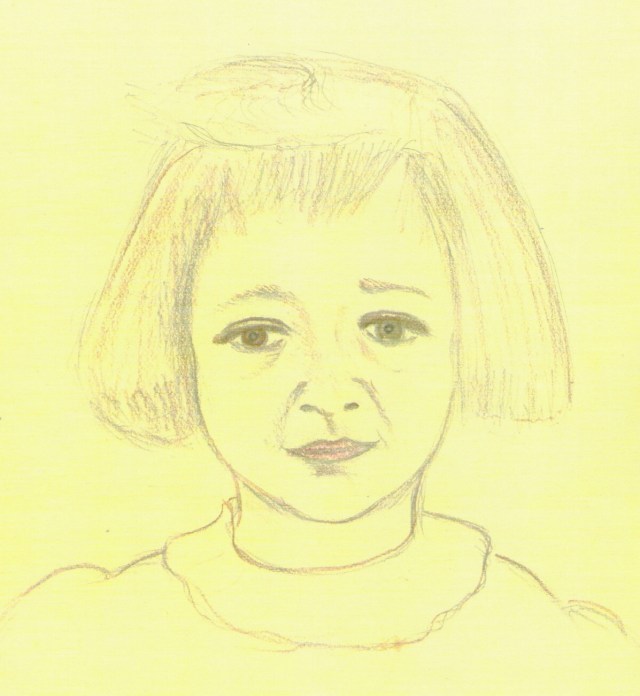
My father’s portrait of me, aged about 4
Many of us, especially if we have been researching for years, just put ‘writing it up’ very firmly in the ‘too hard’ basket and screw down the lid. It is true that it can be a daunting task but it is one that should be tackled, sooner rather than later. To begin with, ‘writing it up’ doesn’t have to mean a book. There are many other formats, both traditional and more unusual, that can be a vehicle for telling your family’s story. Some of these are much less scary than a book and may suit your own particular strengths. Perhaps you feel that your literary skills are lacking. Don’t worry, if you can read this you will be fine.
You do not have to do it all at once. Concentrate on a small twig at a time, not the whole tree. Set yourself a realistic deadline; perhaps there is a family reunion or an anniversary coming up that could be a target. The most important thing is to stop procrastinating and put fingers to keyboard. Yes, you will find loose ends on the way; extra pieces of research that need doing but don’t let these divert you for too long – there can always be volume two! Think about your potential audience and what might appeal to them. In the end, this impossible task can become enjoyable rather than a millstone round your neck.
If your New Year’s resolution was to lose weight or to give up smoking, you might well seek help from a group who were embarking on the same journey. Researching and writing can be solitary activities, so mutual support and encouragement is important here too. If you publicly announce your intention to do something, be it taking more exercise or telling your family’s story, that public declaration is in itself a motivator. Can you get together as a small group and meet to share your progress and problems? Can you find a course that might offer both guidance and encouragement? Whatever route you decide to take, please don’t let 2020 be yet another year when you don’t start to ‘write it up’. Good luck. I am sure you will get satisfaction from your creation.
Janet Few runs ‘Writing and Telling your Family History’ courses for Pharos Teaching and Tutoring. The next one starts on 31 March 2020,. These are online courses, which can be taken from anywhere in the world. This one is particularly appropriate for those with British ancestry.
 The History Interpreter - Janet Few