At Sea, Nice, Eze and Monaco – Days 5 and 6 of our genealogical cruise adventures

In a vain attempt to boost our energy levels, we miss the first two lectures and sit on deck for a short while. This is followed by the second of my writing workshops, this one on finding national and local context. I manage to persuade people to part with money for most of the books I have bought on board. After lunch Michelle talks about surnames and then Sue’s presentation, ‘Do as I say, not as I did’ is an interesting story of her mistakes and encourages us to focus. Rosemary’s second Scottish session gives me some new avenues to explore and some ideas that I can add to various presentations. Paul follows this with a presentation on sources for landed and titled people.

Our usual Windjammer evening meal has become a pattern, with many from our group gathering in the stern to watch the sunset. Most of my menu choices seem to involve rather nice French fries and roasted vegetables but today I opt for curry. As usual, there are numerous desserts on offer and it seems rude to only pick one. Chris is working his way through crumble of the day. The evening lecture is a case-study from Mia. I am a fan of case-study talks, this one about using DNA to find the father of an illegitimate ancestor. Then straight to bed as we have an early start tomorrow.

We resolve to be at breakfast for 6.30am and indeed we are but are foiled by the Windjammer not being open until 7.00am. The regular gluten free toast toasting guy is not on duty and the replacement inadvertently puts it through the non-gluten free toaster. In fact this wouldn’t kill me but he feels obliged to do it again whilst I wait impatiently. I do notice that they handle the ‘gluten free’ toast with the same gloves as regular bread, so I don’t know how they ensure that no crumbs are transferred. We are nonetheless ready for dispatch by the allotted time of 7.45am. We are in group 1 and the first tender from the ship, which cunningly doubles as one of the lifeboats. We arrive in Villefranche and find our coach. Today’s guide is Otillie, who is not a patch on Chantal. Her very heavily accented English and fairly monotonous tone makes her hard to follow.

I am enjoying seeing how much of the signage my school-girl French will allow me to translate. We drive to Nice, which has a population of 350,000. Nice was founded by the Greeks in 600 B.C. and from 1388-1860 was part of the Duchy of Savoy, not France. We visit the flower market. The shelter provided by the French Alps helps with flower production. The other stalls are displaying local produce, notably lavender, olives, herbs and spices. At least it isn’t all bits of plastic tourist tat. We also visit the ‘rest room’, where we have to pay 50c. for the privilege, which seems a trifle extortionate. Before the beginnings of tourism, in the mid-nineteenth century, this area was very poor and it is not ideal for fishing or agriculture.

There is much evidence of ‘The Grand Epoch’ in the architecture; a style that was prominent from 1880-1914 and many of the houses are red and green. We visit the Garibaldi Royal Square; Garibaldi was born in Nice. Next is Massena Square and we also see Le Negresco Hotel, which is a mere €1500 a night. During our free time in Nice we discover that traffic is not obliged to stop when there are pedestrians on a crossing. Well, if they are obliged to, they don’t. We found this out the hard way. There are plenty of mopeds here. One drives past with two unsecured 50 inch televisions, in boxes, on the pillion.

Next, a short ride to the old village of Eze, which is 470 metres above sea level and was founded in 800 B.C.. It seems that all tourist guides are trained to tell you how high up you are. It is possible that its name is a corruption of the Egyptian goddess Isis. Until 1927, when the road was constructed, it was reached only by a pathway. It has narrow, twisty streets and is a French version of Clovelly. We visit the Baroque style, eighteenth century church. There is much talk of the celebrity residents of the area. I am singularly unenthused by the sight of Elton John’s roof. This is certainly the playground of the rich and famous and it is far too glitzy for our taste.

On to Monaco, the second smallest independent country in the world (tomorrow we visit the smallest). It became a country in 1297. Today, much of it is built on reclaimed land. It has 38,000 inhabitants, 30,000 of whom are ex-pats from 140 different countries. There is one policeman for every 66 inhabitants, compared to a ratio of 1:1000 in France. Unsurprisingly, there is little crime in Monaco. We see Princess Caroline’s home, the house owned by Princess Stephanie and the former home of Jacques Cousteau.

There are various lifts and escalators on our tour and there is plenty of getting lost potential, as Otillie’s technique is to take us somewhere, usually up a hill and then leave us to find our own way back – or not. Having barely slept last night, I am struggling a bit with the heat and the exertion required. I have also, rashly, believed the on-board newsletter, which stated that it was expected to be 64 degrees today. I think they meant 74 and it is still an under-estimate. I have far too many clothes on. We visit the St. Nicholas’ Cathedral (aka the Cathedral of Our Lady Immaculate) and see Grace Kelly’s tomb. The cathedral is comparatively modern having been consecrated in 1911 following the demolition of the thirteenth century version in 1874. We decide to wait in a shady park but there is a distinct lack of seats. Fortunately we don’t sit on the grass as it seems, despite the absence of any signs, the grass is sacrosanct. A man has dared to set foot on the un-fenced grass. A policeman is ten feet away. Does he quietly suggest that the gentleman moves? No. He blows his raucous whistle and gesticulates wildly; a lucky escape for us. It does seem that we can sit on the steps of the Oceanarium without fear of censure.

On the way back up the lifts and escalators, we end up with tour group 11. We are not sure their guide will be happy with this, as she regards this lift as being for the sole use of her party. We judiciously place a finger on our stickers, marked 1, so they resemble 11. Our coach is idling for 20 minutes, while we wait for everyone to arrive. Much as we appreciate the air conditioning, the environmental impact of this and indeed our whole trip, is sobering.

On to Monte Carlo, one of Monaco’s four quarters, where the yacht show is in full swing. It is €300 a day for entrance; sadly that does not include a yacht. The first casino in Monaco was built in the 1860s. Nowadays, only 5% of the economic activity in Monaco is related to the five casinos. Most of the wealth is generated from banking and real estate. Property ranges from €35,000-€70,000 per square foot. They also produce computers, cosmetics and jewellery. We walk up yet another steep hill in the heat to see the casino. We don’t attempt to break the bank. Also on view is the dangerous bend in the Monaco Grand Prix circuit. We manage to rescue two refugees from tour group 2 who have been left behind.

Then, an interesting evening talk from Paul on C17th and C18th sources before it is time to collapse.

047 26 September 2019 Monaco.JPG

Gibraltar – Day 4 of our genealogical cruise adventures

Finally, we make it to a 9am lecture. Rosemary Kopittke is giving a very useful introduction to Scottish records through a thorough case-study of her Laidlaw ancestry. My descendants have Scottish ancestry and I am reminded of the value (pun alert) of the Valuation Rolls.

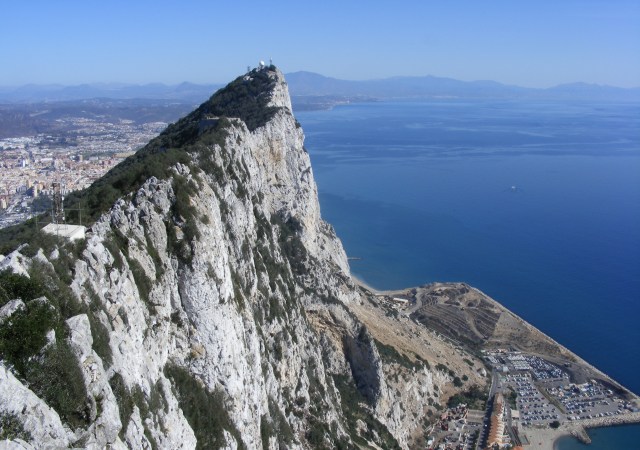
Then it is time for our first excursion, a walking tour of the rock that is Gibraltar. Our guide, Chantal, is hilarious and introduces herself as part Neanderthal and a smuggler. Gibraltar, or The Rock, rises to 426 metres above sea level and we will be ascending to 412 metres. Twenty of us pile into a coach and drive across reclaimed land within view of the site of the Battle of Trafalgar. We pass Morrisons, MacDonalds, all the usual suspects. The population of Gibraltar is 32,000 and apart from tourism, the main economic activities are the gaming industry and the reselling of fuel, which is bought in from Spain. They are very proud to be British and in 1967, voted overwhelmingly to remain so. The island had been under British rule since the Treaty of Utrecht in 1713. Previously, it had belonged briefly to the Dutch, to Spain and prior to that, Morocco. Its importance lies in its strategic position on the mouth of the Mediterranean, hence it being fought over down the centuries.

We ascend in the cable car. The weather is glorious and we have particularly good views of Spain and the north African coast. We see the second Pillar of Hercules, Gibraltar itself being considered to be the other. The Rock is the highest monolith in Europe. Many nationalities are represented in Gibraltar, including those of Maltese descent, who arrived as builders. The border with Spain was closed by Franco after independence, until 1985, allowing no access to Spain. 45,000 years ago, Neanderthals lived on Gibraltar and significant remains have been found.

We walk through the Nature Reserve and see several Barbary macaques, including those with young. The macaques were brought in by Moroccan pirates and there is now a population of about 300. £84 per animal is spent each year on daily feeding from feeding stations, in an attempt to keep them out of the residential area. We are warned not to have water bottles on view or to leave bags open, or our lunch will fall victim to the macaques. There are also many eucalyptus trees, which are also not native.

Then we visit St. Michael’s Cave, which extends 700 feet into the rock and was used as a military hospital in World War 2. It is now a tourist attraction and concert venue. The ancient belief is that the cave system led to Africa. Twenty seven caves have been discovered on The Rock so far; the others are protected. Next stop is the Siege Tunnels. At one time, there were 633 guns mounted on Gibraltar to guard against Spanish invasion. During the American War of Independence, many of the troops normally stationed on Gibraltar were redeployed there. Spain capitalised on this weakness and laid siege to The Rock. ‘The Great Siege’ (there were others) lasted from 1779-1783. The tunnels were constructed as part of a plan to site a downward-facing Koehler gun on The Notch, at the far edge of Gibraltar. Lacking spare gunpowder, the 400 metres of tunnel were dug by the Royal Engineers using alternating fire and cold water to crack the rock. This was overseen by Sir General Elliott in 1782. It took eighteen men six weeks to construct the first part of the tunnel, then the need for ventilation led them to cut an embrasure to the outside. This opening was an opportunity to site another gun and this was done at intervals down the tunnel. ‘Curtains’ of wet rope helped to prevent the fumes from the gunfire blowing back into the tunnel. It was a year before the full length of tunnel was complete, by which time the siege was almost over and the Spanish defeated. A further 52km of tunnels were dug during World War 2.

008 24 September 2019 Top of the Rock.JPGAfter an interesting and warm trip to Gibraltar, we return to the ship. The layer of pollution is evident over the sea but the views are still good. I was particularly interested in Michelle’s talk about ‘Thrulines and Theories of Relativity’. I am eager to get back to the land of the internet so that I can explore mine. It was probably just as well that it was our turn to entertain in the evening, as otherwise we would have struggled to stay awake. I have no idea why we are still so tired. ‘Coffers, Clysters’ is well-received as usual and one of our number receives a seventeenth century make-over.
At Sea – Days 2 and 3 of our genealogical cruise adventures

I wake up at 3.30am. There is a really irritating, periodic, metallic clanging that keeps me awake. I can’t identify its source. At 6.30am I give up any hope of getting any more sleep. A fortnight of this will not be fun. Ah, it turns out that it is probably a wobbly coat-hanger. Empty coat-hangers arranged on wardrobe floor, hopefully problem solved. After breakfast, it is time for my first presentation, this one on women’s occupations. It is a bit of a struggle to stay upright as the ship is rolling in the aftermath of hurricane something or other. Lack of sleep means that we then head for a sun-lounger but it is pretty joy bracing outside, so not as restful as I’d hoped.

After lunch, we listen to Sue Swalwell’s fascinating case study about Elizabeth Swalwell, whose family frequented the eighteenth century chancery courts. Suffering from the after-effects of coat-hanger gate and aware that we have twelve more days to come, in the interests of pacing ourselves, we then go to rest a little, indoors this time. With nine presentations to give, I also have to squeeze in time to run through these. So, no disrespect to the excellent speakers whose sessions I am missing but I need to still be vaguely vertical by day fourteen. Sadly, attempts at sleep were disrupted by what sounded like a heavy trolley running back and forth across the floor of the cabin above, as the ships rolls southwards.

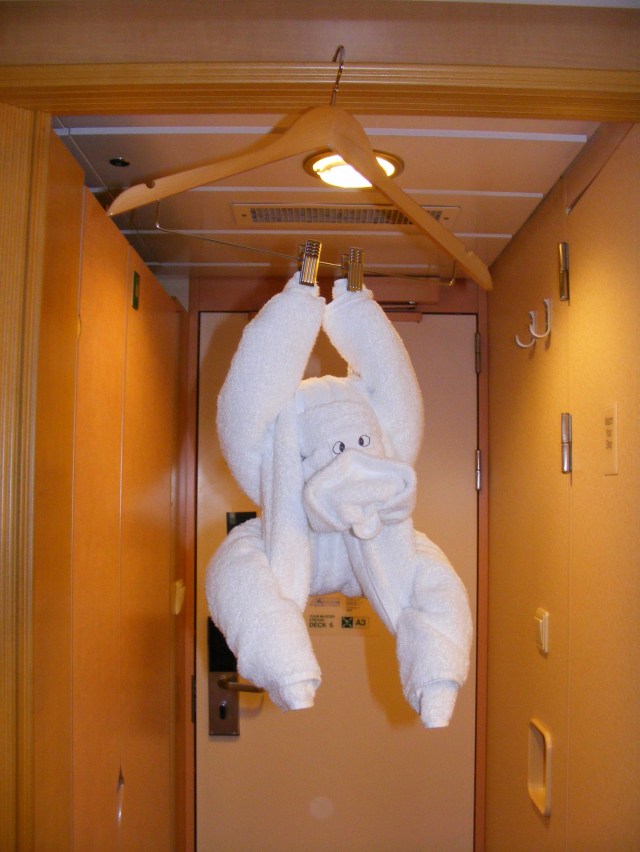
Having eaten too much yet again – pizza for me, more cow for my companion – we listen to Michelle Patient’s excellent presentation, introducing us to DNA testing. We arrive back to the cabin to find a towel sculpture in the form of a monkey suspended from the light fitting, appropriate with Gibraltar as our first port of call.

003 23 September 2019 Towel Monkey.JPG

After a much better night’s sleep, having lost an hour due to the time difference, we take a leisurely breakfast. We are quizzed in depth by the restaurant manager about the food and service. We lavish praise liberally. He has asked for our cabin number. He is welcome to pay us later for our fulsome feedback. We learn more about DNA from Michelle; this time ‘Getting the most out of Ancestry DNA’. We are encouraged to use the, often overlooked, help sections of the website. I now have more ideas to try when I get home.

After lunch, Mia Bennett encourages us to make use of the 300 years’ worth of papers in the British Newspaper Archive. Some of the papers in their care are Indian titles, which was news (oh dear, there’s a pun in there somewhere) to me. I access the archive via Findmypast but a great advantage of a BNA subscription would be the ability to cut and paste the OCRed text. That could save me hours when typing up transcripts.

We play truant from the conference so I can have a swim. It is still a tad breezy on the top deck. I stride purposefully towards a pool, wondering why it is empty. As I begin my descent down the steps, I realise why no one else is swimming here; it is freezing. As I am surrounded by people, I feel obliged to brave this out and act like the sub-zero temperatures were no surprise. I splash about a bit, avoiding the many insects that have met their demise in the pool, just long enough to look convincing, before repairing to the warmth of one of the whirlpool baths.

The next conference session is the help desk but I only have one person who requires my assistance and it is a straightforward and swiftly answered query.

Yet more food in the Windjammer and then our evening session, which is Paul Miner speaking about non-conformists and recusants, explaining the complicated timeline that is the story of British dissent.

Southampton – Day 1 of our genealogical cruise adventures

I never need an alarm clock; I can’t remember the last time I set an alarm and did not wake up before it went off. Equally, it must be months, if not years, since I was not awake before 6am. I have to be ready to leave the house at 6.45am. Initially, I don’t bother to set the alarm, then I decide that this might be the one time that I need it. The redundant alarm clock is already set for 6.10am from earlier in the week. I don’t bother to change it. I wake up at 4.45am, maybe just a little too early. I can’t get back to sleep. Oh, it turns out that I can, at about 5.30am, only to be woken by the alarm at 6.10am! Nonetheless, I am only a couple of minutes late when the taxi, aka Chris, arrives.

An uneventful journey is marginally enlivened by being stuck behind a cesspit-emptying van with the registration letters POO. We arrive at Gate 10 of Southampton Docks, having picked up Chris’ daughter, who is kindly going to drive the car back to her nearby house for the fortnight. Now comes the dreaded procedure that is getting Chris’ large metal box of seventeenth century medical instruments on board. As these include axes, saws and knives, albeit blunt ones, we have not left this to chance. The getting permission process started over a year ago when we spoke, in person, to the security officer on this very ship. Since then it has involved several phone calls to America, even more phone calls to Australia, emails, on-line chats, sending out a detailed inventory complete with photographs and the efforts of seven people. Only this week did we get an email that suggested all might be well. Being an American ship, it might have been easier to bring the musket on board; we could claim the second amendment. We encounter a very rude member of staff at baggage handling, when Chris, admittedly a little curtly, explains we have permission to take the box on. She then refuses to tell us where security is, on the grounds that ‘we obviously knew everything’. This left rather a sour taste. Using our prior knowledge from a previous cruise, we find security without troubling her to do her job, only to be greeted with, ‘Oh, we were expecting this last week’. Have we inadvertently gained permission to take the kit on the wrong cruise?

Chris has to carry the box on board himself. It weighs all of four stone. It is a very long way. He is looking in dire need of medical help. Never fear, there’s a barber surgeon on board. Oh, that would be him then. With several thousand people on The Explorer of the Seas, our home for the next two weeks, it is a happy co-incidence that we find ourselves sharing the lift with friends. It will be an hour before our cabin, sorry ‘stateroom’ (it is a windowless box), is ready. Encumbered as we are with a large metal box containing medical equipment, not for us are the refreshments of the Windjammer Restaurant, or sunning ourselves on the open deck. We need to wait until we can dispose of the kit. We pass the time people watching. A security chap complete with riot helmet walks past, pushing a trolley marked ‘clean laundry’. This appears not to be designed to fool. What is inside does look remarkably like freshly ironed sheets. Pristine bedlinen is obviously at a premium.

Cabin inspected, we head for refreshment. Enormous slices of cake, luridly decorated with a Union Jack, are being served. Why is it that red food colouring never comes out red? Numerous portions of untouched cake are being left on plates. As on previous cruises, I am appalled by the food waste. If you don’t like cake, why take a slice? We have a view over Southampton Boat Show. I am unimpressed by gleaming, luxury yachts. There is however a tall ship that looks much more fascinating.

Next, the obligatory but farcical, safety drill. It seems that some of our fellow passengers do not understand the concept of obligatory. Are we all to be kept here in detention until the miscreants arrive? I wonder if any provision is made for those on board with sensory issues. Bright lights, noise, crowds, having to remain in the room, all the stuff of which nightmares are made. I might just ask how they would ensure that such passengers were accommodated. I have zero intention of bringing a person with sensory issues of my acquaintance on a cruise (the mind boggles) but spreading awareness is no bad thing.

We set sail; is that the correct expression for a vessel with no sails? The Isle of Wight slips past and we wave to invisible friends. Chris has already consumed two ice-creams from the help yourself ice-cream bar. Then a meet and greet for conference goers, over half of whom we know; it is great to get reacquainted. Food next and it is ‘Tex-Mex’ night in the Windjammer. We habitually reject the two sprigs of asparagus and a bit of drizzle on offer in the formal dining area. I’ve gone for sweet chilli chicken and Chris is tucking in to salmon and the first of what I am sure will be many steaks. On our last cruise he ate his way through a whole cow. Another reason for rejecting the formal dining is that I find being waited on discomforting. It is not at all the same as in a British restaurant. The staff act like we are better than them. We aren’t. It should not be a job requirement to be so self-effacing but it is.

002 21 September 2019 Southampton Boat Show.JPGPaul Milner begins the conference with an interesting session on ‘The English Context: history, sources, repositories and processes.’ A veritable minefield for those researching from overseas, as most of the audience are; there are only five Brits at the conference. We debate why some counties are shires and some are not. Could it be the migration patterns? Why is County Durham, the only county to be described in this way? Probably because it is the only non-shire to have a county town (or indeed city) of the same name as the county, so it is a way of distinguishing between the county and the city. And so to bed. On our way past a public area an enthusiastic member of the entertainments’ team is exhorting his audience to believe they are butterflies. Numerous apparently sane adults are waving their arms, sorry wings, about. We don’t linger to find out what all this is about. The ways of cruise ships are unfathomable.

Genealogical Sleuths – Fiction for you to Enjoy

Until recently, I was a columnist for the In-depth Genealogist Magazine and also wrote for their blog. Now the magazine is sadly no more, contributors have been invited to re-post their blog material elsewhere, so that it is preserved. This is another post that I wrote for the magazine; it has been updated since it first appeared in January 2018.

In recent years, several authors of fiction have chosen genealogical sleuths as their main characters. In general, these are crime novels but frequently they have a ‘time-slip’ facet, so that they also contain elements of historical fiction. I have to say that if genealogy was as dangerous a career as some of these books imply, no one would be advised to take it up. The mundane might be more realistic but would not make for very exciting fiction. I thought that I would introduce you to a few of my favourite exponents of this genre. There are others and I hope that readers will share details of those that they have enjoyed. In an effort to be fair, I have listed the authors in alphabetical order.

Nathan Dylan Goodwin writes about ‘forensic genealogist’ Morton Farrier. Two threads run throughout the books that have been published so far. The first relates to Morton’s quest for his own ancestry and the other is his developing relationship with his police officer partner, Juliette. There are five full length novels, plus four shorter adventures in the series. One of the latter, The Asylum, is currently available as free download. In these, Goodwin writes of such things as Edwardian Britain, Suffragettes, the Western Front, The Battle of Britain and his hometown of Hastings. In addition, Ghost Swifts, Blue Poppies and the Red Star is the first in a new series about Harriet McDougall and is set in 1919 as Harriet investigates the story behind the loss of her son in the First World War.

M J Lee introduces us to former detective Jayne Sinclair. So far, there are six books in the series including The Irish Inheritance, which is a case that centres on the Easter Rising, whilst The Somme Legacy covers both the first world war and the suffragette movement. The American Candidate sees Jayne investigate the background of a potential candidate for the American Presidency and takes us back to the 1940s.

The Irish Inheritance Cover LARGE EBOOK.jpg

John Nixon’s genealogist is also female, in the shape of Madeleine Porter. So far, there are eight books in the series and her adventures include, The Cuckoo Clock, Stolen Futures, Family Shadows and Another Summer, which revolves around a First World War mystery. The Cost of Silence begins with the murder of a genealogist. Have they been silenced before they could uncover something inconvenient?

Another Summer (A Madeleine Porter Mystery) by [Nixon, John]


Wendy Percival has also created a female genealogist, in the shape of Esme Quentin. The first book, Blood Tied, begins with the murder of an unidentified victim and unravels a sixty year old family mystery. The Indelible Stain takes us from a dying woman on a North Devon beach, to the story of a young girl’s transportation to Australia. The third book, The Malice of Angels , focuses on the Special Operations Executive in the Second World War. The most recent offering, Legacy of Guilt, is available for free download on Wendy’s website. There is also an Esme novella, Death of a Cuckoo.

BLOOD-TIED  RGB cover image (updated).jp

Steve Robinson’s anti-hero is American genealogist Jefferson Tayte. Many of his cases take him to the UK and his bumbling attempts at relationships echo throughout the seven books. In this series, we have another genealogist who is seeking out his own birth family. The first book, In the Blood, is set in Cornwall; a centuries old murder is solved thanks to his efforts. To the Grave sees Tayte unravelling a secret that has been kept since the days of World War Two. Kindred is also set in the Second World War. In The Last Queen of England, fact and fiction are intertwined as Tayte races against time to solve a puzzle, set by members of The Royal Society, relating to the rightful heir to the throne. The Lost Empress focuses on a 1914 shipwreck that has remained relatively unknown in the shadow of the Titanic and Lusitania.

Geraldine Wall’s series of five books feature Anna Ames, a probate genealogist. The continuing thread concerning Anna’s own family, including, in the earlier books, her husband’s developing early onset dementia, is a positive addition to her ‘File under ……’ series. Although there is perhaps a little less genealogy and more family relationships in this series they are deserving of inclusion. The latest in the series, File under Fortune, follows Anna’s research into her own Traveller heritage.

book cover of File Under Fortune

Happy Reading!