A really interesting brickwall-busting workshop with Mia to start the day. I am pleased to be able to contribute to the demolition. Then at lunchtime we are off to Honfleur. We are now in temperatures that are 15 degrees cooler than three days ago. Some sort of happy medium would be good. Our tour guide today is Amilee. Normandy, where we are, is of course the country of the Vikings (North/Norse men). They were in this part of the world from the eighth century. In 911 Robert I, from Scandinavia, became the first Duke of Normandy. The area is also the home of impressionist art, noted for the move away from aristocratic portraits, in favour of landscapes and movement, with accurate interpretations of changing light. We cross the Seine, named for its snake-like sinuous turns. Normandy is noted for its beef and dairy cattle, cider making and calvados.
From Amilee we learn that Honfleur means ‘house on top of the hill’ and unusually, the port was not damaged during the Second World War. Honfleur was the major harbour until it began silting up, so Le Havre was built 500 years ago on the north bank of the Seine. Le Havre is now the biggest port in Europe and it certainly takes us a long time to drive across it. It is not however the busiest, that honour goes to Rotterdam. Honfleur was the site of many battles during the 100 Years’ War against the English. Amilee mentions fourteenth century English Protestants, which makes me doubt her historical knowledge. Like parts of the south-west of England, Honfleur had links with the Newfoundland cod-fishing grounds. Salt for the fishing industry came from La Rochelle. The French don’t call the English Channel the English Channel, to them it is just The Channel. Honfleur is a focus for artists and the go-to seaside for Parisians.
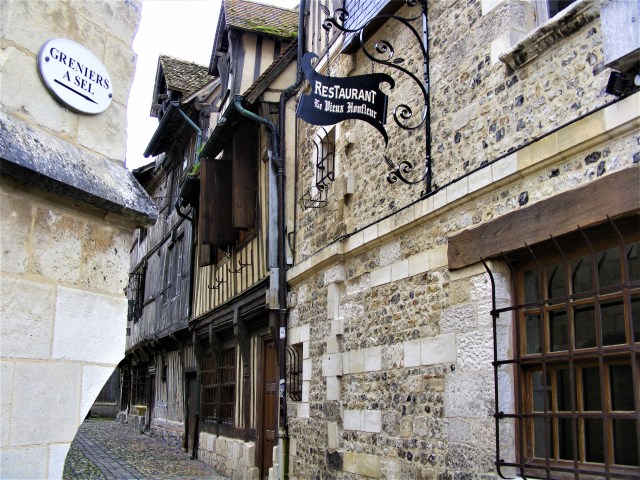
In Medieval times, tax was based on the size of the ground floor of buildings, hence the practice of jutting out the upper floors. This was stopped when the tax was placed on windows instead. Wooden shingles on the facades are typical of the area. St Catherine’s Church is all wooden and is famous for having two naves. We see the ‘road of the little butchers’ aka the Shambles and hear about Frederic Sauvage, the inventor of propeller, which was first demonstrated in Honfleur in 1832. In my tour of the souvenir shops, I have an unfortunate incident with some fridge magnets. I may just have spun the carousel upon which they were displayed a trifle vigorously and some found themselves on the floor. I promise I picked them all up. I am not prepared to comment on whether or not they all survived unscathed.
We move on to Deauville, a town that was developed as the holiday playground of the rich in the nineteenth century. The popularity of sea bathing amongst the well-to-do meant that other attractions, such as the casino and race track were also built. The town is mostly shut up for the winter. Deauville is now full of expensive Parisian holiday homes and it really wasn’t our sort of place; it clearly caters for the luxury end of the market. No opportunities to buy tourist tat here. We wander around the town and along the beach where many of the beach huts are named for film stars.
The evening is Master Christopher’s opportunity to cure a few ailing passengers. He has an excellent turn out and the appreciative audience watch as he performs enemas and amputations with aplomb.

 The History Interpreter - Janet Few