Well it is advent and I usually offer an ‘advent calendar’. After the 100 days posts, I am not sure I can commit to 24 ‘windows’ for you to open but we will see how we go. I have decided to focus on some of the historical/genealogical sources that I used in the writing of Barefoot on the Cobbles.
When you are trying to recreate a geographical past, old maps are invaluable. For the scenes set in Bideford and Torquay, I made use of reproduction, large-scale Ordnance Survey maps issued by Alan & Godfrey. Their output covers a range of British towns, with maps from the 1860s to 1910s. They say, ‘Most of the maps are highly detailed, taken from the 1/2500 plans and reprinted at about 14 inches to the mile. They cover towns in great detail, showing individual houses, railway tracks, factories, churches, mills, canals, tramways and even minutiae such as dockside cranes, fountains, signal posts, pathways, sheds, wells, etc.. Each map includes historical notes on the area concerned. We also publish a series of smaller scale Inch to the Mile maps.’ There are maps available for more than one date for some towns.
Using the 1904 map for Bideford, I planned a courting scene set in Victoria Park, clearly depicted on the map. Fortunately, I double-checked in the newspapers and discovered that the park was created for Queen Victoria’s diamond jubilee, not her golden jubilee. I was writing of the early 1890s; the park was not there at the time, so the scene had to go.
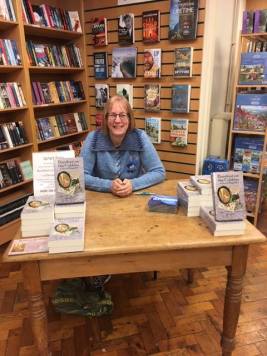 In what passes for normal life, I have been busy book promoting. This week has meant talks in five locations (who thought that was a good idea?) from Taunton, to Plymouth, to Bude. I have also sat in Walter Henry’s lovely bookshop signing books.
I have chatted to my lovely Pharos online students, giving advice on writing up their family history. Their course is coming to an end but January will bring the start of my course on tracing people and places in the early twentieth century, a period that I enjoyed focusing on for Barefoot. Family historians often neglect the twentieth century as being ‘not really history’ but there is plenty to be discovered about individuals and the communities in which they lived between 1900 and 1945. Twentieth century research brings with it the difficulties of larger and more mobile populations as well as records that are closed to view. This course sets out to provide advice for finding out about our more recent ancestors and the places in which they lived, so it is ideal for family historians and local historians alike. You will be surprised how much progress you make if you concentrate on a small time-frame.
More information about Barefoot on the Cobbles can be found here. Copies are available at various events and at all my presentations. You can order from Blue Poppy Publishing or directly from me. Kindle editions are available for those in the UK, USA, Australasia and Canada.

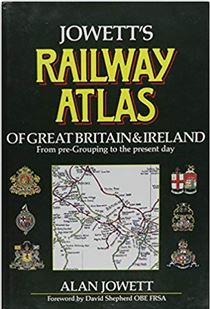 In the novel, my characters take a railway journey. In order to make that section of the book realistic, I needed to research the routes that would have been available at the time. For this, I turned to the invaluable Jowett’s Railway Atlas. It seems that this is now out of print, which is a great shame but there are some second hand copies available online.
 The History Interpreter - Janet Few