#100daysofbfotc Day 47: Jack Foley


Donkeys going down

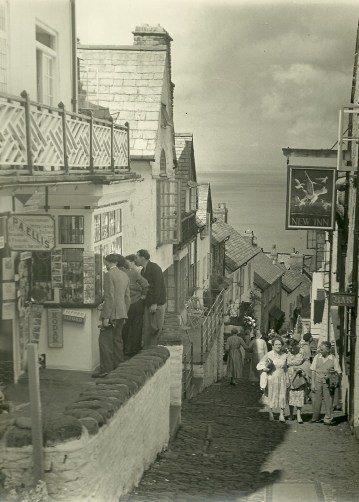
Donkey apparently going down the street

We meet Jack Foley in wartime Clovelly, when he is responsible for supervising the donkeys that transported goods up the cobbled street. As I was writing Barefoot on the Cobbles, Jack’s role in the novel resulted in a lengthy debate. I had composed a passage during which Jack led a laden donkey down the street. It was then pointed out me that donkeys only carried luggage up the street and the downward journey would be undertaken using a sledge. Regretfully, I re-wrote the passage. Then a photograph was found where a laden donkey appeared to be heading down. I regretted my re-write but it seems it was necessary after all, as I later learned that this was a posed photograph and not a reflection of real life in Clovelly.

The John, or Jack, Foley who appears in the novel was born in 1880 into a seagoing Clovelly family. John however remained ashore and became a carriage driver, almost certainly working for Mrs Hamlyn. In later life, perhaps due to the advent of motor transport, he worked as a general labourer. In 1903, he married Dorothy Wonnacott and spent most of his life living at 85 High Street, Clovelly. He died in 1962.

‘The Collins trailed a few paces behind their luggage as the lurching sledge negotiated the cobbles under the adept guidance of Jack Foley.’

Barefoot on the Cobbles will be published on 17 November 2018. More information about the novel can be found here. Copies will be available at various events in the weeks following the launch or can be pre-ordered from Blue Poppy Publishing or the author.


#100daysofbfotc Day 46: Mary – ‘Mrs William’

Mary, a fisherman’s wife, appears in the first chapter of Barefoot on the Cobbles. She is the first mother that we get to know in the novel and through Mary, we can experience a manifestation of motherhood that is rather different from those that are revealed in later chapters. Unlike most Victorian families, Mary has only two children, Albert and Fred. There is no evidence for any other live births but she may have suffered miscarriages. Of course, there could have been another reason for her untypical lack of fecundity. The story of how she opens her heart and home to young Eadie is a true one. Like a number of Bucks Mills’ wives, Mary was often known by the forename of her husband, to avoid confusion with others of the same surname, hence ‘Mrs William’.

St. Anne's Church (old postcard)

St. Anne’s, Bucks Mills

Mary’s post should really have been yesterday. She was born as Mary Jane on 22 September 1842 at Horn’s Cross, Alwington, Devon to Richard and Hannah Hamlyn née Lewis and she was the only child of their marriage. They were a farming family and Mary worked as a launderess; nonetheless, in 1862, Mary met and married William, a fisherman from the neighbouring parish. Theirs was the first marriage in the newly opened Anglican church at Bucks Mills. Their son, Albert arrived nine months later and his brother followed two years after that.

Mary lived at Rose Cottage in Bucks Mills for the last forty years of her life. She died in 1928.

More information about Bucks Mills can be found here.

Albert was explaining to his mother how he had rescued a distressed Eadie from the square.

‘Mebbe you stay here for a day or two maid, ’til your da calms down,’ said Mary.

There was reassurance in the words but who was the more comforted, Mary or this dark-visaged child with sadness in her soul? Mary turned to her son, who had unwittingly presented her with a few days of companionship.’

Barefoot on the Cobbles will be published on 17 November 2018. More information about the novel can be found here. Copies will be available at various events in the weeks following the launch or can be pre-ordered from Blue Poppy Publishing or the author.

#100daysofbfotc Day 45: Richard Wakely

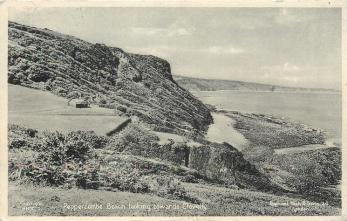
Peppercombe‘Richard’ Wakely is one of the characters in Barefoot on the Cobbles whose christian name had to be altered to avoid confusion. In real life, he was named William and he lived in the hamlet of Peppercombe. Born in 1835, he began his working life as an agricultural labourer and around the time of his marriage to Eliza Found in 1860, he trained as a ship’s carpenter. In order to ply his trade with Waters’ boatbuilders in Appledore, he walked in to town each week, returning to his family at weekends. William was still working in his late seventies even though he would have been eligible for an Old Age Pension.

The Wakelys had a son and five daughters who survived infancy, two others died as babies. William himself died at the age of 95, in 1931.

Her father’s tar-stained holdall was slung across his shoulder and thudded on his back with each successive step. It receded into the distance, as he gained more ground. Richard seemed unaware of his daughter’s presence, let alone her exertions. Lost in thought, he spat a plug of tobacco into the bank and kept his gaze firmly forward, glad that the heat of the day was abating for the journey. Richard contemplated the long walk ahead of him.’

Barefoot on the Cobbles will be published on 17 November 2018. More information about the novel can be found here. Copies will be available at various events in the weeks following the launch or can be pre-ordered from Blue Poppy Publishing or the author.

Day 4 – Skagway

Finally, we seem to have adjusted to the time difference. I attempt to download my photographs from my camera and after a fruitless search, remember that there is no slot for an SD card in this tiny lap top. Do I have the required cable? Of course I do, I just don’t have it here. Fortunately I am able to borrow a slot enabled laptop and back up copies. We sit chatting while we wait for our White Pass Railway and Scenic Skagway tour. There are rumours of Hurricane Florence approaching, forecast to hit the east coast on Friday. That would be the Friday when we are flying home from the east coast. Deep joy, now we are likely to be stranded in Washington airport.

We leave the ship in plenty of time to get our bus and have a quick look at the pier end of Skagway first. The cliff sides are painted with ships’ flags and captains’ names. We later learn that this is a rolling registry of ships that was begun in 1898 and allegedly, the higher the sign, the greater the regard in which the captain was held.

Our driver on bus 109 is Caleb. He warns us that it is a no smoking bus and if anyone smokes, it will be assumed that they are on fire and they will be duly extinguished. After a couple of minutes on the bus we all disembark in order to watch a short video about the area. The Klondike gold rush of 1898 led to the development of Skagway. The trail to the gold fields took an enormous toll on both horses and men. It takes a ridiculously long time for everyone to get back on the bus and two minutes later we are reversing the process yet again as we are at the station.
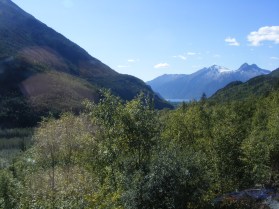
036 10 September 2018 White Pass and Yukon RailwayOur railway carriage, one of 83 in the fleet, is named Lake Klukshu. Skagway means ‘land of the north wind’ but we are fortunate that the weather is glorious, so we have great views of the White Pass and Yukon route. Following the discovery of what was actually very little gold, Captain William Moore, founder of Skagway, together with Skookum Jim, one of the two first nations people who found the initial gold, sought to establish a route to the Klondike that was easier than the existing Chilkoot Pass. Their route, past Lake Bennett, was named White Pass. A sensationalist newspaper headline about the discovery of gold, led tens of thousands of prospectors to take steamers up the inside passage and begin a hazardous 600 mile trek across country to the Klondike. No prospector was allowed to begin the journey without a ton of supplies. The slightly easier White Pass was favoured over the shorter Chilkoot Pass as it was, in theory, possible to take pack animals. Over 3000 horses or donkeys perished on the Pass before the railway on which we are travelling was constructed. They began building this narrow gauge railway in 1898 and reached the summit, 110 miles away in 1899. The route involves steep gradients and tight turns and construction was hampered by temperatures as low as minus 60. By the time the track heading north joined the track coming up from the south, in 1900, over 35,000 men had been employed in building the railroad at some point. The tracks ceased to carry ore after the price slumped in 1982 and the railroad became a tourist destination.

The steam engine that works this route is undergoing maintenance, so we are being pulled by a diesel engine. We travel forty miles through impressive scenery and across scarily rickety looking bridges beyond the White Pass summit, which is 2885 feet above sea level, as far as Fraser, where we disembark. We have now crossed into British Columbia, Canada but not for long. The lakes here freeze in winter and there is sometimes still ice in June, so they are lifeless. After our train ride, Caleb collects us in the coach for our drive back down the Tormented Valley to Skagway. The valley gets forty feet of snow a year. Caleb tells us that no-one has been born in Skagway in twenty seven years. There is no doctor here just two nurse practitioners. As soon as someone is thirty weeks pregnant, they are sent to Juneau. As an aside, the women in front of us are each wearing two baseball caps. This is just plain weird.

We are dropped off in the interesting town of Skagway, in which almost every shop is a tourist trap. There probably aren’t many other employment opportunities for the resident population of 850. Many of the shop owners are standing outside, trying to entice us in and deprive them of their end of season stock.

It is very hot and we spend an enjoyable hour on the deck in the sun once back on board. After a meal of chilli jacket potatoes, the waiter entertains us by balancing three forks on top of cocktail sticks that are in turn balanced in the pepper pot holes – you kind of have to see it. In the evening Dick Eastman talks to us about getting the best out of Google.

#100daysofbfotc Day 44: Captain Thomas Powell

Captain Thomas Folliott Powell was a gift to an author looking for interesting minor characters. He appears only briefly, in chapters 2 and 3 of Barefoot on the Cobbles, yet his behaviour has ramifications that echo through the remainder of the novel. When I first discovered that Polly had been a domestic servant at Chudleigh Villas and that the Powells had advertised for a servant in the local press at the appropriate time, I decided that they made a perfect match. On further investigation, the Powells’ story opened up several opportunities.

The position of troops during the mutiny – wikimedia

Thomas Folliott Powell was born on 3rd August 1834 in Newport Pagnell, Buckinghamshire, the son of William Powell, a solicitor and his wife, Eliza née Miller. The family descended from minor gentry. Thomas bought a commission in the army in 1853 and served in South Africa, the East Indies and India. As a Captain of the 6th regiment of foot, he was involved in the Indian Mutiny of 1857-9. Thomas retired from the army in 1865 and was able to sell his commission for £2500.

There is some confusion about the name of Thomas’ wife, who appears in the novel as Emily but who was in reality Mary Jane Winter (known as Amy), who had been born in the East Indies. They married in London in 1868. Four daughters and a son were born between 1876 and 1882. We can only speculate why there were no children during the first eight years of the marriage. EDIT I have now discovered that there were also two other sons who died in infancy; one was born in 1874 but that still leaves a long gap before the birth of the first child.

The family moved to Chudleigh Villas, Bideford in the late 1880s. Thomas seemed unable to match his lifestyle to his income and he was supported by his widowed mother, who provided the furnishings in their home and made them an allowance of £300 a year. Thomas had first been declared bankrupt in 1883, when he was living in the Plymouth area. He squandered the money he had made from his commission and it seems that a gambling addiction was a major contributor. His father had, perhaps wisely, left Thomas nothing in his will and when we meet him in the novel, Thomas is once again in financial difficulties. The family downsized to Ford Cottages, in New Road, Bideford. His second bankruptcy was annulled in 1898 and Thomas died in Portsea, Hampshire the following year.

‘ Mrs Powell regained her composure and resumed her tirade, ‘Why couldn’t you just have found enough to pay off Mr Tardrew? If you’d only done that, all this might have been avoided. Then there’s that money you owe to Tanton’s Hotel, how could you have run up such a bill? Your mother has been more than generous, we should be able to live comfortably on the three hundred pounds a year that she gives us. What on earth will she think? We cannot expect her to keep making us an allowance if you are such a spendthrift. It is no wonder that your brother has washed his hands of you.’

‘What’s done is done, eh Emily,’ Captain Powell replied. ‘Like as not I shall be declared bankrupt again.’ ’

Barefoot on the Cobbles will be published on 17 November 2018. More information about the novel can be found here. Copies will be available at various events in the weeks following the launch or can be pre-ordered from Blue Poppy Publishing or the author.

Day 3 – Juneau or not Juneau

We still haven’t cracked the sleeping thing, so are up at 4.00am. There are allegedly a large number of hump-backed whales round the ship but all I glimpse is a few spurts of foam. We are heading north toward Juneau and the scenery is impressive. Unfortunately, so is the wind, which gusts at 55 knots. We make the mistake of ascending to the top deck and can barely stand up. Today was supposed to be the day of our extra special, incredibly expensive, float plane experience to see brown bears but the plane cannot take off so, disappointingly, the trip is cancelled. In addition, the wind meant that the ship couldn’t dock in Juneau until two hours later than scheduled. Whilst we were waiting, we spent a very pleasant time in the Windjammer restaurant on deck 11, sunning ourselves and chatting with friends.

018 9 September 2018 Mildenhall GlacierFinally, we are able to dock and the sun is shining on the righteous and on us too. Juneau was a gold rush town, founded in 1880 and is now the state capital. We are invited to join a mad genealogists’ excursion to the Mendenhall Glacier in a hired mini-bus. The first challenge is to cram all twelve of us inside. This involves trying to avoid being garrotted by the seat belt that is strung across the doorway. It is a short drive to the glacier near Nugget Falls. Despite the name, virtually no gold was taken from here and in the early part of the twentieth century, money was made from hydro-electric power, before the area turned to tourism. We learn a little of the local Tlingit people. It is very peaceful here, despite it being a tourist honey pot. Sadly, climate change is taking its toll and the glacier is retreating at an alarming rate. We see some bald-headed eagles on our journey but not in a spot suitable for photographing.
We have been encouraged to visit the Red Dog Saloon and this is something else. The atmosphere is dark and crowded and there is live country music being played. The floor is covered in four inches of sawdust and the ceiling in the flags of various ships. In between, the walls are decked in hunting trophies and graffiti. Chris has trouble finding any kind of beverage that the basque-clad waitress recognises. We settle for Sprite. Then it is back to the ship.

I succumb to the international dishes of the day and consume sweet and sour chicken. Afterwards, Michelle and Maurice entertain us with more on DNA.

#100daysofbfotc Day 43: Clovelly, Rat’s Castle

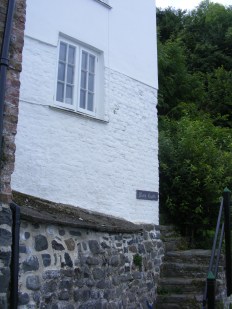
DSCF0708Rat’s Castle, a tiny two-roomed property near Clovelly Quay, makes a brief appearance in Barefoot on the Cobbles as it was Albert and Polly’s first marital home. This cottage was frequently allocated to Clovelly newly-weds, two rooms being all that they required. Tenancies were often short; as soon as the family began to arrive they would be moved on to a larger home. The origins of its name are unknown but presumably the cellars attracted rodents.
‘They had been granted the opportunity of renting the two-roomed cottage known as Rat’s Castle. This tiny dwelling near the quay was reserved for newly-weds and it had suited them well for the past year.’

Barefoot on the Cobbles will be published on 17 November 2018. More information about the novel can be found here. Copies will be available at various events in the weeks following the launch or can be pre-ordered from Blue Poppy Publishing or the author.


Day 2 – At Sea

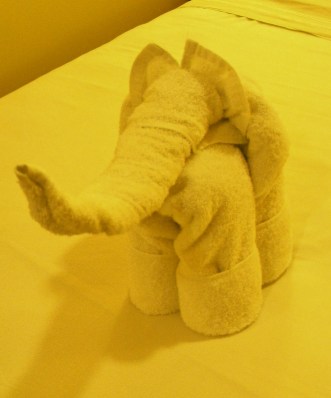
004 8 September 2018 Towel Art

Towel Art

It is 3.50am. My body thinks it is time to get up, so I bow to the inevitable. Today is a conference day so we settle down to some excellent lectures. Firstly it is Maurice Gleeson on ‘Commemorating the Missing’. I have heard this before but this was a slightly different version and my particular interest is because it centres on a battle that has Barefoot on the Cobbles connections. Next, is Caroline Gurney with a very informative presentation, ‘Lost in London’, followed by Susan Brook speaking on the English Poor Law. Cyndi Ingle is as entertaining as usual, this time on ‘Being your own Digital Archivist’.

I am feeling the ship’s motion rather more than I was expecting and have a throat that resembles rough grade sandpaper, add to that the lack of sleep and I am wondering how my session on the impact of non-conformity will go. Go it did, although I didn’t really feel as if I was on fire with it. After a short break to chat, it was time for Helen Smith’s DNA talk and then back to deck 11 to encounter ‘washy washy’. Today she has added ‘happy happy’ to her exhortations. It is Mongolian day in the restaurant. I opt for that well known Mongolian dish – pizza. There has been heavy rain all day so we haven’t missed an opportunity to sun ourselves on deck.

In the evening, Mike Murray gave a hilarious DNA presentation. With a great ‘punch line’ when he revealed that the relatives that he had been talking about were in the audience.

#100daysofbfotc Day 42: Mr Ellis

scan0002Mr Ellis does not appear in Barefoot on the Cobbles in person but his shop is part of the Clovelly village streetscape. John Ellis was born in Peterborough in 1854 and began his working life as an apprentice to a printer and stationer. In his twenties he described himself as an artist but it seems that he could not make a living from this and later, he worked for a woollen drapery in the town. It is not known how he met his wife, Alice Jewell from Clovelly. It is likely that John joined other visiting artists who were attracted by Clovelly’s picturesque street. He and Alice settled in Clovelly after their marriage in 1900 and they had one son, Paul. Although he preferred to be out in the street painting, John Ellis ran a High Street shop, selling artists’ materials and photography equipment, amongst more general items. His son later took over the shop and became a well-known photographer, being responsible for many of the scenes depicted in north Devon postcards.

‘ ‘Ellis’ shop is just down there on the left,’ Daisy said, more confident now. No one could be angry at her politely giving directions to trippers. ‘Mr Ellis is a bit of an artist himself, I am sure he would have what you need.’ ’

Barefoot on the Cobbles will be published on 17 November 2018. More information about the novel can be found here. Copies will be available at various events in the weeks following the launch or can be pre-ordered from Blue Poppy Publishing or the author.

Day 1 – On Board

After four hours of broken sleep it seems it is morning. There is nowhere that we can get breakfast so we take the most expensive taxi ride of my life ($60) and head for the ferry terminal. The one meal of the day I find difficult to miss is breakfast, especially since, bar the one and a half packets of pretzels, it is already twenty four hours since we last ate. The only advantage to the lack of breakfast provision is that we can put the notional cost towards the taxi fare. According to the taxi driver, Seattle’s highlights seem to be that it is home to the international headquarters of Amazon, Microsoft and Starbucks.

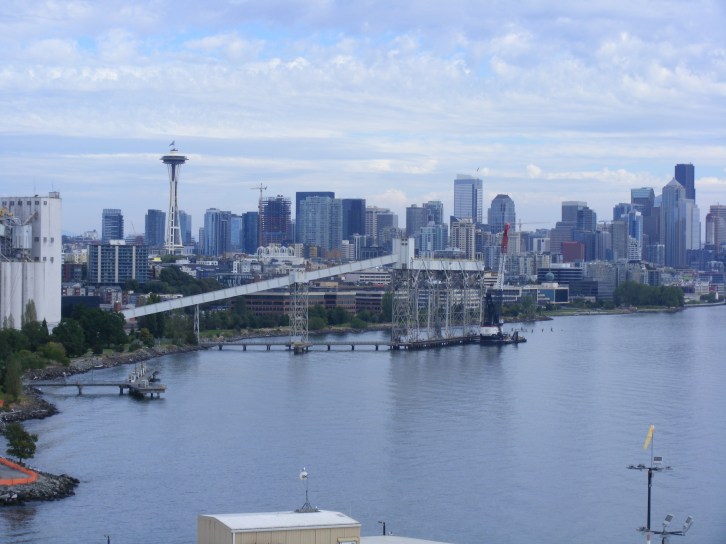
003 7 September 2018 Seattle from the ship.JPG

Seattle

The Royal Caribbean check in process is remarkably smooth and we have already encountered some of our party. I am feeling decidedly light-headed due to the combination of lack of food and intermittent sleep, so we make straight for the 11th floor buffet. Giving that it is 10.45am, it is by no stretch of the imagination any sort of meal time, yet folk are tucking in to three courses as if their lives depended on it. For us this is both evening meal and breakfast but I doubt our fellow diners are so food deprived. We then spend a very pleasant couple of hours on the sunny deck and begin to feel slightly more human. Some cruisers are already on a mission to get the most possible value from their drinks package. Then it is time for conference check in and the chance to greet many old friends and make new ones. The joys of the mandatory emergency drill follow. A keen wind and a raucous poolside party, complete with very loud muzack, drive us to seek refuge somewhere where we can hear ourselves speak. There is a distinct lack of such places.

We are first in the queue when the informal dining room opens for evening business. There is a crew member sporting a stars and stripes covered cowboy hat. She is manically screaming ‘washy washy’ as she squirts all on sundry with hand sanitizer. It may be sleep deprivation but I am somewhat irritated by this. It is reminiscent of meals I have taken in school canteens. Point one, hand sanitizer brings me out in a nasty rash and point two, I am an adult and as such am perfectly capable of being responsible for my own personal hygiene, should I deem it necessary. The staff clap us into the restaurant, amidst fist bumps and high-fives. I have my grumpy old woman hat firmly in place; this is just weird. There is however a great selection of food from which to choose. Today’s culinary theme is ‘Tex-Mex’. I pass on the steak that still looks capable of meaningful life and opt for chilli.

In another example of weird nanny stateness, the carpet in the lift contains an insert that informs us of the day of the week. We are already finding our way round the ship and we join our fellow conference goers for Dick Eastman’s lecture on going paperless. By this time I am struggling to stay awake, so we call it a night.