Social History Book Advent Calendar Day 4

Apologies for the late arrival of today’s contribution to the advent calendar. I have spent the last eighteen hours adding to the list of things I do not have wrong with me. Said list is now assuming the proportions of a three volume novel. Still the good news is that, although what I do have remains a mystery, I don’t appear to have anything sinister. I spent the whole of last night on a trolley in A & E and this afternoon raising the alarm when the woman in the opposite bed tried to pull her cannula out, something that occurred about every five minutes. This means I haven’t slept for 36 hours, so I hope I can be excused if I cheat a little with today’s social history book and use one of my own. I say one of my own; it has my name on the cover but it is really the work of eighty wonderful ladies.
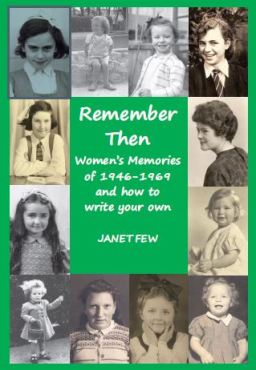
CoverRemember Then: women’s memories of 1946-1969 and how to write your own  is what happens when you let eighty women spend a year and a half recording their memories of life in Britain throughout the pivotal period 1946-1969. This twenty four years was one of tremendous change in almost every area that they investigated. During this time, we moved from liberty bodices to mini skirts and from ration books to ready meals. We witnessed the emergence of youth culture, the comprehensive education system, conspicuous consumerism and a new wave of feminism; the Britain of 1969, was very different to that of 1946.

Very little additional research has been done, the women’s voices have been allowed to speak for themselves. Memories are just that and sometimes memory is fallible. Efforts have been made to check dates and facts but for the most part, the ladies’ accounts have been taken at face value. The aim was not to write a comprehensive social history but to give a flavour of the period from the view-point of those who lived through it. Even reading the first names of the participants takes you back to the classrooms of the 1950s.

The ladies described their homes and neighbourhoods, clothes, housework and food, education and work, health and childrearing, leisure and celebrations, as well as tackling more emotive subjects, such as relationships and attitudes. Over a hundred illustrations and a comprehensive timeline of events evoke the essence of the era. This book is much more than just a collection of women’s memories. At the end of each chapter is the brief that the volunteers were given when working on that topic. This can be applied to other time frames and will help the reader, male or female, to write reminiscences of their own.

The women who took part came from a variety of social, economic and geographic backgrounds. Some ladies went to boarding schools, some to grammar schools and others to secondary moderns. Some left school at fourteen, others have PhDs. Some are only children, others had large extended families and some grew up in care. The ladies were aged from 59 to 95, so some experienced this era as children, some as teenagers and others as married women with families. I wove together the words of this disparate group of volunteers, using direct quotations from their reminiscences wherever possible, to reveal this period, as seen through their eyes. The result is a many faceted perspective of life at the time.

The book allows those born after 1969 to gain an understanding of what life was like for earlier generations. This makes it valuable reading for those working with older people, as it can spark conversations and help to awaken memories. If you lived through this era yourself, you will find yourself exclaiming, ‘I remember that!’ on every page.

Social History Book Advent Calendar Day 3 and Coming up Trumps

As regular readers will know, I am very keen on encouraging the younger generation to take an interest in history and heritage. One of the ideas in my booklet Harnessing the Facebook Generation: ideas for involving young people in family history and heritage* is to use family photographs to make Top Trumps cards. I thought, now that I have grandchildren who are old enough to play this, I would put the idea in to practice. There are available templates online but in the end I made up my own and I found 38 photographs of members of the family tree that could be used. I know I am fortunate to have so many pictures but they are rather one-sided, the vast majority coming from my maternal grandmother’s family. If you don’t have enough pictures you could always use pictures of where they lived or drawings (I did wonder about gravestones but maybe not for 3 & 4 year olds!). I decided not to limit it to direct ancestors, partly because then I wouldn’t have enough but also because I wanted to commemorate 4x great aunts who died childless and would otherwise have no one to remember them.

DSCF4299I did have some problems. The cards, are printed on paper and laminated as my printer won’t take card. This is not ideal and you can see through the backs of the cards but this doesn’t matter because of the way that the game is played. The cards are also a bit of a strange shape and it was incredibly difficult to get them all exactly the same size. It probably took me best part of a day to produce two sets. Yes, I could have gone to a pound shop and bought sets of Top Trumps but that would not be the same on so many levels.

We have yet to try these out with the target audience, as they will see the light of day at Christmas. I know in one case I shall have to somehow make the ancestors relate to robots – I am still working on that bit!

On the topic of Trumps – Twitter came up trumps yesterday. I was busy with the arrest scene in #Daisy aka Barefoot on the Cobbles and wanted to know what wording was used in a caution in 1919. I made a Twitter request and sure enough I woke up to eighteen responses including the answer! Incidentally, Daisy will soon have her own page on this website. As it is a ‘based on fact’ novel, I have a large number of old photographs of the characters and the landscape in which the story is embedded. I will be putting some of these online over the next few months – watch this space – well not exactly this space but the space on the website that doesn’t quite exist yet.

Maids, Wives, Widows: Exploring Early Modern Woman's Lives 1540-1714 by [Read, Dr. Sara]From my bookshelf today I offer you Sara Read’s Maids, Wives, Widows: exploring early modern women’s lives. This is a complete guide to how women lived in the period 1540-1740. It covers their day to day activities both domestic and cultural, employment, both paid and unpaid, childbirth and childrearing and much more. The author has used a wide range of contemporary sources in her research and there is a very useful bibliography. The book is illustrated with black and white plates. Inevitably, any social history of this period is relying on sources that tend towards the better off but nonetheless this is a wonderful book for family historians who want to bring their female ancestors to life, for historical novelists looking for background for powerful female characters or for those who just like to immerse themselves in the past. The Amazon link gives you the option of a quick ‘Look Inside’ preview – go for it. I predict that Alex in New Zealand – who is seeing how far through December she can get without buying one of my suggestions – may succumb at this point. There may well be another offering from Sara Read behind a later advent ‘window.’
(Available from me, from the publishers or as an ebook. It is also available via UK and Canadian outlets.)

Social History Book Advent Calendar Day 2 and a bit about Christmas trees

It seems I should have issued a Government Health Warning, so I will remedy that today. If as a result of ‘opening’ my advent calendar, your book budget plummets and your book shelves bulge – I TAKE NO RESPONSIBILITY. Clear?

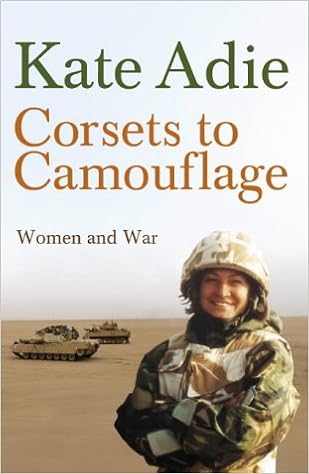
Today’s offering is Kate Adie’s Corsets to Camouflage: women at war. Former war correspondent, Kate Adie, looks at the contribution of British women to the war effort, principally but not exclusively, in the two world wars. She covers not only the armed forces but nurses, land girls and munitionettes. Her own experiences reporting on the gulf war conclude the book. I particularly like the personal touches, when the author reveals snippets of her own family history to illustrate situations or outlooks. The book is illustrated with some not very clear black and white photographs of women involved in conflict at the beginning of each chapter and some much better plates in colour and black and white. This is not just a book about warfare, it is an important contribution to women’s history and an account of changing attitudes to women in traditionally male roles.

So this week I have been decorating the Christmas tree. I know this seems early but my decorations will be abandoned straight after Christmas and I wanted to get my money’s worth. Regular readers will know that my Christmas decorations hold a special significance for me and may also remember the awful incident two years ago when I thought I had lost them. Fortunately no such trauma this time. The tree may be a little smaller than the ideal – it fitted in the room without difficultly but I am please to have it there. I also assembled the History Group’s entry for the village Christmas tree competition. Last year our entry won a prize but this year groups have seriously upped their game and some entries resemble a Harrod’s window display. My excuse for our somewhat low-key effort is that we’ve been spending time on history group activities instead; nonetheless we wanted to be support the event. It is the taking part and all that.


Social History Book Advent Calendar Day 1 and a bit about Medical Procedures

It is December, my descendants have snow, so it must be time for something seasonal. Last year I shared some of my favourite historical novels in my blog ‘advent calendar’; this year it is the turn of non-fiction. Family historians, historical novelists and history fans in general need to immerse themselves in the past; these are books that help you to do just that. For the next twenty four days I will share with you a book that has helped me to evoke a past era. I have just pulled volumes from my bookshelves, so the historical periods will be varied and the choices eclectic. Some of the posts will be very brief and they will be interspersed with other randomness but here goes.

Food In England: A complete guide to the food that makes us who we are by [Hartley, Dorothy]Today’s offering is Dorothy Hartley’s Food in England: a complete guide to the food that makes us who we are. The book was first published in 1954 but unless you are interested in food history in the later twentieth century, this does not matter. The fact that it is still in print underlines the value of Hartley’s work. If you want to know what we used to eat and how it would have been cooked here is a substantial 676 page volume that will come to your aid. There is a chronological thread throughout the book, beginning with the contribution of the Romans, Saxons, Danes and Normans to our diet. There are line drawings to illustrate, amongst other things, cooking methods, breeds of sheep and techniques, such as scalding a pig. In addition there are plates showing kitchens an dining through the ages. There are also chapters on various groups of ingredients, including meat, vegetables, bread, dairy produce and drink. It is no secret that my culinary ‘skills’ are minimal and that I have no interest whatsoever in food preparation in the present. I do however find historic cookery fascinating. So although this is a book that the cooks amongst you will enjoy, it is also valuable if you want to know what your ancestors ate and how they would have prepared it. If you are an historical fiction writer and you want to make sure that the characters in your novel aren’t eating an anachronistic meal or if you are staging an event that involves period food, this book is highly recommended.

In other seasonal news, I thought that I would relate the saga of the flu injection. I am officially too young for this – just thought I’d make that point – but various health weirdnesses mean that I get invited by a disembodied, automated voice to have a needle jabbed in my arm. In fact no one seems to have told said automaton that I have actually now had my injection, as she is still ringing me up at various intervals. I digress. My appointment is for 10.41. I turn up at 10.30 to be told that the staff are about to have their coffee break but I can be booked in. ‘Booking in’ involves a tick being put against my name and being handed a piece of paper listing potential nastinesses associated with said injection. I sit down and the receptionist disappears for her caffine fix. A man comes to sit in her place. I have no idea of his rank but clearly most things are above his pay grade. He spends the next fifteen minutes repeating 30-40 times ‘I can’t book you in please take a seat and wait. The receptionist will be back in 15, 14, 13 (whatever) minutes. What is so difficult about ticking a name and handing over a piece of paper? Is the receptionist’s union going to object if someone usurps her role? It can’t be a data protection thing because everyone is here for a flu injection and they all go to reception and give the chap their name. Why have a person there at all? Why not just write a notice? During the next fifteen minutes forty people enter the surgery and no one leaves. The patients’ nearest and dearest, sat in cars outside, must be wondering if we are all being swallowed up in some vaccinatory black hole. I begin to feel quite sorry for the guy on the front desk. In the end the ‘audience’ are giggling hysterically as he repeats his message, using exactly the same words and intonation, for the umpteenth time. The joys of getting old.