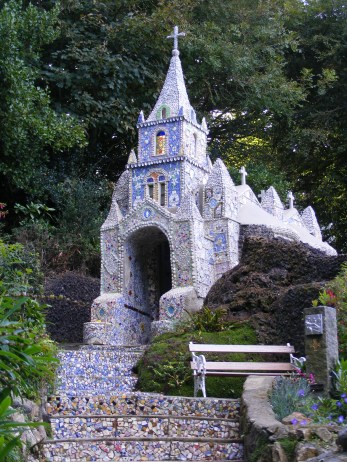
 Today was our last day on Guernsey and we aimed for the south coast. On the way we called in at The Little Chapel. This is a fascinating grotto, decorated with millions of pieces of broken china. Low-key it’s not and probably not what you’d want in your back garden but well worth seeing. It was built in 1914 by Brother Deodat and was inspired by chapels at Lourdes.
We then tried and failed, to find the nursery from which Chris has ordered flowers over the years. We are certainly seeing the back lanes of Guernsey, many of them in both directions as we re-traced our steps more than once. I still haven’t really cracked navigating round the island. There seems to be a positive policy of not having road names and if there are road signs, they are so small that you can’t read them until you are too late to make the turning.
We did find our way to the Occupation Museum; it seemed important to respect this aspect of Guernsey’s history. This is a privately run labour of love and we learn about the five years of occupation – 1940-1945. Half of Guernsey’s population, including men of military age, were evacuated before the Germans took over. On Alderney only eleven islanders remained. The Germans changed the driving regulations, so that everyone had to drive on the right. This would not have affected the locals much as they were not allowed motorised transport. Cinemas remained open but showed German films. The islanders went round painting V for victory on stones and walls; anyone caught doing this would have been severely punished. The Germans painted laurel wreaths under the V signs, to indicate German supremacy.
Prisoners of War were brought in to construct fortifications round the coast, which was heavily mined, with over 66,000 devices. In 1942, all non-Guernsey born people were sent to internment camps. After D-Day the islands were effectively cut off and there were severe food shortages. By December 1944 the Red Cross began delivering food parcels and the island was finally liberated on 8 May 1945. The museum was full of poignant individual stories of both locals and occupiers.
There was a very amusing incident involving beige shorts (not mine) and missing melted chocolate peanuts but I have promised not to mention that so I will leave it to your imagination. There was, thankfully, very little work we must not mention today, so I took the opportunity to try to make sense of my family history notes from yesterday. The Huguenot connection looks even more interesting than I first thought and rapid contact with another researcher revealed why they were forced to flee from the Poitou region. One child had already been removed from the family as her parents had been married in a Protestant church, which was not legally valid. It is likely that they came to Guernsey in 1699-1700, when they realised that the wife was once again pregnant, leaving the oldest daughter with other family members in France.
 The History Interpreter - Janet Few
A few years ago I researched the family history of chum’s cousin surname Romeril, who was born in Lincolnshire but spent his early years on Guernsey. His father was a Wesleyan minister who took the position on Guernsey for his health in 1940. Months afterwards, the Germans landed. He remembered that they almost starved after D-Day, as the American General Eisenhower in charge of the invasion refused Churchill’s plea to free the Channel Islands, realizing that they had no strategic importance, and simply by-passed them. Once the invasion was well along, and then of course there were the landings in Sicily and Italy, the Germans on the islands could no longer be supplied by the German military machine, and their boots, clothing, and munitions were wearing out, and they were starving too. Just like the population they had captured. They were equally captured.
He remembered that the German soldiers took none of the food which was brought by a negotiated visit by the Red Cross ship the Vega a few days after Christmas 1944, as it had been brought to support the Channel Islands population, not the German army. Given that they were almost starving themselves, he thought that was amazing. However, many of the native population took pity on the starving Germans, and shared their food with them voluntarily. Cheers, Brenda p.s. BIFHSGO Conference next weekend!
Enjoy BIFHSGO – wish I was there!
I wish you were too!
Your chat about engaging younger people in September 2015 got me started for the first time ever on facebook. to keep in touch with two young people for whom I am honourary Grannie, my late husband’s grandkids in Ottawa, while I was in the UK for 13 months. I still message with them on facebook, setting up times to get together with them. And you also got me started on a One Place Study, don’t forget that!
The moral of this story is that you certainly had an effect, at least on me! Hugs to you in grateful thanks, Brenda