Irish Adventures Day 30

We seemed to have survived Storm Agnes unscathed so headed off for Cobh, which I was pronouncing Cob but is apparently pronounced Cobe, to rhyme with robe. The railway station at Cobh aka Queenstown has been converted into a heritage centre that commemorates Irish emigration; over three million people left from Queenstown between 1815 and 1970. We were attracted by the signs to a free car park, which looked like it was going to be a fair way from the centre but turned out to loop back so as not to be, so we were glad that we resisted the lure of paid for on street parking.

There is a statue outside the centre that commemorates Annie Moore, a fifteen year old girl from Cork who was the first person to go through the immigration centre at Ellis Island, where there is also a statue of her. You can book a hour’s consultation with a genealogist at the centre for an eye watering €80. I need to put my prices up! We’d barely got through the door when Chris somehow got into conversation with someone who had been at the same school as he had and knew people he knew. I am used to this happening at home but this did seem to be quite a coincidence.

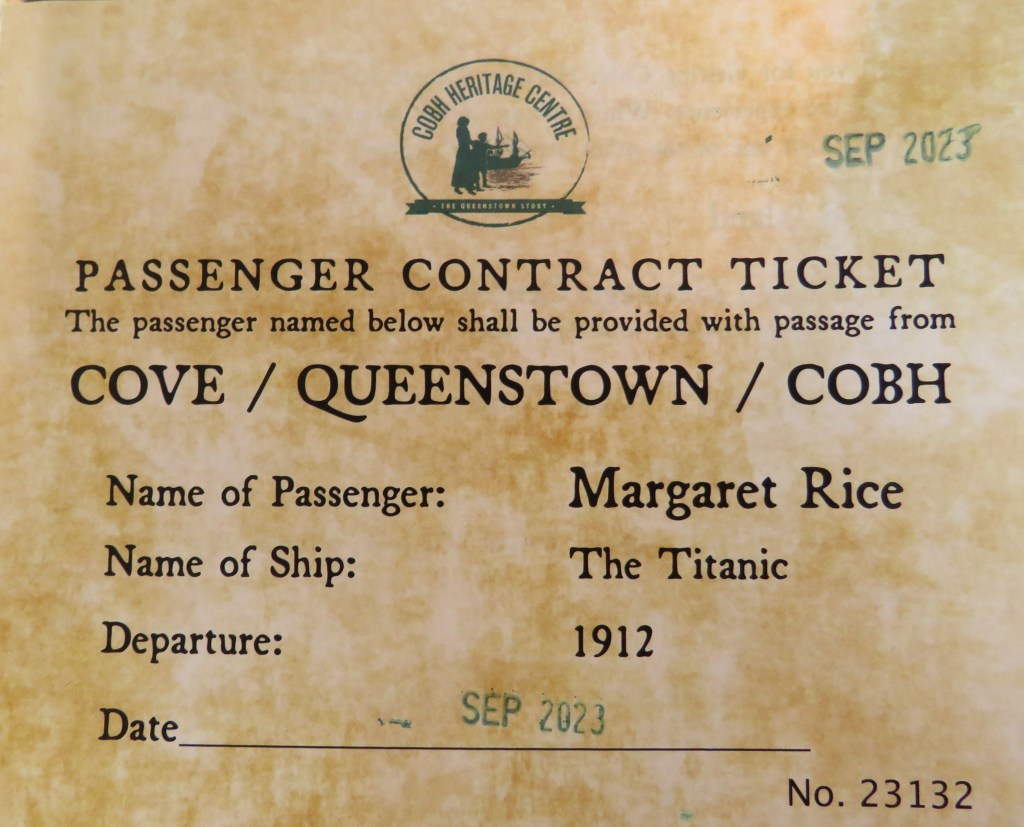
On admission to the centre we were given tickets bearing the name of a real emigrant and the actual ship on which they sailed. These emigrants left Ireland and different times in history and we were told that we would find out their fate as we went round the museum. We were both given tickets for the Titanic, so realised that this probably wasn’t going to end happily. Chris’ character was a twenty year old who eloped with a young eighteen year old to avoid being shot by her disapproving family. It is allegedly their story that inspired the film Titanic. I on the other hand was a widowed mother of five, Margaret Rice, who had been back to Ireland on a visit following the death of her husband with whom she had emigrated in 1899.

The exhibition was very well done and the personal stories were an effective touch. Several waves of emigration and emigrant ships were highlighted. Two hundred political prisoners were sentenced to transportation to Virginia in 1620. They had marched to Dublin to protest at being dispossessed of their land when Sir Arthur Chichester ‘planted’ Protestants in Wexford. From the mid-seventeenth century, Spike Island was used as a holding centre for those awaiting transportation. Many were also leaving as indentured servants. Cromwell was responsible for sending huge numbers of men, women and children to America and the West Indies, many of whose only crime was to be Irish. Kidnappers were offered substantial rewards for everyone they delivered for transportation. With around 50,000 people sent overseas in this way and sold to plantations between 1652 and 1659, in total it is estimated that Cromwell removed half a million Irish people through transportation, murder and starvation, in what was effectively an ethnic cleansing measure. In 1798, over six hundred United Irishmen were transported to Australia following an uprising. I was aware of the Roses from the Heart project to commemorate female convicts to Australia by embroidering bonnets in their name. 25,566 bonnets have been made and some were on display.

The emigrants who left from Cobh in the 1820s, many of whom went to Canada, were also part of the story. Cobh was, of course, the last port of call for the Titanic before she sailed and there was a memorial to all those from Ireland who embarked, the vast majority of whom perished, including our characters. I was pleased to see a photograph of my Margaret and her five sons. I wonder how that survived as the whole family were lost. Only Margaret’s body was recovered; she is buried in Halifax, Nova Scotia. The Lusitania, torpedoed off the Cork coast during the second world war was another disaster that was commemorated in the exhibition. 1198 of the 1959 passengers died and survivors were cared for in Queenstown and Kinsale.

Next was a bit of a drive to the supermarket of our choice. Slightly more of a drive than we’d intended because the satnav was fooled by the new road layout. We did pass some mud flats, where I glimpsed birdlife, including egrets, snipe and oyster catchers, which has been sadly lacking on this trip. On this day we clocked up more than 3000 miles since leaving home.
Irish Adventures Days 28 & 29

Day 28

Fortunately, the predicted overnight storm wasn’t too bad so we could begin our day’s adventures. Another day, another ring, this time the Ring of Beara but first to travel south to reach it. We, ok I, decided to cross the Kerry peninsula, rather than going round the main road, which we had travelled on before. In order to do so I set the satnav to follow the shortest route instead of the fastest. Do we want it to warn us of unsuitable roads? Yes, probably. The satnav makes a bleeping sound. Turns out that was it warning us, who knew? We wound our way up into the mountains until the road gave out. In theory it was a road, both map and satnav were agreed on this but it was a very narrow, bumpy, unmade-up track. Allegedly it went on for at least three miles. Having not realised this was a mistake in time to reverse back out of our predicament, we persevered amidst mutterings about the impact on the suspension. It was a mile before there was space to do a many point turn without falling over a cliff or in a bog. We took a slightly less short route but one that had the advantage of tarmac. This led us past Lough Caragh and across what is allegedly Ireland’s highest mountain range. The sum total of traffic that we encountered in an hour’s driving was one tractor. A rough road (but a least it was a road) and a series of tunnels took us to the eastern edge of the Ring of Beara and into County Cork.

The Ring was another scenic drive, similarly devoid of suitable places for comfort stops as the Ring of Kerry. There were lovely views over Bantry Bay. Many houses were painted yellow, perhaps there was a job lot of paint going cheap. As we reached the north coast, there were large mussel farms. I had hoped that our route would take us along the small portion of the Ring of Kerry that we missed in order to go through the Dunloe gap but by this time the satnav was firmly set to fastest, so we ended up going a different way. In the absence of an alternative on the Ring of Beara, we returned to Muckross for refreshment and their irresistible cakes. Their gift shop’s winter sale had started, so I was able to pick up a couple of much reduced jumpers.

Day 29

It turned out that Storm Agnes, which we thought had been and gone was here right now. We were due to travel a hundred or so miles south to our final site. Should we go or should we stay? It was pretty windy. Once the wifi decided to wake up I found a decent weather tracking site. It looked like the worst of the storm was likely to be about 1pm and it would be more severe in Kerry, where we were, than in Cork, where we were going.

Should we wait until 5pm to travel, when it looked like things would calm down? It was by this time 9.45am, should we go and hope to get there before Agnes did her worst? We ummed and ahhed a bit. I left the decision firmly in the hands of the driver, on the understanding that whatever he decided would become our joint decision and there would be no recriminations! We lurched from one alternative to another and finally decided we would go for it, stopping if necessary. We are dab hands at packing the caravan up quickly and were on the road by 10am. Apart from fording a few flooded patches of road there were no real issues and it wasn’t even raining for the first hour. We did notice that Killorglin was in darkness as we passed through, with the shop and traffic lights out, so it seemed they had no power. We felt that the potentially dodgy bit of the journey might be the Derrynasaggart Mountains but we passed through these without incident. The satnav was a tad fooled by the new N22, which she didn’t recognise but which made our journey quicker, even though this was the most exposed part of the route.

At last we neared Youghal. Should this be pronounced You-gal or Yog-hal? I am not convinced by the satnav’s version of Your. Interestingly, occasionally, the satnav lapses into Irish, so we were heading for Corcaigh, rather than Cork; she did a similar thing for Limerick but Your doesn’t seem, by any stretch of the imagination, to be an approximation of the Irish for Youghal. We arrived at 1.10pm and the last ten minutes had seemed to be windier, so the 1pm predictions were about right.

Accessing the site was ‘interesting’. First, there was a van in the entrance, so we had to wait in the road whilst I paddled across a waterlogged site in a howling gale to find out what we should do. Once the van was out of the way, we were directed up a narrow drive in the hopes we could drive out of a different gate to get where we needed to be. It turned out that this was too narrow and we couldn’t fit the van round the corner. Cue reversing the caravan back round the corner and back up the narrow entrance way. One of the site owners/staff offered to do this for us. Much to my surprise Chris, who would have been capable of these manoeuvres, agreed. I guess then the driver would have been responsible for damaged walls or caravans. Fortunately there was none. In the end the van was turned through 180 degrees and manhandled into position by site staff.

Next to set up as the wind got a little fiercer. When there is a storm force gale going on one thing you need is for your caravan legs to go down for stability. These are electronic ‘automatic’ legs that do have their moments. This was one of those moments and they were on strike. Fortunately we were able to coax them into action and we were able to balance on four legs and two tyres to weather the storm.

Irish Adventures Day 27

With the forecast half decent for once, we set off for a clockwise ride round the ring of Kerry. Having skirted part of the Killarney National Park already, I thought that we would cut off the easternmost part of the ring and drive through the Dunloe Gap instead, as I had planned to do before rain stopped play yesterday. As we began to drive through the gap between MacGillycuddy’s Reeks, we reached Kate Kearney’s Cottage, a large car park and café where plenty of coaches were gathered. A sign suggested that the road beyond this point was for walkers, horse-drawn carts and cars if they were accessing accommodation. A couple of other cars were launching themselves into the abyss. We rashly decided we were ‘accessing’ our route home via the Dunloe Gap. If we thought that driving through the Dingle Peninsula was a challenge, that was nursery slopes compared to today’s route. A ten mile journey, a seven foot wide road (and that’s being generous) winding and I do mean winding, its way up the side of a cliff, with sheer drops in many place. Horse drawn-carts to negotiate, travelling in both directions, as well as the occasional oncoming car. What might just be called passing places were infrequent but fortunately, most people were going in the same direction as us. It took us an hour, which will give you an idea of how carefully it needs to be driven. The visibility wasn’t perfect but was good enough for us to appreciate the spectacular scenery. My advice: travel this road, it is most definitely worth it but don’t attempt to do so by car unless you are bonkers/an extremely good driver, or probably both. On no account try to drive this in anything larger than a standard car, even a small camper van would be impossible. Hiring a jaunting car will probably cost an arm and other appendages, prices start at three figures but that is definitely the way to go and will be a highlight of your trip. My driver claimed that he was enjoying the challenge but it is very unlikely that most drivers would feel the same.

We continued round the rest of the Ring of Kerry. This is number one in our guide book. It was lovely and I was making allowances for the less than optimum visibility. It is a long drive and although there are stretches that are awesome, some parts are a bit mundane. There weren’t many opportunities for toilet/refreshments stops; plenty of restaurants that looked much too upmarket for us but very few open cafés. The best part was the Dunloe Gap, which isn’t part of the official Ring, for obvious reasons. So, yes, do this but I think number one is over-egging it.

We’ve finished our DVDs about farming in the seventeenth century and are now working our way through Ruth Goodman and co. slaughtering animals nineteenth century style.

Yes that is a road you see, not a river.

Irish Adventures Day 26

For those of you saying ‘Are we nearly there yet?’, not too long to go now, we should make it in six more episodes after this one.

This was a day of continual heavy rain, interspersed with intervals of torrential downpours. In poor visibility, we headed for Killarney and although it wasn’t our original plan, decided to begin the day indoors, in the hope that the weather might improve. Spoiler alert – it didn’t. Killarney is noted for its horse and cart trips. These are known as jaunting cars and as we drove up to our destination, Muckross House, we accidentally ended up at the jaunting car entrance instead of that for regular cars. We manage to end up where we needed to be and were pleased to see that this wasn’t quite so overrun with tourists as some other places we’ve been.

The Herbert family settled at Muckross in the early 1700s. In 1837, Henry Arthur Herbert married May Balfour, who he met whilst on his Grand Tour and they commissioned Muckross House, which was completed in 1843. Henry became an MP and they entertained Queen Victoria at Muckross in 1861. The estate was heavily mortgaged and was let for hunting and fishing. There was certainly a preponderance of dead animals on display, including the ubiquitous 10,000 year old Irish Elk antlers. The estate was sold firstly to a member of the Guinness family and then to the Bourn family, before being given to the nation in 1932; it became Ireland’s first National Park.

I particularly wanted to see the traditional Irish farms, which were adjacent to Muckross House. Had we followed the route I tried to persuade the satnav to take us, we would have arrived here on time for them opening at 1pm, having circled Killarney National Park first. Clearly the satnav though only a lunatic would want to climb narrow mountainous paths in driving rain so we ended up in Muckross rather earlier than intended. Having exhausted the craft shops and resisted the temptation to buy stuff we didn’t need, the only remaining indoor option was the café, remarkable for its amazing selection of cakes. We made our refreshments last as long as possible then I swapped my not actually as waterproof as all that shoes for wellies and we took a quick and very damp tour round the grounds.

Next, an equally damp but worthwhile visit to Irish Traditional Farms, depicting a small, medium and large farmhouse from the area, as they would have been in the 1930s, although the actual buildings were older. There were people in the buildings to tell us their history and each farm was equipped with livestock. There was also a working blacksmith, who demonstrated his craft with incredible skill.

Having completed our tour, we debated whether to go straight back to the van or to go via the scenic route. Given the weather, there would be precious little scenery visible, so we decided to call it a day and head for home. Ironically, when I was first planning this trip in 2019, thinking it might be in 2020, when clearly it didn’t happen and when I was revising the plans for this year, I was reassured that the only family history that might be involved was the visit to Ballyedmond. It wasn’t until this point in the holiday that I remembered that some of my grandchildren were 1/16th Irish. To be fair, I don’t think I knew this in 2019. Arggh. What ancestral locations had I missed? A quick rush to the research notes. It turns out that all I know is ‘Ireland’. A bit more work and my strong suspicion is Tipperary. I will have to leave the ancestral photography to them if they ever visit.

Irish Adventures Days 24 & 25

Day 24

As we didn’t have too far to travel and we didn’t want to arrive before check in time, there was time for a look round Adare first. We have already seen quite a bit of the main and almost only, street from the car, as the traffic doesn’t tend to flow very quickly through the town. Adare is a very pleasant looking settlement, much of which is a nineteenth century estate village, with attractive thatched cottages, set out by the Earl of Dunraven. We found a free car park on the outskirts of town; possibly rather more outskirtsy than ideal. First stop was the heritage centre where we could have booked a guided tour if we’d had time. There was a small exhibition which rather gave the impression that it was no longer a priority. Here we learned that Adare Castle was built in 1220 and was owned , briefly, by Geoffrey de Marisco in the 1220s. Cromwell ordered the dismantling of the castle in 1657 and most of the village was destroyed. We wondered if this was the same Marisco family who owned Lundy Island. We had a quick look in Adare’s Catholic Church but the incense was a bit overpowering for a long stay; it was once part of Ireland’s only Trinitarian Monastery, founded in 1230. The aim of the Trinitarian Order, which originated in France, was to rescue those who had been taken hostage in the Holy Land during the Crusades. There is also an Augustinian Friary in Adare, founded in 1315 by John FitzThomas FitzGerald. It was known as the Black Abbey, from the colour of their habits.

We drove on to our penultimate campsite at Glenbeigh. En route there were numerous charity collectors in the middle of the road at junctions, roundabouts and traffic lights. We have also seen this elsewhere This did seem to be effective, if inordinately dangerous. I can’t believe the charity’s risk assessment takes account of this. The route took us through the beautiful Kerry countryside and the site is nestled at the foot of the mountains, close to the coast. There is more heavy rain forecast for the next week, We can only hope that the forecast is about as accurate as it has been for the past few days.

Day 25

This was the day that our luck with the weather finally ran out. Undaunted, we set off in mist and rain to err ‘view’ the scenery of the Dingle Peninsula, well in theory anyway. A clear sunny day would have been glorious but it could have been worse and we did see some spectacular views through the drizzle and cloud. There’s a Ring of Kerry and a Ring of Beara but no Ring of Dingle, probably because the Brandon Mountain gets in the way. Instead, there is more of a figure-of-eight that takes you round the Dingle Peninsula.

We started heading westwards along the south coast of the peninsula, dropping south of the N86 between Anascaul and Dingle, to remain as close to the coast as possible. The route we took is highly recommended, especially if you aren’t blessed with a rainy day when the wind was strong enough to make it difficult to stand up straight. It also requires a driver who isn’t fazed by single-track, twisty roads and who can reverse up the same when something comes in the opposite direction.

We paused for a short while in Dingle to see if there were any interesting fishing boats; there weren’t. Then round the westernmost point and back to Dingle before heading northwards between Brandon Mountain and Stradbally Mountain. Inevitably, this took us up and what goes up must come down, so down as well. Here we were warned that we should turn round if our vehicle was more than six foot wide. We were pretty sure the car was indeed more than six feet wide but things seemed to be coming the other way, so we pushed on. There was a scarily sheer drop to my left and not very far to the left either. On the right towered the granite cliffs, as the narrow road twisted back and forth and we were rewarded with the sun shining on the north coast. Despite the limitations of the weather, the Dingle Peninsula has edged into first place on my best scenery list.

The satnav was deliberately set to shortest route, rather than quickest, which meant that we did not travel on the N70 from Tralee to Castlemaine but on the road that passes through the Slieve Mish Mountains. It is definitely worth going this way if you are confident driving in the conditions mentioned above.

Next was a supermarket shop in what was probably the most inadequate supermarket imaginable. It began by us circling said supermarket looking for its car park, only to discover that there wasn’t one. We secured an on street parking space and then found a distinct lack of things that we were hoping to buy. To top it all, there was only one check out and we arrived with our modest basket full (it would have been less modest if they’d had what we wanted) just as someone began unloading €200 of shopping.

Irish Adventures Day 23

Sorry for the break in transmission. We are now safely back home but you still have a way to go, partly because I don’t normally post holidays in real time but also I’ve been hampered by being in places where the wifi required me to huddle under a tree and for most of the time we were on that site it was raining.

It was time to head eastwards and for once, avoid the outskirts of Limerick. We drove through Tipperary. It has indeed been a long way for us, 2193 miles since we left home. We arrived at Rock of Cashel, another of the guide book’s top ten, coming in at number nine. This meant the inevitable thirty strong queue for the toilets. I decided I could wait. It was just as well, as this meant we arrived just at the right time. A flash of my English Heritage life membership card and we were whisked through like VIPs to join the guided tour that had just started. Rock of Cashel was the seat of the kings of Munster from the fourth century until 1101, when it was given to the church. Brian Boru, later High King of Ireland,  was crowned here in the tenth century. On the site is St. Patrick’s Cathedral, a defensive tower house, the hall of the Vicar’s Choral and a round tower.

We went into the Cathedral first. St. Patrick’s Cathedral was built in the thirteenth century and replaced an earlier structure. The tower was added in the fourteenth century. It is a gothic, cruciform cathedral with an exceptionally short nave. Normally the nave is twice as long as the choir. Initially, the lack of space meant that they were built the same length but to make room for the tower house, the nave was shortened further to become just half the length of the choir. This was thought to make the cathedral unlucky.  The height of the lancet windows was reduced by a third when stained glass was installed. This was a money-saving exercise, as the glass was so costly. Following the Reformation, the Cathedral was Protestant but it was taken over as a Catholic Cathedral in 1641. The Earl of Inchiquin regained it for the Protestants in 1647. He arrived with 2500 soldiers to find 800 people taking refuge in the cathedral, guarded by just 300 soldiers; they were all massacred and the interior of the cathedral was destroyed. The building was abandoned in 1748 and some of the roof removed to avoid paying tax. Massive storm damage in 1848 led to further deterioration. Fragments of a thirteenth century wall painting survived because it had been plastered over after the Reformation. It was rediscovered when a builder accidentally knocked off some plaster.

There were spectacular views from the rock across, we were told, ten counties and we had clear blue skies; luckily the forecasters got today wrong. In a field below was Hore Abbey, also known as St Mary’s of the Rock. It was founded in the 1270s as a Benedictine Abbey but the Archbishop David MacCarwell evicted the Benedictines in favour of the Cistercians. The legend is that this was because he’d had a nightmare in which he was murdered by Benedictines. He was unpopular for spending money that was earmarked for the building of a hospital on the abbey.

Our precipitate arrival meant we had the magic green wristband that allowed us entry into Cormac’s Chapel. There was extensive restoration in 2009, in order to try to remove the moisture from the chapel and visitors are now limited because they tend to breathe, which was having a detrimental effect. Cormac’s Romanesque Chapel was built between 1127-1134 by Comac MacCarthaigh, King of Munster. It contains the first known spiral staircase in Ireland. Entrance is now via the back door under a tympanum depicting an animal that is probably meant to be the bull of St. Luke, despite it looking like a hippopotamus. The front door was blocked off by rival kings. There is a twelfth century sarcophagus inside that has Scandinavian style decoration. It was moved to the chapel from outside to preserve it; this involved removing a wall. There are also some remnants of frescoes from the 1170s, when Henry II visited Ireland and convened the Synod of Cashel. They were done by an artist who also decorated Henry II’s chapel in Normandy and they use expensive pigments including lapis lazuli from Afghanistan.

We looked in the Hall of the Vicar’s Choral, built in the 1420s by Archbishop O’Hedian. This has been styled as it would have been at the time, which means there has been heavy restoration and use of replicas, which is a shame.

There was a bit of a debate about whether we should move on to Kilkenny, which was a further thirty eight miles east and eighty five miles from our campsite but it was, after all, number three in the guidebook charts. We decided to go for it. On arrival we had to look for a car park, which was fairly easily found and very cheap. It did seem to be at the ‘wrong’ end of the city in quite a run down area. There had been signs to the Castle from 40km away but once in the city, could we see any? Of course not. You’d think you could see something like a castle from a way off but no. Fortunately, our instincts were correct and it wasn’t too far away.

Kilkenny Castle, on the banks of the River Nore, was a twelfth century fortress, built by William Marshal. For six centuries it was the home of the Butler family until, having already auction off most of the contents, the 6th Marquis of Ormonde sold it to the people of Kilkenny for £50 in 1967. It is now maintained by the Office of Public Works.  It was extensively remodelled in the nineteenth century. Eighteenth to twentieth century exhibits from a wallpaper collection were on display. There were also seventeenth century tapestries based on a design by Reubens. Here we saw some more 10,000 year old Irish elk antlers. The animal stood at a height of seven feet. I was most impressed by the picture gallery, not for the art but for the elaborately painted ceiling. The gallery was built in the nineteenth century. We did manage to acquire the first ice cream of the holiday. It seems that most places have assumed that the ice cream eating season is over as we’ve seen many empty fridges.

I am willing to admit that perhaps we somehow missed the best bits but although interesting, I am not quite sure whose palm Kilkenny greased to warrant being number three in the guide book’s top ten. I will reveal my own top ten at the end and no one has greased my palm. I could be open to offers!

Irish Adventures Day 22

Sorry, there’s more you still have a little way to go and this now seems like a distant memory.

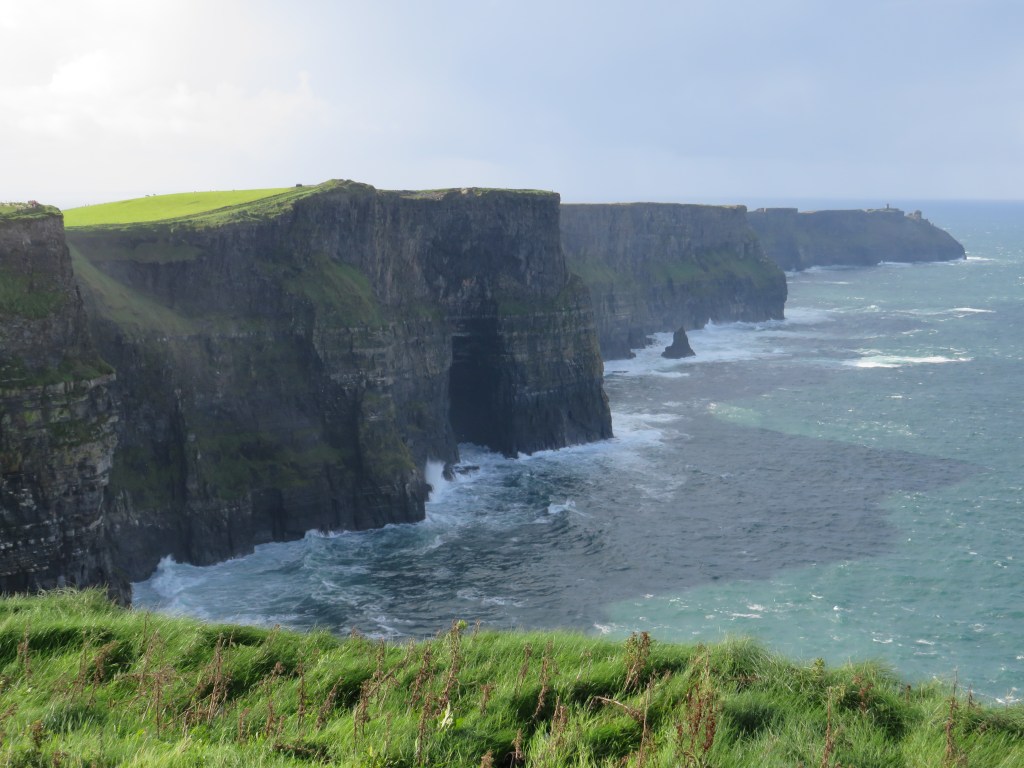
The Cliffs of Moher rank at number 4 in the top ten things to see in Ireland, according to our guide book, so despite them being sixty miles away, we had booked for the ‘experience’. Together with the Burren nearby, the cliffs are a UNESCO Global Geopark; an area with outstanding geology and local culture. The cliffs are 200 metres high with the crashing Atlantic below. The flagstones found on the cliffs were quarried in the nineteenth century and many are now paving English streets. Five hundred men were once employed in this industry but it was made redundant by the invention of concrete. The name comes from ‘Mothar’, meaning ruined fort; there was an Iron Age fort on the site. Storms led Spanish Armada ships to be wrecked along this coastline. Around the bottom of the cliffs are various spots that are allegedly where Spanish sailors were executed and buried. The tower at the highest point of the cliffs was built by Sir Cornelius O’Brien. It was intended as a viewing point for visitors. He also provided a piper to entertain them.

The weather was alternate sunny spells and squally showers, with high winds. We managed to walk to the top of the cliffs in the dry and the visibility was better than anticipated. There are quite a lot of steps but golf buggies were transporting those who couldn’t manage the walk. If you visit and think you might need one, do check out if they need to be booked in advance, there didn’t seem to be very many considering the number of people visiting.

The cliffs are allegedly home to buskers but they were not in evidence, perhaps deterred by the weather. Strong winds and salty air doesn’t do their instruments a lot of good, so these are either custom made to help withstand the conditions, or replaced frequently.

We went back to look round the visitors’ centre. We watched a slightly sick-inducing film of the bird life of the cliffs and the marine life below. This was projected across three screens at angles to each other. It was probably meant to be ‘immersive’ but it had a similar effect to being carried from room to room by someone on a Zoom call. There was the opportunity to have our photograph taken, superimposed on a Cliffs of Moher landscape by using a green screen. You could then email it to yourself. This involved ‘swiping right’ to find your own picture amongst everyone else’s. To me if photos are in a horizontal strip and it says ‘swipe right’ and there is even an arrow pointing to the right, you push them across in the same direction as you’d read a line of text. We failed to find our photo. My trusty companion insisted ‘swiping right was the opposite direction. My argument that that wasn’t right, or indeed correct, fell on stony ground when he located our picture. Good job I am not on Tinder, or should I worry why said companion knows how to ‘swipe right’? The resulting photo has us looking decidedly fuzzy and out of focus in front of a lovely background.

No one can blame Ireland for exploiting everything they’ve got to attract tourists but this was definitely a tourist honey-pot and you couldn’t escape the commercialisation and dozens of coaches in the carpark. A bit like the Giants’ Causeway and Land’s End, this is no longer the wild unspoilt landscape it should be.  To be fair, the visitors’ centre has been built into the cliff in an effort to disguise it but I prefer more out of the way places, some of which, close to home, are equally spectacular. More than 1½ million people visit each year, compared to 100,000 in 1978; perhaps I should have visited in 1978! You’d think therefore that there might have been a few more toilets, larger café facilities and more pay stations in the gift shop. Given that the height of the tourist season has passed, the queues were ridiculous.

We debated heading up the cliffs in the opposite direction but at this point it decided to rain a little more aggressively, so we headed back to the car. We have finished The Story of England and have now embarked on Tales from the Green Valley, the seventeenth century prequal to Victorian Farm.

Irish Adventures Days 20 & 21

Day 20

Despite the forecast for 70% or more chance of rain all day every day for the next eight days and an early shower, we left Carrowkeel to a cloudless sky. We opted to avoid the toll charge on our drive south to Adare. It isn’t that we are pathologically adverse to paying toll charges, it is just that this often has to be done online and we weren’t sure that we would have access to online. By now we have got the hang of the pulling over and travelling on the hard shoulder to let faster traffic pass, which is how things are done in Ireland. We are limited to 80kph when the caravan is on the back. I spend our travelling time translating the kph to mph, which fortunately our satnav does, even if the car is unhelpful in this respect. We drove through Galway and Clare to arrive in another new county, Limerick.

In theory there is only wifi at reception at this site. When choosing our pitch, I opted for one as near as possible to reception. My travelling companion is less keen, ‘we will get all the passing site traffic’, says he. ‘Oh’, I say , innocently, ‘but look it is lovely and sunny and has its own picnic bench.’ Yes, it does also have one teeny tiny bar of wifi from within the caravan, enough to download emails at least. Not that that was a consideration of course!!! It did prove useful as we hadn’t been able to book a site for our last five nights, when we wanted to be in Cork or Waterford. Sites we tried were either closed by the end of our stay, only took camper vans not caravans, or were no longer operating. That teeny tiny bar of wifi enabled us to find somewhere for the final leg of our trip. Slightly longer stays for our last three stops and it feels like we are on the downhill slope now, as indeed we are. The site also provides us with breakfast blackberries.

Day 21

With the forecast rain more in evidence, we retraced our journey from yesterday a short way to visit Bunratty Castle and Folk Park. Fortunately, by the time we arrived, the rain had virtually stopped and we manage the tour without getting soaked.

The site began as a Viking trading post and then a wooden fortification was built at Bunratty, overlooking the river Shannon, in 1251 by Norman, Robert de Muscegros. A stone castle was built in 1277 by Thomas de Clare and the present building was erected in 1425 by the MacNamaras and was later taken over by the O’Briens, who were to become Earls of Thomond. It has been much altered since and was seriously damaged by troops fighting with Oliver Cromwell and later William III. The castle and land passed to Plantation families and had been abandoned by 1800 until it underwent significant restoration in the 1950s, by which time it was little more than a shell. You’d kind of think that if you’d seen one castle you’d have seen them all but there is something a bit different about Bunratty. There is a huge contrast between the large central rooms, including 10,000 year old Irish Elk antlers retrieved from a bog, some very odd light fittings, that are apparently called  leuchterweibchen and are German in origin and the tiny rooms in the towers, which are accessed up some fairly perilous, narrow spiral staircases. Definitely not recommended for those with mobility problems and I did wonder how many visitors had to be rescued having got stuck somewhere in the warren-like one-way system.

In the 1960s, improvements to aircraft, meant that refuelling stops at Shannon airport were no longer necessary and an active campaign to attract foreign tourists to the area began. Much of this revolved round medieval banquets at the recently restored Bunratty Castle, which were offered to visitors for free, along with a coach tour and overnight accommodation to anyone who stopped over at Shannon airport. The banquets continue, although are no longer free and many celebrities have attended over the decades.

The castle is now part of a folk park, with reconstructed Irish dwellings. We’ve been to a few of these now and a bit like castles, you’d think it would be seen one, seen ’em all but we are not yet Folk Parked out and each one offers something slightly different. Here at Bunratty there were farm animals to see and a few costumed characters including a loquacious blacksmith telling tales of the little folk. There was also a shopping street, where some of the shops were also doing duty as retail outlets for crafts people. The last building of the tour was the tea rooms where I opted for an enormous slice of coffee cake. It is very rare for me to be beaten by such things but delicious though it was, I did admit defeat. I couldn’t even offer it to my companion as he is allergic to coffee.

Irish Adventures Day 19

Where to start with the story of our visit to Strokestown? There was so much to take in. As per the weather forecast, there was mist and drizzle as we headed eastward along the N5 to Strokestown, taking us into a new county, Roscommon. This is the home of the Famine Museum and as such tells the story of a significant part of Ireland’s history and also the blameworthy role of the English. This is definitely somewhere that should be on the itinerary of anyone touring Ireland. We arrived just after it opened and were disappointed to see that the house tours were fully booked by coach parties but it was the museum we were most interested in. In general, I am not a fan of audio guides but you definitely need one to get the full benefit of the experience. This is the third iteration of the museum, which was established in 1994; this version was only opened last year. It is excellent, telling the harrowing story in an evocative and informative way. When Jim Callery purchased the estate in 1979, from the Mahon family, who had owned it for three centuries, he discovered 55,000 documents, recording the full extent of the Mahon’s occupancy and being particularly informative about the famine years. One of the documents at Strokestown was the 1846 Cloonahee petition, signed by starving peasants begging for work and seeking action from the Strokestown District Relief Committee.

There was a significant population rise in Ireland between the 1740s and 1840s, with Roscommon seeing a 300% increase, putting a strain on resources, even before the famine took hold. By 1847, there were approximately 12,000 people living on the Strokestown estate. There was a strict hierarchical system, with Protestant ‘Ascendancy’ families owning more than 70% of the land in Ireland. Middlemen rented large tracts of land from the landowners, then sub-let to cottiers at inflated prices, with leases that gave the cottiers few rights and many were unable to pay their rents. In 1845, about a third of the population were cottiers. Spalpeens or labourers worked for the farmers, in return for the chance to grow potatoes. A labourer would eat 14lb of potatoes a day, making up 90% of his calorific intake. Most of these were Lumper potatoes, a high yielding variety but susceptible to blight. Such reliance on a single crop made it all the more catastrophic when it failed. There were failures of the potato crop across Europe at this time but the impact was softened by the availability of other crops.

The Great Hunger of the 1840s led to one million deaths and two million emigrations from Ireland, at a time when the total population was under nine million. Major Denis Mahon inherited the Strokestown estate in 1845, by which time it was £30,000 in debt. This was not unusual and many landowning families were in a similar situation. Denis Mahon did provide relief for his tenants , in the form of weekly doles of corn, this cost them a penny a pound, or in some cases was freely given. Nationwide, over three million people a month received relief in the summer of 1847. The landowners were not happy about the cost of relief; some refused to pay the poor rates, leaving workhouses without funds. The British government felt that free doles made the peasantry lazy, so road building or ditch digging was expected in return for relief. Many of the poverty stricken were too weak to undergo this work, leaving the over-full workhouses as the only option. Aided by his land agent, John Ross Mahon (no relation), Denis Mahon instigated a mass emigration scheme, as this was cheaper than keeping people in the workhouse. The least productive tenants were those who were given assisted passages.

In summer 1847, 1490 emigrants left from the 32 townlands that formed part of the Strokestown estate. The heads of household are all named outside the museum. This is very much a theme of the museum, with many individuals commemorated by name and their stories told, or words recalled. Despite Denis suggesting that they depart from Sligo, John Ross Mahon arranged for the emigrants to walk to Dublin, more than 100 miles away, then leave from there, via Liverpool. The walking route is alongside a canal. Assuming the canal was built then, why were they not allowed to travel that way? A memorial trail, The National Famine Way, now marks their route. The emigrants left on four vessels for Grosse Ile in what is now Canada, as this was cheaper than America. Half of the emigrants died on the journey or whilst in quarantine.

Secret societies, such as the Molly Malones, aimed to disrupt the system of rent, taxation and the payment of tithes. Denis Mahon was murdered in November 1847, allegedly by members of the Molly Malones. The Museum gave a very balanced picture, showing Denis as someone who did try to help his tenants to a certain extent, whilst, at the same time, he was condoning John Ross Mahon’s mass evictions. The family went to extreme lengths to get tenants to give evidence regarding the murder. Those who did so were given free passage to Canada, those who refused were refused relief or evicted. Three men were hung and one imprisoned for the crime; the alleged ring leader was last heard of in Canada but was never caught. Denis’ English son-in-law, Henry Packenham Mahon inherited Strokestown and evicted many tenants.

We hit the 30% no rain window as we finished looking round the museum, so walked round the large walled garden. Unlike the museum, which was very impressive in many ways, the garden has been sadly neglected. We also followed the Woodland Walk. As we returned to the complex, looking for refreshment, we saw that there were spaces on the 2pm house tour, so decided it was worth a leisurely refreshment break and an hour’s wait. We paid the extra few euros to take the house tour and did another quick tour of the museum while we waited. We were very glad we were able to see the house as well.

Our young and enthusiastic house guide, John, was typical of guides we’ve had elsewhere and told a lively story of Strokestown Park House and the Mahon family. I sensed a definite ‘atmosphere’ in the downstairs of the house, although we were told no ghost stories. A young American visitor also remarked how cold it was. Nicholas Mahon was born in the south of Ireland and was a mercenary solider. He was given land at Strokestown for his support of the Cromwellian plantations of Protestant English in Catholic Ireland. He rebuilt the house in 1696. It is a Palladian style edifice with seventy three rooms, designed to portray wealth and status. Later generations of the family were better at spending money than acquiring it and there were insufficient funds to support the lavish lifestyle. Maurice Mahon the first undertook several expensive building projects, including rebuilding most of Strokestown to try, unsuccessfully, to create the widest street in Europe. We did notice on our way in how ridiculously wide the main street was. Another innovation was a tunnel between the stables and servants’ quarters, so scurrying servants wouldn’t mar the view from the windows.

The last Mahon in residence was Olive Packenham Mahon, who struggled to maintain the estate. She began by selling off art work and replacing it with reproductions. When she could no longer afford reproductions she made excuses for the gaps on the walls. Latterly, she tried to run the house with just two servants and was reduced to living in one or two rooms. The old-fashioned kitchen was unworkable and plans were made for the installation of a smaller, modern kitchen. Fortunately, the old kitchen was not removed but was boxed in, with a smaller kitchen being constructed within it, thus preserving the original range and other features, which were later rediscovered. Unusually, the kitchen had a gallery, from which the lady of the house could observe the servants at work. When the property was sold, it was on the condition that Olive could live out the rest of her life there. Most of her furniture and artefacts passed to the new owner when she moved to a nursing home for the last months of her life. This meant that almost everything in the house was original to the building. Sadly, it seemed that those on coach tours had been encouraged to prioritise the house. This is definitely worth seeing and we were very glad we waited to do so but this meant that most tourists were doing a quick wander through the museum, without an audio guide and missing so much of its significance.

Irish Adventures Day 18

Just a short episode this time as day 19 needs a post to itself.

With the weather forecast predicting 70% chance of rain all day every day for the following week and there being, the forecast claimed, just one more day of decent weather, we tweaked the itinerary slightly. First a visit to the nearby National Museum of Country Life, which was set up to complement the Dublin museums. Entry is free although donations are encouraged. Here, in this C21st building next to Turlough Park House, the emphasis is on the story of the people of rural Ireland. The contrast between the romanticised rural idyll and the reality of grinding hard work was emphasised. Many crafts were featured and it was brought home just how many skills have been lost. We began with a video presentation, then looked at the exhibits. Information about Curragh making and using heather bushes to make lobster pots went down well with the fisherman of my acquaintance. I was fascinated by the folk traditions, such as the straw boys, which have associations with mummers plays. Wearing conical hats that rest on the shoulders, obscuring their faces, the straw boys appeared at celebrations and parties. My one criticism of the museum was that many of the artefacts were unlabelled, so you were left thinking, ‘that looks interesting, what is it?’

After a shopping trip, we drove to Connemara National Park. We passed the fisheries at Killary, one of Ireland’s three fiords. One who knows identified that mussels were being farmed. The beautiful mountain scenery was different again, much greener and with little heather. The narrow roads, complete with potholes, were reminiscent of home. We looked round the exhibitions in the visitors’ centre, which explained the formation and importance of the bogs and the adverse impact of acid rain. A short stroll round the park and it was time to return to the van.