Oban and Inveraray

The lifting of the wildlife jinx does not extend to allowing us a glimpse of the red deer that others have seen on our site. It is too late now as today we are leaving to head for North Ledaig site, just north of Oban. For some time we travel behind a tanker belonging to the firm Grant Henderson. It is clearly a Scottish company but their website has been registered in Italy. If I tell you that the first part of their URL is http://www.wemovesh. you may understand why. There is evidence of new building along our route. Most of this is Scandinavian in style and I suspect destined for second home owners.

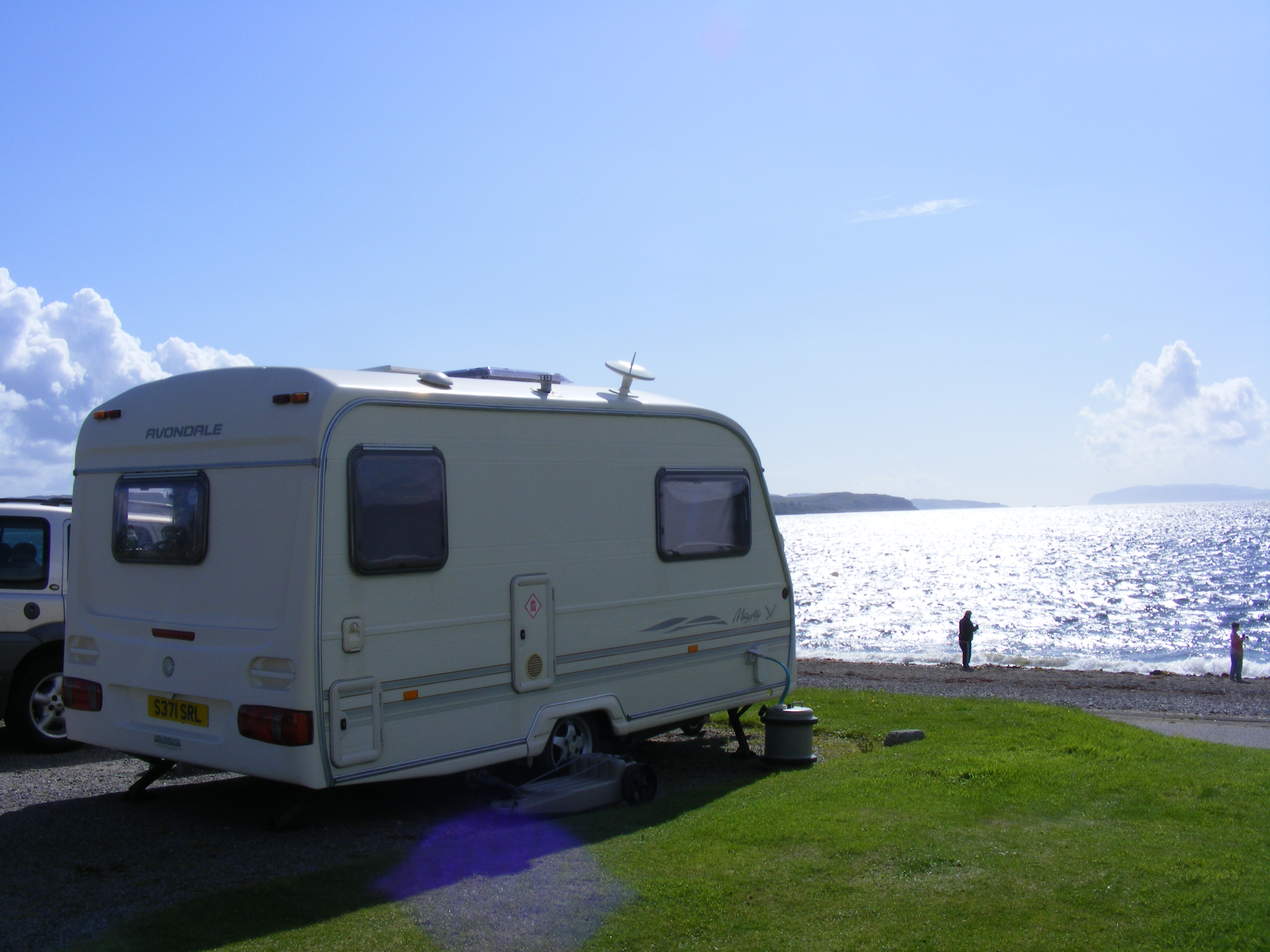
Our site is spectacular and there are no difficulties with us having arrived an hour early. Despite only being here for four nights and the site being full we have a premier pitch, within yards of the sea, giving us amazing views across Ardmucknish Bay towards the island of Mull. The sun is shining and I can even forgive the lack of internet. I do have to add that the wind is rivalling Hurricane Bertha, either that or it is Hurricane Bertha, so it isn’t exactly sunbathing weather.

We go to see what Oban has to offer, passing some prestigious marinas and securing the last parking space in the car park. MacCaig’s monument towers over the town. This coliseum style, unfinished tower was constructed in 1897, giving work to unemployed stonemasons. At sea is a replica Viking longboat but no one seems to fear invasion. Oban is a busy, horseshoe shaped harbour and the annual raft race is about to begin. We discuss the potential seaworthiness and navigability of the entries. The back end of a long thin series of oil drums, piloted by four spidermen, gradually disappears underwater, until the oarsman at the back is barely visible. Tesco’s entry, which looks like a polystyrene pallet, takes a long time to get going but bravely completes the course. Chris’ seagoing experience enables him to successfully pick the winners. Four men in luminous yellow onsies, in charge of this entry from Autoglass, are first by some considerable margin. In the audience there is a lady with mauve hair who has two rats on he shoulders, I guess it takes all sorts. We are sat next to a couple with a white German Shepherd dog. Every one of the crowd who pass ask what breed the dog is. The owner answers patiently numerous times but must be tempted to hang a notice round her pet’s neck.176 9 August 2014 Van at North Ledaig

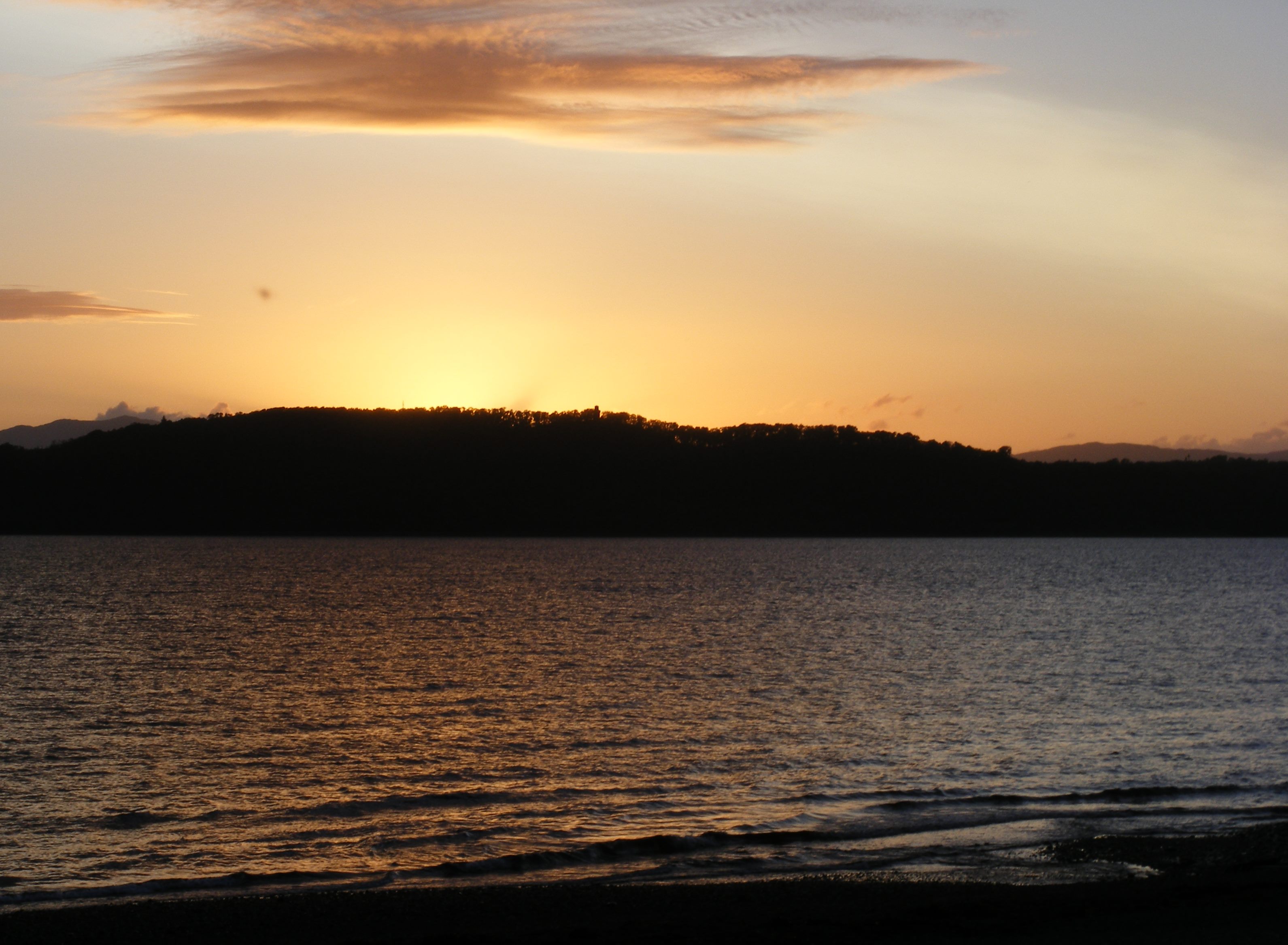
We enjoy resting in the sunny van enjoying our stupendous view and watching the sunset over Mull.

The awful weather that we were expecting on Friday has arrived two days late. Yesterday’s wind has dropped but there is a great deal of rain. We splash off to Inveraray Castle, the prestigious home of the Dukes of Argyll. The Duke is the chief of Clan Campbell and we have learned that the Campbells have not always been universally popular. The current ‘castle’, along with the town of Inveraray, was created in 1746 by the then Duke to replace the former defensive castle. The fact that they didn’t feel the need for a defensive structure at this time says plenty about the Campbells. The armoury contains 1300 pikes, muskets and swords and is thought to be the highest room in Scotland. It seems even the homes of the aristocracy have problems with damp and we learn that this has been the case since the roof had to be a replaced following a fire. The Georgian style is augmented by some Victoriana as Queen Victoria’s daughter Louise married a future Duke of Argyll when he was Marquis of Lorne. As always I find ‘downstairs’ more interesting than ‘upstairs’ and they have sugar cones and a smoke powered jack for turning the spit. I guess this works a little like the historic Christmas ‘angel chimes’. The rain even eased up long enough fo us to take a quick turn around the garden.180 9 August 2014 Sunset at North Ledaig

Back at the site I manage to tap into some local internet. I have been given the necessary password, although my attempt at guessing it was only one character out! I almost wish I hadn’t been told the secret as this is the most excruciatingly slow connection in the world and my emails gradually come through in tens before it drops out altogether.

A Dull Safari

Currently on the slowest internet connection in the world so check back on this post later for cute animal pictures! A drive eastwards through beautiful country, past Loch Tay and Ben Lawers, which is 1214 metres above sea level; ben meaning hill. There is evidence of logging and black-faced sheep are plentiful. We arrive at the nature reserve at Loch of Lowes advertised as Osprey Haven. A peaceful haven yes but sadly lacking in Ospreys. Nest cam depicts an empty nest and it is thought that the female Lady, who has returned to this area for twenty-six years, has already migrated as nothing has been seen of her for three days. Sadly, this year one of her three eggs was taken by a crow and the other two were infertile. The chap on the cash desk seems embarrassed by the absence of their star attraction and lets me in as a concession. We look across the loch from the hide but there is little activity. There are plenty of woodland birds to observe from the viewing window and I get a glimpse of the back view of a red squirrel.

Back past the van for refreshment then a short drive in the opposite direction to Glen Falloch Falls. People are tombstoning from the top of the waterfall. This is not just irresponsible teenagers but a chap and his young sons. Unlike other jumpers this family are not kitted out in crash helmets, wetsuits and life jackets but are leaping in to cold, rocky pools with fast flowing currents in their ordinary clothes. I know I am risk adverse but this seems ridiculously foolhardy and I wonder how pressurised the twelvish year old feels to perform in front of dad.

The next day is the one day of the holiday that we really need to be dry. Inevitably the weather forecast warns us that we are in the tail of Hurricane Bertha and there will be heavy rain. We set out in good time for the hamlet of Dull where we are off on a ‘Highland Safari’. Hilariously, Dull is twinned with Boring in Oregon. In fact Dull just means meadow in Gaelic. Our guide, clad in highland dress, is Steve, who does a superb job and our travelling companions are a family of eight from Hong Kong, celebrating the doctorate of one of their number with a Scottish holiday. Steve is wearing a Black Watch kilt; nearby Aberfoyle is the home of the Black Watch regiment. A traditional plaid is eighteen to twenty foot long but Steve has settled for a shorter version.

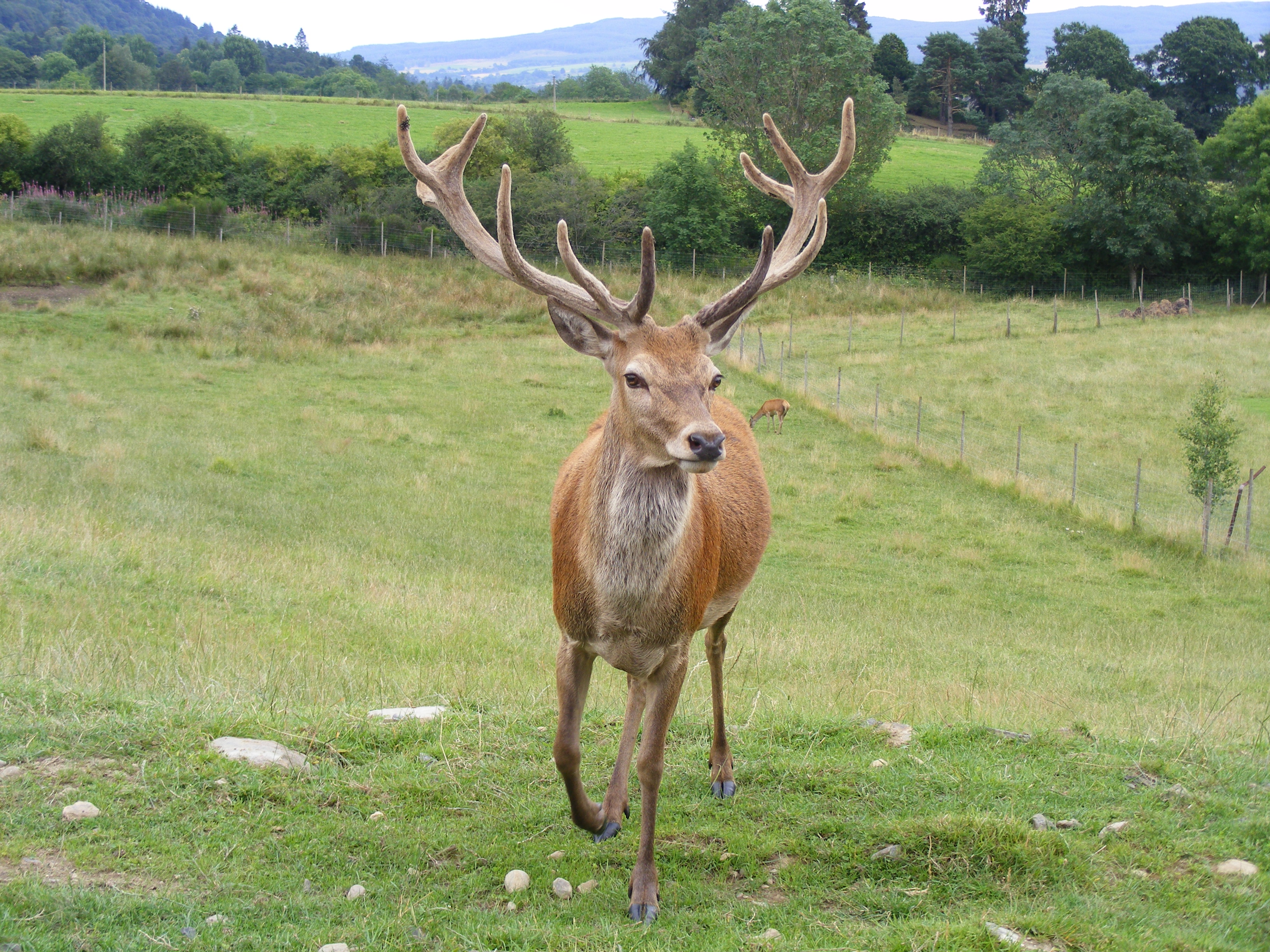
We are travelling in a Pinzgauer, a 6 wheel drive, Austrian military vehicle that makes light work of the off road terrain. We learn of the economy of the area, now farming, forestry and tourism but previously weaving and milling for the barley, vital for the distilleries. We pass through a North Atlantic hazel wood. Apparently this preponderance of hazel and ash is unusual and Steve, who is a forester when he isnt being a ranger, is hoping to get it protected. Currently it is being coppiced on an eight year rotation, using handsaws to minimise the environmental impact. We see black Aberdeen Angus cattle and sheep that are a cross-breed of Texels, Herdwicks and Scottish Blackfaces. We climb above the tree line and Steve bemoans the difficulties of getting in and out of a military vehicle, to cope with farm gates, whilst wearing a skirt. We are told there should be grouse; we see none. There may be curlew; we see none. Meadow pipits are darting back and forth but true to form, the deer are also conspicuous by their absence. I seem to have this effect on wildlife. Allegedly there are 150 red deer on the hillside but we can see not a one. This does not detract from the occasion and we are having a great time. We do find and sample, whinberries, also known as whortleberries but here called blaeberries, a little like a sour blackberry. The heather here is ling, rather than the bell heather that we are used to further south. There are also harebells. It seems there is a debate going on as to whether harebells should be recognised as the third European bluebell, creating a Scottish bluebell alongside the English and Spanish varieties.

The land has been and is used for shooting. The glorious 12th August, heralding as it does the start of the grouse shooting season, is almost upon us. We view the rock built, circular structures known as grouse butts, designed to shelter those wealthy enough to participate. In theory, the expression head and shoulders above the rest, comes from the marksmen putting their heads above the wall to take aim. We are give a wee dram of local whisky and finally we sight a dozen or so red deer in the distance. Then on to Schiehallion Bothy for the picnic supplied by Highland Safaris. Bothys are small huts that can be freely used by passers by in need of shelter. We have encountered something similar in Australia but cant believe that they wouldnt be abused nearer to home.

Steve explains the difficulty of maintaining a balanced ecosystem and the relative merits and demerits of letting nature take its course and intervention by man. There are believed to be 350,000 red deer in Scotland. With the extinction of their predators (bear, lynx and wolf) in this country, there is a necessity to cull 5-10% of deer each winter. A large landowner in the north of Scotland had plans to reintroduce these predators but was told that they had to be enclosed. A 500 mile fence was duly constructed but then the landowner was informed that he had now created a zoo, which required a licence that he didnt have! We have wonderful views of the Tay Valley. The Tay is the third largest river in Britain but carries more water than the two largest (the Thames and the Severn) put together. The Munro Schiehallion overlooks us. It is 3445 feet high and the areas only freestanding mountain, i.e. one that is not part of a range.

Much of the coniferous woodland consists of introduced species, planted for commercial purposes. Amongst these are the Douglas Fir, discovered by Mr. Douglas. Douglas was searching for more species on Hawaii when he fell into a pit dug to trap wild cattle. Sadly a cow also landed in the pit with disastrous results for Douglas. One area of woodland has oil barrels in the trees to provide nesting sites for owls, as the trees there are too small.

165 8 August 2014 ZoomBack at the centre we are now to have a Red Deer and Barn Owl Experience. Andy, another friendly ranger, is in charge. He explains that antlers, of what ever size, take 110 days to grow before being shed. They differ from horns, which are permanent. Pregnant hinds might eat antlers for extra calcium. When rutting stags fight the dominant animal will always be higher up the hill. We have the opportunity to feed Rua, Zoom and their hinds, who are being looked after by the centre. These have come from captive settings elsewhere or been bred at the centre. There are problems with Sika deer, introduced by the Victorians, interbreeding with the native Red deer, creating hybrids. Next we meet Ossian the Barn Owl and are able to stroke her. 172 8 August 2014 Ossian Barn Owl

Apart from a few drops of rain as our safari set off, the forecast bad weather does us a favour and waits until we are headed home before it puts in an appearance. It has been a brilliant day and I purchase a horn cup as a souvenir, thinking it will do duty in my seventeenth century world. On the way back we encounter seven Italian camper vans in convoy trying to get in a very small car park, which had an entertainment value. Then as we near the site a pine marten crosses the road, so perhaps my jinx on native wildlife is wearing off.


Steam Ships and Men in Kilts

Despite my inevitable worries that we won’t find it, we locate Trossachs Pier without difficulty. We are here for a trip round Loch Katrine (pronounced Kat-rin) on the steam ship Sir Walter Scott. The vessel was built in 1899 in Dumbarton by William Denny and brothers. It now runs on bio-fuel, using 300 litres a day. The Loch is 540 feet deep and as it is the source of Glasgow’s drinking water, we are encouraged not to pollute the supply by jumping in. As the water temperature is 3-4 degrees, this seems unlikely. This used to be a sheep farming area but worries about contamination of the water meant that they and local cattle were all moved away. Recently Scottish Water have allowed cattle to graze near the Loch again and we see some by the shore. There are also some intrepid goats clinging to a rock face. The majority of our fellow passengers have bikes with them. It seems the thing to do, for those with the stamina, is to take a one way Loch trip and cycle back. Other passengers have their dog with them. Not unusual you may think but they have also brought the dog’s bed!

Here we are in Rob Roy country. Rob Roy MacGregor, outlaw and notorious cattle raider was born at Glengyle on the shores of Loch Katrine. His story was embellished by Sir Walter Scott. The other literary figure with a connection to the Loch was Jules Verne, who wrote a science fiction story ‘The Underground City’ about a city under the loch. We also see Royal Cottage on the shoreline. This was constructed especially for a royal visit by Queen Victoria in 1859; she spent just one night there. Twenty one cannons were dragged to the lochside in order to provide a twenty-one gun salute; the reverberation succeeded in breaking the windows of the cottage.

Our guide book suggests we visit Crieff where there are allegedly spectacular views from Knock Hill. It is quite a long way out of our way but we can’t resist a ‘must see’. We fail to locate Glen Tullet, where we were aiming for but at the second attempt, park in Crieff, making use of the car park belonging to The Famous Grouse distillery attraction. Every distillery in Scotland seems to be open to the public, famous or not. Allegedly a walk to Knock Hill is signposted from here. It certainly begins to be signposted and then, after a short while, we are left to guess. We guess wrong and end up on a quad bike track, dodging hurtling vehicles. The views are good but probably not worth the effort and we cut our losses and return to the van.

Day 16 Wednesday 6 August 2014 Killin Highland Games
Our site at Blair Drummond is enclosed within a large high wall. Also enclosed within the wall are numerous children. It is the school holidays so this is not unexpected and I don’t have anything against children but these do seem to have particularly piercing voices and a desire to career around the site on bikes and scooters incessantly. We attempt to move on to our next location. This van comes with various high-tech gadgets that are all very well when they are working. In theory we turn a key, press a button and the caravan’s legs automatically raise or lower. The trouble is that, despite arrows for up and down, the mechanism seems to opt for one or the other at random. Today we need the legs to go up but they only seem to want to lower. After a bit of judicious jiggling we achieve the desired effect. The next problem is attaching the van to the car. The terrain means that the car is higher than the van, too high in fact for the two to join together. Chris suggests that I jump up and down in the back of the van. Our knowledge of physics tells us that if I can make the back go down, the front will rise and all will be well, Fortunately I have eaten plenty of chocolate and my great weight tips the front of the van up sufficiently to hitch up the van.

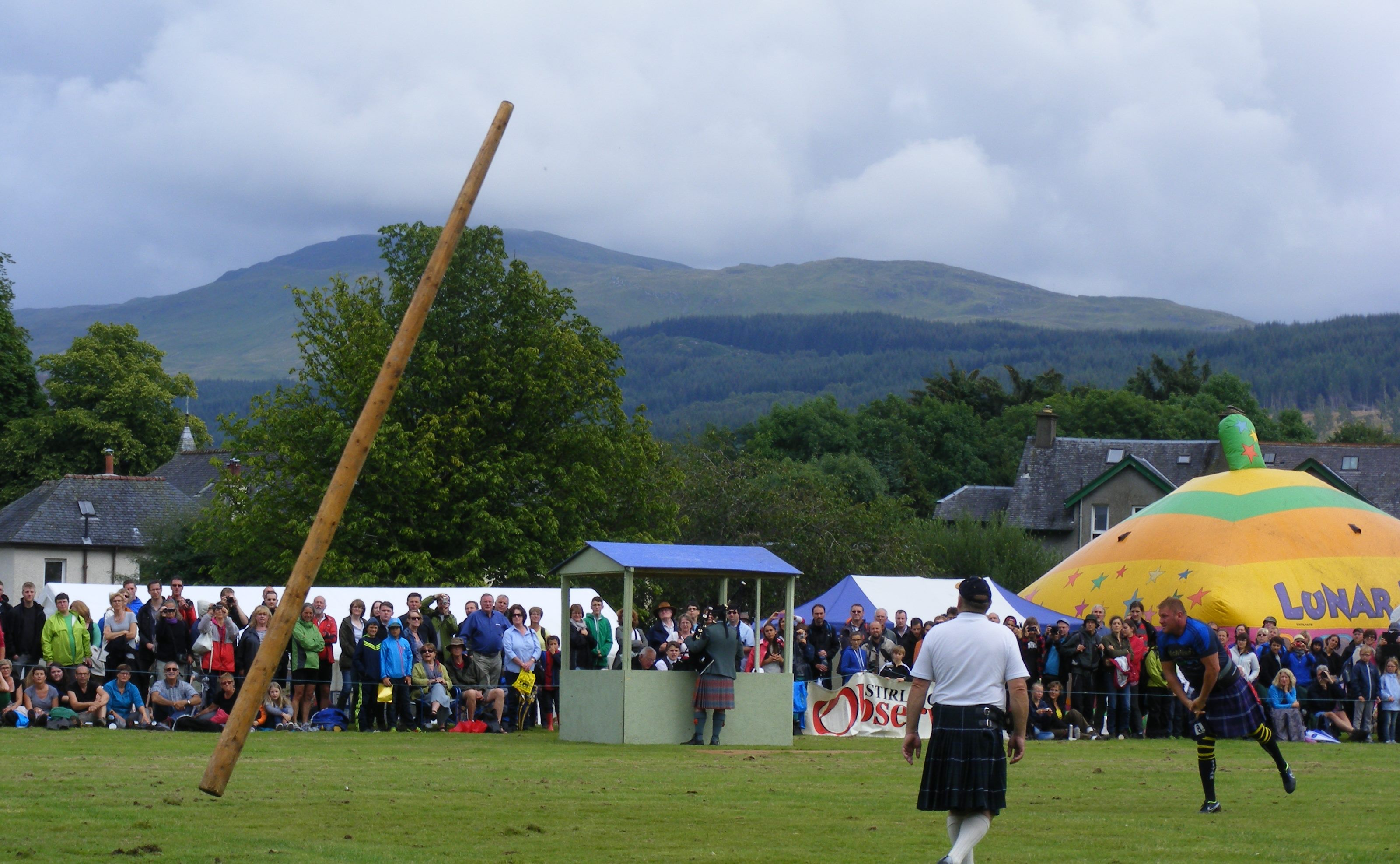
We are making a short journey back eastwards to Killin. Here we are on a beautiful, peaceful, wooded site. Other residents tell us that deer are regular visitors. It seems that we have arrived in Killin on the day of their Highland Games so we decide to join in the fun. There are bagpipe and highland dancing contests and displays of local food as well as a hill run and the traditional highland games. We watch ten kilt-clad contestants, including an Icelander and an Australian, the latter fresh from competing in the Commonwealth Games. They put shots and throw a 56 pound weight. Some of the contestants have a quick practice playing catch with this and I wonder about the health and safety implications of the event. The wielding of a long handled wooden hammer is even more risky but there are no casualties. Caber tossing looks very tricky and I wonder what military activity provided the origin for this activity. Bridge building comes to mind but why would the tree trunks be thrown and not just tipped over? Chris takes and interest in the Arbroath Smokies and even a fan of offal, consumes some haggis. Much as I like sampling local cuisine, I settle for sausage.140 6 August 2014 Killin Highland Games Tossing the caber

We take a quick look at Dochart Falls on the way home. Our site has no internet access put we have been given permission to lurk in the car park of the site up the road, which has the same owners. I duly lurk and discover what I have missed in the last few days. Despite the lack of internet and phone signal our media blackout is lifting as here we can get ITV channels on the TV, despite the site wardens being convinced otherwise.

Adventures in Stirling

Although access was not without its problems, we are sad to be leaving this site on Kintyre with its lovely sea views, having not had the weather or opportunity to enjoy them. We travel the long way round Kintyre in order to avoid the twenty miles of single track road but it turns out that this might have been the lesser of two evils. Without warning there is a hairpin bend on a very steep uphill stretch. The road is wet, slippery and in need of resurfacing. You remember how no one round here seems to be able to reverse? Well, we are reversing quite nicely, the trouble is we are meant to be going forwards. The car wheels are spinning, the back of the caravan is in a hedge and there are some seriously scary moments before Chris somehow manages to change our angle of approach and get us going in the right direction.

There is some beautiful scenery on this side of Kintyre as we drive alongside Loch Fyne. This only gets better as we travel north of Inveraray through Glen Aray, beside Loch Awe. I had hoped to listen to the last of the Commonwealth Games on the car radio but it seems we are beyond any sort of useful radio coverage. Then eastwards through the northern edge of Loch Lomond and Trossachs National Park to our site near Stirling. We had planned an afternoon visit but it is later than we hoped and we decide to reschedule and relax after getting our supplies. To do this we pass four major supermarkets before reaching the one of our choice and then we discover that fuel was cheaper at one of the others so end up going there too. Our media blackout continues as we are without television coverage for the next three days and internet availability is coming at a price but who needs media? We will cope. Ok, so one of the coping strategies was to pay for 24 hours’ internet access but nobody’s perfect.

We have booked ourselves a place to see a ‘Battle Show’ at the newly opened Bannockburn Battle Experience. This is another attraction that the National Trust for Scotland have clearly invested in heavily. So, as all around us are marking the 100th anniversary since the outbreak of the first world war, we are commemorating 700 years (on 24 June) since Robert the Bruce and the ‘Scottish Patriots’ routed Edward II. It is ironic that we are learning about a fight for Scottish independence in the run up to the referendum over the same issue. It is this area that has provided us with the first evidence of support for the yes campaign. Everyone we have spoken to up until now and the very few posters we have seen, have been in favour of union with England.

We don our 3-d glasses and are in the thick of the fighting. This is a little different from what we are used to in the seventeenth century and spears are not wielded in quite the same way as pikes. Here we have long-bows and cross-bows, the former were banned by Elizabeth I in favour of more modern ‘weapons of fire’; a very short-sighted move as the long bow is infinitely more accurate than the musket. In fourteenth century Scotland the fighting unit is the schiltron, rather than the pike block. After ‘conversing’ with some virtual characters of the time, we are called for our Battle Show. We learn how, despite being outnumbered 2:1, Robert the Bruce, aided by Sir James ‘Black’ Douglas, took advantage of the terrain to defeat the English troops.

122 4 August 2014 Wallace Monument

The Wallace Monument, Stirling

Other visitors have booked to take part in a virtual Battle of Bannockburn war game, re-writing history. We are able to watch this from the viewing gallery. Participants take it in turns to move their allocated units and can attack if they wish. It is interesting that the women, of what ever age, tend to go for strategy and keeping out the way, whilst the men are much keener to engage with the enemy. One of the adult players clearly isn’t aware that this is a family show and each time it is his turn says, ‘attack the b****rs’. History is indeed re-written and the Battle of Stirling golf course (the players seemed to avoid putting their troops near the Bannock Burn) ends with a victory for Edward II.

We stop for a weapon handling session, interested in comparing the swords and helmets that we are used to with those of 400 years earlier. The whole experience is very well done and designed to attract today’s young people but I do have some reservations, as I do during some of our seventeenth century activities. It does seem to be making a game out of warfare and the players revel in ‘killing’ thousands of enemy troops. I just wish at some point someone would explain the horrors of war and that, even though it was 700 years ago, these were real people who suffered and died and it matters.

Next it is a short journey to Stirling Castle, not quite as short as it should have been owing to us paying attention to the sat nav but short none the less. Stirling seems to be a beautiful, serene city, with soft stone buildings, cobbled streets and a commanding position overlooking the River Forth. In the time of Robert the Bruce it was believed that the Forth completely bisected Scotland and that the only land route from lowlands to highlands was across Stirling Bridge, hence its strategic importance. When the English were defeated by Robert the Bruce many Scottish castles were destroyed, so the English could not attempt to regain them and use them as strongholds. This of course meant that the Scots couldn’t use them either, maybe they didn’t think of that.

Today for the first time we are aware of school holiday crowds; the castle is heaving and its car park is full. We are directed down a side street to get out of the way of a bus. It seems it is perfectly possible to park down this side street. Notwithstanding, cars are queuing for what is likely to be a very long time in order to get a space in the car park. Our chosen parking spot has not only saved us queuing but has also saved us £4. I know I have mentioned it before but we really have benefited from the savings that our National Trust membership has gained us and we are grateful for the reciprocal arrangement with National Trust Scotland. We walk up the steep hill to the castle and as we approach I remember that Stirling Castle is managed by Historic Scotland and is not a National Trust property. Instead for this we need our English Heritage card. The good news is that I have remembered to bring it. The bad news is that it is back at the bottom of the hill in the car. A member of our party is dispatched to fetch it.

It is a good job that we didn’t try to squeeze this visit in yesterday afternoon as there is a great deal to see. We start in the Queen Anne Garden then move on to the ‘Access Gallery’ in the vaults. There are plenty of interactive opportunities, although a little less high-tech than Bannockburn. We can play medieval instruments, if we were smaller we could have dressed up and there are various things to touch and press. Stirling has been an important defensive site since the ninth century, if not before. The first evidence of its use as a royal castle is in 1110 under Alexander I. It played a role in William Wallace’s victory over the English at the battle of Stirling Bridge in 1297. Most of what is seen today is a result of James V’s ambitious and status seeking building campaign following his marriage to Mary of Guise in the early sixteenth century. In keeping with European Renaissance style, 250 sculptures were erected outside. These depicted classical figures, alongside James himself, making a statement about his rule. These would almost certainly have been painted although there is now no evidence of this and sadly many are now damaged, not least by acid rain. Local Devon lad General Monck laid siege to Stirling Castle in the English Civil War. The last siege at Stirling took place in 1745 when Charles Stuart, ‘Bonnie Prince Charlie’ failed to take Stirling for the Jacobites.

Costumed characters provide additional information. We learn about the series of tapestries depicting a unicorn hunt and its religious allegory. The castle is also famous for the Stirling Heads, a series of large circular woodcarvings that have now been replicated. Like the sculptures these are a combination of classical images and depictions of members of the Scottish royal family.

The lack of good drying weather this week has meant that we are running short of clothes so, on returning the van, we do a major wash and invest in a tumble dryer. I don’t know what was wrong with the machine but let’s just say it performed one of its two functions very well. Our laundry is superbly tumbled but not at all dry. We hang it out as best we can on our teeny tiny airer and hope that the showers will steer clear.

Islands in the Sun – and rain

We pop in to their site to say goodbye to Martha, Rob and Ed. The latter is looking very cute in his wet suit and I am allowed to accompany him to the site pool. Then it is time to leave. Despite a slight issue when the automatic caravan leg winder only seems to want to lower the legs not raise them, we set off for the Kintyre peninsula. The sat nav tells us is seventy miles to our new site but that seems to involve two ferries so we opt for the land route, which is more than twice as far.

 We cross the Clyde via Erskine Bridge and are in beautiful countryside by the loch in the Loch Lomond and Trossachs National Park. There are many single story, white washed cottages. Then we are travelling alongside Loch Fyne and arrive on Kintyre – as in Mull of, although Mull is one Scottish island we won’t be visiting. Despite having read the Caravan Club’s instructions to ‘only approach the site this way’ several times, my eye has missed out a vital word. This means that I navigate us the wrong way, which involves twenty miles of single track road. Fortunately there are frequent passing places, marked by black and white poles. When Chris finally accomplishes the feat of getting us to the site entrance there are more problems. First we negotiate a long bumpy track to reception, then we take a wrong turning on the site. We find ourselves in a field full of tents on soft ground with no way out expect the way we have come and very little space to turn a car and caravan. Despite some wheel spin Chris accomplishes this and drives our unit between two cars with the proverbial cigarette paper space on either side. All I can say is that it is a good job our wing mirrors were higher than those on the cars. If caravan manoeuvring were a Commonwealth sport Chris would be in with a chance of a gold medal.

The next day we leave the van at 5.50am, yes 5.50am, to get the ferry from Kennacraig to Islay. It is cloudy but serene across the bay with many baby rabbits. We are trying not to mention our destination as we don’t know how to pronounce it. Is it ‘Iz-lay’ or is the ‘s’ silent (as in ‘island’) making is ‘I-lay’? Turns out it is ‘I-lah’, well, who knew. A shower means that the outside seats on The Hebridean Isles are wet so we sit in the reclining lounge. It is the seats and passengers that recline, rather than the lounge itself you understand. Reclining is all very well but in order to see out of the windows of the reclining lounge you have to adopt a meerkat like pose as the windows are very high. We complete a customer service questionnaire. Actually, I complete two, one each on behalf of my travelling companion and myself (still no reading glasses). Now, what to do for the next two hours and ten minutes of our journey? One of our party is already asleep, so conversation is limited. Mind you after three short nights who can blame him?

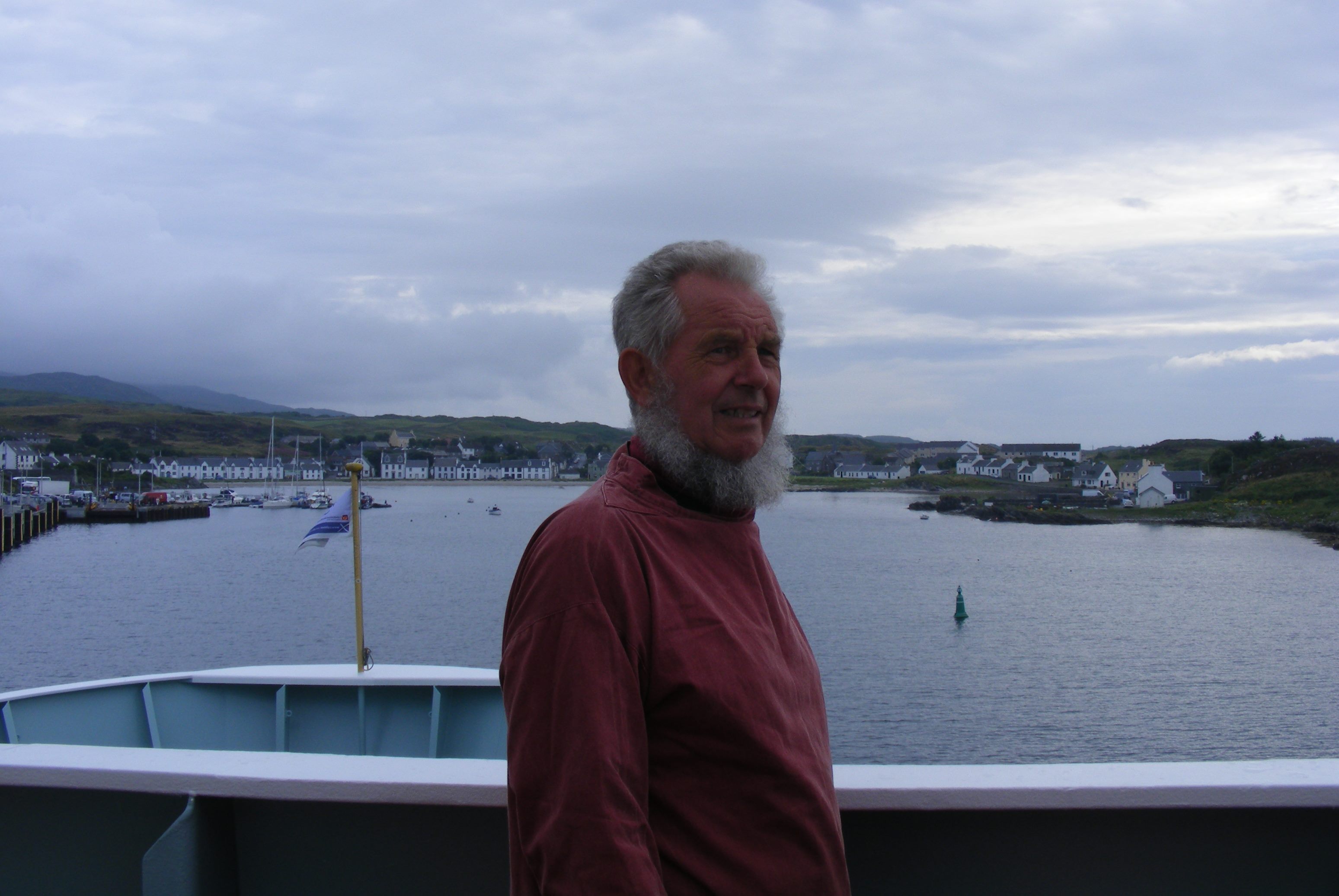
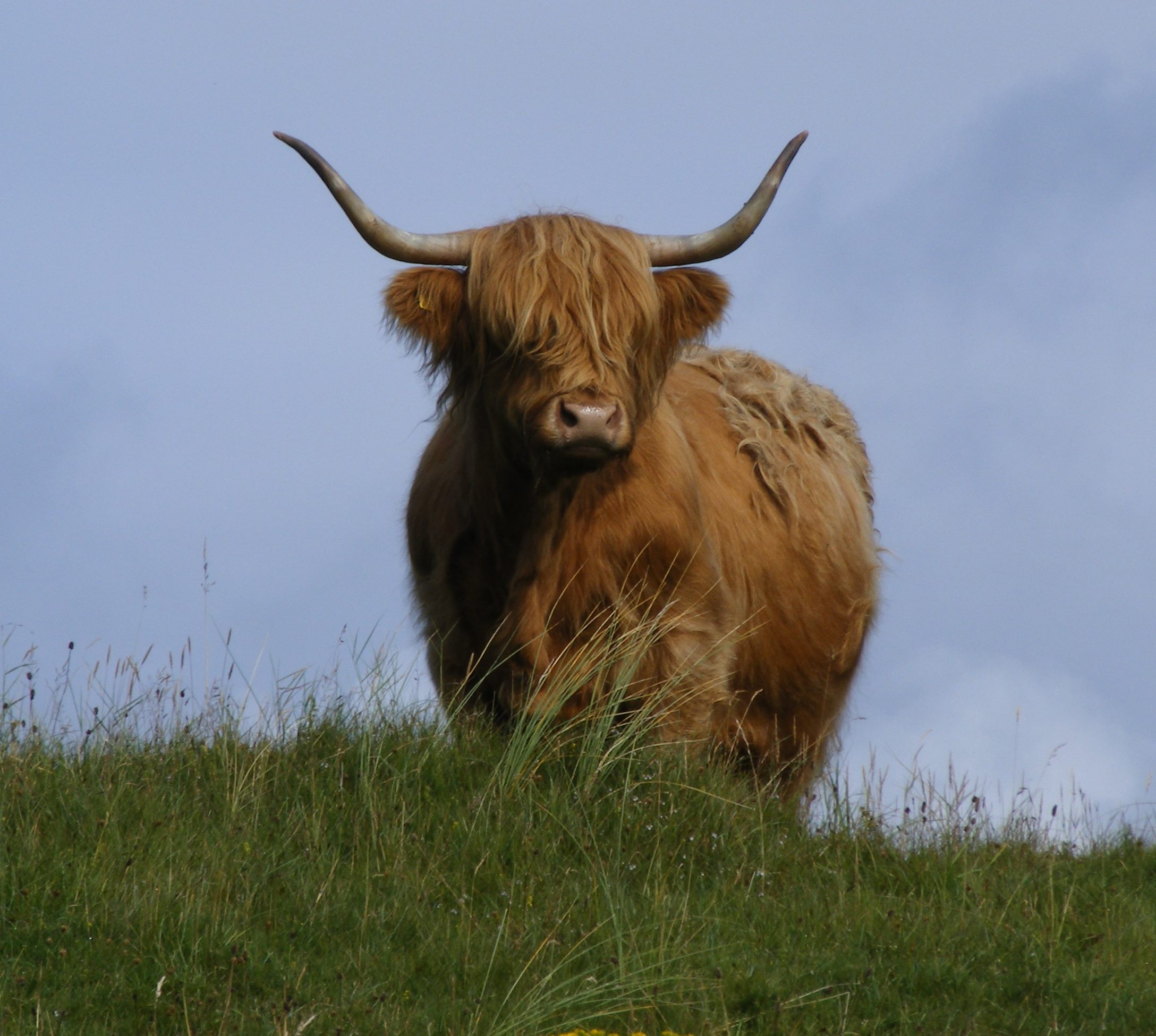
We land at Port Ellen and our pre-ordered hire car is ready and waiting. Then begins a roughly clockwise tour of the island, starting at the Mull of Oa, just as the sun comes out to greet us. We have noticed that cemeteries here seem to be seriously in the middle of nowhere and Islay is no exception. 086 1 August 2014 Chris on way to IslayThere are some impressive highland cattle roaming the beach and I also spot some hooded crows that are new to me. We fail to make the sands sing; that would be because we weren’t quite in the right place. A tractor passes with a huge trailer full of clam shells; the aroma lingers for a long way. We notice evidence of peat cutting and arrive at Bowmore Round Church. It was built in 1767 by Donald Campbell. The idea behind it being round is to prevent the devil hiding in the corners. A coach is disgorging its passengers as we arrive at the Round Church and we seem to have gate-crashed some filming; we suspect it is a new series of An Island Parish. The graveyard has numerous second world war graves to unknown sailors. Incredible scenery is interspersed with unsightly but no doubt necessary, signs of industry. This is of course the land of whisky distilleries and we see several.
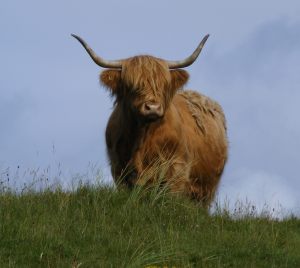
094 1 August 2014 Highland Cattle 5At Port Charlotte we stop at the Museum of Islay Life, which has been set up in a disused Free Church. There is an eclectic mix of exhibits and one can imagine their hearts sinking when a well meaning local donates yet another bit of tat that has to be lovingly displayed. There are pictures of a D & N MacKenize bus of the 1930s; this is the firm that we have hired our car from. We chat to the friendly staff member. It seems there are variations on witchcraft prevention in Scotland – red string round the door, rowan trees instead of bays and quartz stones on the gateposts. I ask if there is a toilet. There is a staff one that I can use but health and safety requires the custodian to tell me that this is at my own risk. I fail to see what risks could be attached to this activity but maybe I am not thinking hard enough. In any case I emerge unscathed.

We drive down to the westernmost point of Islay, a fishing village called Porthnahaven; now we are further north than Ireland, next stop to the west is America. We get the very small ferry from Port Askaig to Feolin on Jura. I am already panicking in case there isn’t room for us on the return trip; perhaps we should join the queue now. Jura was granted to the Campbells in the early seventeenth century and the last Campbell left in 1938. A famous resident was George Orwell, who wrote 1984 on Jura; I guess there weren’t many distractions!

Jura appears deserted with no sign of habitation for several miles as we travel north on the only road. There is a complete lack of livestock and no sign of farming activity. Apparently there are cattle and 6000 red deer on Jura but we don’t see a single one. The human population is about 200, virtually all of whom are concentrated in the one settlement of Craighouse. Chris enjoys looking at the boats and we set off back to Feolin in good time for the ferry. Suddenly a warning light appears on the dashboard and the car loses all power, this is seriously worrying, are we going to be stranded on Jura? We have no idea how we are going to resolve this, it seems unlikely that Chris’ AA membership will extend to rescuing us from Jura any time soon. Chris turns the engine off and on again and all seems to be well. Inevitably we arrive in time to be first in the queue for the ferry but this is just as well as one car does get left behind.

Back on Islay, as instructed, we go to fill the car with petrol. We don’t seem to be able to open the petrol cap. The vehicle handbook is in the glove compartment and it seems to explain everything possible that one might need to know. I can use the cigarette lighter and CD player, I know all about the air bag but have no clue how to fill up with petrol. Fortunately the garage owner can cope; brute force is required. The ferry for our return to Kintyre is the Finlaggan. The gangway for passenger access is set at a slope of 1:2. Chris is manfully helping the ferry staff carry a child and bag-laden buggy up the gantry. Once on board we are once again in a media spotlight as photography is taking place, presumably for a new ferry brochure. We offer to move out of the way but are told this isn’t necessary; maybe we will be photo-shopped out. Finally a chance to watch Tom Daly and his new diving partner win silver in the synchronised diving on the ferry TV before returning, shattered, to the van.

A slightly later start today but only slightly, as the Claonig to Lochranza ferry operates on a first come first served basis and we spotted a camper van heading for the queue last night. Presumably they were planning to fly camp (legal in Scotland) to ensure their place on the ferry. Having seen none of Jura’s 6000 deer yesterday we do see two on the way to the ferry. We are second in the queue. Now I can stop worrying about whether or not we will fit on the ferry (surely it has room for two vehicles) I worry instead about whether or not we can pay our fare by credit card. Even with all the ‘emergency change’, of which there is quite a bit, we are £1.10 short. All is well, card payments are accepted and we are headed for Arran. It is raining, that would be raining quite a lot. We have worked out how to cover most of the island’s main roads, which form a figure of ‘eight’, assuming the eight has three circles instead of two. It takes a few goes to work out how to do this with as little repetition as possible (I can name at least two friends who now have paper and pencil out trying it! If that’s you, the cross pieces between the circles are roads from one side to the other and not just cross roads, so you can’t avoid some repetition).

We start off going clockwise from Lochranza and halt at Brodick Castle. This has the advantage of being under cover but the disadvantage of being shut. In the end it turns out not to be shut at all. In common with all those we have encountered so far the staff are really friendly. They explain that they have opened early and will be providing a single guided tour any minute now before shutting for a wedding. Hurrah! The guidedness of the tour is a bonus as normally it is show yourself around and ask questions of the room guides. Arran is of strategic importance as it guards the entrance to the Clyde and Brodick is one of three ancient fortifications on the island, the other two being at Lochranza, which we saw through the rain on our way to Brodick and Kildonan, which we didn’t. Brodick has been used as a defensive site since Viking times. The earliest parts of what now stands are sixteenth century but most is nineteenth century. The Castle was owned by the Dukes of Hamilton, whose main residence was in Hamilton and it was used as a hunting lodge. Cromwell was responsible for the death of the then Duke and Brodick was used as a Parliamentarian garrison before being returned to the family after the Restoration.

The entrance hall contains 87 stags heads. No one could be more opposed to hunting for sport than I but it certainly makes a statement. I score seven out of eight on the ‘what are these unusual historic objects?’ quiz in the kitchen, missing out on the pudding mould. There was a decidedly eerie feeling in the basement and that was before the guide regaled us with tales of bodies in tunnels. We decide it is not the weather for looking at the gardens and paddle back to the car. Some die-hards are still playing golf but we are trying to remain vaguely dry. Walking up tracks from the road to view standing stones are also off the itinerary. We head from east to west across ‘The String’. The roller coaster road and the surface water mean that this is a little like a water ride in a theme park. By this time we are in thick fog and even the most intrepid of cyclists, of which there have been many, usually on the narrowest parts of the road, have given up. Then there was the bus meets car (not ours fortunately, we were behind the bus) incident, when the car driver was another incapable of reversing. The bus driver solved this by making it clear he was in no position to reverse, which he wasn’t but it took some time for progress to be made.105 2 August 2014 Deer near Carradale

After a brief detour to the southernmost point of the island at Kildonan, we headed north again. Whiting Bay seems to be the affluent side of the island, with large houses, probably designed for the golfing set. All this being in the middle of nowhere has meant we are a little low on fuel. We manage, with the help of the sat nav, to find a petrol station at the second attempt – the first was no longer open. This is at a combined petrol station and DIY shop, which makes sense. It was also the local off licence, which was a less likely combination. Although Arran provided our first view of Scottish heather there was no sign of the knitting to which the island has given its name. I don’t know why Scottish cars have reverse gears as no one knows how to use them. We encounter yet another example on a single track road. We are 200 metres from a passing place, the car coming in the other direction is about 5 metres past theirs. Their attempt at reaching the pull in results in their getting stuck in a ditch. The passenger has to get out of the car and push them out. As the rain is still torrential, Chris was a little slower than usual in offering assistance. So slow in fact that they were gone before he had the opportunity of getting wet.

We slightly revise our planned route, miss out Lamlash to Brodick and head west again, this time across ‘The Ross’, a higher road than The String and lined with pine forests, at least that’s the bits we could see through the rain. Deciding to call it a day, we return for a earlier ferry than the one we had intended. On a quick trip to the facilities I get caught in a downpour and find myself in the car in my underwear, having removed soaked clothing, for the second time this holiday. There is some delay with the ferry but eventually we are vanward bound. Considering Arran is sheltered on both sides the crossing is pretty jolly choppy and I am regretting consuming a packet of stale chilli rice crackers that I found lurking in the bottom of my bag. I wonder if I may be going to see them again. Fortunately I do not have to dwell on the logistics of being unwell on a boat when in a state of undress as we reach Claonig without mishap.
 

5 go wild in Glasgow – well relatively wild

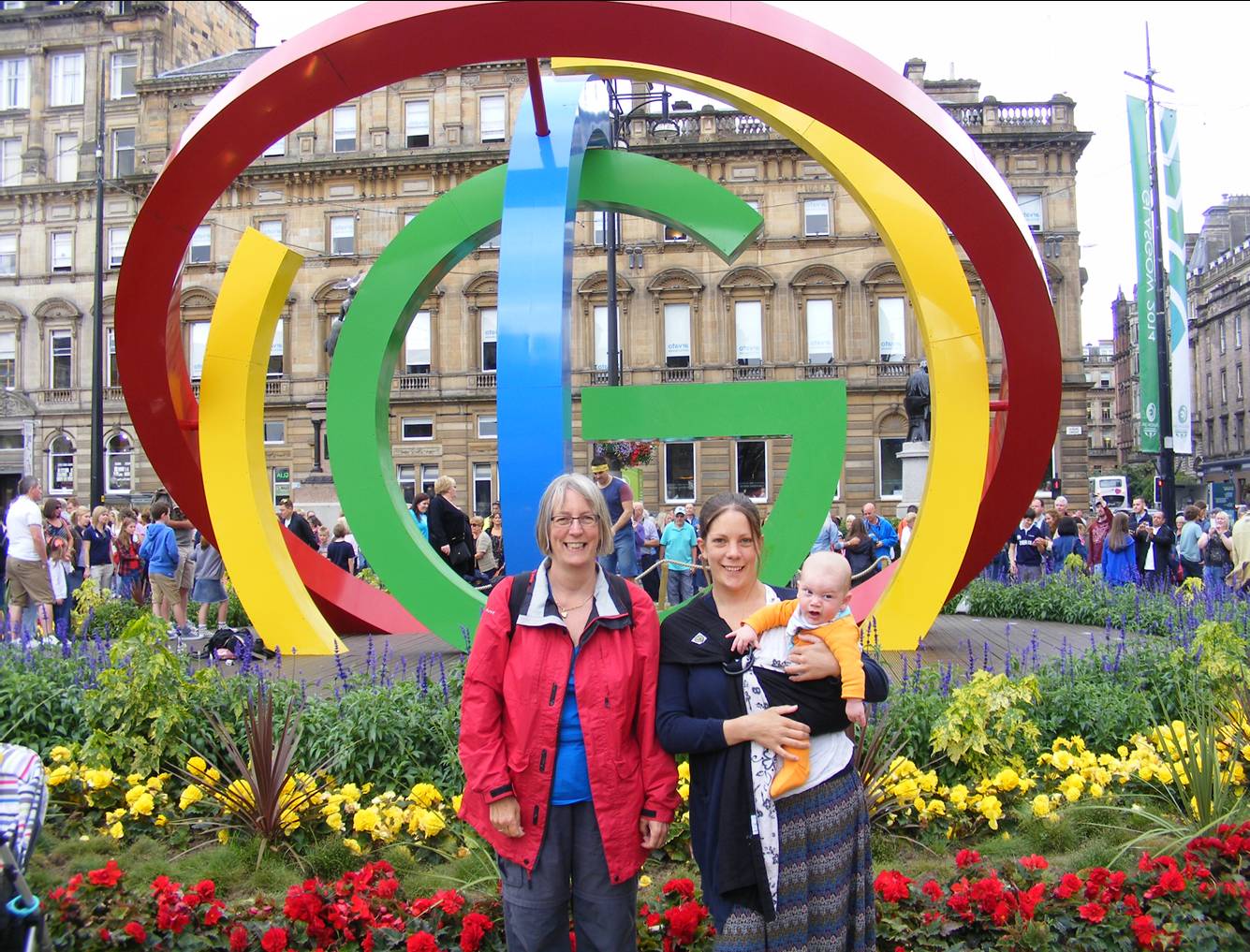
The five of us head for Glasgow on the train from Ayr. Even though I am not in general a fan of cities, Glasgow is looking good. We spend some time on the green but pass up the opportunity of queuing for an hour to have our pictures taken by the Games’ logo. We compromise by queuing not at all and being portrayed by its reverse image. With a bit of judicious photo-shopping I even make it look like we are standing on the right side! Every busker in Scotland is clearly taking the opportunity to benefit from Glasgow’s time in the spotlight. Quality varies; my favourite was the elderly lady in a headscarf with her accordion. We pass various athletes we can’t identify in the streets of Glasgow. Walking through the jewellery quarter our men folk like the look of the £29.50 price tags until they realise it is £2950. There is also a clothes shop with virtually no stock but a window display containing over 1000 old sewing machines. I bet they don’t change their display very often. Unfortunately the reflections from the glass make it difficult to photograph. There are a number of impressive murals on the walls and everyone is very friendly. We follow a ‘Clyde Trail’, seeing how many Games’ mascots we can spot without walking ourselves into the ground, bearing in mind that Martha has Edward to carry.J M & E logo reversed

With Martha and I involved in the planning it is inevitable that those of our party heading for the Games do so in good time. We have decided that a teething Edward probably won’t cope with an evening session so Martha loses out, Chris has passed on participation so Rob and I board a vomit filled train for Mount Florida station and Hampden Park. We are of course far too early and have to wait for security to open but the journey has been hassle free and lacking in delays. I wonder why the huge queues on the other side of the road are not getting on the numerous empty buses that pass but it turns out that they too are waiting for security. The security staff do their best to entertain the queue and we are soon through to the stadium. We have excellent seats with a good view of the decathlon javelin, which is one of the first events. There are plenty of finals on the programme this evening. The women’s triple jump is on the far side of the stadium and England’s Laura Samuels wins silver. The woman’s 10,000 metres ends in a clean sweep for Kenya but is particularly interesting for the three laps in the middle when the field was led by Beth Potter of Scotland.

The semi finals of the men’s 400 metres feature Martin Rooney who is head and shoulders taller than the other competitors. Medal ceremonies come thick and fast and we are destined to hear the Jamaican anthem often enough to know it by heart. The ceremonies for yesterday’s 100 metres finals have been held over to today so more chance for us to practice the Jamaican anthem and we see Adam Gemili awarded his silver medal. Alongside the cool radio controlled vans that retrieve the missiles in throwing events, the synchronised hurdle arranging, involving many of the workforce, appeals. Will Sharman gets the silver medal for England in the 110 metre hurdles. Then there is an inevitable Jamaican one, two, three in the women’s 400 metres.

I am very excited to see that one of the Scottish hammer competitors is Andy Frost, who went to school with Rebecca and who I remember being born when his family lived across the road. Sadly tonight is not his night and he just misses out on a chance for an additional three throws but England get the silver. The final decathlon event, the 1500 metres, is exciting with two English competitors in medal contention. In the end Ashley Bryant improves his standings to come home with the silver and somewhat of a pattern seems to be emerging.

Rob and I have our exit strategy planned like a military operation. We watch the final event from the top of the stadium. It is the women’s 1500 metres and guess what, England get the silver medal, thanks to Laura Weightman. As the athletes cross the line we are gone and by the dint of swift walking, we reach Mount Florida station just as the platform is filled to capacity and a train is drawing in. I cannot see how all these people are going to fit on one train but it turns out that many of them are not heading for Glasgow. We are on the train and there isn’t even anyone standing. Once in Glasgow we make the Ayr train with five minutes to spare so are running an hour and a half earlier than our expected scenario. Chris kindly meets us at the station, just a shame that he is at one entrance and we come out of the other. We are back in our respective vans by midnight, which is probably just as well as Rob is due to be on the 6.50 train in the morning in order to go back to the Games.

The next day, after a morning catching up, I take the train to Glasgow where I meet Martha, Rob and Edward. We call in at the Museum of Modern Art and although Edward likes the mirrors and stained glass, we decide we don’t quite ‘get’ most of the exhibits. Today we time our journey to Hampden Park better and there is no queue for security. There is a debate as to whether my kindle requires scanning but the verdict is that it does not. Quite how I might secrete contraband in a kindle I have no idea.

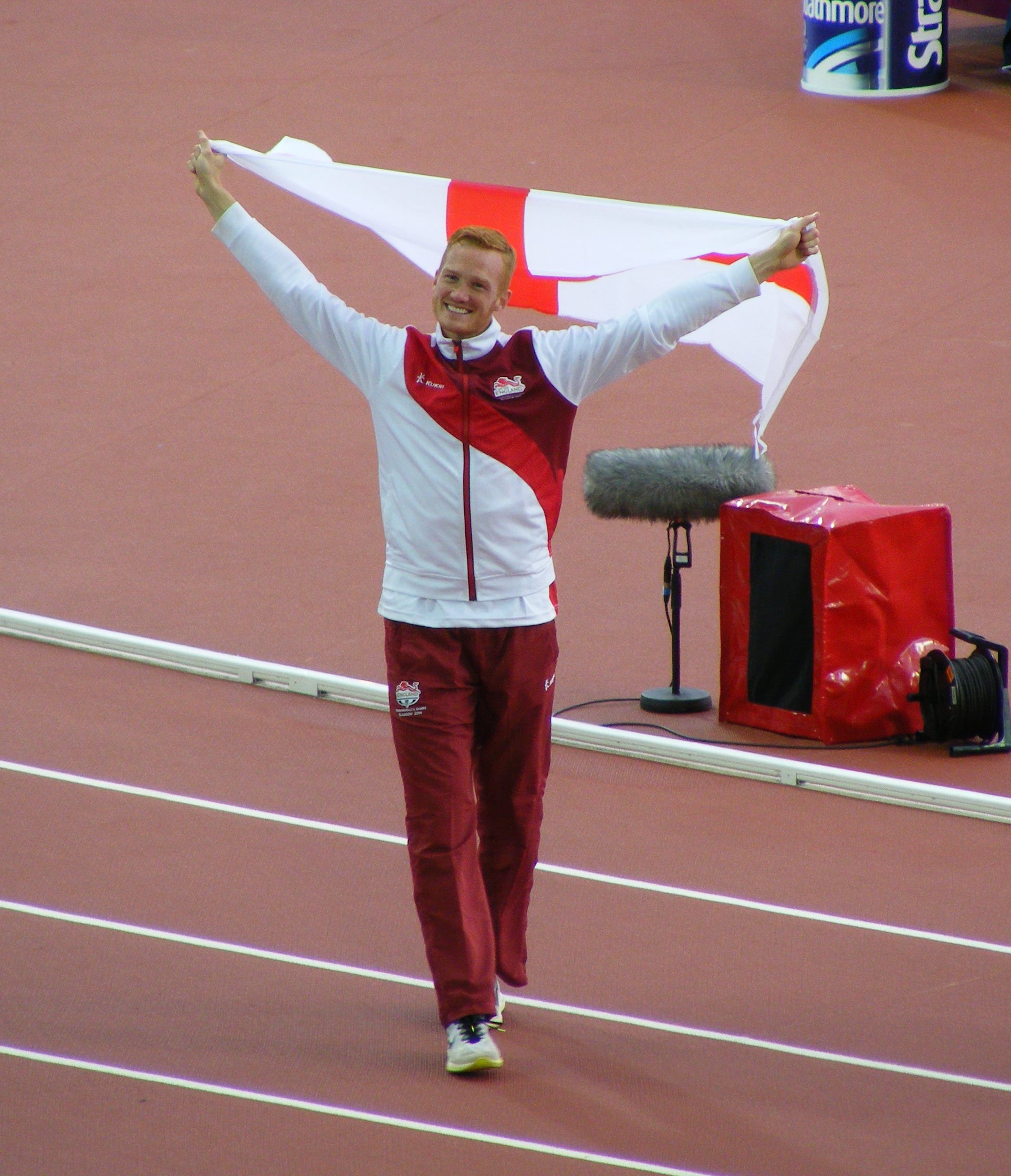
A stereotypical Glasgow mizzle has set in at the start of the evening; particularly trying for those competing in the field events. We are at the other end of the stadium tonight and higher up. This makes it hard for us to see the sixth event of the heptathlon, which is the javelin; two English competitors are in with a chance of a medal. We have a much better view of the men’s high jump final in which England come fourth. There is a stupendous reception for Greg Rutherford as the long jump final gets underway; the weather has improved by this time. Meanwhile the Hampden crowd goes mad for Eilish McColgan, daughter of Liz, who manages a season’s best in the steeplechase, behind a predictable Kenyan one, two, three. We see the medal ceremony for the 1500 metres from last night. Then the final heptathlon event, the 800 metres, where England’s Jessica Taylor hangs on to the bronze medal in a race against the Jamaican athlete.

Valerie Adams begins her defence of the shot put at our end of the stadium. The people sitting in front of us seem to know one of the athletes, clearly this gives them the right to stand up and block our view at random moments. Martin Rooney just misses out on a medal in the men’s 400 metres, which is won by Kirani James in a new games’ record. Meanwhile another games’ record is slaughtered by Australia’s Kim Mickle when she throws the javelin more than three metres further than the previous record. The men’s 800 metre semi-finals feature David Rudisha and England’s Michael Rimmer also scrapes into the final.081 30 July 2014 Rutherford 4

Edward, Earl of Wessex is the token royal in residence and he presents Kirani James with his medal. The Grenadan national anthem is very jolly and makes a change from those of Jamaica and Kenya. Next comes death by women’s 200 metres heats, of which there are eight. The stadium begins haemorrhaging spectators. Not only does this seem rude to the athletes, it is also unfair on all those who applied for tickets and were unsuccessful. We agree to remain for these heats, in which we see all three English competitors safely make the final. We also form part of a dramatically reduced audience who wait to view the three final medal ceremonies, including that of Greg Rutherford. Our theory is that, as people have steadily been leaving the stadium for best part of an hour, they will be on their way making it easier for us to secure transport. This was fine as a theory but sadly they are not quite far enough on their way and we have to queue to be allowed on the railway platform. The station staff are doing their best to keep the passengers in a good mood with ‘Glaswegian waves’ (pretty indistinguishable from the Mexican sort) and singing. We get a seat on the train but are later leaving this time and also just miss our connection at Glasgow, so we arrive in Ayr an hour later than yesterday but it has been worth it to be part of another great sporting occasion.


Burns Country

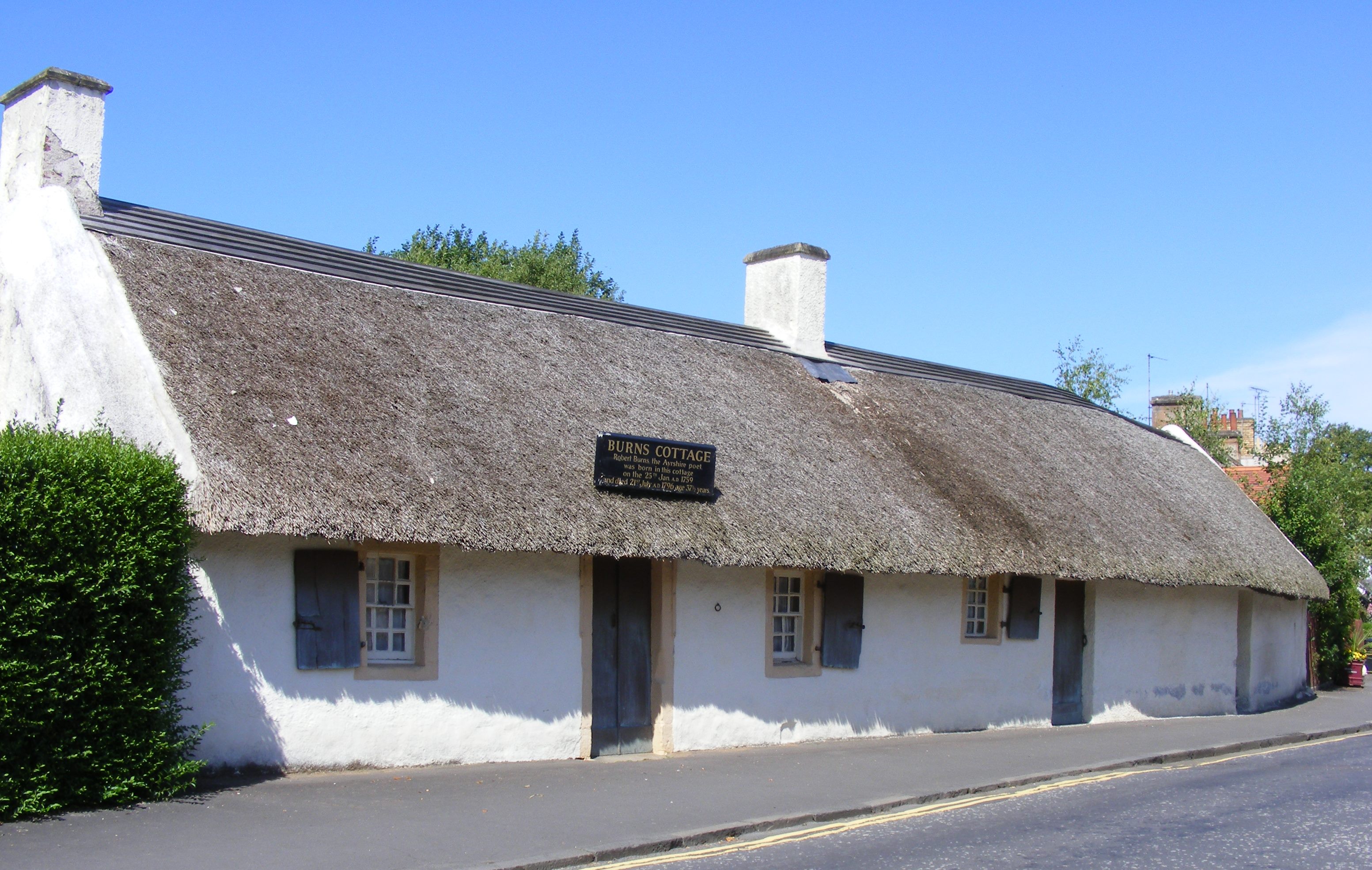
Site availability necessitates a short distance move to the nearby site at Ayr. Earliest arrivals are 12.00 so we are on site at 11.59. We then go to visit the Robert Burns’ birthplace museum in Alloway. I was surprised to find that Alloway was a small settlement, centred round its Burns connections. I have to confess that Burns is not high on my list of favourite poets and I was expecting something low key. The weather is glorious again as we arrive at another impressive museum; Scotland have certainly bitten the tourism bullet in a way that England have not. We viewed Burns’ actual birthplace, walked through pleasant gardens and looked at various actual and interactive exhibits. These included designing our own Burns shortbread tins and participating in a Burns Night celebration. I did well at haggis killing but less so at the dancing!034 28 July 2014 Front of Burns' house

We take a look at the ruined kirk, with, thanks to Burns, its associations with witches. Then we take in the views from the Burns’ monument. Like Burns, the designers of this monument were Freemasons and their symbols are evident. Finally we cross Brig a Doon. I have memories of a production of Brigadoon from when I was at college but I hadn’t realised that there really was a Brig (bridge) a(cross) the River Doon. I vaguely remember that Brigadoon only existed at certain times but there it is and we don’t get lost in the mists of time.

 In the evening we go to greet Martha, Rob and Edward who have arrived at a nearby holiday park. Martha is less than impressed with the so-called travel cot that has been provided for Edward but which resembles a cross between a prison cell and a dog pen. Next stop Commonwealth Games.


Farms of Varying Kinds

Today it is raining again, as well as being ten degrees cooler than it was last week but we are here to see what has to be seen so we travel north into Lanarkshire to see the Scottish Museum of Rural Life. We witness some more strange driving (yes another woman) who seems to end up on the central grass of the roundabout facing the wrong way. Fortunately no ill effects and we continue on our way. Although the landscape is still bleak, as we get nearer to the outskirts of Glasgow, the settlements seem more prosperous. We encounter a cycle race on our way. It seems this is not the Commonwealth Games’ road race but lycra clad wanna bees.

We arrive at the museum and yet again we can utilise our National Trust memberships in order to gain entry. The state of the art museum has plenty of interesting exhibits and we also get Raymond the tractor driver to take us up the hill to the farmstead. The Reid family held land as lairds of Wester Kittochside from 1567 and later built a farmhouse on the land. The current farmhouse dates from 1783 and is substantial, suggesting that the Reids prospered on their 110 acres. After ten generations, the last of the line donated the land to the Scottish National Trust in the 1990s, allowing the museum to be built. Amongst the farm animals, I am most excited to see the soon to fledge baby swallows in the barn.028 27 July 2014 Whitelee Wind Farm

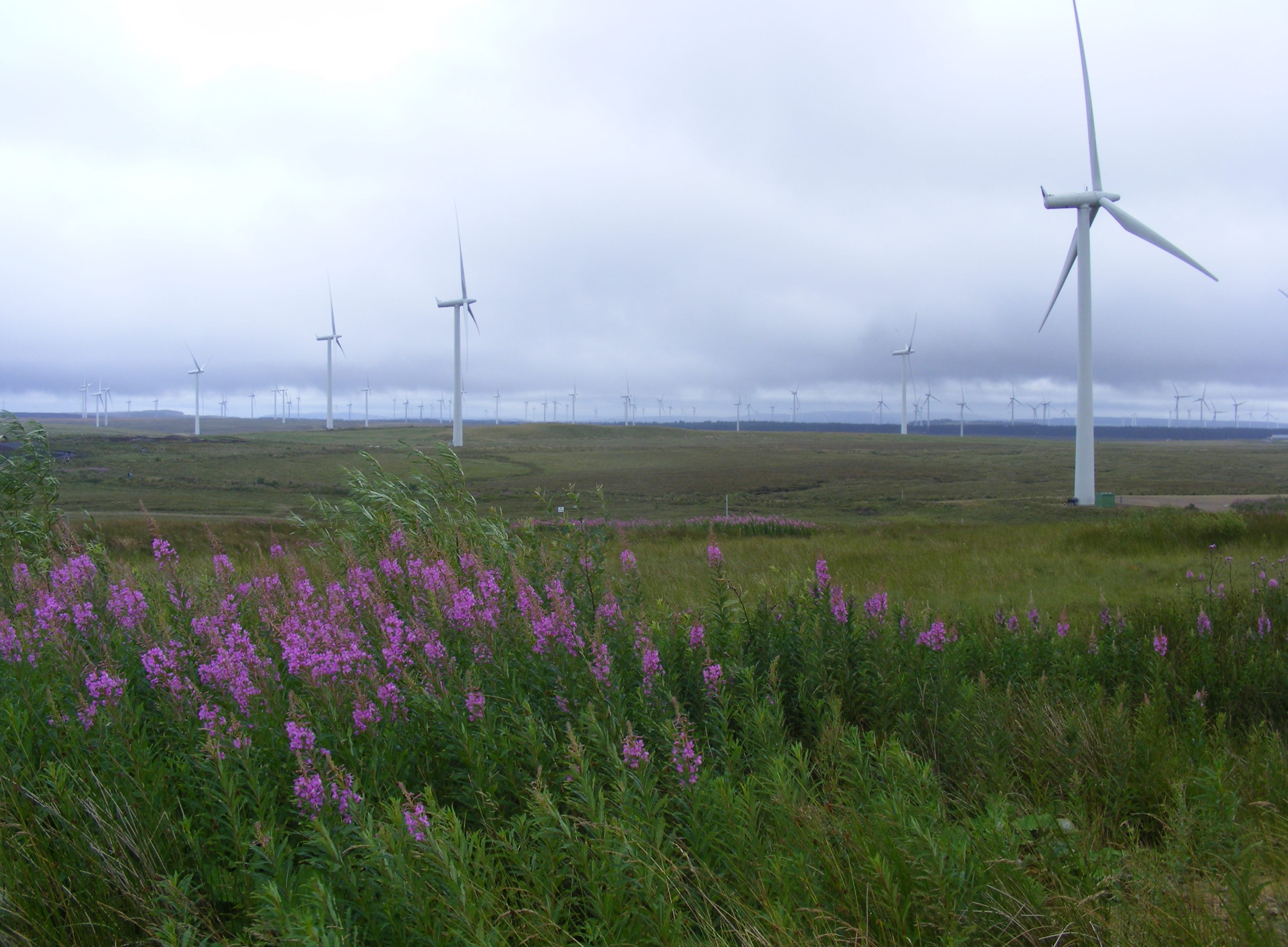
On the way home we call in at a rather different sort of farm, Whitelee Wind Farm, the largest of its kind in the UK. There is an impressive visitors’ centre, designed as part of the green energy PR machine and therefore free to enter. There are plenty of activities and it is great to see that sadly now rare sight, families doing things together. The land on which the 215 turbines are built is also designed for walking, cycling and as a wildlife habitat but the weather wasn’t suitable for us to explore on foot. We were very close to some of the turbines, which were 110-140 metres high and in action. One of the downsides of wind energy is held out to be the noise from the turbines but these were completely silent. What ever we might feel about wind energy, if we want to carry on consuming electricity as we have in recent years, we need to do something. Whilst agreeing that some locations are not necessarily suitable for turbines, I would rather see this than power stations and pylons.

Across the Border for Real (not a reel you understand)

After our quick foray into Scotland yesterday we retreated back to England. Now we are crossing the border intending to stay. It seems very strange being away knowing half my family are at home staying in my house but I will see the other half very soon. There is something strange up with the sat nav. Set it up for our destination town and road and it is twenty miles nearer than if I set it for the campsite itself. Fortunately I discover where I have gone wrong in plenty of time. I am sure I can’t be the first person to confuse Culzean Road, Maybole with Maybole Road, Culzean. We travel along the M6 and M74 before turning off on to the A70. Here the landscape is barren and desolate with evidence of open cast coal mining. The villages seem run down and depressed. Annoyingly the road we need is closed but we manage to negotiate the diversion and only one U turn is required before we arrive at Culzean. It seems we have not booked this site. We so have booked. My itinerary says we have so it must be so. They insist we haven’t. Fortunately cancellations mean there is room for us. This site has a swimming pool but it is £9 a day for a family. This is good value if you have a family with you but it seems rather a lot just for me so I invest in 24 hours’ internet connection instead and begin to catch up.022 26 July 2014 Walled Garden Culzean Castle 1

In the afternoon we visit Culzean Castle and Country Park. Apparantly Culzean is pronounced Culeen and this is the largest estate in Ayrshire. Our English National Trust cards mean we do not even have to part with money to see this Adam designed stately home on the Firth of Clyde, once home to the Kennedy family. There is a list inside of some of the many servants who have worked at the castle at various dates. Many of these are clearly taken from the census returns but one, from the 1740s, is Scipio Kennedy who, with that first name and sharing has he does the family name, must surely have been a slave.

Today is decidedly cooler and by mid afternoon it has begin to rain but undaunted we look at the walled garden. This is huge and more a garden with a wall than a walled garden in the traditional sense, although the head gardener insists that the walls do have warming properties. Talking of warming properties, it seems every shop on the premises has its heating on full blast. I know it is not as hot as earlier in the week but this does seem unnecessary. We look at the deer in the deer park then investigate swan lake. This is not a balletic performance but a lake with swans and terns on. By this time the rain has set in and we are getting as wet by the lake as we would in it so we head back to the van.


Witchcraft and School Friends

Hastily, I should explain that he two parts of the title are not connected!

Saturday I got up at the crack of dawn and dawn cracks pretty early in June in the UK, to set off for London. As I heaved a case of books on and off trains I started to realise that a week of moving books and furniture (there will be a forthcoming post about this activity) had taken a toll on my back. Notwithstanding, I arrived at The Society of Genealogists to take part in their Seventeenth Century day seminar. Unfortunately even my ‘first train of the day’ start was not early enough to get me there in time to hear Elsa Churchill but I caught most of Colin Chapman’s informative session, packed with sources for C17th research. Colin and I often turn up on the same bill and it is always a pleasure to listen to him. After the lunch break and some running repairs to the air conditioning, which appeared to allow the room to be cold or hot but nothing in between, it was my turn.

I chatted about the impact of witchcraft on the lives of our C17th ancestors and lightened my load by re-homing some of my books, in return for a perfectly reasonable sum of money. Strangely, after becoming interested in this topic as part of my general foray into the social history of the C17th, I discovered that one of those tried for witchcraft, Joanna Elford, was probably related to me. I was followed by Michael Gandy and was very thankful that it wasn’t the other way round. Michael’s subject was how to read C17th handwriting and I suspect the audience were expecting sight of letter shapes and perhaps collective interpretation of documents. This was not to be. It takes an exceptional speaker to engage an end of the day audience for an hour and a half with not a single visual aid. Unbelievably, Michael held the room in thrall with an entertaining, relevant, tour de force on this topic without actually showing us any C17th writing at all – brilliant.

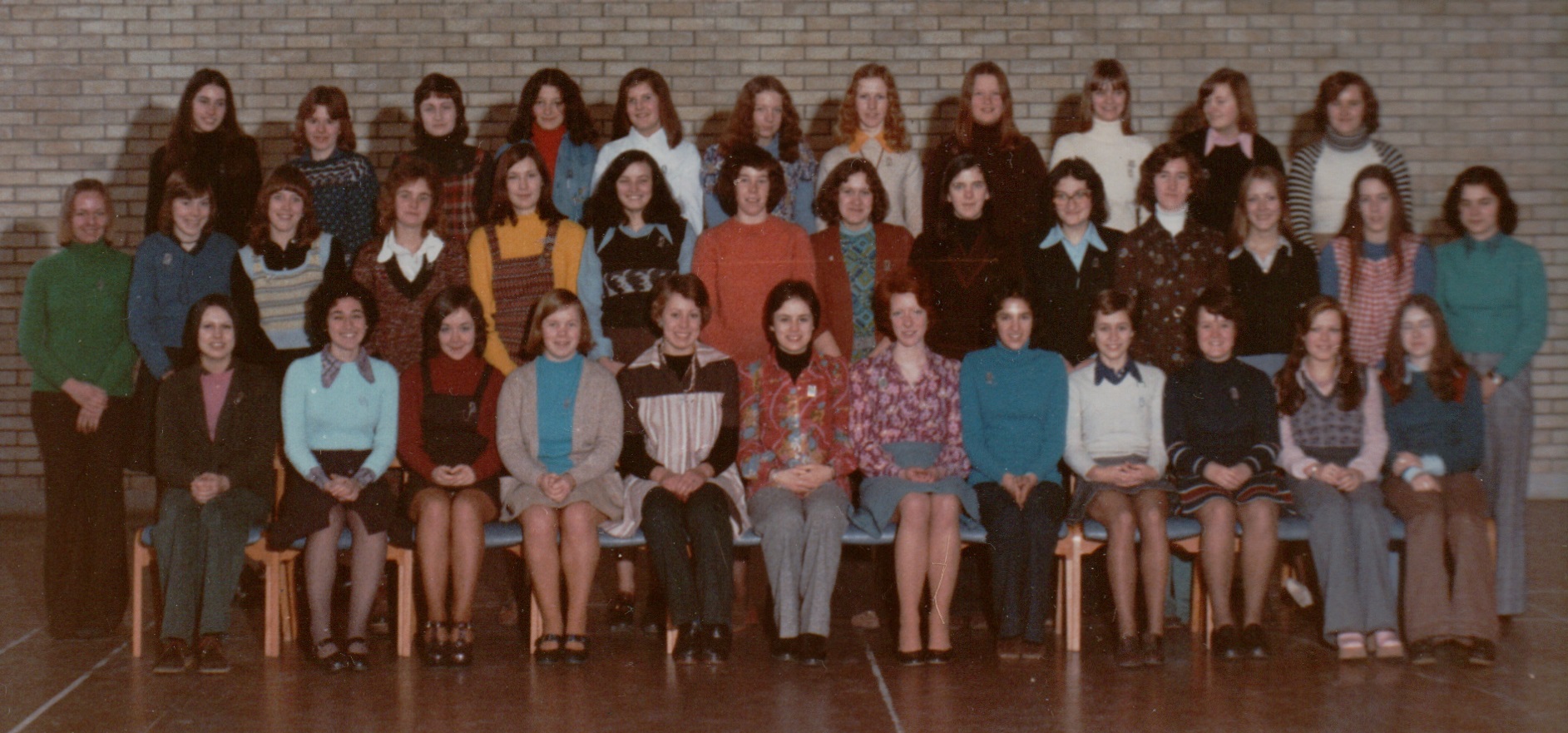
Then it was off to catch up with my school fellows who made up the class of 1974. I had missed the reunion itself but fifteen tail-enders were to spend the night in a nearby hotel and I set off to join them. School reunions can be fraught with anxieties: ‘What shall I wear?’ in my case compounded by the lack of room in the case full of books and the need to make it suitable for the talk as well. ‘Will I recognise anyone?’ ‘Will anyone recognise me?’ and if they do, does this mean I have worn well or that I still look as gawky as I did at school? ‘Have I been sufficiently successful?’ And most importantly, ‘How do my wrinkles/greying hair/middle aged spead compare?’. Of course anyone who voluntarily reconnects with a group of people they haven’t seen for forty years is going to be someone who is comfortable in their own skin, someone who feels they have ‘arrived’, by their own standards if not by anyone else’s.

StitchSCAN0137-SCAN0138

I limp my way as far as East Croydon station and decide that I really can’t face trying to find out where they have hidden the 64 bus stop since I was last here. I therefore elected to spend a high proportion of my book sales money on a taxi to the hotel. Said hotel is ‘posh’ by my standards. Ok, I know most of my hotel going is of the Premier Inn variety but this is four star. Although the surroundings are lovely it turns out that really only the prices are four star. Admittedly our party was accompanied by two sets of wedding guests and a group of England football supporters, who may well have been renegades from one of the wedding receptions but the service was execrable. I was expecting the food to be of the variety where you need a magnifying glass to see anything beyond the drizzle but there were several mouthfuls on each plate. Unfortunately, I somehow managed to choose something that contained two of my least favourite foods but that was my own fault.

My room is situated in the furthest reaches of the building, on the top floor and along an extremely long corridor. I struggle along with my case, which although no longer quite so full of books, was still heavier than my increasingly ‘twinging’ back was comfortable with. I come to terms with the room’s idiosyncrasies. The shower has no visible means of being switched on. I try turning, pushing and pressing various parts of the mechanism and am on the point of giving up when something I do results in water gushing out. Sadly, it took whoever was in the neighbouring room until 2.00am to work out how theirs worked and then they had a noisy and lengthy shower. Then there was the bed. To begin with I had twin beds that had been pushed together. I kept losing things down the narrow gap between the beds. Having retrieved the Kindle for the third time, whilst listening to midnight wedding revellers, I was beginning to despair. The bed was also as hard as ….. I will refrain from making any of the possible obscene similes here and just say it wasn’t very hard, not ideal when one has a bad back.

Of course none of this really mattered because we were there to meet our former school fellows and the chatting and reminiscing was in full force. We all have slightly different perceptions of the rarefied atmosphere that was our alma mater but agreed that we had an excellent grounding for our varied futures. Whether school days were the best or worst days of our lives, if we are historians, we should be recording our memories. Of course it is much easier to recall those memories in the company of those who shared them. If an actual reunion isn’t possible, what about a virtual one? Facebook, Google+, or just plain emails, are all possible vehicles for this. I and my classmates may not being doing this again in another forty years but a good time was had by all.

Then there was the journey home. Now, as I have said on previous occasions, I am no longer fit to be let out on my own. One of my former school fellows had offered to shepherd me back to the station. Where I come from two busses a day is considered a regular service but of course I am now almost in the metropolis so there are plenty of options, despite it being a Sunday. We are going for the tram. Ah, there are no trams. The police have cordoned off the area round our destination due to an illegal rave. I know I and my former classmates were on the rowdy side but to call us an illegal rave seems harsh. A bus driver is planning to go as close as the police will allow to the station and we hop on board. In my case the ‘hopping’ was more of a hauling but we are on our way. Although the road is closed, the station is open and I start the journey home through the engineering works and tube line closures. I manage to get an earlier than planned train out of London but sadly not early enough to get a different train from Exeter onwards. Two hours on a wooden bench at Exeter station puts paid to any remaining mobility in my back. Eventually home safe and sound. Now to edit the ‘year book’ that we are compiling; interesting to see the different paths that we have all taken.