Days 12 & 13 The Catlins

We left Te Anau at 9am in 4 degree temperatures and driving rain. We managed to navigate ourselves to Fiordland Electrical to buy a fire, as we have had to return our borrowed one to Te Anau Top 10. Allegedly this is likely to be the worst New Zealand winter for years. We debate the possible merits of two alternative routes, hoping to avoid snow. We opt for the possibly more risky one, snow wise, which was our original intention and set off towards Manapouri. We travel along the South Scenic Route with no sign of snow. It would probably be slightly more scenic if we could see much of it through the mist and murk. We stop to admire the racing seas and Stewart Island lurking in the low cloud. After a slight detour we find our site at Invercargill.

Not being fans of oysters, we pass up the opportunity to visit the Bluff, where the annual oyster festival is in full swing. ‘Bluffies’ are apparently world renowned in oyster circles. Deciding that we have had enough of getting wet, we relax in the van. Now we are only getting wet from the dripping laundry that is hanging round our ears.

079 25 May 2018 Rainbow, Fortrose, South Scenic HighwayWe safely negotiate our way out of Invercargill, where the street names bear testament to the Scottish/Victorian heritage. Keeping a sharp eye out for the maroon triangles that denote the South Scenic Route, we head eastwards. Today there are spells of sunshine amidst the showers, creating impressive rainbows at Fortrose. Many of the cattle are Belted Galloways and I wonder at the logistics of bringing mammals out to New Zealand from Europe by boat. How much food would be required? What would one do with the results of cows/sheep/deer consuming said food?

The bird life so far has been disappointingly European in flavour, compared to our previous visit; perhaps because we are further south, or maybe it is the season. Today though we do see black swans, pukeko and heron. The Catlins National Park is beautiful and there is very little traffic. We encounter several hundred cattle being walked along the road in the opposite direction. We are used to stopping for cows at home, just not quite so many of them! At Waihola Lake there is a long fence that has been stuffed with hundreds of trainers, presumably odd ones that have been washed up on the shore.

For some reason, we exceeded our internet access at Invercargill, despite doing very little online. This meant that we could not check on the directions to today’s site, which is 2½ km outside Dunedin. It would be helpful to know in what direction. We are know on New Zealand’s ‘motorway’, a slightly more busy dual carriageway, which makes going slowly looking for likely turn off more difficult. Fortuitously, we spot a road sign to Kaikorai Valley. The site is in Kaikorai Valley Road. Adopting the strategy that worked in Queenstown, we take the exit and apart from overshooting the well hidden drive-in entrance, we reach Aaron Lodge Top 10 without incident. So far, we feel not investing heavily in a sat-nav was the right decision – famous last words.

Day 11 Doubtful Sound

And tonight’s nocturnal disturbance was the battery going in the smoke detector, so that it bleeped annoyingly every few seconds. We finally braved the cold in order to disconnect it. Another day, another Sound; this time Doubtful Sound. Typically, although it has been dry all night, it begins to rain at breakfast time. We walk down to the Real Journeys office and board our coach for Lake Manapouri. Randomly, the driver detours round a housing estate in order to deliver a letter. Then it is on board the MV Titiroa to cross the lake to West Arm. We manage to avoid the lake’s thirty three islands. Next it is on a coach with Mike to Deep Cove. Actually it is on two coaches as the road have given way, so we have to walk across a bridge at one point. This road is only accessible by water at either end. We cross the snowy Wilmot Pass and see the HEP station. Most of the electricity generated is used at the aluminium smelting works near Invercargill.

We finally board the Fiordland Navigator for our cruise of Doubtful Sound. ‘Sound’ is actually a misnomer – blame Captain Cook. Technical a sound is a V shaped inlet, created by river action, whereas a fiord is a glacially cut U shape, so this is a fiord. The ‘Doubtful’ part of the name was because Cook was doubtful that the prevailing wind would allow vessels to get back out of the ‘sound’ easily. We tuck into our complimentary Mitre Peak lunch from yesterday. I have never seen such huge sandwiches. They were about three inches thick, making eating them delicately a bit of a challenge. They were accompanied by similarly large-scale muffins.

063 23 May 2018 Rainbow, Doubtful SoundOur geography field trip continues. We sail up Crooked Arm, which on its own is a similar size to Milford Sound. Today we can enjoy a sound that we can actually see, as the rain stops and there is even occasional sunshine. There are also rainbows, which, inevitably, are not done justice by the photography. The majority of our fellow travellers are American university students. Some are wearing more make-up than I have possessed in a life-time. Others are clad in tee-shirts and thin cardigans – it is three degrees, still others sleep the cruise away. At one point the captain cuts the engine and generator ‘so we can listen to nature’s silence’ for about ten minutes. This was never going to go well, especially as the rain begins again during the process.

Our return trip proceeds without incident and we are hoping that our journey tomorrow will not be impeded by snow. as we head still further south and east. Today there was snow between Queenstown and Te Anau, so we are only narrowly escaping the weather.

Day 10 Milford Sound

A some point in the middle of the night the heater we rented with the camper van whimpered and died. In other nocturnal news, having left Chris’ phone on in case of yet more re-arranging of our itinerary, we received a call at mid-night about PPI. It was a night of torrential rain, with thunder and lightening rolling and roaring round the lake. This was marginally quieter than the door of our neighbour’s camper van, which they felt obliged to open and shut approximately every thirty seconds between 11pm and 1am. This they recommenced at 6am.

We were ready in good time for our 7.45am pick up to (hopefully) go to Milford Sound. We can actually see the road from the camper van. Given the pouring rain, one of us wanted to wait until we saw a vehicle draw up and then make a run for it. The other one would have been out there getting soaked from at least 7.30am. No prizes for guessing which was which. In the end, the mini-bus was early so it was a case of head out when we spotted it, which was at 7.40am. One of us had only asked, ‘Can we go outside and wait now?’ about eleventy billion times by this point. We were the first on board, which meant that we could sit at the front but this position came with the responsibility of being umbrella monitor. Our super ace guide for the day on our Fiordland Tours/Mitre Peak Cruise was Jonathan. He began by asking us if we would rather go tomorrow instead, as the weather was forecast to be better. None of the fourteen on board were able/keen to do this so we headed intrepidly on.

Jonathan gave us some information about what we couldn’t actually see due to the poor visibility. He did try to make a positive out of the heavy rain: the waterfalls will be more impressive. Between the years 1000 and 1800 half of New Zealand’s rainforest was burnt in order to aid the hunting of the now extinct flightless bird, the moa. Farmers moved in and free ranging deer were introduced. These soon became a pest and wild deer were killed or corralled into venison farms. This apparently involved leaping out of helicopters and winching up deer in order to transport them. We do indeed see some impressive waterfalls through the murk and also some cabbage trees, the southernmost growing palm tree. There is beginning to be a problem with non-native pine trees. These have been planted as a carbon-emissions pay back but they are encroaching on the National Parks and altering the habitat. Fiordland covers 5% of New Zealand and at 1.25 million hectares, it is the country’s largest National Park. It is also one of the world’s wettest places. They are not wrong there. The ten metres annual rainfall here is twenty times the annual rainfall of Christchurch. Just a bit of a shame that all ten metres have decided to fall today.

We stop for morning tea and very acceptable scones at Gunn’s Camp. Then comes the news that the Milford Road is closed due to a ‘wet slide’ avalanche. The heavy rain has put weight on the snow and the road is blocked. It may, or may not, be passable later. We walk the Marian Lake trail while we wait to see what transpires. I was lured on this short walk by the possibility of seeing blue ducks or Pukeko. The rain is still torrential and we are wielding complementary umbrellas. I have my camera in my other hand. Then comes the unbelievably wobbly suspension bridge over the rushing torrent. I am never a fan of anything high up or wobbly and the feeble looking safety wires on either side were only about 2 foot six high. Given the umbrella and camera, I was left with no spare hand with which to cling to the side wires for grim death. I lurch from side to side alarmingly but somehow make it across and indeed back. There was not a Pukeko in sight.

We return to the road junction to find the road still closed so we resign ourselves to having to miss Milford Sound. As compensation, Jonathan drives us up back past Gunn’s Camp to the Humboldt Falls. Then comes the news that the road is open after all. We are too late for our scheduled cruise but Jonathan thinks they will hold a boat for us. We are now very short of time as we have to be back on the Te Anau side of the tunnel before 4.00pm when the road will be closed due to forecast snow and we may be marooned in Milford, perhaps for days. Either that or the mini-bus will turn into a pumpkin, probably the former. We decide to give it a go.

Our own boat is not sailing but we can hitch a ride on a Juicy cruise instead. Their booked party has given up and not risked coming through the tunnel. Better still there is a selection of curries on board that they have ordered and which we can consume. This is our second free meal of the day as we still have the bonus packed lunch awarded to us in return for not being able to go to Milford Sound yesterday. We set off on Juicy’s Gem of the Sound. We learn that the rainwater forms a layer on top of the salt water in the sound. This is a rare phenomenon that only occurs in a handful of places in the world. We stop at McKenzie falls and venture out to view the Tasman Sea, ‘the Roaring Forties’, with its four metre swell. Our voyage is slightly shortened to ensure that we get back through the tunnel before the witching hour. We do get up close an personal with Stirling Falls. Some of those on board accept the invitation to stand on deck. Any parts that were not already drenched by the rain are now soaked in spray. Judiciously, we remain indoors at this point.

049 22 May 2018 Mirror LakesWe make it back through the tunnel in time, just as snow is beginning to fall. There are a few stops on our way back to Te Anau, including a fruitless Kea hunting stop, a chance to photograph the Mirror Lakes and also to view Lake Te Anau from Te Anau Downs. By this point, the rain has almost stopped and we can actually see not just our hands in front of our faces but the lake as well.

Back on site, I become very grateful for the charm offensive that Chris has been launching on the ladies at reception since we arrived. He has managed to blag us the loan of a heater.

Day 6 Along the 8 to Cromwell

In one of our wakeful moments during the night, we looked out at the acclaimed stars. They were certainly very bright and numerous but our own at home are pretty impressive too, so perhaps we did not fully appreciate the awesomeness.

The next three days are more about the journeys than the destinations. Before leaving Lake Tekapo, we retrace our steps into the town for provisions and call in at the ‘historic’ Church of the Good Shepherd. Our arrival coincides with that of a coach load of selfie stick waving, Japanese tourists, who seem incapable of understanding the clear graphic that forbids photography inside the church. It appears that standing in the doorway and pointing one’s camera towards the interior is somehow not taking photographs of the inside of the church. To be honest, although there are lovely views of the lake from here, if you can dodge the plethora of tourists, we aren’t too impressed with the ‘historic’ nature of the church, even by Antipodean standards; it was built in 1935!

024 18 May 2018 Lake Dunstan, CromwellWe head south down the 8, passing through a more barren landscape. We drive through Twizel, a town that grew up round the Hydro-electric industry and along the twists and turns of the Lindis Valley to Cromwell. This town, on the shores of the man-made Lake Dunstan, is in what used to be a gold mining area but is now better known as a wine-growing region. We take a walk round the town, most of which is housing estate and eventually reach the deserted historic quarter, which we remember from our previous visit. I was expecting to need multiple coats, gloves and hats but it is beautifully warm and despite road signs warning us that it is winter, our camper van tells us that the outdoor temperature is 21 degrees, allegedly warmer that it is at home! This is as far south as we reached on our previous visit, so from here onwards we are in uncharted territory.

Day 4 Methven to Lake Tekapo

Despite waking up at midnight thinking it must be morning, we manage to sleep until a reasonably sensible hour. Shampoo-gate then ensues, when all inhabitants of the van deny having hidden the small bottle of shampoo that must be in the van somewhere as we have just used it. As yet, it remains unfound. There still seems to be no hot water, another fail on the ‘how to work the camper van’ front.

008 16 May 2018 The van at Lake TekapoWe leave Methven at 10.25am and the dashboard tells us it is nine degrees outside (for the benefit of those who are more familiar with the other sort of temperature calibrations, about 50 degrees). With the beautiful Southern Alps on our right, we drive down the 77 and 72, crossing the Rangitata River and on to the 79 through Geraldine and Fairlie. Then it is ‘The Starlight Highway’ to Lake Tekapo. I hadn’t realised it when I planned the route but here we are in the Aoraki Mackenzie International Dark Sky Reserve. This is allegedly one of the best places in the world to view the night sky. It is pretty stunning by day too, with the autumn-tinted trees reflected in the clear lake. Apparently the glacial ‘rock flour’ gives the water its startling turquoise tinge. The people we speak to in shops, along with the site receptionist, all seem surprised that we are staying for two nights. Does no one normally stop for more than one night? We gather two nights may be a good thing as tomorrow is predicted to be particularly favourable for stargazing. The bad news is that snow is forecast. On this site, we have a premium lakeside pitch, only slightly marred by the boating clubhouse, if you look to the right.

We have now cracked turning on the gas in the van and procuring hot water – hurrah! Chris’ phone also seems to have staged a remarkable recovery so, if necessary, we might be able to make a phone call. After a coffee/tea break we stroll along the shores of the lake to the hot springs. It seems you can have a combined stargazing tour and swim in the thermal pool but this involves staying up until midnight, so we may give that a miss and just go for a swim at dusk tomorrow instead. Tekapo means ‘sleeping mat night’ and the settlement at the lake grew up in the 1940s as a centre for hydro-electric power. Now it centres on tourism. We are 710 metres above sea level, so I should be able to cope with the altitude. It is certainly very peaceful. Purple lupins are in flower and we see plenty of ducks. We plan a longer walk tomorrow.

Having given over our bag space to costumes and props, we do not have enough sets of clothes to last the holiday, so it is time to find the laundry. We abandon our newly-washed clothing on the communal washing line. We are fairly confident that no one would be likely to make off with it but it may be frozen solid by morning. Investing $15 in hiring a fan heater for the whole of our trip was probably a good move as the temperature drops rapidly in the evening. We have to devise menus that can be cooked using only a hob and a microwave as the van does not include an oven. Chilli-con-carne seems a good option. I am not sure if chilli powder is more powerful in New Zealand, or if the resident chef was a little over-generous but it fair took our heads off. Enjoyed the first portion of hokey-pokey ice cream of the trip, remembered from our previous visit.

Day 2 Endless Night

Qantas_A380-800_VH-OQL_SIN_2012-4-1It is deemed to be night for the majority of the flight from Heathrow to Singapore, which does at least agree with our body clocks for the first part of the journey. We really do not want to still be asleep at what for us is 9am though. No Bejewelled on this in-flight games system, so I settle for Mastermind. Judging by some of the questions, it was compiled about twenty years ago. Nonetheless, I win a virtual million pounds twice. Not a great deal to recount from this twelve hour flight, apart from the person in the row behind me reaching round and stealing my pillow when I bent forward to get my bag from the floor. Fortunately, the plane is half empty, so we have a row of four seats to ourselves, giving us a spare. The thief though has five pillows to himself!

We have three hours to wait at Singapore airport. Time to access the internet thinks I. Or not. After much more jiggery pokery I finally persuade my lap top to reveal the login screen. I need a code. I don’t have a code. I walk a considerable way and find a machine that allegedly provides codes. Before it will part with its secret, it requires me to scan my passport, which is back where I’ve just come from. I retrace my steps along the concourse to fetch said passport. ‘Scan your passport here’. This I do. Nothing happens. No permutation of passport positions, including the one suggested by the machine, yields a code. Never fear, there are always the free wifi machines. I attempt to log in to emails. ‘Outlook has detected an unusual log in’ and will send me a code to access my emails. The only snag is, they are sending it to a different email address, one that I can’t access because they detect an unusual log in on that address too – arghhhh!!!! To add insult to injury, Windows 10 will only let me play cards on my computer when I am logged on. Good job I have brought actual cards too.

It is night again on the seven hour flight from Singapore to Brisbane. We’ve only been awake about five hours so it is back to the in-flight entertainment. This time Suduko, which is not really something I’ve tried much before. I decide I’ll just play a few games until I am tired. I graduate from needing hints on the easy version to cracking medium difficulty boards unaided. I wonder why I am being offered my second breakfast of the day already. It seems I have Sudukoed the ‘night’ away.

Day 1 To the Airport

jo-rutherford-photography_-3

Random irrelevant picture just because I can – picture credit Jo Rutherford

Reassuringly, this time, the holiday account actually does begin on day 1 as this is all our own doing and we don’t have to fit in with the itinerary of an organised tour. Having been too mean, or indeed too sensible, to pay £25 per person per flight (of which there are three each way) to reserve seats in advance, I had planned to check in at 9.15pm, when I had been advised I could choose seats free of charge. We really didn’t want to spend a total of twenty four flying hours sat in different parts of the plane. So what was I doing at the witching hour? I was distracted by the compelling weirdness that is the Eurovision Song Contest. So mesmerised was I by the warbling and chicken impressions of the eventual winner that it was 6.15am before I remembered. I hastened to the computer to see if there were any adjacent seats left and successfully secured us positions that did not mean our escape was blocked by an unsuspecting and knowing our luck, immovable, fellow passenger. This did involve telephoning my travelling companion at what he clearly thought was an unearthly hour to ascertain his passport number. To be fair, he would normally not be troubled by a call at this time of the day but he is recovering from some lurgy at present. I am keeping everything crossed that I am not incubating a similar ailment but hopefully the moment of infectiousness has passed.


Continue reading

Days 6-10 Loose in Lima aka the Great Escape

I must apologise, dear readers, for leaving you stranded in Arequipa. I finally feel able to put fingers to keyboard to relate what happened next. By Friday morning it was clear that my body could not cope at 2000 metres above sea level. All the remainder of our trip was to be at this level or considerably higher, so the common sense thing to do was to go home. We bade a fond farewell to our fellow travellers and got a taxi to Arequipa airport. It was all a bit manyana but eventually we took off, heading back to Lima. I start to feel a bit better, which was a relief. This was the easy part. We reclaimed our baggage and my case appeared wrapped in a polythene bag. The zip had come apart a little but it seems nothing was lost. We spent half an hour queuing and another half an hour at Lima airport’s Latam desk, trying to rearrange our flights home. There were no spaces before Monday. We needed to find somewhere to stay until then. Our guide had given us the name of a suitable hotel in case of this eventuality but neither of us could remember it. My internet security refused to let me access the airport wifi so I could look for something. A random taxi driver offered to take us to a hotel. It transpired he was one of the unofficial drivers we had been warned about, although not as unofficial as one we encountered later. He did at least have an ID badge and a certificate of something or other in his car. His choice of hotel would not have been ours but we were exhausted by this time and couldn’t think how else to find a hotel with vacancies. He also charged us significantly over the odds for the journey.

The one advantage of the hotel was that was cheap; our stock of sols was running low. We did have a travel card with US $ on but access to funds relied on us finding a reliable ATM, unlikely in this decidedly dodgy part of the city. Yuri’s comment that 9% of Lima’s population are criminals was ringing in our ears. Have we been sold into white slavery? Are we staying in a crack den? We have three days to spend skulking here. There is an on site ‘restaurant’. We do eat there on the first evening. Once was probably enough. No one spoke English and the menu seemed to be chicken, chicken or chicken. We had chicken. We feel it was probably purchased from a market similar to the one in Nazca. The hotel seems to be used by Peruvians on their way to and from the airport. They arrive and depart at all hours of the day and night, loudly. Some are unpleasantly unwell during their stay; those are the ones in the neighbouring room. Soundproofing is not a strong point.

DSCF0219[1]

From the Window of the Dodgy Hotel

We are by a main road and the hooting from the cars is constant. It is 32 degrees outside. We could at least open the window and the air conditioning was noisy but efficient. The hot water was slightly more reliable than in some of the more up-market hotels we had stayed in. We knew we needed water and food. We weighed up the twin hazards of braving the back streets and abandoning our belongings in our room. We hastily sneaked round the block and found a small food store. We were looking for things that were recognisable and not likely to give us food poisoning. We purchased a stash of water, Ritz crackers, cereal bars and wrapped cake. There was no fruit in sight. We lived on these for three days of our incarceration. Sufficient to say I probably don’t want any more Ritz crackers any time soon. Night three in this ‘delightful’ hotel and there was a distinct smell of burning. We were on the fifth floor. The chances of there being any kind of fire escape were somewhat less than nil. The hotel did not seem to be on fire.


I played endless games of patience, did a bit of proof reading and sorted out my holiday photos. There was intermittent internet access but the single plug socket was too far from the bed, which was the only place to sit. The plug socket also sparked alarmingly when it was used. There was a seriously unpleasant smell at night. Our room was not cleaned during our stay, remember what we are doing with our toilet paper in a windowless, fanless ensuite. To be fair, the smell probably wasn’t coming from our room. I am glad that the miasmic theory of disease has been discredited. We dream of Hotel Antigua Miraflores and realise how dependant we have been on our wonderful tour guide Yuri for keeping us safe.

I tried to check in for our rearranged flights online. It seemed that there was a problem. We have been recorded as US citizens. This despite my handing over our clearly UK passports. We hoped that this wouldn’t lead to yet more days stranded in Lima. Finally, Monday arrived. I must say that, for all its faults, this establishment did seem to have a more reliable hot water system than some we have stayed in and the towels were slightly larger. ‘Larger’ is a relative term. All the towels we have been provided with in the hotels here barely reach round me and I am hardly huge. In our haste to escape I forgot to apply deodorant. Not the best idea when I had 48 hours in these clothes and the first twelve were in a hot country. We mimed ‘taxi to airport’ at the front desk. This resulted in some passing chap off the street loading our cases in his car. Fortunately the zip on my case seemed to be fixed. We arrived at the airport in one piece and began the ten hour wait for our flight. We decided the airport was preferable to yet more time in the dodgy hotel and we also had the check in problem to sort out. Thankfully the mistaken nationality was not an insuperable problem and we watched the world go by, playing yet more games of patience. Our day was enlivened by the appearance of the bomb squad and explosives dogs. We were herded to one side of the airport and a fuse was laid in case the suspect package needed to be blown up. The dog gave it the all clear and we managed to retain our hard one seats, which are in short supply.

7pm and with great relief, we watched the lights of Lima recede into the distance. One skill I have acquired on this trip is the ability to get at least a little sleep on a long haul flight. This time our enforced sleep began at 10pm Lima time. Seven hours later we were allowed to wake up. A lady a couple of rows in front of us had problems with her Latam breakfast. She hadn’t worked out that she had been given a packet containing what passes for cutlery. She was using her fingers. That worked well for her toasted sandwich thingy but yoghurt – more tricky. Ah, she solved it by using the little stirry stick thing that she had been given for her coffee. Numerous games of Bejewelled later and we were at Madrid airport. The pilot said it was 45 degrees outside but it certainly wasn’t.

Then the joys of automated passport control. I have to take my glasses off to be recognised by the machine. This means that I then can’t read the instructions but we passed through unscathed. It was then time to get on the coach from Heathrow. I had rebooked this using the erratic hotel internet. I had no way of printing the ticket so I precariously waved my laptop under the nose of the driver. He peered at the teeny tiny print and informed me that in my stress I have booked us on a coach that goes …… tomorrow. I looked pathetic, I begged. He has room, he took pity on us, we were on our way. 1am and we were at home at last, five days after we left Arequipa. I slept until 9.45am! 9.45am! This is unheard of, I also slept through the night without waking, something I have only ever done a handful of times in my life. I did still have falling bejewelled jewels before my eyes but it was good to be home.

Intellectually and as a spurious geography teacher, I knew what I thought Peru would be like but you really do need to see it to comprehend just how different it is. Our tour was designed to give us an impression of the real Peru and was endorsed by National Geographic, as it supported local communities and industries and it was interesting and informative. Now I am home I am truly thankful for many things: a clean water supply, living somewhere where air con is not necessary, being able to understand what I am hearing/reading, rain, being able to cross the road in relative safety, the fact that I no longer need to continually apply hand sanitizer, silence! Do I wish I’d stayed at home? No. Would I go somewhere ‘adventurous’ again? Probably also no but it has been an experience. Next stop New Zealand!

Day 5 To Arequipa or toilets we have known

Today is the long drive south-east to the mountains of Arequipa. We set off at 6.30am. On leaving Nazca we see an Incan fort, marking their occupation as far as Nazca, where they benefitted from the Nazca people’s hydrological engineering expertise.

We learn that, in 1575, Spanish was made the first official language, with only Quechua, of the native languages, being allowed. It is still spoken. We see a windfarm. This and Hydro-electric power from the Andes make electricity very cheap. A home for four people pay the equivalent of about £10 a month. There are three main train lines in Peru, constructed in the early twentieth century. As they lacked suitable wood for railway timbers fast-growing eucalyptus trees were introduced for the purpose.

Most people have begun to take their altitude sickness medication, which is a diuretic, making frequent stops necessary during our twelve hour journey. The first is by a street olive stall, free samples are offered. Some of the olives have been stuffed with chilli. Brian discovers this the hard way. The olive trees were introduced by the Spanish and some of the trees are 400 years old. We purchase some honey coca sweets, allegedly helpful with altitude. Coca is the plant from which cocaine is derived. We are encouraged to chew the leaves but somehow sweets seem more innocuous. Our first toilet experience leaves some of us confused as the toilet paper is situated outside the cubicles. It helps to be aware of this before entering the cubicle. Not everyone was.

Most of the traffic on this stretch of the Pan-American highway is heavy commercial vehicles. There are a fair few hairpin bends and sheer cliffs but thankfully not quite as bad as the extreme roads television programme. We are assured that this is the ‘straight bit’. There are political slogans painted on the cliff sides. Toilet stop two incorporates ice cream eating. Ice cream, like ice and salads is something else you have to take care consuming here. We are opting for wrapped, branded ice cream and are surviving so far. So, this stop’s toilet – well there is certainly a toilet bowl. It and the accompanying basin do not however appear to be connected to any kind of water supply. Outside is a hose and bucket. Periodically, someone fills the bucket and flings water down the toilet bowl!

DSCF0207[1]We encounter toll gates along the Pan-American highway. We are pulled over by the police and our driver has to rattle off the nationalities of all on board. That seems to satisfy the officer and we are waved on our way. There is definitely more vegetation now and even rice fields, irrigated by the Cotahuasi river.
We stop for a lovely lunch, which is our reward for enduring such a long journey. It includes fritters, plantar (a type of banana, which tastes a bit like parsnip) and delicious cake. There are fully functioning toilets here. As we leave the coast, there is more vegetation and we see our first cows and sheep. Volcanic ashlar has been used for construction here. Arequipa is known as the white city, partly from the use of white ashlar and also because there were many light skinned people, due to intermarriage with the European settlers. It was founded in 1540 by Garci Manuel de Carbajal and is now Peru’s second city, having been the capital for part of the nineteenth century. At our final toilet stop we pay 1sol to be issued with our toilet paper; randomly, some of the cubicle doors don’t fit their respective door frames. We cross a bridge designed by Eiffel, of tower fame. We are now officially ‘at altitude’, as Arequipa is 2335 metres above sea level, although we will be going much higher. My chest is beginning to hurt. We reach the hotel, our second in the Casa Andina chain. I scoff a double dose of altitude tablets and drink quarts of the complimentary and seriously revolting coca tea. I had been warned that I might feel as if I was having a heart attack. In the hopes that I am not actually having a heart attack I settle down for the night. I am not scheduling this post ahead of time so, if it appears, I survived!

Day 1 Surviving Miraflores

Today is officially day one, so that the diary coincides with our official itinerary. We awake to the sounds of strange bird calls. I hope we can see some of the wildlife. We follow a circuitous route to the restaurant for breakfast. Breakfast is the only meal that we are assured of each day but if they are all like this one we won’t starve. It is now over twenty four hours since we last ate, as we were too tired to seek food last night but surprisingly, I don’t feel particularly hungry. I sample some lovely fruit juice, natural yoghurt that is beautifully un-sweet and a rather dry granola that is probably better for me than the granola I have at home but not so pleasant. This is followed by fresh fruit and a cooked dish. I pass on the weird textured scrambled egg, which my companion assures me was very nice but I try the ‘fries’ which are sweet potato, this is served with cold ham and cheese and red pepper salad with cold mushrooms. There are also rolls and jam and I brave the very strong but lovely, caffeinated coffee, resolving to ration myself. My companion mutters about the lack of black pudding and bacon. I do sympathise with him over the ‘tea’ that he chose though. It was hardly traditional English breakfast tea.

To be honest, I would have settled for a relaxing day in the shade of the hotel but my intrepid travelling companion is of the opinion that we should brave the streets of Lima and who am I to gainsay him. We walk four blocks down to the clifftop overlooking Lima Bay. Miraflores appears to be one of the better cared for districts but each property has massive security gates and we spot discarded syringes on our walk. There is a pleasant park along the cliff top, with large numbers of dogs, mostly of breeds that are recognisable to us. We have been told to avoid dogs on account of deciding to forego rabies vaccines. Fortunately none of them seem to be foaming at the mouth or out of control! The park is set up like an outdoor gym, with appropriate equipment and there are plenty of joggers and a couple of exercise classes going on. One of these appears to involve waving unsheathed swords about. A man is hanging upside down on some parallel bars in a very insecure fashion. Underneath his head is solid concrete! We spot some drab birds with shrill cries and enjoy the warm temperatures. The cliffs are covered with purple morning glory. We chat to a retired American teacher who appears to now live in Lima, then it is back to the hotel.

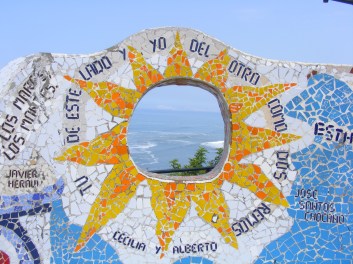
008 1 April 2018 Mosaic at the parkOur Australian friends, with whom we are sharing this adventure (we are blaming them for everything!), arrive. They have already spent two months in South America. We stroll back down to the park in the afternoon. There are street sellers trying to con gullible tourists; we do succumb to an official looking ice cream salesman, who is unperturbed by us paying with a 50Sol note. The lollies were unusual but refreshing and the ‘choc-ice’ was ice cream sandwiched between bourbon like biscuits. The extreme gymnasts and joggers have mostly given up due to the heat but there are tightrope walkers who have strung ropes between the trees. I have already developed some interesting blisters from my first walk in sandals for six months.

At 6pm we meet the rest of our select group of eleven and our effusive tour guide Yuri. I am thinking of renaming this blog ‘How to kill yourself in Peru’. We are on a G Adventures tour and I am trying to embrace the ‘adventures’ part, honestly I am. Poor Pam and Brian are having to act like nannys. I was feeling proud of myself for remembering to don factor 50 before our afternoon walk. I haven’t worn sunscreen since our neobuild adventure several years ago. Our insect repellent is not compatible with the sunscreen, so we will have to choose between sunburn and being bitten but there are no bitey things here. Then it turns out I shouldn’t have been drinking the tap water or cleaning my teeth with it. I do feel a bit naïve. I guess I thought that in an immaculate looking hotel in the capital city we’d be fine. Actually, to be honest, I hadn’t thought at all. There are warning notices everywhere but not one that says ‘Danger of death – don’t drink the tap water’. Does this means you can’t lick your arms after having a shower? Not that I do lick my arms – why would you? – but you get the idea.

Then I got locked in the toilet in the hotel lobby. Fortunately my banging and cries of help brought rescue. You know that thing about me not being fit to be let out! Yuri takes our party to a local open air restaurant El Parquetito. I judge that I haven’t eaten outside in the evening for more than 40 years. The musical accompaniment relies heavily on 1970’s British pop. It is very agreeable and we get to know our fellow travellers. Mostly of early retirement age, there are three are from Canada, two from the US, an Estonian, a Swede, Pam & Brian from Australia and us. We are given a complimentary Pisco Sour, the national drink, which is a brandy like spirit, with lemon and egg white. It tastes good but we are normally very occasional drinkers, so it will probably make the walk back to the hotel interesting. I resist the unadventurous temptation to order lasagna from the menu and go for something that is basically chicken and chips in a tomato and onion sauce. It does at least have a foreign sounding name. It is certainly edible but it is late for eating by our terms and our bodies still think it is 2.30am, which makes it even harder. Chris opts for a beef thingy.

We have been warned that we have to use copious amounts of hand-sanitizer so we don’t get something dire. We have no hand sanitizer. I have an allergic reaction to hand sanitizer, my hands will be raw by the end of the holiday. I guess raw hands are preferable to an unpleasant illness so we stop at a late night shop to buy some hand sanitizer and some water. There are several ‘flavours’ of hand sanitizer but the shop assistant makes the choice. I am given ‘Exotic Romance, Sensual Beauty’. I can’t read anything into this. The male American ahead of me in the queue has been given the same. Allegedly it is coins that are the danger. I resolve to let my travelling companion be the keeper of the coins. Why can’t we adopt the seventeenth century custom of passing them though buckets of vinegar in times of plague?