#100daysofbfotc Day 100: Polly

02 Mary Elizabeth and Albert BraundThe final day has to belong to Polly, whose anguish reverberates throughout Barefoot on the Cobbles. She wasn’t intended to be the main character but I think most readers will identify her as such. It was meant to be Daisy’s story. In fact, before the novel got a title, I referred to it as ‘Daisy’. Daisy’s role however is reactive; it is Polly who plays a significant part in driving the narrative. Without doubt, Polly is the character with whom I found it easiest to identify. I understood her fears, her hopes and her despair. She is not a typical ‘heroine’; for most of the book she is elderly, prickly, diffident and not particularly sociable.  William Golding wrote, in Free Fall ‘‘My yesterdays walk with me. They keep step, they are gray faces that peer over my shoulder,’ and this sums up Polly. She is a victim of her life experiences, as indeed are we all. I am fascinated by human behaviour and what makes individuals act in a particular manner, especially if their actions are those that others find strange. Writing the novel gave me the opportunity to explore and attempt to explain, Polly’s motivations and those of the people she encountered.

Polly Wakely was born on 1 April 1872, in Peppercombe Valley, the daughter of a ship’s carpenter. The 1891 census shows that she was in service at Chudleigh Villas, East-the-Water, Bideford. In 1893, she married Albert and as the novel shows, they set up home in Clovelly and had eight children. Barefoot on the Cobbles is Polly’s story, I hope I have done her justice.

There is no quotation from the novel today because tomorrow you can read it in its entirity for yourselves. More information about the novel can be found here. Copies will be available at various events in the weeks following the launch or can be pre-ordered from Blue Poppy Publishing or the author. Kindle editions can be pre-ordered for the UK and also on Amazon.com.

#100daysofbfotc Day 55: Clovelly Church

1 April 2012 Clovelly ChurchyardDespite many of the main characters being Methodists, Clovelly Church appears in several key scenes in Barefoot on the Cobbles. It is here that the incident involving the suffragettes begins and here that we witness two funerals. On New Year’s Day, All Saints was also the venue of the annual ‘Club Service’, attended by members of the Friendly Societies.

This twelfth century church is at the top of the hill, away from the cobbles and close to Clovelly Court. There had been a timber-built place of worship on this site before the current church was built. The impressive roof is part of the renovations that took place in the fourteenth century. Further additions took place in later centuries.

‘Leonard shifted his body to gain himself a few extra inches of space and clutched the slightly damp, well-worn hymn book. The distinctive smell of steaming wet worsted pervaded the air. Reverend Simkin sonorously announced the first hymn. Tom Finch, during the week the rector’s gardener but proud organist on a Sunday, began to play, with more regard to volume than melody. Oh God our Help in Ages Past, comfortably recognisable to Methodists and Anglicans alike.’

Barefoot on the Cobbles will be published on 17 November 2018. More information about the novel can be found here. Copies will be available at various events in the weeks following the launch or can be pre-ordered from Blue Poppy Publishing or the author.

#100daysofbfotc Day 24: Bucks Mills, The Coffin Arms

Coffin Arms 1928By the time that it is mentioned, in the first chapter of Barefoot on the Cobbles, it has been twenty years since the Coffin Arms closed its doors. Its unusual name comes from the local landowners, the Pine-Coffin family. The Coffin Arms served the fishing village of Bucks Mills as an ale house for fifty years before the licence was transferred to the Coach and Horses at Horns Cross. Bucks Mills has been a dry village since that time. It is likely that it provided off sales rather than being an inn.

The cottage formed part of the Pine-Coffin estate and was almost certainly built, along with most of the other dwellings on that side of the Bucks Mills road, in the 1810s. The earliest known tenants were the Bale family. During the 1840s the Coffin Arms was taken over by Samuel Harris, who combined beer selling with lime burning. Thomas and Thirza Webb were in residence in the 1860s, until Thomas transferred the licence to his brother-in-law, Joseph Dark.

Once the Coffin Arms became a private residence, it was the home of the Steer family for fifty years. Jane Steer took four orphaned nieces and nephews into her home. This brought the total number of inhabitants in 1871 to fourteen.

In the 1920s, with new owners, the name was changed to Woodlands. The house has lain semi-derelict for decades. More information about Bucks Mills can be found here.

‘He had signed the pledge at a young age of course but did not find abstinence irksome. Since the Coffin Arms closed to customers decades ago, there was no ale-house in Bucks Mills, so alcohol was not a temptation.’

Barefoot on the Cobbles will be published on 17 November 2018. More information about the novel can be found here. Copies will be available at various events in the weeks following the launch or can be pre-ordered from Blue Poppy Publishing or the author.


#100daysofbfotc Day 19: Clovelly Quay

10393817_343879402427231_2897722245522442543_nThe quayside at Clovelly is the lifeblood of the village and it is a location that forms an integral thread in the fabric of Barefoot on the Cobbles. Here, the fisherman put out to sea, risking their lives for an uncertain harvest. When the weather is inclement, they mend their nets or weave lobster pots on the quayside, eager to get back in the tiny wooden boats and seek the shoals that are their livelihood. Holidaymakers alight here to exclaim over the village’s quaintness and to swell the coffers of the inhabitants. Anxious watchers line the quay scanning the waves for the returning lifeboat.
In the time of the novel, it was a bustling, working quay, with a fishing fleet unloading its daily catch and men now too old for the rigors of the sea, watchfully reliving their youth. Thus the quay is the social hub of the village, a focus for gossip and the comfort of old friends. Barefoot on the Cobbles is set at a time when the tourism was just beginning to compete with fishing as the lynch pin of the village economy.

‘For years he had sat on the quayside, listening to the old men yarning about their younger days. He had envied their memories, stories of travel and exploits that became more far-fetched with every telling but which awed the small boys whose lives had yet to unfold.’

Barefoot on the Cobbles will be published on 17 November 2018. More information about the novel can be found here. Copies will be available at various events in the weeks following the launch or can be pre-ordered from Blue Poppy Publishing or the author.

#100daysofbfotc Day 16: Peppercombe

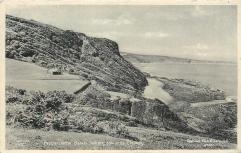
PeppercombeThe Wakely family, who feature in the early chapters of Barefoot on the Cobbles, live in Northway, at the top of the beautiful Peppercombe Valley. The small hamlet of Peppercombe nestles on the north Devon coast, between Bideford and Clovelly. At the time of the novel, fishermen put out from the rocky beach, In the lee of the looming red cliffs. Further up the wooded valley, straggled a handful of small cob cottages, inhabited by fishermen and labourers. As the track nears the main road, a mile from the shore, the landscape opens into farm land. Peppercombe has been inhabited for centuries, as is evidenced by the remains of an iron age fort, now named Peppercombe Castle. There was a large house of the same name in the village but this no longer survives. Little remains of the limekiln that would have been working in the valley when the Wakelys first lived there.

The valley now belongs to the National Trust and some of the cottages are available as holiday lets. There is a short history of Peppercombe, together with some photographs, on the Devon Perspectives website.

‘The lane was edged with pungent cow parsley; red campion and rose-bay willowherb set the hedgerows aflame. The cloudless sky had a shimmering intensity that comes only when a hot day tips inexorably into eveningtide. The gentle insect hum, the birdsong and the surrounding beauty, raised her spirits and gave renewed purpose to her stride as she struggled to catch up with her father.’

Barefoot on the Cobbles will be published on 17 November 2018. More information about the novel can be found here. Copies will be available at various events in the weeks following the launch or can be pre-ordered from Blue Poppy Publishing or the author.